NVIDIA's Evolving Healthcare Strategy: Unlocking the Potential of AI in Medicine from GTC 2022
NVIDIA
Artificial Intelligence Computing Service Provider
The application of AI in healthcare is becoming increasingly extensive, particularly with the introduction of emerging digital technologies, which require AI empowerment across many stages. A growing number of people recognize that AI, much like traditional utilities such as water, electricity, gas, and highways, is becoming essential infrastructure in the era of the digital economy.
As a leading provider of AI computing power, NVIDIA places immense importance on artificial intelligence. The GPU Technology Conference (GTC), established in 2009, has now fully transformed into a premier AI event. During the traditional opening keynote address at GTC, Jensen Huang, Founder and CEO of NVIDIA, unveiled several new AI-focused products, elevating AI computing capabilities to unprecedented heights.
How significant is this increase in computing power? While various complex technical terms may be difficult to remember, a straightforward and impactful statement such as “20 H100 GPUs can handle traffic equivalent to that of the entire global internet” is likely to spread rapidly across the internet. This enormous data communication and processing capability will also facilitate the real-time execution of data inference for large language models, turning what was once impossible into reality.
At its core, AI is about annotated learning and data processing. Therefore, the healthcare sector—which accounts for 30% of global data volume and boasts a compound annual growth rate (CAGR) of 36% from 2020 to 2025—is inevitably a top priority for AI applications. In Jensen Huang’s keynote address, AI applications in healthcare occupied a significant portion of the presentation. Meanwhile, Kimberly Powell, Vice President of Healthcare at NVIDIA, showcased NVIDIA’s latest developments in the healthcare sector during her specialized session. VCBeat (WeChat ID: Vcbeat) has compiled these insights.
Reading Tip: There’s a surprise at the end of the article.
Since the launch of its NVIDIA Clara platform, specifically designed for medical scenarios, in 2018, NVIDIA has been continuously optimizing and expanding it in recent years to strengthen its footprint in healthcare. Initially, NVIDIA Clara served merely as a software development toolkit for medical imaging AI researchers, aimed at standardizing imaging data and accelerating AI training.
Subsequently, through collaboration with industry partners, NVIDIA Clara began to expand into genomics. After all, the genome represents a far larger data source; processing hundreds of millions of base pairs requires more optimal computing power to ensure that experiments remain cost-feasible.
As NVIDIA’s understanding of healthcare application scenarios deepens, an increasing number of medical industry solutions are being integrated into the NVIDIA Clara platform. Just as “GeForce” established NVIDIA’s initial prominence in the gaming industry, NVIDIA clearly aims to closely associate “Clara” with healthcare. Positioned as an intelligent computing software platform for healthcare developers, Clara provides efficient and user-friendly data analysis tools for pioneers eager to explore the healthcare sector.
Screenshot from the official live video stream
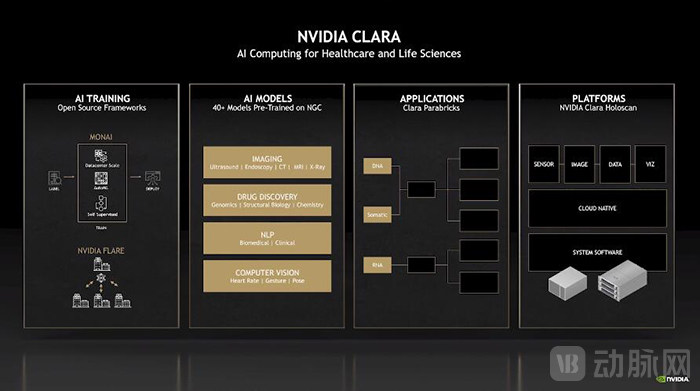
Currently, NVIDIA Clara has completed its strategic layout across key nodes spanning “model training, models, applications, and AI edge computing platforms,” thereby substantially maturing the ecosystem of the Clara overall solution.
In terms of model building, MONAI is a key component of the Clara ecosystem. This open-source AI development framework was initially launched by NVIDIA and King’s College London. MONAI features automated annotation tools to assist developers in labeling data, and it enables automated model selection and hyperparameter tuning. Additionally, MONAI supports self-supervised learning, allowing models to be trained on unlabeled data, thereby reducing annotation time.

Screenshot from the official video livestream
MONAI has been specifically optimized to address the unique requirements of medical data, enabling it to handle the distinctive formats, resolutions, and metadata inherent to medical images. Developers can leverage its specialized data transformations, neural network architectures, and evaluation methods tailored for the healthcare domain to assess the quality of medical imaging models.
Due to its open-source nature and ease of use, MONAI has been well received since its launch. As of February 2022, MONAI had reached 50,000 monthly downloads. Notably, in the most recent quarter, monthly downloads doubled. More than 65 papers have been published based on MONAI.
In addition to MONAI, the NVIDIA FLARE framework based on federated learning will help resolve the biggest challenge in AI model training—how to ensure data privacy. Traditionally, model training requires uploading all data to a central server, which may involve sensitive clinical data and patient privacy.
Federated learning enables multiple institutions to iteratively train models using their own data and subsequently upload the trained models for sharing. Once participants have performed several rounds of local iterative training, they send the updated model versions back to a centralized server. Upon receiving the uploaded model updates from various locations, the server aggregates them to update the global model. The server then shares the updated global model with the participating institutions, allowing them to continue their local training.
Throughout the entire process, only the fully trained model is transmitted, rather than sharing pathological data as in traditional approaches. This method effectively safeguards medical data privacy and provides a robust solution to the challenge of training AI models without direct access to raw data.
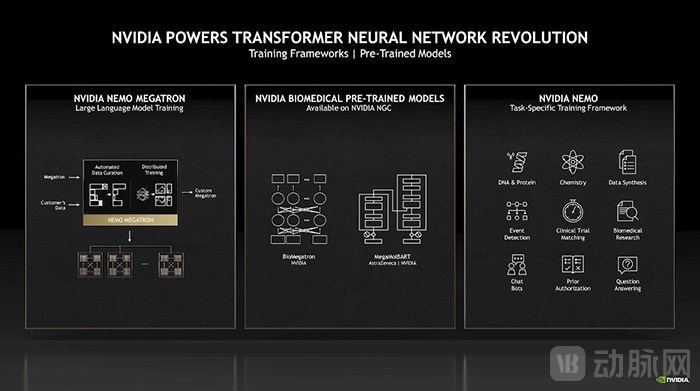
Leveraging industry collaborations, NVIDIA also released more than 40 pre-trained models at GTC 2022, spanning four major domains: medical imaging, drug discovery, natural language processing (NLP), and computer vision. These models were all trained using NVIDIA tools, such as NVIDIA NeMo Megatron, which is designed for efficient training of large transformer-based language models.
This open-source project, led by NVIDIA, enables enterprises to overcome the challenges of training complex NLP models. By leveraging data processing libraries that automate the complexities of LLM training—ingesting, curating, organizing, and cleaning data—and utilizing advanced data, tensor, and pipeline parallelization techniques, it allows for the efficient distribution of large language model training across thousands of GPUs.
Simply put, tasks that were previously assignable to only one individual can now be distributed to hundreds or even thousands of people without disruption, naturally resulting in a significant reduction in the time required.
Furthermore, developers can further train it using the NVIDIA NeMo Megatron framework to serve new domains and languages. At GTC 2022, NVIDIA showcased several pre-trained models, including its self-developed BioMegatron and MegaMolBART, which was developed in collaboration with AstraZeneca.
MegaMolBART is primarily used for reaction prediction, molecular optimization, and molecular generation. It is based on AstraZeneca’s MolBART Transformer model and was trained on the ZINC compound database, which enables researchers to pre-train models to understand chemical structures without the need for manually labeled data. Leveraging its statistical understanding of chemistry, the model is employed to perform various drug discovery tasks, including predicting interactions between chemical entities and generating novel molecular structures.
Leveraging the NVIDIA NeMo Megatron framework, the model underwent large-scale training on supercomputing infrastructure, achieving molecular generation with high accuracy and specificity. Incidentally, Cambridge-1, the UK’s largest supercomputer used for this training, is also powered by NVIDIA chips.
The Nemo training framework offers extensive compatibility. In addition to molecular prediction, it can be applied to scenarios such as event detection, clinical trial matching, biopharmaceutical research, prior authorization, and chatbots.
Screenshot from the official live video broadcast
Janssen Pharmaceuticals leverages NVIDIA’s BioMegatron pre-trained model and NeMo framework to build a model for predicting unknown adverse drug reactions.
Furthermore, the University of Florida College of Medicine leveraged the latest Megatron framework and the BioMegatron pre-trained model to develop GatorTron. Trained on clinical data from 2 million patients accumulated over more than a decade, this model boasts 5 billion parameters, making it the largest clinical language model to date.
In addition to models and pretrained models, NVIDIA’s computing power has also brought about a qualitative leap in gene sequencing. Traditionally, it has been challenging to rapidly characterize variants causing genetic diseases from whole-human genome sequencing. Whole-genome sequencing can better detect these variants, but it typically takes days or even weeks to return results.
In time-sensitive situations, prolonged wait times can mean the difference between life and death—for example, when identifying suspicious pathogenic variants in critically ill patients.
Recently, scientists from Oxford Nanopore Technologies, NVIDIA, and Google collaborated with a research team led by Euan Ashley, MB ChB, DPhil, Professor of Medicine, Genetics, and Biomedical Data Science at Stanford University School of Medicine, to develop “uNap,” a third-generation AI-powered genomic sequencing workflow tool capable of characterizing pathogenic variants in just 7 hours and 18 minutes.
This tool can be executed on NVIDIA’s cloud platform, NGC, and requires only a single NVIDIA DGX A100 system, significantly simplifying the computational infrastructure needed for gene sequencing. This enables clinicians and researchers to analyze genomic data internally within their institutions, without relying on external resources.
Ultimately, the system generated the complete human genome and variant list in 5 hours and 2 minutes. Subsequent manual review to characterize pathogenic variants was completed within 7 hours and 18 minutes. Compared with the previous record of 14 hours, uNAP reduced the required time by half.
Subsequently, NVIDIA Clara further optimized the genomic sequencing workflow using the DGX-A100, enabling whole-genome sequencing to be completed in just 4 hours and 10 minutes on a single server. This reduced the computational cost per patient from $568 to $183.
In terms of platforms, NVIDIA has launched the NVIDIA Clara Holoscan MGX, an extension of the Holoscan platform. This is a platform that enables the medical device industry to develop and deploy real-time AI applications at the edge. Compared with Holoscan, the most significant feature of MGX is its compliance with specialized medical certifications, having passed the IEC 60601 and IEC 62304 standards, and its integration of embedded security features.
Clara Holoscan makes real-time data processing a reality through high-throughput data transmission and processing, such as the real-time analysis of pathological data. The volume of pathological image data is extremely large, reaching up to several terabytes (TB), making real-time analysis virtually impossible. With the Clara Holoscan platform, researchers have reduced the analysis time for cancer cell pathological images from two days to real-time, enabling the first-ever real-time observation of a single cancer cell dividing into three.
Clara Holoscan can be easily integrated with existing medical devices, providing continuously upgraded SaaS services to leverage NVIDIA’s capabilities in AI, accelerated computing, and advanced visualization. With Clara Holoscan, developers can customize applications to run as a suite of modular microservices on both devices and servers.

Screenshot from the official live video broadcast
The Clara Holoscan SDK supports this effort through accelerated libraries, AI models, and reference applications for ultrasound, digital pathology, and endoscopy, helping developers leverage embedded and scalable hybrid cloud computing. With an end-to-end deployment platform, enterprises can more easily upgrade their applications, bringing new research breakthroughs to daily medical practice. Meanwhile, over 16,000 medical device brands in these fields have more than 2 million devices operating globally, representing a vast market.
Overall, NVIDIA further refined its healthcare strategy at GTC 2022. By continuously expanding the scope and capabilities of NVIDIA Clara, the NVIDIA Clara ecosystem is gradually taking shape and will continue to extend its influence through the development of AI infrastructure.
For more of NVIDIA’s breakthroughs in healthcare, please refer toGTC Official Website。