

Shansiwei Secures Tens of Millions in Series A Funding to Advance Domestic Production of High-End Imaging Core Components

HM CAPITAL
Healthcare Investment Institutions
VCBeat has learned that Sensview recently completed a tens-of-millions-yuan Series A financing round, led by HM CAPITAL, with follow-on investments from existing shareholders Redhill Capital, Tibet Ruishang, and Shuangliu Juyuan Venture Investment. Yuanxing Capital and Zero2IPO Capital served as financial advisors for this round.. The funds raised in this round will be primarily used forNew ProductLine R&D, marketing, productionCapacity expansion and supply chain optimization, etc.
HM CAPITAL’s lead investment in sensview signals mainstream investors’ optimism toward domestically produced high-end core components and their strong endorsement of sensview, a leader in solid-state imaging.
According to available information, Chengdu Sensview Technology Co., Ltd. (hereinafter referred to as “Sensview”) was established in September 2019. As a national high-tech enterprise specializing in high-performance X-ray imaging chips and detectors, the company is committed to becoming a leading professional supplier of solid-state imaging detectors in China and a globally recognized brand.
What Is Solid-State Imaging? Dr. Luo Jie, founder of Sensview, stated: “Sensview is a hard-tech company that develops core components for high-end imaging equipment based on semiconductor chip technology. In the past, semiconductors were also referred to as solid-state physics within the industry. Therefore, we hope to use the term ‘solid-state imaging’ to fully articulate the technology applied by Sensview and the business we are engaged in.”
To date, Sensview has mastered the three core underlying chip technologies for detectors and has planned its layout for other solid-state imaging chips and detector products. Meanwhile, its current main products, such as CMOS flat-panel detectors and X-ray imaging ASIC chips, have achieved mass production and commenced commercialization.
From an investment perspective, one reason why sensview has garnered favor from institutions such as HM CAPITAL may be that its founder, Dr. Luo Jie, has already established a clear roadmap for the company’s development over the next decade.
On one hand, sensview will gradually expand into niche application scenarios for X-ray imaging, such as healthcare, industrial, and security inspection. On the other hand, leveraging its underlying chip technology, sensview will build technical platforms for CMOS flat-panel detectors, CT detectors, photon-counting detectors, and optoelectronic detectors.
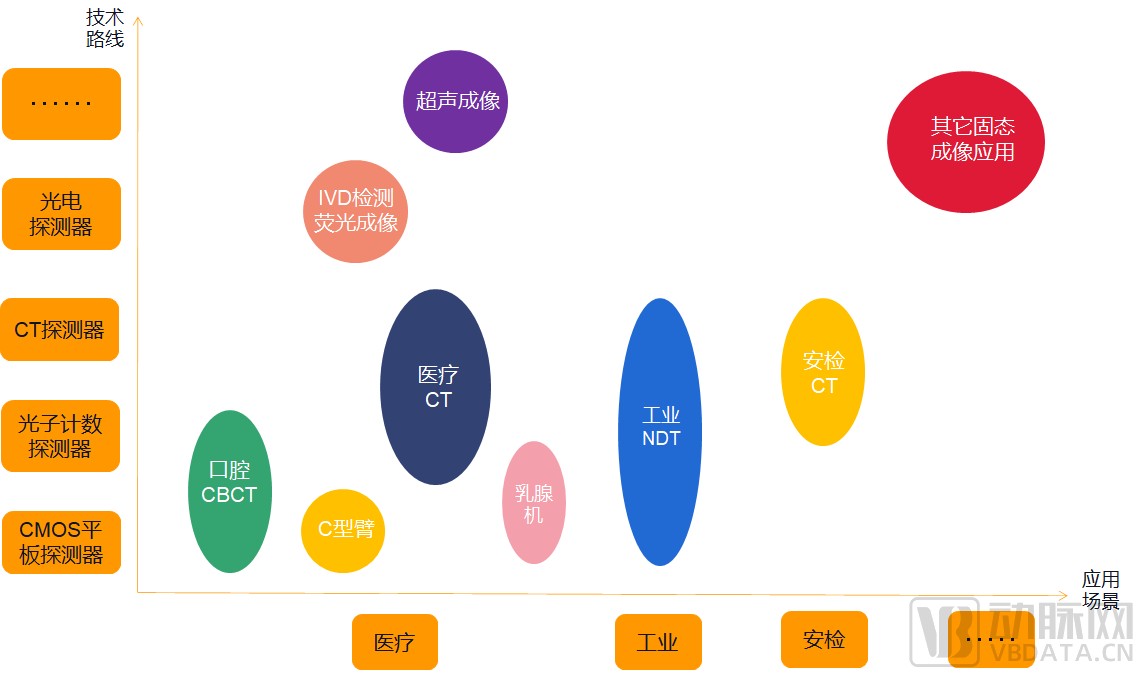
(Note: The area of the circle represents the market size.)
From the perspective of application scenariosDetectors required for different application scenarios have differentiated requirements in terms of performance and dimensions. Therefore, Sensview is developing customized high-performance detectors tailored to specific application scenarios, such as small-size CMOS flat-panel detectors for dental CBCT and large-size tiled CMOS flat-panel detectors for the C-arm X-ray machine market.
Currently, Sensview’s core CMOS flat-panel detector products are applied in scenarios such as dental CBCT, industrial non-destructive testing (industrial NDT), C-arm X-ray machines, and mammography systems. In the future, Sensview plans to further expand its other detector technology platforms, extending application scenarios to numerous fields including medical CT, security inspection CT, fluorescence imaging, and optoelectronic detection.
Experts in the dental instrument industry believe: “With the rapid growth of private dental hospitals and clinics, dental medical services will further benefit patients across China. Meanwhile, the incremental market for dental CBCT will grow in tandem, and coupled with the replacement of existing equipment, the market size for dental CBCT is expected to exceed RMB 10 billion.”
The flat-panel detector, a core component of dental CBCT systems, will also enter a phase of rapid growth.
In the field of industrial non-destructive testing (NDT), as smart manufacturing advances steadily, the NDT market in industries such as electronics and new energy is experiencing explosive growth, driving a substantial surge in demand for its core component: detectors.
C-arm X-ray systems are rapidly gaining widespread adoption in hospitals, driven by advantages such as low radiation dose, compact footprint, and high mobility. Market data indicate that the C-arm X-ray system market is projected to exceed RMB 10 billion. Initially, C-arm systems acquired images using image intensifiers based on CCD technology. Today, CMOS flat-panel detectors are gradually replacing image intensifiers, owing to their lower radiation dose, faster imaging speed, and superior image quality.Therefore, in the field of C-arm X-ray systems, the market for CMOS flat-panel detectors is rapidly expanding.
In addition, fields such as mammography, security CT, medical CT, fluorescence imaging, and optoelectronic detection are all hot sectors with substantial market potential and promising development prospects.
From the perspective of technological roadmap, sensview, leveraging core underlying technologies such as chips, has strategically laid out R&D efforts in CMOS flat-panel detectors, CT detectors, and photon-counting detectors. In the future, sensview is also expected to further expand its technological platforms in optoelectronic imaging and detection, as well as ultrasound imaging.
Dr. Luo stated, “Based on the characteristics and performance of different types of detectors, Sensview will develop products that truly meet market needs by addressing pain points in application scenarios.”
Overall, sensview has proactively positioned itself in high-growth sectors with substantial market potential. Both its application scenarios and technological roadmap exhibit strong scalability, enabling continuous expansion into other emerging fields in the future.
Currently, the global X-ray detector market is largely monopolized by companies from Europe, the United States, Japan, and South Korea. As a deep-tech company, Sensview has not only mastered underlying core chip technologies but also aims to promote the localization of high-end core components.。
Dr. Roger believes: "In the volatile international landscape, high-end core components are almost entirely dependent on imports, posing significant supply chain security risks."The localization of high-end core components holds paramount significance in that it ensures the security and stability of supply chains for domestic enterprises under extreme circumstances, thereby facilitating China’s internal economic circulation.。”
Secondly, the localization of high-end core components also represents domestically produced customizableCurrently, many complete imaging equipment products on the market suffer from homogenization, as relevant companies adopt similar imported core components, making it difficult to achieve true differentiation. SensView, formerly the Detector Division of Beijing Nanovision Technology Co., Ltd., developed China’s first CMOS flat-panel detector and customized CT detectors for static CT systems. To date, Nanovision’s static CT remains unique globally, offering a tenfold increase in temporal resolution, a 64-fold increase in spatial resolution, and a 40% reduction in radiation dose compared to traditional CT.
Thus, it is evident that true differentiation can only be achieved through innovation in foundational technologies and core components. Furthermore, only by achieving the domestic production of high-end core components can Chinese enterprises have greater opportunities to customize these components and pursue genuine differentiated innovation.
Dr. Luo stated, “Customizing core components requires long lead times and extremely high R&D costs, whereas overseas supply chains generally offer only generic products. Sensview, however, has mastered underlying core chip technologies and possesses the capability to customize high-end core components, enabling it to develop differentiated products tailored to the specific needs of its partners.”
Finally, the localization of high-end core components will further reduce costs for domestic enterprises.Compared with overseas enterprises, domestically produced high-end core components can lower product prices by leveraging lower production costs in China, thereby creating greater profit margins for domestic companies. Meanwhile, domestic companies will also have the opportunity to innovate products through customized core components and penetrate international markets by capitalizing on their cost and differentiation advantages.
Based on the above considerations, sensview is actively promoting the localization of high-end core components by leveraging its mastery of fundamental core technologies.
In December 2020, Sensview completed a pre-A round of financing amounting to tens of millions of yuan. After one year, Sensview successfully secured another A-round financing of tens of millions of yuan. It is evident that Sensview has maintained full control over its fundraising pace in line with its own growth trajectory, leveraging capital to accelerate progress toward the strategic direction outlined by its founder, Dr. Roger Luo.
However, why has Sensview repeatedly impressed investors and secured funding? Dr. Luo Jie attributes this primarily to four factors: the industry sector, the team, technology, and strategy.
In terms of the trackHard-tech sectors such as semiconductors and medical devices are currently at the forefront of industry trends. As a hard-tech enterprise mastering core chip technologies, with its products primarily applied in medical imaging, Sensview is well-positioned at the intersection of both the semiconductor and medical device tracks. It is therefore no surprise that the company has garnered favor from prominent investment institutions.
In terms of the team, sensview boasts a multidisciplinary R&D team. For instance, Roger Luo, the founder of sensview, holds a Ph.D. from Tsinghua University. He has extensive experience in semiconductors, radiation detection, and medical imaging, and previously led the development of China’s first domestically produced CMOS flat-panel detector. Lian Xuan, sensview’s detector technology expert, earned his Ph.D. from the University of Tokyo in Japan. He has long been engaged in radiation detection-related work, possessing a solid foundation in detection physics and substantial R&D experience.Overall, the Sensview team spans multiple disciplines, including semiconductors, radiation detection, and medical imaging, forming a multidisciplinary, comprehensive R&D team withExcellenceR&D capabilities.
In terms of technology, Sensview has mastered core chip technologies, enabling the design and mass production of wafer-level CMOS image sensor chips, as well as the tiling of large-format chips. The company has acquired expertise in various high-precision ADC chip technologies ranging from 14-bit to 24-bit, along with foundational knowledge of X-ray detectors, allowing for optimized designs tailored to specific requirements. Currently, Sensview has achieved large-scale mass production of wafer-level CMOS chips and, through process optimization, has attained a high yield rate that is competitive on the international stage.
In terms of strategy, Sensview has proposed the “Specialized, Refined, Differential, and Innovative” strategy and relies on this strategy to guide its corporate development. Dr. Roger stated, “As a small and medium-sized technology company in the next-generation information technology and high-end equipment manufacturing industries, Sensview will leverage next-generation semiconductor technologies to deeply cultivate upstream niche segments of high-end equipment manufacturing, such as medical, industrial, and security inspection applications. By focusing on key core technologies and detector products that address critical bottlenecks, we aim to closely align our corporate development with national needs and strive to become a nationally recognized ‘Specialized, Refined, Differential, and Innovative’ enterprise.”
“Specialization” refers to professional specialization. Sensview is committed to a specialized development path, leveraging its proprietary technologies in wafer-level CMOS image sensor chip design and mass production to provide specialized products for customers in high-performance X-ray imaging and other solid-state imaging applications;
“Jing” signifies refinement. Adhering to a philosophy of relentless improvement in R&D and manufacturing, Sensview provides high-performance detector products for applications in healthcare, industry, and security screening, while establishing refined management systems to enhance the quality of high-end core components.
“Te” signifies specialization. Leveraging its unique underlying chip technology, process technology, and detector technology, Sensview provides specialized and customized detector products and solutions for innovative enterprises in China;
“New” signifies novelty. Sensview will continue to increase its R&D investment, consistently launch high-tech products with independent intellectual property rights, and proactively position itself in emerging fields such as direct conversion detectors, dual-energy flat-panel detectors, and photon-counting detectors, so as to develop more innovative products with high technological content.
In addition to its market positioning, team, technology, and strategy, sensview also holds significant advantages in its product offerings. Based on the materials used in photodiode arrays, detectors can be classified into amorphous silicon detectors and monocrystalline silicon detectors. The CMOS flat-panel detectors and CT detectors planned by sensview both follow the monocrystalline silicon detector technology roadmap.
Why Did Sensview Choose the Single-Crystal Silicon Detector Technology Route? Dr. Luo Jie Told VCBeat, “This Is Related to Sensview’s Product Philosophy.”
In medical application scenarios, sensview aims to enhance the safety of its medical imaging products.As is well known, the primary purpose of radiological imaging is to diagnose patient conditions and facilitate better treatment. However, X-rays involve radiation that is harmful to the human body. Therefore, sensview aims to obtain clearer radiological images using lower and safer doses.
Guided by this philosophy, Sensview has selected single-crystal silicon detectors, which offer higher detection efficiency and superior low-dose performance, as its core product. Dr. Roger stated, “Compared with amorphous silicon detectors, single-crystal silicon detectors offer superior material properties and performance due to the ordered atomic structure of their material, enabling lower radiation doses, reduced image noise, faster imaging speeds, and higher resolution in medical applications.”
In industrial non-destructive testing applications, sensview places greater emphasis on efficiency.Dr. Luo stated, “Currently, there are multiple approaches to achieving industrial non-destructive testing. However, sensview is guided by the principle of high efficiency, aiming to help factories enhance inspection efficiency, improve manufacturing productivity, and optimize the quality of industrial products through its high-efficiency X-ray detectors.”
With a product philosophy that better addresses the pain points of application scenarios, Sensview’s R&D and design outputs are more aligned with the needs of end-users in the medical and industrial sectors. Consequently, Sensview achieved scaled sales in 2021 and is poised to realizeRevenueMultiplicative Growth。
Leveraging its robust R&D capabilities and innovative products, sensview has garnered numerous honors and received substantial policy support. For instance, in July 2020, sensview was included in Chengdu’s Gradient Cultivation List for the New Economy; in August, it won a Top 10 Award in the Healthcare Angel Group of the Tsinghua Alumni Three-Innovation Competition; and in December, it was listed in the Second Batch of Chengdu’s Black Technology Companies Directory.
Additionally,Sensview won the first prize in the Sichuan Division of the 2021 China Innovation and Entrepreneurship Competition in September, and passed the National High-Tech Enterprise Certification in October.。It is worth mentioning that Sensview took only two years to obtain the National High-Tech Enterprise certification since its establishment.
Such rapid certification as a National High-Tech Enterprise is closely attributable to its emphasis on technological R&D, strong team execution, and patent applications. According to reports, by the end of 2021, Sensview had obtained three invention patents, three utility model patents, seven exclusive rights to integrated circuit layout designs, and three software copyrights. Including intellectual property rights currently under acceptance or substantive examination, Sensview’s cumulative IP portfolio exceeds 30 items.
Looking ahead, sensview plans to steadily expand its product portfolio, accelerate the R&D of new products, and lay the groundwork for its next-generation technology platform. Meanwhile, sensview will increase its market investment to provide a secure and stable supply chain for more enterprises in China, and collaborate with partner companies to develop differentiated products driven by foundational technological innovations.
HM Capital“It is stated that the performance of detectors largely determines the image quality, imaging speed, and dose rate of medical imaging equipment, making them the most critical components in such systems. As clinical demands for the performance of medical imaging equipment continue to rise, so too do the requirements for detector performance. CMOS detectors and photon-counting detectors represent inevitable future trends; however, these technologies have long been dominated by foreign brands, while domestic capabilities remain relatively weak, creating a critical technological bottleneck urgently in need of breakthrough. Sensview boasts profound technical expertise and mastery of foundational chip technologies, representing a rare and valuable team in China. The team’s extreme focus on product development has deeply impressed us, and it is precisely this dedication that has enabled the high-quality localization of CMOS detectors. Currently, its products have gained recognition from leading enterprises across multiple industries. Given the core team’s strong capability in tackling complex challenges, we believe Sensview possesses significant potential for product expansion and will continue to explore new opportunities in the future. We look forward to Sensview becoming a global leader in domestically produced solid-state imaging detectors under the leadership of Dr. Luo Jie.”
Redhill Capital“The resolution of foundational ‘chokepoint’ technologies has always been a key focus for Redhill. Sensview is precisely such a company, leveraging its core chip capabilities as a competitive moat and integrating semiconductor, radiation, and medical imaging technologies across disciplines to build a multi-tiered product portfolio. Since Redhill’s investment, we have been pleased to observe Sensview’s progress over the past year in both R&D and commercialization. The company has not only achieved mass production of small-panel CMOS detectors for dental CBCT but also overcome key technical challenges associated with large-panel CMOS detectors. Sales have doubled, and the company has begun exploring frontier areas such as CT detectors, dual-energy detectors, and photon-counting detectors, while expanding applications into scenarios including gene sequencing chips, non-destructive testing of lithium batteries, and fluorescence imaging. We believe that under the leadership of Dr. Roger, the company will enter a period of rapid growth, and we look forward to Sensview leading innovative development in the industry in the future.”
HM Capital is a professional fund dedicated to healthcare investment. Leveraging the ecosystem advantages of the Huimei Medical Group, it invests in the healthcare ecosystem through a multi-dimensional and comprehensive approach. Committed to building a professional investment platform with global vision and local execution capabilities, HM Capital helps early-stage and growth-stage healthcare companies achieve rapid growth through a dual-currency, multi-strategy fund investment model.
HM CAPITAL works closely with fast-growing, innovative healthcare companies. Through its one-stop empowerment platform, it provides member enterprises with comprehensive strategic value-added services and systematic support from a global perspective, sharing HM CAPITAL’s worldwide business network and resource ecosystem with exceptional entrepreneurs.
Danlu Capital is an investment firm specializing in early-stage equity investments in innovative medical technologies. Founded in early 2018 by Lu Qinchao, former Partner at Sequoia Capital China, and Su Zhenbo, former Managing Partner at Fenxiang Investment Management, its core team members hail from renowned venture capital firms and possess extensive healthcare industry resources in both China and the United States. Danlu Capital continues to deepen its focus on the early-stage healthcare sector, systematically investing across multiple domains, including innovative medical technologies such as high-value consumables, in vitro diagnostic reagents, consumer healthcare, and digital health, as well as innovative drugs and novel healthcare services.
Chengdu Airport Innovation and Entrepreneurship Investment Co., Ltd. was established in October 2009 with a registered capital of RMB 761 million, operating as a state-owned venture capital firm in Shuangliu District, Chengdu. The company is primarily engaged in equity investment and fund management, and currently serves as a council member of both the Chengdu Venture Capital and Private Equity Association and the Chengdu Angel Investment Association. It focuses on investment opportunities in national strategic emerging industries—such as electronic information, next-generation information technology, new materials, and healthcare—as well as key sectors prioritized for development in Chengdu.