

ZhiyanShe Empowers Alipay Dental, JD Health, and Over 1,200 Clinics Through a Dental Middleware Platform
In the development of private dental practices, customer acquisition has always been one of the major challenges.
Guohai Securities’ report on the dental sector categorizes private dental institutions into three types: dentist-led, brand-led, and marketing-led. It highlights that the underlying distinction lies in their respective approaches to customer acquisition. The first two categories require private dental institutions to possess strong brand reputation and robust clinical teams, whereas the latter relies on offline advertising, online user acquisition spending, and frequent large-scale promotional campaigns to attract patients. Customer acquisition costs typically account for 15% or more of revenue.
Regrettably, private dental medical institutions currently rely predominantly on Category III customer acquisition methods, resulting in significant pressure from marketing costs. Taking Yaboshi, a private dental chain, as an example, its updated prospectus reveals that its selling and distribution expenses (primarily comprising marketing, promotion, and advertising expenditures; service fees paid to third-party marketing service providers; and salaries and bonuses for sales and marketing staff) amounted to RMB 226 million, RMB 300 million, and RMB 243 million in 2018, 2019, and 2020, respectively, accounting for approximately 30% of its revenue in each year.
If leading dental chain operators are facing such challenges, the customer acquisition costs for other fragmented, standalone dental clinics can well be imagined.
Meanwhile, internet healthcare giants such as Alipay and JD Health are also actively entering the oral care sector, with their business scope encompassing not only the sale of oral hygiene products like mouthwash and electric toothbrushes, but also the marketing of dental medical services.
However, oral healthcare services require localized implementation. Therefore, identifying and partnering with a cohort of dental institutions that guarantee medical quality and deliver compassionate care has become a critical component of internet healthcare platforms’ strategic expansion into the oral healthcare sector.
Based on the aforementioned background, it is not difficult to discern that in the new era,Building a closed loop of online products and offline services, and integrating online and offline experience scenarios will become the development trend in the dental healthcare market. In this process, the role linking private dental institutions with internet healthcare platforms is crucial.
The Dental Research Society possesses such linking attributes:Within just over a year of its establishment, it signed cooperation agreements with Alipay Dental, JD Health, and Ping An Good Doctor, providing multi-platform appointment integration services for more than 1,200 chain dental clinics across 70 cities.
However, it would be clearly biased to understand Chiyan She solely from the perspective of resource matchmaking. The integration of dental service capabilities, C2M product incubation, digital supply chains, and dental clinic networks constitute the core business layout of Chiyan She. According to relevant materials,Chiyan Club’s strategy is described as follows: “Leveraging the service capabilities of its dental internet middle platform to enhance, across the entire patient journey, the efficiency of patients’ decision-making and clinical visits.”
How should we understand the role positioning of a “dental internet middle platform”? What is the current status of its various business segments? What core competencies must a “middle-platform” enterprise possess? How does Chiyan She empower the oral healthcare industry? What are its future plans? With these questions in mind, VCBeat conducted an exclusive interview with Zhao Ke, founder of Chiyan She, to seek answers.
Chiyanshe originally intended to create an oral health service platform.
In 2020, Chiyan Society was established. Prior to this, Zhao Ke had served as a management trainee in Johnson & Johnson China’s OTC pharmaceutical division. Upon completion of his rotational program, Zhao Ke embarked on his first entrepreneurial venture in the oral care industry—Hippo Dentist. This is an oral health service platform that enables users to schedule clinic appointments online via its mobile app, with the platform facilitating connections to professional dentists.
Subsequently, Zhao Ke (alias: Wei Ying) joined Alipay Dental, becoming the head of dental business operations within the Alibaba ecosystem. During an incubation project at Alipay Dental, he met Wang Xiaolei (alias: Chong San), the head of technical development, who later became a co-founder of Chiyan Society.
Zhao Ke’s two entrepreneurial ventures and one professional work experience are all related to dental services.
The underlying reasons are naturally linked to the booming development of the oral healthcare services market.
According to Guohai Securities’ “In-Depth Report on the Dental Medical Services Industry,” from a macroeconomic perspective, the penetration rate of dental services in China was approximately 24% in 2020, with relatively low patient visit volumes and substantial latent demand for treatment. Furthermore, as household income levels and health-seeking awareness continue to rise, the dental medical services industry is poised for sustained high growth.
From a micro perspective, the oral healthcare service sector features a rich hierarchy. The rising penetration rate of high-value procedures will drive a clear trajectory for growth in average revenue per user (ARPU), with dental implants and clear aligner orthodontics each poised to independently support terminal markets valued at hundreds of billions of yuan.
“In 2016, the term ‘consumer healthcare’ was gradually gaining traction within the industry, with sectors such as dentistry and medical aesthetics beginning to heat up. I personally believe that oral care is a universally relevant industry; everyone has needs for oral health, though these needs may vary,” said Zhao Ke.
Therefore, for Zhao Ke, the oral care services industry became the unequivocal choice for his entrepreneurial and professional endeavors.
Moreover, in its early stages, Chiyan She was a platform-based enterprise, much like Hema Dental. “At the outset, our goal was to build a service platform dedicated to the vertical dental care sector. At that time, Chiyan She primarily provided standardized dental treatment services and appointment scheduling directly to consumer-end (C-end) users,” Zhao Ke revealed to VCBeat.
The shift in positioning stems from sluggish user growth.
According to Zhao Ke, after three months of exploration, the operational logic of Chiyan Society’s system and its coordination with clinics have been initially clarified, and a user base has begun to accumulate. “But to be honest, user growth has been relatively slow, falling far short of our expectations.”
Therefore, when business operations were nearly at a standstill,Zhao Ke also slowed his pace, pondering two questions: what is truly lacking in the midstream dental sector, and what has VCBeat Research accumulated.
Regarding the first question, Zhao Ke responded with great conviction during the interview: “The dental industry’s midstream segment is most in need of middle-platform enterprises, which serve as ‘supplier’ entities.”
What are the underlying reasons?According to Zhao Ke, over 80% of orders for dental services on internet healthcare platforms are customer-acquisition products such as dental cleaning. However, for these consumer-oriented medical services, the most critical aspect is not the initial transaction, but rather the post-transaction fulfillment, follow-up, and supporting services.
However, for such internet healthcare platforms, the service fulfillment phase following the sale of dental care packages lacks follow-up and is effectively “lost.” Therefore, when internet healthcare platforms such as Alipay Dental and JD Health engage in dental services, what they need most is a middle-platform role to provide supply-side support.
And this is precisely the accumulation of expertise that the Dental Research Society has built since its inception.
“Upon self-examination, we realized that what Chiyan Society does is exactly what a middle-platform enterprise does. We have established the foundational capability system for dental services, assembling various dental service capabilities into a unified module that can be plugged in and used directly, much like a USB flash drive,” stated Zhao Ke. Therefore, in May 2021, Chiyan Society officially launched its middle-platform transformation strategy and began to proactively embrace internet healthcare platforms.
It is precisely this strategic transformation that has enabledChiyan Society has secured numerous partners, including JD Health, Ping An Health, Alipay Dental, Taikang Bybo Dental, Weile Dental, and Colgate, while accumulating a user base of 100,000.
“Chiyan She can help online medical platforms launch their oral health services and integrate the entire workflow within as little as one month.” This was Zhao Ke’s exact statement during the interview.
Behind this efficiency lies a system of standardization and intelligence. The former corresponds to the standardized dental procedures curated by VCBeat, while the latter aligns with the CDM (Customer-Dentist-Manufacture) model.SaaS System for Node Layout.
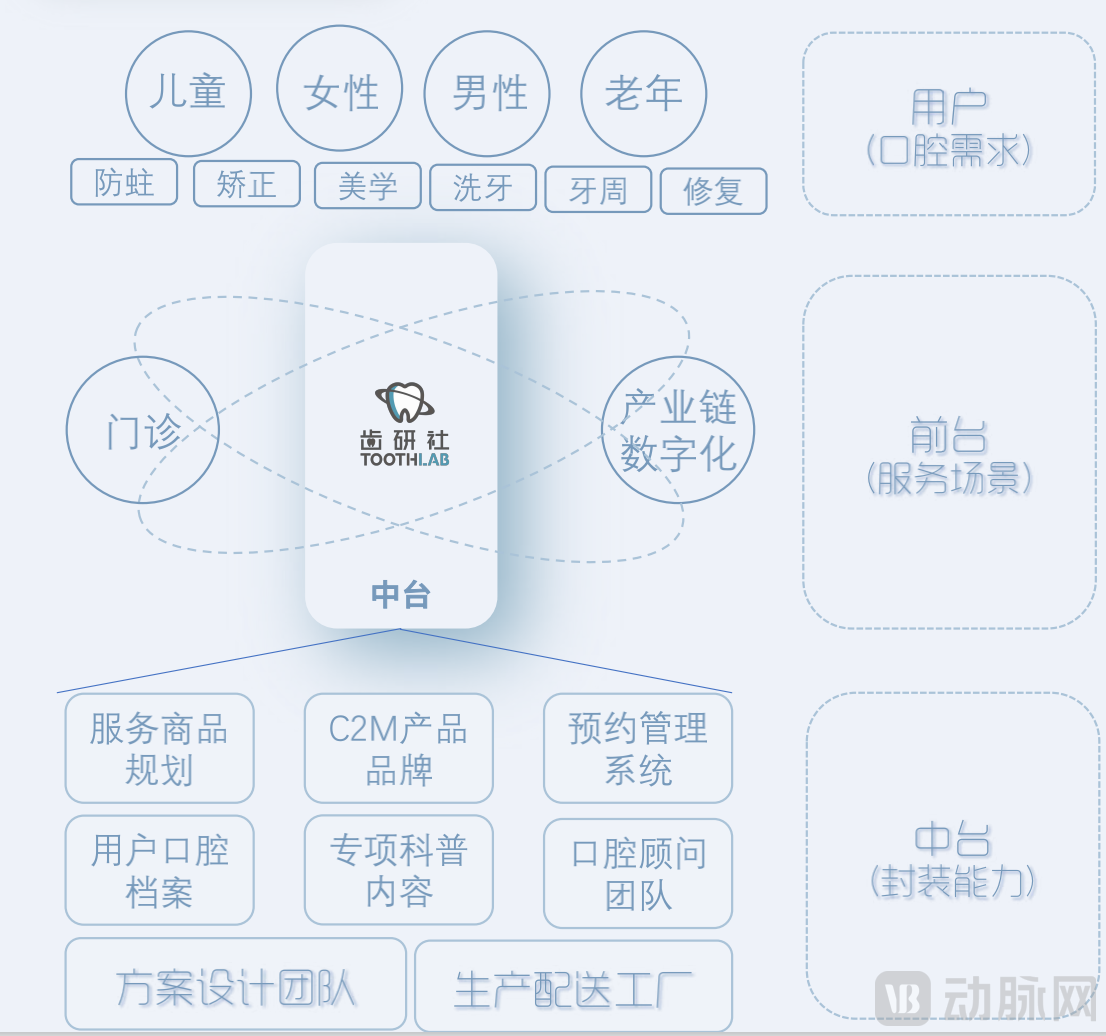
Schematic Diagram of Chiyan Society's Business Model
Among these, standardized dental service items are the cornerstone of Chiyan Society's business operations.
According to Zhao Ke, dental services mainly fall into three categories: basic preventive care, basic treatment, and complex treatment. Among these, basic preventive care and basic treatment have already achieved standardization. Taking pediatric caries prevention as an example, the interventions are limited to two procedures—fluoride varnish application and pit-and-fissure sealants—with relatively standardized durations. “However, complex treatments such as fillings and extractions have a lower degree of standardization.”
Nevertheless, Chiyan She has unbundled certain dental filling services to standardize them as much as possible.
First, Chiyan Society categorizes dental filling materials into three types: imported fillings for adults, standard resin fillings for adults, and glass ionomer fillings for children. “These three categories actually cover the majority of dental filling scenarios,” stated Zhao Ke.(Porcelain materials are classified under all-ceramic restorations; Chiyan Society has also made corresponding arrangements, which will be elaborated in the next chapter.)
Subsequently,Different dental filling materials correspond to different standardized prices. In terms of related services, Chiyan She will break down the required service items in as much detail as possible and then integrate them.
In this regard, Zhao Ke cited an example to VCBeat: The service process for dental fillings involves several steps, including imaging examinations, caries removal and disinfection, cavity preparation, material filling, polishing, and occlusal adjustment. These are procedures that patients undergoing dental fillings are highly likely to receive during their visit. What Chiyan She (Dental Research Society) has done is to integrate these steps into a bundled package.
“To sum it up in one sentence, we strive to map out the standard workflows and essential procedures for every service item in dental care, presenting and delivering them to clinics and patients in a standardized manner,” summarized Zhao Ke.
Through this approach, Chiyan Society has currently streamlined more than 20 standardized service offerings and, on this basis, successfully signed agreements with 1,200 dental clinics across 70 cities, establishing its basic supply capacity.
The SaaS system laid out along the CDM nodes is a manifestation of VCBeat's connectivity capabilities.
In the interview,Zhao Ke emphasized that, unlike most SaaS systems currently used by dental clinics on the market, Chiyan She’s SaaS system is more focused on supply chain and business workflows, rather than providing support for daily management, scheduling, pricing, and cash register management in dental clinics.
In this system, the user and the platform are collectively referred to as the C-end. For the node from the C-end to the clinic (D-end), the system’s primary function is to enable online appointment booking by users and centralized scheduling across multiple platforms; for the node from the D-end to the M-end, the system primarily provides support for treatment plan design, production, and distribution.
Additionally, according to Zhao Ke,Currently, the system provides multi-platform appointment integration services for over 1,000 dental clinics and features a “multi-store mode” to meet the management needs of dental clinic chains.
However, judging from the design of this system, it is not difficult to see that Chiyanshe’s layout will also involve the supply chain and the upstream industry.
“For a dental middle-platform enterprise, service delivery capability and connectivity are merely foundational capabilities, while data capability and supply chain capability represent advanced capabilities. This is precisely what Chiyan She aims to pursue in its next phase,” said Zhao Ke.
Among these, data capabilities will be the key focus for VCBeat Research Institute over the next 2–3 years.
According to Zhao Ke, Chiyan She currently accumulates user data through three channels: first, users’ browsing histories on the Chiyan She app; second, relevant data collected by the oral care consultant team while serving the user; and third, clinical visit data returned by clinics after the user’s treatment.
By the end of 2021, the Chiyan She app had reached 100,000 users. Based on their browsing histories—including topics followed, products viewed, and clinics monitored—Chiyan She assigned data tags reflecting diverse oral health needs to these 100,000 users.
After accumulating user data, Chiyan Society’s next step is to engage in in-depth user operations:In 2022, Chiyan Society will establish oral health profiles for users based on their data tags and apply these profiles to both online consultation services and offline clinical visits.
With user authorization, sharing users' dental records with partner medical institutions not only enhances the efficiency and precision of the entire service-to-treatment process but also empowers dental clinics to proactively understand users' potential oral health issues and treatment preferences, thereby enabling them to provide more accurate and tailored treatment plans.
“In the past, prior to a patient’s visit, dental clinics only had access to basic appointment details such as name, contact information, scheduled procedure, and arrival time. Information regarding treatment history, patient preferences, and potential oral health issues could only be compiled by front-desk staff upon the patient’s arrival, resulting in low efficiency,” said Zhao Ke. He added that one of Chiyan She’s future key priorities is to consolidate user data and achieve information sharing with partner medical institutions to enhance service efficiency.
andWhile building its data capabilities, VCBeat Research is also actively expanding into the dental supply chain.
It is reported that Chiyan She’s supply chain strategy primarily focuses on incubating C2M products for high-value projects and collaborating with third-party enterprises to procure matching high-value consumables.
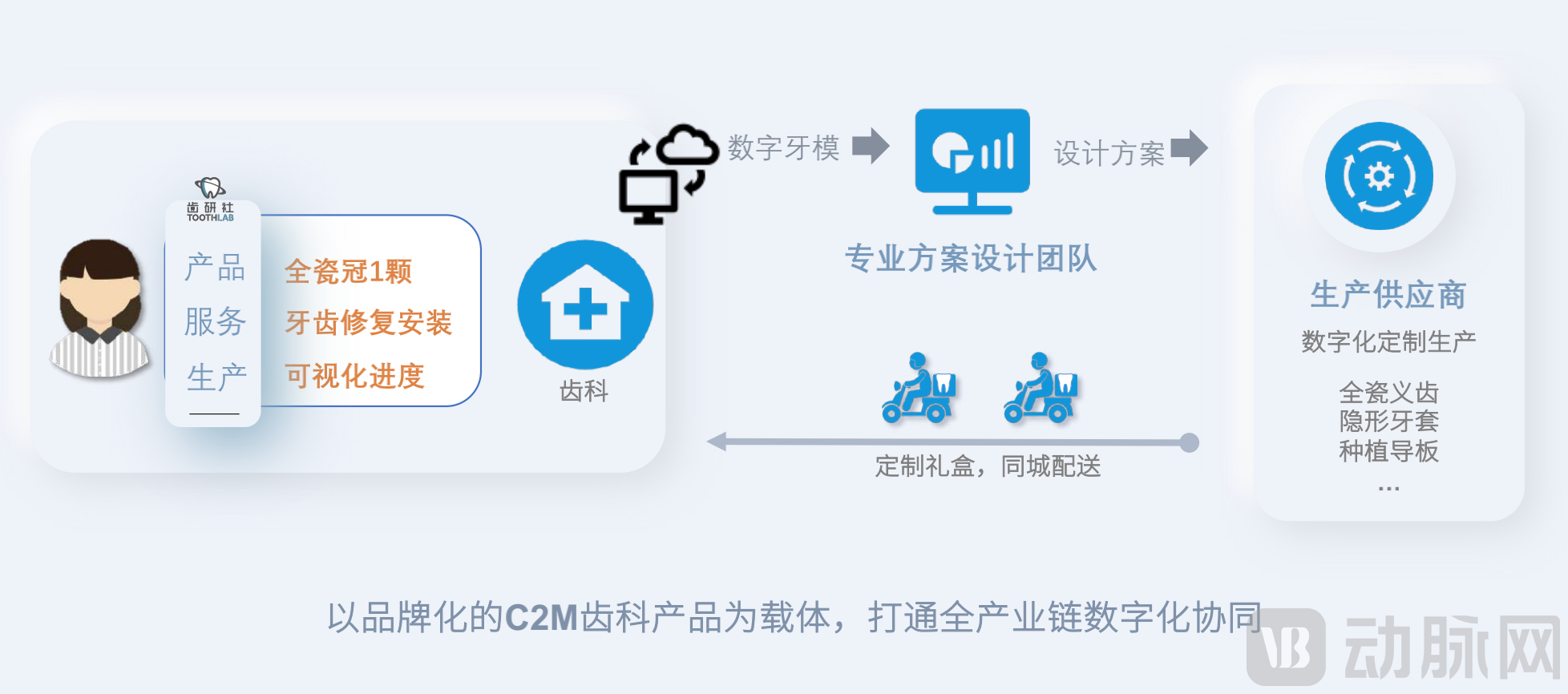
Schematic Diagram of the Digital Collaborative Layout Across the Entire Industry Chain of Chiyan Society
The first C2M product incubated by the Dental Research Society is a 3D digital all-ceramic crown, launched in October 2021 in collaboration with a domestic all-ceramic material brand. The product features traceable materials and uniform pricing across China, and has been adopted by approximately 200 dental clinics in key cities nationwide.
When asked about the rationale behind incubating C2M products, Zhao Ke cited two primary reasons:
First, to further enhance the standardization of dental procedures.
As previously mentioned, complex dental treatment procedures exhibit a lower degree of standardization compared to basic oral healthcare and fundamental therapeutic interventions. Standardization can, in fact, be further categorized into product standardization and service standardization. The custom-made dental crown products launched by Chiyan Society aim to address the issue of product standardization.
Second, to enhance users' decision-making authority.
During his tenure as a management trainee at Johnson & Johnson, Zhao Ke observed that physicians held absolute dominance in over-the-counter (OTC) drug selection decisions within hospital settings, whereas patients had begun to exercise autonomous decision-making power in pharmacies and on pharmaceutical e-commerce platforms. A similar trend has emerged in the dental industry.
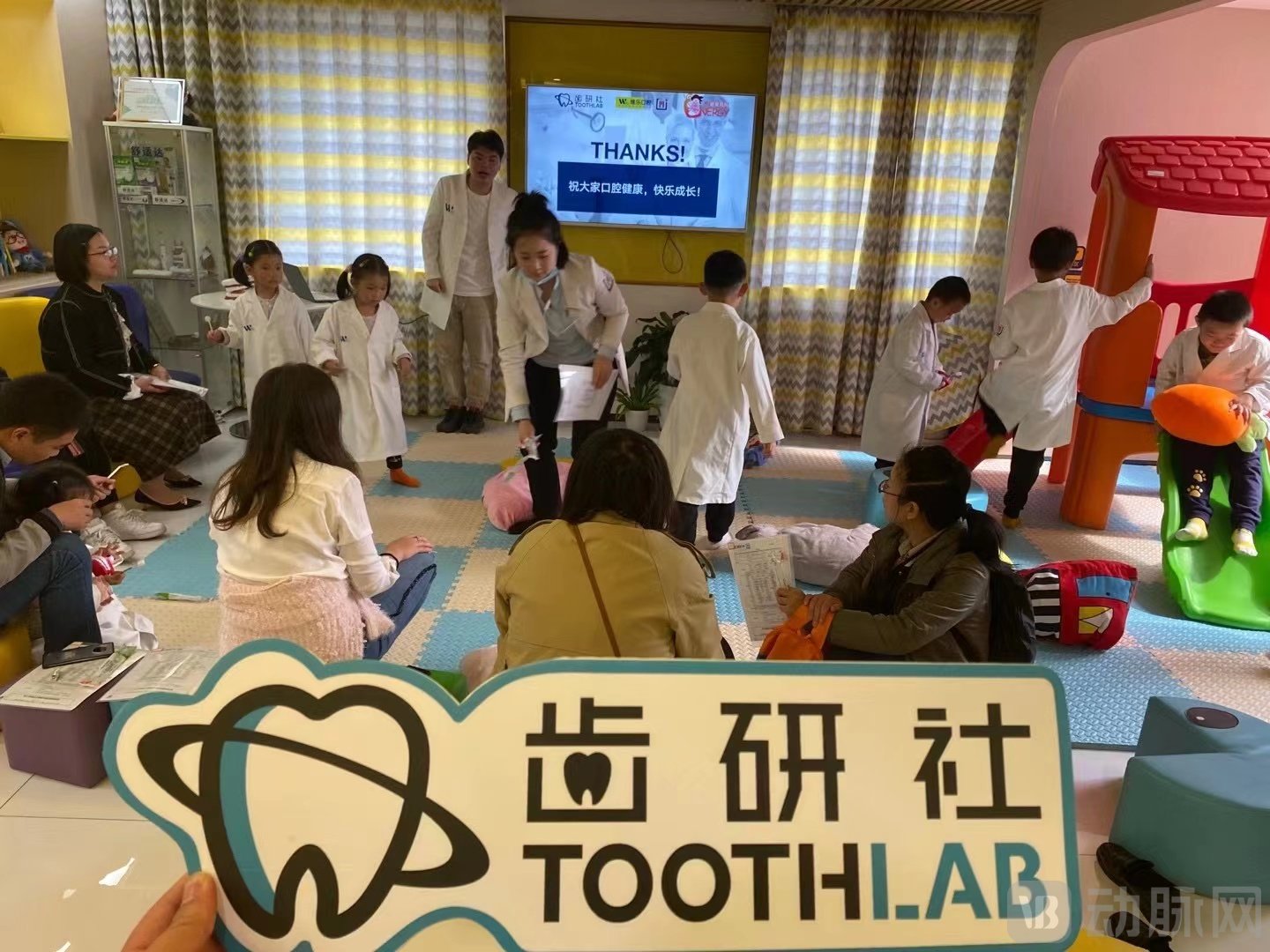
“Little Dentist” Experience Activity Jointly Organized by Chiyan Society and Meiwei Dental
“Take antipyretics as an example. If a patient goes to a pharmacy and directly asks the pharmacist for a specific best-selling antipyretic, they are highly likely to purchase that particular medication. However, if a patient simply describes their symptoms to the pharmacist, they are more likely to be recommended and purchase a different medication,” Zhao Ke told VCBeat. “This has provided me with significant insight:”OTC drugs can be viewed as the consumer healthcare segment within the pharmaceutical market, while dentistry represents the consumer healthcare segment within the broader medical services industry. The enhancement of patients’ decision-making authority not only boosts their willingness to undergo treatment but also improves clinic service efficiency and even raises the revenue ceiling for the industry.
Therefore,Zhao Ke emphasized that whether providing standardized dental services or incubating C2M products, the original mission of Chiyan She is to enhance patients’ understanding of and decision-making power over products and services.
As the discussion once again centered on VCBeat’s C2M product incubation project, Zhao Ke shared additional details about the collaboration with VCBeat.
In the collaboration on all-ceramic crowns, Chiyan She will primarily be responsible for two aspects: first, formulating the product’s marketing strategy “to help consumers better understand the product and enhance its brand awareness”; second, securing authorization from upstream all-ceramic material brands and overseeing the selection of manufacturing facilities.
Moreover,It is worth noting that the all-ceramic crown is merely the first C2M product incubation project resulting from the collaboration between Chiyan Society and upstream dental brands. In the future, Chiyan Society will engage in further collaborations with upstream brands on products related to dental implants, orthodontics, teeth whitening, and veneers.
“The mission of Chiyan She is to provide patients and dentists with greater access to cost-effective, technologically innovative treatment solutions.”“At this stage, our role is that of a dental middle-platform enterprise providing encapsulated oral care service capabilities. In the future, we will build branded products on top of these middle-platform capabilities,” summarized Zhao Ke. “Regardless, what Chiyan She aims to achieve is to provide more standardized solutions and products for both patients and dentists.”