

Aijo Medical Files IPO Prospectus: Pioneering Digital Solutions for Precision Joint Surgery and Comprehensive Osteoarthritis Care

i-jion
Developer, Manufacturer, and Distributor of Medical Devices
Human aging and degeneration are natural physiological processes; therefore, there is a strong correlation between age and the incidence of orthopedic diseases. As population aging intensifies, the incidence of orthopedic conditions continues to rise year by year. Among these, osteoarticular diseases are particularly prevalent and common. It is reported that 78.5% of elderly individuals in China suffer from osteoarthritis.
For the treatment of osteoarticular diseases, current conservative clinical management primarily aims to slow disease progression and cannot provide a cure. Shang Xifu, Director of the Department of Orthopedics at the First Affiliated Hospital of University of Science and Technology of China (Anhui Provincial Hospital), points out that once osteoarticular diseases reach the end stage, artificial joint replacement becomes the patient’s last “lifeline.”
On one hand, although China is the world’s second-largest market for joint replacement surgery, the overall volume of procedures remains insufficient to meet the demands of a large patient population, particularly among the elderly. On the other hand, numerous clinical pain points in joint replacement surgery remain urgent to address, with surgical precision being one of the core issues.
Joint replacement surgery requires precise positioning for bone resection and prosthetic implantation, demanding high technical expertise and posing significant operational challenges. Traditional procedures rely heavily on surgeons’ individual experience and subjective judgment. In this context,Digitalization Has Become a Key Direction in the Development of Surgery。
Digital empowerment is driving orthopedic surgery toward standardization, precision, and intelligence. It not only shortens the learning curve for surgeons and reduces the traditional overreliance on individual experience but also ensures surgical accuracy, effectively reducing the incidence of postoperative complications.
Aijiao Medical, a national high-tech enterprise dedicated to the digital transformation of musculoskeletal disease treatment.Currently, the company holds a Class III medical device registration certificate for the “Total Knee Arthroplasty Positioning System” and a Class II medical device registration certificate for the “Knee Joint Soft Tissue Tension Meter,” with several other products in the clinical registration phase.
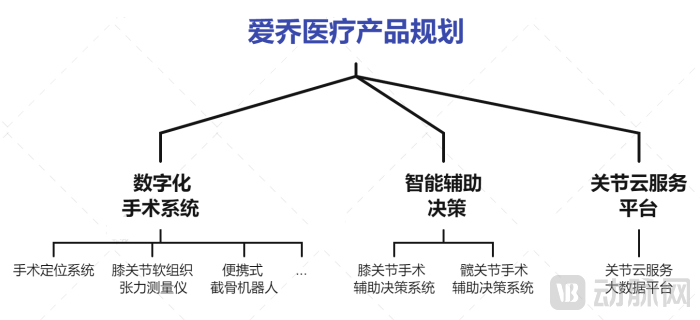
In Aiqiao Medical’s strategic plan, its digital surgery system—featuring capabilities such as surgical navigation and soft-tissue tension assessment—serves as the “vanguard” of its digitalization initiatives. The company aims to create an integrated solution comprising a “digital surgery system + intelligent decision support + joint cloud service platform,” thereby accelerating the digital transformation of joint surgery.
Among various joint replacement procedures, total hip arthroplasty and total knee arthroplasty account for approximately 90% of the total volume of joint replacement surgeries. According to statistics, the number of hip and knee arthroplasty procedures performed in China exceeded 800,000 in 2020, showing a significant upward trend year by year.
In terms of joint replacement rates, China is the second-largest market for joint replacement surgeries after the United States, yet its replacement rate remains significantly lower. Data shows that the knee replacement rate in the U.S. is 258.7 per 100,000 people, whereas in China it is only 13.5 per 100,000 people. Based on U.S. penetration rates, an estimated 3.9 million patients in China require knee replacement surgery, highlighting substantial growth potential in the future.
From the perspective of surgical essentials, total knee arthroplasty involves two key aspects: first, determining the alignment of the lower limb and performing bone cuts along a perpendicular mechanical axis; second, achieving soft-tissue balance in both the extension and flexion gaps of the knee joint. Aijiao Medical’s Intelligent Knee Positioning and Alignment System (IKPAS) and Intelligent Knee Balance Assessment System (IKBAS), both based on sensor technology, provide precise solutions for these two critical aspects, respectively.
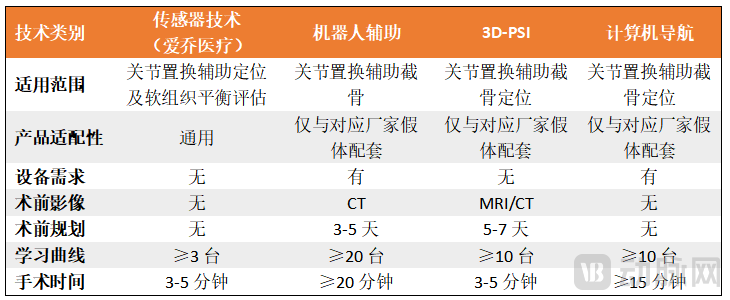
To address the precision challenges in joint replacement, several auxiliary products for osteotomy positioning, such as computer navigation systems, have emerged on the market. However, these products are only compatible with prostheses from their respective manufacturers and require surgeons to alter their operational habits, resulting in a prolonged learning curve and increased difficulty in clinical adoption.
Source: Aiqiao Medical
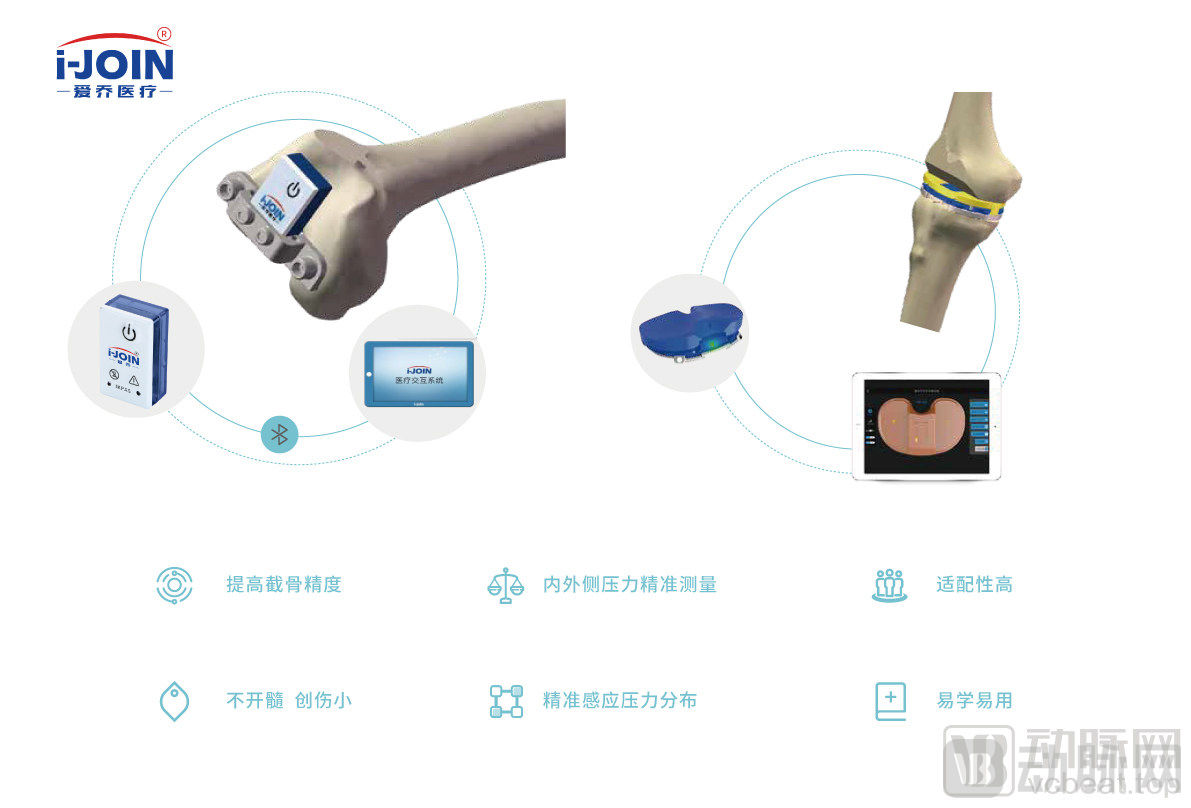
The IKPAS positioning system and the IKBAS soft tissue tension meter provide single-use sterile products, enabling sensor-based intraoperative decision support to effectively enhance surgical precision and minimize trauma. Specifically, the products feature the following characteristics:
First, innovate technical pathways to enable real-time data acquisition and feedback during surgery.AiQiao Medical’s products are developed based on sensor technology, utilizing MEMS (Micro-Electro-Mechanical Systems) chip technology. These sensors enable real-time acquisition of patient-specific data during surgery, allowing physicians to make decisions based on real-time data and individual patient conditions, thereby determining the optimal implantation position.
Second, it offers high measurement precision, addressing critical clinical pain points.While a certain degree of error is permissible in knee arthroplasty, ensuring precision remains a key technical challenge for medical devices. Taking surgical positioning systems as an example, AiQiao Medical spent one and a half years developing its system, which achieves control through algorithmic and kinematic models.Control measurement accuracy within 1.5°, and increase millimeter-level positioning accuracy to 97.4%., fully meeting clinical needs.
Additionally, its soft tissue tensiometer can measure the tension of periarticular soft tissues with an accuracy within 10 N.It is reported that there are many soft tissues around the knee joint. In some pathological knee joints, these soft tissues may undergo contracture, which disrupts the structural balance of the knee, leads to concentrated stress distribution, and causes postoperative discomfort or even pain in patients. Therefore, it is essential to restore tension to a stable state during surgery.
However, in traditional surgical procedures, there is no objective assessment standard for balance of tension; it is usually judged based on the surgeon’s experience. Aiqiao Medical’s soft tissue tension meter focuses on measuring the magnitude and distribution of tension, providing physicians with objective data references. Currently, this product has been launched on the market and continues to undergo post-market clinical studies to further optimize the product.
Third, the product is easy to operate with a short learning curve.First, Aiqiao Medical’s digital products do not alter physicians’ operational habits; second, the learning curve is short, with proficiency in product operation typically achieved after just three procedures. This makes technology adoption particularly easy for physicians, especially those with limited experience.
Source: Aiqiao Medical
Furthermore, no additional equipment is required, effectively controlling medical costs. On one hand,, the cost of MEMS chips is kept at a low level, and Aiqiao Medical's products are used as consumables during surgery.On the other hand,, iQiao Medical’s digital products do not require hospitals to procure additional unit devices. Therefore, their products do not increase hospital costs or add to patients’ financial burden, making them highly suitable for widespread adoption in primary-care hospitals.
Affordability is one of the goals of Aiqiao Medical’s product research and development. Mr. Chang Tao, founder of Aiqiao Medical, stated, “All our products must be user-friendly and affordable for the general public.”
Starting from the sensor technology path, Aiqiao Medical had no benchmarks to refer to and had to explore everything on its own during product development. What supported it in walking alone in the dark was the team.
The core team members of Aiqiao Medical possess many years of industry experience, and the company has a total staff of over 50. Chang Tao stated, “We are still a young team, steadily learning and progressing as we grow.” Currently, Aiqiao Medical has refined its quality management system, conducting product research and development, production, and marketing around the core principle of “quality first.”
Furthermore, Aiqiao Medical has established a clinical advisory team. Professor Zheng Chenggong from the School of Biomedical Engineering at Shanghai Jiao Tong University serves as the Chief Advisor, while professors and experts from Peking University Third Hospital, Shanghai Sixth People’s Hospital, Nanjing Drum Tower Hospital (Affiliated to Nanjing University Medical School), and Beijing Jishuitan Hospital serve as Clinical Advisors. Aiqiao Medical aims to foster deeper collaborations with academic institutions and clinical practices.
For orthopedic surgery, the core value of digitalization lies in empowering the surgeon’s “hand” (robotic arm), “eye” (navigation), and “brain” (AI).
Aiqiao Medical divides product development into three phases:
Phase 1: Develop a Digital Surgical System. Research and develop a sensor-based digital joint surgery system to enable low-cost, precision surgeries.
The second stage involves an AI-assisted decision-making system based on intraoperative sensor data and deep learning, which reduces surgical complexity and dependence on physicians' experience.
Phase 3: Build a cloud-based data platform for end-to-end diagnosis and treatment of joint diseases, providing patients with screening, preventive intervention solutions, and data consultation services.
Source: Aiqiao Medical
Chang Tao stated, “In the long term, we aim to leverage our digital and intelligent hardware products to implement digital medical solutions for the early diagnosis, early prevention, and precise treatment of joint diseases. Joint disorders are age-related conditions that may affect anyone. How can we mitigate the fundamental impact of these diseases and ensure a high quality of life for patients? I believe the key lies in earlier disease prevention and early intervention. As a medical device company, it is our responsibility to provide patients and physicians with these precise and intelligent auxiliary tools.”