

ADI Redefines Wearables with High-Precision, Locally Developed Health Monitoring Chip ADPD6000

Analog Devices
Semiconductor Device Manufacturer
Wearable health devices have garnered significant attention in recent years. By transcending the spatial constraints between in-hospital and out-of-hospital settings, they enable real-time, continuous data acquisition and monitoring, and their efficacy has been thoroughly validated in clinical practice. Nevertheless, concerns regarding the reliability of wearable devices persist among many stakeholders.
Compared with traditional large-scale in-hospital equipment testing, the operating environment of wearable health devices is subject to greater uncertainty and poses more significant challenges. Meanwhile, to meet the stringent requirements for portability and power consumption, components of wearable devices often necessitate trade-offs in performance and specifications. Addressing these two conflicting demands hinges on advancements in core technologies.
Not long ago, semiconductor giant Analog Devices (ADI) launched its new ADPD6000 series of multi-modal vital signs monitoring sensor front-end solutions, announcing that it would revolutionize the wearable industry with high-precision data. Notably, this is also the first wearable solution independently defined and designed entirely by ADI’s local team in China.
We are entering an era of data-driven healthcare, with wearable devices, as one of the primary data interfaces, gaining increasing attention. It can be said that the potential for wearable devices is as vast as the scope of healthcare itself. However, all of this hinges on the premise that wearable devices must capture truly useful and precise data.
This scenario emerged at the dawn of the wearable device boom, nearly halving the initial momentum. One reason was that early wearable devices offered overly limited functionality, restricted to basic features such as step counting, resulting in low user stickiness. Meanwhile, although these devices appeared to collect substantial amounts of data, such data held little value for medical applications.
At its core, a primary reason was the lack of significant breakthroughs in the core technologies of wearable devices at that time. Despite the broad prospects outlined in long-term strategic plans, the solutions available then were clearly not yet ready and still required more time to mature.
On the other hand, there have always been many shortcomings in the accuracy of data collected by wearable devices. “A tiny initial error can lead to a huge deviation.” For clinical applications, data accuracy is particularly important. However, measurement accuracy is often the most challenging aspect, influenced by various factors.
He Yuan, Senior Marketing Application Manager at Analog Devices’ China Product Business Unit, who has focused on the wearable medical health market for many years, stated that improving the measurement accuracy of wearable devices is a highly challenging task: “Because wearable devices must consider aesthetic design, they have a small contact area with the human body, and the placement may not be ideal; furthermore, material choices are limited. In addition, other factors—including variations in users’ skin tone and body hair, whether the environment is dry or humid, and whether it is outdoors or indoors—all affect measurement results. These conditions are entirely different from the stable environments found in hospitals.”

He Yuan, Senior Marketing Application Manager, China Product Division, Analog Devices
Improving measurement accuracy is easier said than done. Taking body temperature measurement as an example, in addition to the traditional mercury thermometer, current mainstream devices include contact electronic thermometers, forehead infrared thermometers, and ear (tympanic) thermometers. However, the significant discrepancies among different devices are evident from the numerous complaints found in online product reviews on e-commerce platforms.
If even the seemingly simplest task of temperature measurement presents such challenges, it is all the more difficult for wearable devices to acquire accurate, valid, and reliable data. Wearable devices must integrate multiple functional components within an extremely limited space while operating under strict power constraints. This imposes exceptionally high requirements on component design, as well as on key performance indicators such as measurement accuracy, power consumption, and anti-interference capability.
Meanwhile, although the portability of wearable devices offers convenience to users, data measurement inevitably encounters various obstacles, such as complex environments, unstable operations, and poor contact. Taking ECG monitoring as an example, hospitals can apply conductive gel during measurements as a compensatory mechanism, but this is clearly impractical for wearable devices. Consequently, compensation must be achieved solely through hardware design and algorithms.
Therefore, improving the measurement accuracy of wearable devices can be approached from two aspects: hardware and software, namely, the precision of data acquisition and the effectiveness of algorithms. This is a systematic engineering endeavor that requires substantial technical expertise to achieve.
He Yuan stated that the ADPD6000 has undergone numerous optimizations in product functionality and data accuracy to cover a wider range of more extreme scenarios.
The ADPD6000 integrates three technologies—PPG (photoplethysmography), ECG (electrocardiogram measurement), and BIA (bioelectrical impedance analysis)—on a single chip, enabling the measurement of indicators such as heart rate, blood oxygen saturation, electrocardiogram, body fat percentage, and basal metabolic rate.
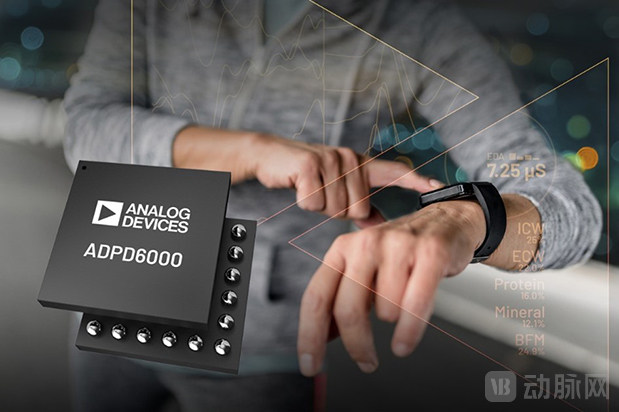
ADI Multimodal Vital Signs Monitoring Sensor Front-End Solution: ADPD6000
In the optical path section relied upon by PPG, the ADPD6000 offers an extremely high signal-to-noise ratio, ensuring signal quality and measurable coverage while reducing measurement errors caused by common skin interference factors. Additionally, it features ambient light rejection and dynamic interference suppression, enabling adaptation to a wider range of environments and testing conditions.
“For example, users with dark skin, a loosely worn watch, long body hair, and moles or tattoos. To accurately measure heart rate in such extreme conditions, specialized optimizations are required,” said He Yuan.
Analog Devices (ADI) has extensive expertise in hospital-grade ECG technology. This time, ADI has incorporated the architectural technology of professional medical-grade ECG devices into the ADPD6000, achieving reliability and stability that meet professional medical standards. Furthermore, the ADPD6000 has been specifically optimized for certain extreme scenarios.
For instance, performing ECG measurements during dry winter conditions presents a considerable challenge. This is because human skin tends to generate high voltage offsets in dry environments, which is a significant cause of measurement errors in wearable devices. Excessively high polarization voltages can also lead to signal saturation, preventing the acquisition of ECG waveforms.
“Given this extreme scenario, we have specifically introduced innovative architectures that significantly enhance the dynamic range for high-voltage electrostatic interference. The direct benefit perceived by users is that even in very dry environments—where ECG signals were previously unmeasurable—the ADPD6000 can easily deliver high-quality waveform readings,” explained He Yuan.
ECG Lead Detachment Represents the Second Extreme Scenario. Lead detachment refers to situations in electrocardiogram (ECG) examinations where lead wires become disconnected or have poor connections, resulting in the failure to display normal ECG waveforms. He Yuan stated that this phenomenon is a major challenge in wearable ECG measurement and a critical pain point urgently needing resolution within the industry: “How can lead detachment be detected? For instance, when the device is worn too loosely, or there is poor contact between the skin and one of the watch’s electrodes; alternatively, some individuals naturally have very dry skin. In such cases, many existing solutions struggle to effectively monitor for lead detachment.”
The ADPD6000 also addresses this concern. “The hardware state machine intelligent engine built into the ADI chip acts as an intelligent assistant within the chip, enabling precise detection of lead disconnection based on the status values from electrode inputs. Meanwhile, it can be customized according to intervention states designed by customers. We are highly competitive in this aspect,” said He Yuan with confidence.
In addition to PPG and ECG, the ADPD6000 features proprietary capabilities for BIA testing. These exclusive patented technologies minimize the impact of complex environmental factors, ensuring impedance measurement accuracy.
“Currently, to ensure measurement accuracy, smartwatches typically require at least four electrodes for BIA impedance testing. Two of these electrodes are usually located on the watch case, making contact with the arm, while the other two are positioned beside the dial, requiring finger contact. However, the electrodes beside the dial are very small, making it nearly impossible for users to press them without simultaneously touching the arm or the watch case, unless they adopt an extremely awkward posture. As a result, the impedance measurements are often inaccurate,” He Yuan explained to VCBeat regarding the challenges of BIA impedance testing.
He Yuan stated that ADI has extensive expertise and patents in hardware-level and solution-level technologies, addressing these issues right from the chip architecture design. Even if users have varying finger contact conditions with the watch casing during testing, the ADPD6000 can still compensate for such errors.
The ADPD6000 also successfully addresses the challenge of asymmetric link design errors, a common issue in wearable devices. Due to aesthetic considerations in wearable device design, electrode placement and size are constrained, necessitating the use of an asymmetric link architecture. This represents one of the most significant differences between wearable devices and clinical-grade equipment used in healthcare settings. However, this very asymmetric link design can compromise the accuracy of impedance measurements.
“This is a physical phenomenon that is difficult to avoid,” He Yuan stated. Compared with link-symmetric environments that exist only under ideal conditions, test errors in asymmetric links expand exponentially. To address this technical challenge, in addition to solid expertise in analog and digital circuit technologies, precise control over the entire signal chain architecture is required. Such stringent requirements have made solutions capable of mitigating this phenomenon exceedingly scarce.
“ADI possesses unique proprietary technologies and patents. By combining hardware with algorithms, it can reduce physical errors to a very low level even under asymmetric link conditions, fully meeting the requirements for precise measurement.”
In addition to its advantages in technical architecture and design, ADI’s customer-centric approach is also noteworthy.
First, ADI provides customers with a comprehensive suite of solutions to help improve their development efficiency. In addition to offering complete system-level evaluation boards and watch reference designs that enable multi-parameter testing, research, and reference validation, ADI also provides software development kits (SDKs) and mass-production solution recommendations. Furthermore, it can supply sample code and round-the-clock local support tailored to customer needs.
This is the common “Turnkey” one-stop development model in the semiconductor industry, which can reduce customers’ R&D costs and complexity. Customers can directly and rapidly integrate the solution upon receipt, significantly improving efficiency.
Of course, as the chip definition and design development are entirely completed by our domestic team, we have a profound understanding of the product architecture. Customers with requirements for in-depth independent development can also obtain the necessary services.
Meanwhile, with its team based in China, ADI is able to provide round-the-clock professional communication and issue-tracking support without time-zone delays. Leveraging ADI’s extensive development experience, its feedback and response speed are widely recognized within the industry: “In terms of technical support, our professional communications face no time-zone barriers, ensuring very smooth interactions with customers. Our technical capabilities speak for themselves, and many customers highly appreciate our support services,” added He Yuan.
Providing customers with the most responsive, on-demand service is a key reason why Analog Devices (ADI) has strengthened its local strategy in recent years. On one hand, China boasts one of the largest market sizes globally; on the other, with significant leaps in technological capabilities in recent years, the country has emerged at the forefront of many industries. Taking the wearable device market as an example, Chinese brands account for two of the top five global vendors by shipment volume. Moreover, more well-known consumer electronics brands are aggressively expanding into this market, with a clearly upward trend.
For this reason, in December 2019, ADI established a dedicated China Products Business Unit, deploying its core R&D resources to China to define and develop products tailored to the local market. This makes it one of the few business units among multinational semiconductor companies to set up an independent cost accounting center in China. In December 2020, ADI China was upgraded to Analog Devices Investment Co., Ltd., boasting comprehensive capabilities spanning demand research, product definition, R&D, marketing, sales, and operations, thereby enabling it to respond to customers’ innovation needs with localized decision-making and “China speed.”
“Currently, the China Products Business Unit of Analog Devices (ADI) has more than 200 chip design and system application R&D engineers in China, enabling efficient completion of requirements analysis, product definition, and design development within a short timeframe. Taking the ADPD6000 as an example, it took just over a year from project decision-making to final completion,” said He Yuan during his presentation.
Today, ADI’s China Product Business Unit, established over two years ago, has begun to deliver on its “In China, for China” commitment. It has successively launched multiple products independently defined, designed, and developed by its local team in response to Chinese market demands. These products have gained recognition from leading customers and achieved strong economic and social benefits. The core value of “customer-centric innovation, delivering products with high standards and high quality” has also been fully demonstrated.
In recent years, China’s technology industry has experienced rapid development, with its vast market demand attracting numerous foreign semiconductor companies to establish a strong presence in the country. ADI China’s deep localization strategy enables it to respond agilely to local innovation needs, better integrate into the domestic industrial ecosystem, and serve Chinese customers effectively.
ADI has accumulated profound system and technical expertise in the field of wearable health and vital signs monitoring. Regardless of whether they have obtained NMPA medical device certification, a significant portion of wearable devices on the market adopt ADI’s solutions. Unlike previous offerings, the newly released multi-mode vital signs monitoring sensor front-end solution, the ADPD6000, was entirely developed by ADI’s local team. This fully demonstrates the capability of ADI’s China team to manage the entire process from product definition to mass production, while maintaining ADI’s traditional advantages of high performance and high reliability.
Of course, this is just the beginning. The ADI China team is closely following wearable technology trends, developing new features and algorithms. In addition to mature algorithms for PPG, ECG, body fat percentage, basal metabolic rate, total body water, and skeletal muscle mass, algorithms for continuous cuffless blood pressure monitoring, blood glucose levels, and psychological state assessment are also under active research and evaluation. Undoubtedly, these advancements will inject new momentum into the development of wearable devices. We look forward to seeing what the future holds.