

Exegenesis Bio Announces First Patient Dosed and Discharged in Pivotal Gene Therapy Trial for Type 1 Spinal Muscular Atrophy
On March 26, Hangzhou Jiayin Biotechnology Co., Ltd. (hereinafter referred to as “Hangzhou Jiayin”) announced that the first subject had been dosed in the clinical study of its independently developed gene therapy drug, EXG001-307 injection, for the treatment of Type 1 Spinal Muscular Atrophy (Type 1 SMA), conducted at the Children’s Hospital of Zhejiang University School of Medicine. To date, the drug has demonstrated a favorable safety and tolerability profile. Under the meticulous care and medical management of clinical staff, the treated pediatric patient has been successfully discharged.
Currently, this clinical study is rapidly advancing and actively recruiting participants. By enabling precise diagnosis of pediatric patients with spinal muscular atrophy (SMA), a rare disease, the study aims to provide more children and their families with the opportunity to receive targeted AAV gene therapy.
Spinal Muscular Atrophy (SMA) is the leading genetic cause of death in infants and young children under two years of age. It is an autosomal recessive neurodegenerative disorder caused by mutations in the SMN1 gene, resulting in a deficiency of SMN protein in the motor neurons of the brainstem and spinal cord.
The carrier rate of the SMA-causing gene in the general population is high (approximately 1/40–50), and the incidence among newborns is also high (approximately 1/6,000–10,000). As a relatively common rare disease that poses a significant threat to patients’ survival and health, it was included in China’s “First Batch of Rare Diseases Catalog,” jointly released by five ministries and commissions, including the National Health Commission, in May 2018.
In China, approximately 15 million babies are born each year, which means that at least 1,500 new cases of spinal muscular atrophy (SMA) occur annually, subjecting at least 1,500 families to the suffering caused by this disease.
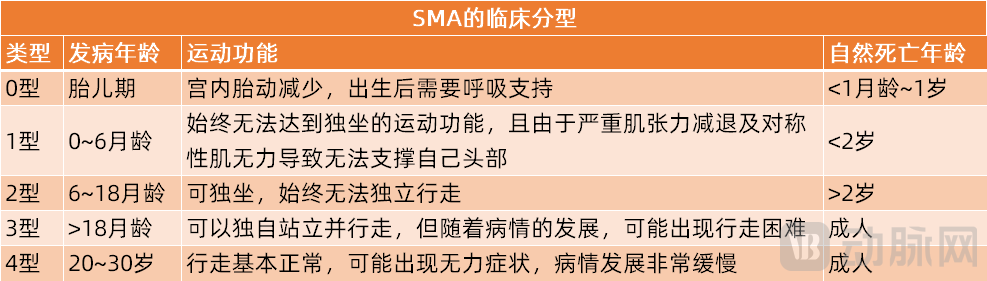
Among these, Type 1 SMA (i.e., SMA Type 1) is the most severe clinical subtype (excluding the extremely rare Type 0), with an expected survival rate of only approximately 8% of patients beyond 20 months of age. Affected infants rapidly exhibit motor function regression and symmetric limb weakness within the first six months of life, demonstrate poor head control, and fail to achieve motor milestones commensurate with normal development. A hallmark feature is the inability to sit independently, necessitating reliance on strollers or wheelchairs. Dysphagia and feeding difficulties are common, posing a risk of asphyxia due to aspiration (inhalation of secretions or food into the lungs); nutritional support may require tube feeding for liquid diets. These patients are highly susceptible to aspiration pneumonia, and the majority die from respiratory failure before the age of two.
Table 1. Clinical Classification and Prognosis of SMA
Currently, there are three drugs approved by the U.S. FDA for the treatment of SMA: the gene therapy Zolgensma (Novartis), the antisense oligonucleotide (ASO) drug nusinersen sodium (Spinraza, Biogen), and the small-molecule drug risdiplam (Evrysdi, Roche).
Zolgensma is the first and only gene therapy approved by the FDA for the treatment of spinal muscular atrophy (SMA). This gene therapy utilizes a scAAV9 vector to deliver the normal SMN1 gene into patients via intravenous infusion, leading to the production of functional SMN1 protein and thereby improving the function of affected cells, including motor neurons. Nusinersen sodium (launched in China on April 28, 2019) binds to pre-mRNA to enhance exon 7 inclusion, resulting in increased production of functional SMN protein. In contrast, risdiplam (launched in China on June 17, 2021) binds to exon 7 and alters its conformation, facilitating better interaction with splicing regulatory proteins and increasing SMN protein expression.
Zolgensma is an intravenously administered gene therapy that provides long-term efficacy with a single infusion. Nusinersen sodium requires intrathecal administration (via lumbar puncture) and necessitates repeated, long-term dosing; Risdiplam is an oral medication that also requires long-term administration.
Long-term follow-up clinical data as of June 2020 show that all 13 patients in the earliest cohort treated with Zolgensma (SMART study; conducted from May 5, 2014, to December 15, 2017; low-dose cohort, n = 3; high-dose cohort, n = 10) underwent follow-up as scheduled. The median follow-up duration for these 13 patients was 5.2 years (range: 4.6–6.2 years). All 10 patients in the high-dose cohort survived (100% survival rate) and did not require permanent ventilation. All 10 high-dose patients who underwent long-term follow-up maintained previously achieved motor milestones and showed no further deterioration during the follow-up period. Two patients achieved a new milestone of “assisted standing” without caregiver assistance.
The aforementioned data also demonstrate that results from ongoing clinical follow-up of patients with type 1 spinal muscular atrophy (SMA) treated with gene therapy (Zolgensma) support its favorable long-term safety profile and provide evidence for the sustained clinical durability of the therapeutic dose.
Zolgensma is extremely expensive on the market ($2.125 million, approximately RMB 14.88 million) and has not yet been launched in China. Therefore, it remains inaccessible to patients in China.
Therefore, for SMA patients in China, there is a need for a safe, effective, and accessible gene therapy that can be administered as a single dose and provide long-term efficacy.
EXG001-307 has a mechanism of action and administration similar to Zolgensma. It is a novel gene replacement therapy for the treatment of type 1 spinal muscular atrophy (SMA), with the potential for long-term efficacy after a single dose.
During product development, Hangzhou Jiayin adopted an innovative design aimed at reducing the cardiac and hepatic side effects associated with gene therapy in pediatric patients, thereby enhancing therapeutic efficacy. Preclinical animal studies have also validated the concept behind the innovative design of EXG001-307. Furthermore, Hangzhou Jiayin utilizes its proprietary serum-free suspension culture and chromatography processes for GMP-compliant drug manufacturing. Both the manufacturing process and product quality standards have reached internationally leading levels within the industry.
Hangzhou Jiayin, established in July 2019 and located in the Zhejiang Provincial Pharmaceutical Port Town in Hangzhou, is an innovative pharmaceutical company dedicated to providing the most viable gene therapies to the global market. The company has assembled a premier team of top scientists and entrepreneurs in the industry, forming a comprehensive powerhouse with expertise spanning gene therapy drug design, preclinical research, CMC development, GMP manufacturing, clinical trials, operational management, and business development (BD). In addition to possessing strong differentiated competitive advantages in pipeline selection and technology platforms, the company boasts internationally leading capabilities in viral vector production processes and large-scale manufacturing. It has built gene therapy production facilities compliant with cGMP standards in China, the United States, and Europe. Its scalable, cost-controllable platform technologies and large-scale production capacity effectively accelerate the advancement of its multiple product pipelines through clinical development and toward commercialization.
The Hangzhou Jiayin team has demonstrated strong capabilities in addressing critical industry challenges in gene therapy, such as the design and screening of viral vectors with high tissue specificity, low immunogenicity, high infection efficiency, and efficient long-term expression, as well as the stable, large-scale, and cost-effective production of high-purity viral vectors. Recognized by top-tier investment firms, the company holds significant potential.
Recruitment Information for Subjects with Type 1 SMA:
Key Inclusion Criteria:
(1) Age not exceeding 180 days after birth
(2) Genetically diagnosed with SMA via biallelic SMN1 mutations (deletions or point mutations); possessing two copies of the SMN2 gene;
(3) Clinical history and physical signs are consistent with the presentation of type I SMA, namely hypotonia, delayed motor development, poor head control, rounded shoulder posture, and joint hypermobility;
Major Exclusion Criteria:
(1) Gestational age at birth less than 35 weeks (245 days)
(2) During the screening period, oxygen saturation <96% while awake or asleep and not receiving any supplemental oxygen or respiratory support.
(3) Requires invasive mechanical ventilation or tracheostomy, or current use of non-invasive ventilation support for an average of ≥16 hours/day.
(4) Presence of severe non-respiratory diseases within 2 weeks prior to screening; presence of upper or lower respiratory tract infections within 4 weeks prior to screening.
(5) Previously participated in clinical studies of other SMA drug therapies.
For detailed inquiries or to participate in this project, please contact us:Contact Person: Dr. XuContact Number:13306816092
References:
[1] Dabbous, O., et al., Survival, Motor Function, and Motor Milestones: Comparison of AVXS-101 Relative to Nusinersen for the Treatment of Infants with Spinal Muscular Atrophy Type 1. Adv Ther, 2019. 36(5): p. 1164-1176.
[2]Available from:
https://www.clinicaltrials.gov/ct2/show/results/NCT02193074?term=ENDEAR&cond=SMA&draw=2&rank=1&view=results