

From the Father of Balances to a Life Science Tools Leader: Sartorius Files IPO Prospectus Highlighting Three Key Success Pillars

Sartorius
Laboratory and Pharmaceutical Equipment Manufacturer
It is a century-old time-honored brand,
Also an innovator in the field,
It is a product born out of the Second Industrial Revolution,
It is also the pulsating heartbeat along the Rhine’s flowing course.
Since the term “life science tools” emerged in recent years, Sartorius has been hailed as a giant in the life science tools sector. Yet this stature was not innate; even the rise of an industry titan follows discernible patterns.How Did Sartorius Rise from a Small Balance Product to Remain Resilient and Continuously Expand After More Than 150 Years of Turbulence?
1. Connecting Points to Form Lines
In 1870, Florenz Sartorius, a mechanic from Göttingen, Germany, used the industrial aluminum production method invented by chemist Friedrich Wöhler to manufacture the world’s first short-arm analytical balance. As a result, Sartorius is known as the “Father of the Balance.” The company he founded under his own name, Sartorius, established its global presence with this product. To this day, Sartorius analytical balances remain widely used in laboratories around the world.
Since its inception, Sartorius has continuously broken and set new records in the field of weighing. The first microbalance for weighing in standard environments, the first analytical balance with digital display, stability control, and digital output, the first series of laboratory electronic balances to incorporate advanced MC1 microprocessor technology, the first ultra-microbalance, and the balance with a Guinness World Record for 0.01 μg precision—all these innovations have come from Sartorius.
In 1922, Sartorius collaborated with Nobel laureate and inventor of membrane filtration technology, Richard Zsigmondy, to commence the industrial production of microporous membranes, laying the foundation for the development of bioprocessing technology. In 1927, Sartorius and Richard Zsigmondy established the joint venture Membranfilter-gesellschaft mbH (Membrane Filtration Company), thereby expanding the company’s business from laboratory equipment into the field of bioprocessing.
In the field of membrane filtration, Sartorius has continuously achieved breakthroughs: the first tangential flow ultrafiltration system, the first production of membrane filter cartridges capable of pressurized heating and integrity testing worldwide, the first Minisart filter, and the first stainless steel pressure filtration device for ultrafiltration...
Over its 152-year history, Sartorius has demonstrated countless examples of breakthroughs and innovation. Each time it surpassed a previous milestone of its own making, the company swiftly leveraged that innovation as a starting point to expand its reach, gradually securing most of the “firsts” in specific fields and rapidly establishing its industry influence.
It is not just Sartorius, nor is it limited to companies in the life sciences tools sector; most startups follow this same trajectory as they grow from novices into industry giants: they begin by focusing on a single product, then expand their footprint to achieve a comprehensive portfolio across that product line, and subsequently extend their reach along the upstream and downstream segments of the industrial chain based on their product strategy, gradually emerging as dominant players in their respective fields. While this logic may appear straightforward, every successful innovation is underpinned by countless accumulated failures, and every seemingly simple choice and strategic move has profound implications for the company’s future development history.
In the mid-1990s, Sartorius announced its strategic shift to focus on the biopharmaceutical industry, divesting its previous operations in the food and industrial sectors. As is well known, biopharmaceuticals were still an emerging technology globally at that time. However, the rapid development of the biopharmaceutical sector over the following three decades has proven the foresight of Sartorius’s decision. This marks the most significant distinction between Sartorius and other life sciences tool giants: while most competitors maintain broad portfolios spanning food, chemicals, and other industries alongside their biopharmaceutical offerings, Sartorius’s strategy is notably more focused and clear.
In 2011, Sartorius streamlined its group structure once again, reorganizing into three divisions: Biotechnology, Laboratory Products & Services, and Industrial Weighing.To date, Sartorius primarily operates two major business segments: Laboratory Products & Services and Bioprocess Solutions.
The former serves laboratories in pharmaceutical and biopharmaceutical companies as well as various research institutions., providing scientists and laboratory personnel with laboratory equipment and solutions to simplify and accelerate research and quality control processes, thereby improving experimental success rates. Main products/services include weighing instruments, pipetting and dispensing equipment, laboratory pure water systems, laboratory filtration and purification systems, microbiology products, etc.
The latter is dedicated to providing comprehensive solutions for biopharmaceutical companies.From initial concept to market launch and production, Sartorius helps biotechnology scientists and engineers develop and manufacture new drugs. Its main products and services include cell culture media, bioreactors and fermenters, fluid management, process filtration and purification, process control, and data analytics.
Since then, Sartorius has streamlined its business portfolio to focus on the biopharmaceutical sector, striving to become a leading provider of biopharmaceutical solutions in the industry.
In terms of brand image, Sartorius has also continued this “minimalist” style. In 2020, on the occasion of its 150th anniversary, Sartorius unveiled a new brand identity and manifesto: Simplifying Progress. Sartorius will continue to help scientists and engineers streamline processes and accelerate time-to-market through innovative products and technologies.

Sartorius’ New Corporate Logo, Image Source: Sartorius Official Website
2. Simplifying the Complex
Sartorius’s “decluttering” has been highly successful.
In 2021, Sartorius reported total sales revenue of €3.449 billion, a year-on-year increase of 47.7%.
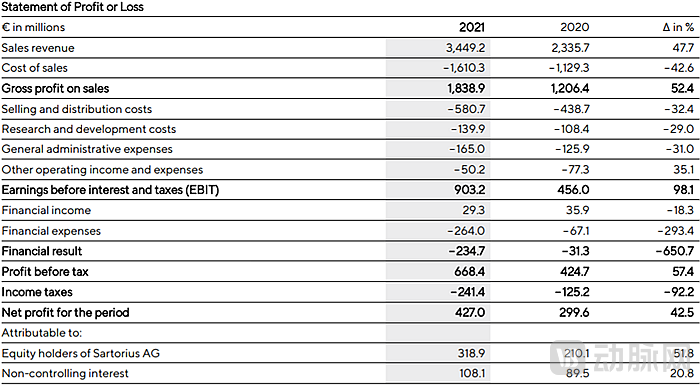
Sartorius 2021 Revenue Data, Source: Sartorius 2021 Annual Report
Among this, acquisitions accounted for only about 5%, with the remainder of revenue derived from core operations. Sales revenue in Sartorius’s Bioprocess Solutions segment grew by 54.7% to €2.727 billion, serving as the primary driver of performance growth. Additionally, pandemic-related demand—mainly due to certain customers’ investments in and expansion of COVID-19 vaccine production—contributed approximately 20% to the segment’s sales growth. Amid the pandemic, capacity expansions at multiple facilities worldwide supported business growth in the Bioprocess Solutions segment.
During the two exceptional years of 2020 and 2021, Sartorius not only remained unaffected by the pandemic but also achieved rapid growth through its end-to-end mRNA solutions. Why did Sartorius become a key supplier to mRNA companies during the pandemic?
Since 2020, Sartorius has engaged in close collaborations with global enterprises involved in COVID-19 research and development, including those utilizing mRNA technology platforms. The company has established a comprehensive platform process solution that spans from plasmid preparation to mRNA manufacturing—including in vitro transcription (IVT) reactions—as well as ultrafiltration-based purification of both mRNA and lipid nanoparticles (LNPs), followed by sterile filtration, storage, cryopreservation, and fill-finish of the bulk drug substance. Sartorius provides end-to-end services covering process design, facility construction, and project management, enabling clients to accelerate their transition from process development to commercial-scale production.
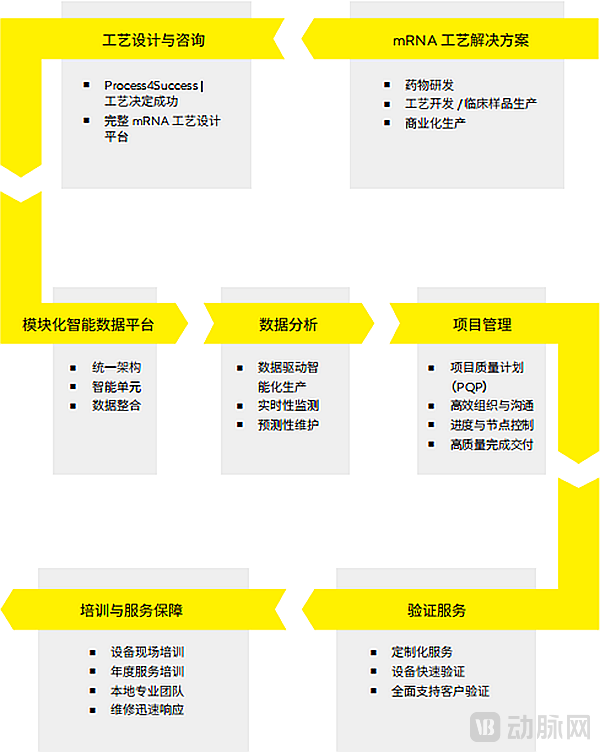
Seven Key Modules: Sartorius mRNA Solutions. Image source: Sartorius official WeChat account
Sartorius’s mRNA solutions can be condensed into seven major modules. These seven modules share an interconnected underlying logic and can be specifically customized to meet diverse customer requirements. Within the seven-module workflow for mRNA industrialization, three process steps are particularly critical.
1. Plasmid Production and Its Linearization Process
mRNA drugs are produced via in vitro transcription using plasmid DNA (pDNA) as a template. Since pDNA amplification is typically achieved through fermentation of engineered Escherichia coli (E. coli) strains, the starting point of the mRNA manufacturing process lies in the establishment and qualification of the E. coli master cell bank. The process then proceeds from cell thawing through fermentation, harvest and clarification, purification, linearization, and aliquoting/storage to obtain templates suitable for mRNA transcription. For this platform solution, Sartorius’s comprehensive plasmid process platform covers pDNA fermentation, cell harvest and lysis, as well as ultrafiltration and purification of plasmid DNA, including final sterile filtration, bulk drug substance aliquoting, and cryopreservation.
2. In Vitro Transcription (IVT) and Purification of mRNA
The main steps in mRNA drug substance manufacturing include in vitro transcription (IVT), chemical modification, separation and purification, and aliquoting and cryopreservation of the mRNA drug substance. Among these, the IVT process is the most critical step in the entire mRNA drug substance production workflow, as the majority of production inputs and costs are attributed to IVT raw materials—particularly the enzymes used. The primary challenges currently facing IVT processes are inconsistent transcription efficiency and lack of standardization in transcription protocols; even when using identical reagents and consumables, variations in transcription efficiency persist. Sartorius’s ambr® high-throughput technology platform enables process development at milliliter-scale volumes, significantly enhancing the efficiency of IVT process optimization while also effectively reducing raw material costs for IVT reactions due to the smaller bioreactor volumes.
3. Plasmid Lipid Nanoparticle (LNP) Production and Formulation Filling
Due to the instability of liposome-encapsulated mRNA and its sensitivity to shear stress, hollow fiber filters can be used for ultrafiltration and buffer exchange. Sartorius’s hollow fiber filter products offer the advantages of low adsorption and ease of cleaning, making them well-suited for pilot-scale and manufacturing processes. They are currently widely employed in the ultrafiltration and buffer exchange steps following the production of marketed mRNA lipid nanoparticles (LNPs).
Furthermore, in addition to the aforementioned key process steps for mRNA, Sartorius’s single-use fluid management solutions comprehensively address mRNA process requirements, providing customers with end-to-end solutions that include solution storage, mixing, transportation, aseptic connection and disconnection, freeze-thaw cycles, and formulation filling.
From this perspective, the introduction of integrated solutions not only helps companies lower process barriers and achieve “cost reduction and efficiency enhancement,” but also encourages them to adopt Sartorius’s end-to-end services after initially selecting a single Sartorius product, thereby gradually expanding the scope of services provided to clients. Furthermore, once chemistry, manufacturing, and controls (CMC) processes for biopharmaceuticals are established, they rarely undergo significant changes. Consequently, companies that opt for Sartorius’s end-to-end solutions are highly likely to become long-term partners, generating sustained and substantial revenue for Sartorius.
3. Mergers and Acquisitions
Mergers and acquisitions are a common means for companies to gradually expand.
Sartorius’ most recent acquisition took place in February this year, when it completed the purchase of Novasep’s chromatography division, thereby expanding its footprint in the chromatography sector. The acquired product portfolio includes chromatography systems primarily suited for small-molecule biologics (such as oligonucleotides, peptides, and insulin), as well as innovative systems for continuous manufacturing of biopharmaceuticals.
In July last year, Sartorius completed the acquisition of cell culture company Xell AG. “This acquisition helps us expand our current portfolio of culture media, specifically including specialized media required for viral vector production and the field of media analytics. At the same time, we are accelerating the expansion of our production network in this rapidly growing sector,” said René Fáber, Member of the Executive Board of Sartorius and Head of the Bioprocess Solutions Division.
During the same period in 2021, Sartorius also acquired a majority stake in the reagent manufacturer CellGenix. In 2023 and early 2026, Sartorius plans to acquire the remaining shares of CellGenix. Following this acquisition, Sartorius intends to significantly expand CellGenix’s facilities in Freiburg, transforming them into a technology center within the group dedicated to the development and production of high-quality critical raw materials required for cell and gene therapies.
According to Sartorius’s 2021 annual report, acquisitions contributed approximately 5% to the company’s revenue growth in 2021. Not only in the past year, but since its inception, Sartorius has been gradually refining and expanding its industrial chain footprint by acquiring companies within the sector. Unlike Thermo Fisher Scientific and Danaher, which engage in frequent transactions, Sartorius prioritizes quality over quantity in its M&A activities. These consecutive acquisitions have continuously opened up new branches for the Sartorius “tree.” Based on incomplete statistics, the companies acquired or merged with by Sartorius over the past two decades are as follows:
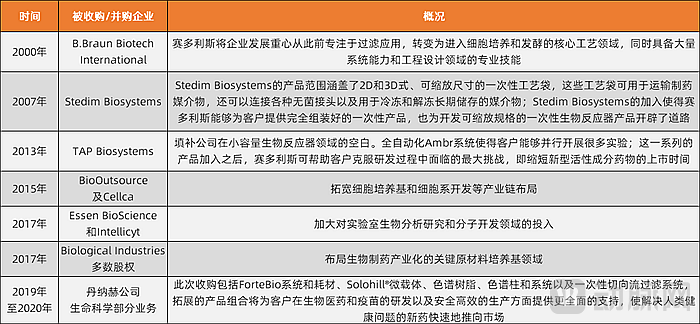
Incomplete Statistics of Sartorius’s Acquisitions and Mergers in Recent Years, Compiled from Public Sources
It is evident that Sartorius has achieved a more focused business layout after successfully “streamlining” its operations. In recent decades, the companies acquired or merged by Sartorius have all been part of the life sciences tools value chain, including single-use process bags, bioreactors, cell culture media, chromatography, and filtration systems, continuously enhancing its capabilities as a full-process solution provider.
In Closing
From stainless steel to single-use technologies, from manual operations to digital solutions, and from fed-batch to perfusion processes. Compared with other giants in the life sciences tools sector, Sartorius’s business portfolio is truly focused.
From its humble beginnings with a small balance scale to its current position as an advocate for integrated biopharmaceutical solutions, Sartorius’s strategic evolution over the past century appears devoid of any dramatic or turbulent legendary tales. Perhaps it is simply the inherent rigor and conscientiousness ingrained in the German artisanal spirit that has propelled this century-old enterprise to become an industry giant.
While maintaining a rigorous attitude toward its products, Sartorius has by no means succumbed to the complacency and conservatism often associated with long-established companies. On the contrary, at many pivotal moments, it has chosen to strategically position itself in emerging fields that were still in their nascent stages.
In 2021, Sartorius Stedim, the core business subsidiary of the Sartorius Group, achieved significant success in China, with its revenue contribution increasing from €180 million in 2020 to €303 million in 2021. This growth was significantly attributable to Sartorius’s early strategic positioning.
In 1995, Sartorius established its subsidiary in China: Beijing Sartorius Instrument Systems Co., Ltd. More than two decades ago, systematic biomedical research in China was still in its early stages of development. Sartorius’ entry into the Chinese market at that time involved a certain degree of risk, but was driven primarily by the recognition of a mismatch between domestic supply and demand. Capitalizing on the principle that “scarcity enhances value,” Sartorius stood to gain access to a vast blue-ocean market.
It is precisely because Sartorius entered the Chinese market at an early stage of industry development that its life sciences instruments, such as electronic balances and pH meters, were voted by users in 2001 as one of the “Top Ten Well-Known Life Science Instrument Brands.” With the rapid growth of its business in China, Sartorius established Sartorius Scientific Instruments (Beijing) Co., Ltd. in 2006, and subsequently set up branch offices in Shanghai, Chengdu, and Jinan, as well as representative offices in Guangzhou, Xi’an, Shenyang, and Wuhan.
Sartorius’s success may be attributable to both chance and inevitability, shaped by the times as well as its own efforts. Likewise, we anticipate that outstanding companies will gradually emerge from among Chinese life sciences tools firms currently in the early stages of development. We look forward to domestic enterprises leveraging blockbuster single products as a springboard for success, pinpointing their development goals within the vast landscape of life sciences tools, and growing into emerging giants.
As long as biomedicine endures, life science tools will persist.
Reference article:
1. “Sartorius Achieves Strong 2021 Close with Sales Surging Over 50%; Maintains High Growth and Intensifies Carbon Emission Reduction Efforts in 2022”;
2. “The mRNA Sector Continues to Heat Up: How to Address Process Challenges”;
3. “Sartorius: The Innovation Journey of a Century-Old German Enterprise”;
4. Sartorius Official Website and WeChat Official Account...