

JD Health Reports RMB 30.68 Billion in Annual Revenue with 72.7% Surge in Service Income: What’s Next for Growth?

JD Health
Internet Medical and Health Service Platform Provider
As one of the most closely watched healthcare companies, JD Health released its 2021 annual performance report on March 28: total revenue reached RMB 30.68 billion, a year-on-year increase of 58.3%; net profit under non-IFRS measures amounted to RMB 1.4 billion, representing a year-on-year growth of 91.5%.
Among the overall performance, service revenue stood out, with a year-on-year increase of 72.7%, higher than the overall growth rate.
JD Health started at a high level and achieved rapid growth, with its sustained growth capability after going public becoming a focal point of industry attention. As its core business, the sales of pharmaceuticals and health products have contributed the majority of JD Health’s revenue. However, in light of overall performance trends in recent years, its service-oriented attributes have demonstrated increasingly significant growth potential.
Annual report data shows that revenue from the sales of pharmaceutical and health products remains the primary source of JD Health’s total revenue. In 2021, JD Health’s product revenue reached RMB 26.177 billion, a year-on-year increase of 56.1%, accounting for 85.3% of its total revenue.
Product sales are a core strength of JD Health. With a diverse portfolio of pharmaceutical and health products, a robust supply chain system, and rapid delivery capabilities, the company benefits from strong bargaining power in upstream procurement due to its rapidly growing sales volume, which translates into competitive pricing on the sales end. These factors constitute the key advantages driving the growth of JD Health’s product revenue, and the company continued to enhance these capabilities in 2021.
In terms of drug categories, JD Health has accelerated its coverage of new and specialty medications. In 2021, a number of new and specialty drugs from global pharmaceutical companies made their online debut on JD Pharmacy, including BeiGene’s independently developed Class 1 innovative drug Baizehui® (Pamiparib Capsules), Takeda China’s Firazyr® (Icatibant Acetate Injection) for the treatment of acute attacks of hereditary angioedema (HAE), and Roche China’s Xofluza® (Baloxavir Marboxil Tablets), an innovative anti-influenza medication. These launches have provided users with greater access to cutting-edge global innovative drugs and treatment solutions.
To further enhance the accessibility of new specialty drugs, JD Pharmacy’s “self-operated pharmaceutical cold chain” now covers more than 200 cities across China, effectively expanding the range of cold-chain medications available.
Furthermore, JD Health has opened more offline self-operated DTP (Direct-to-Patient) pharmacies in additional regions, facilitating better integration of its online and offline pharmaceutical supply chains. Although JD Health has not disclosed the specific number of DTP pharmacies in its performance reports, data from Qichacha shows that JD Grand Pharmacy (Qingdao) Chain Co., Ltd. made new investments in 19 pharmacies in 2021. This to some extent reflects the rapid pace at which JD Health is expanding its DTP and other offline pharmacy networks.
In terms of delivery efficiency, by the end of 2021, JD Health utilized 19 pharmaceutical warehouses and over 400 non-pharmaceutical warehouses across China through JD Logistics, enabling next-day delivery for 80% of its self-operated pharmaceutical orders.
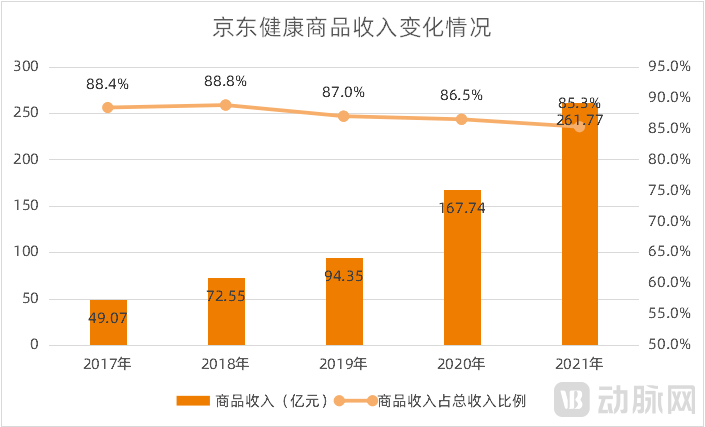
Changes in JD Health’s Product Revenue; Data Source: Annual Performance Reports and Prospectus; Chart Compiled by VCBeat
Although JD Health’s product revenue grew from the RMB 10-billion range in 2020 to the RMB 20-billion range in 2021, with the absolute increase approaching RMB 10 billion, its share of total revenue declined from 86.5% in 2020 to 85.3% in 2021. Viewed over a longer timeframe, this trend is not incidental; in recent years, the proportion of product revenue has been on a consistent downward trajectory.
Of course, given the substantial scale of pharmaceutical and health product sales, the aforementioned decline in proportion has been gradual. Nevertheless, this trend still offers valuable insights for interpreting JD Health’s business performance.
Corresponding to the declining proportion of revenue from sales of pharmaceuticals and health products, JD Health’s service revenue has continued to expand its share, with rapid growth in revenue scale.
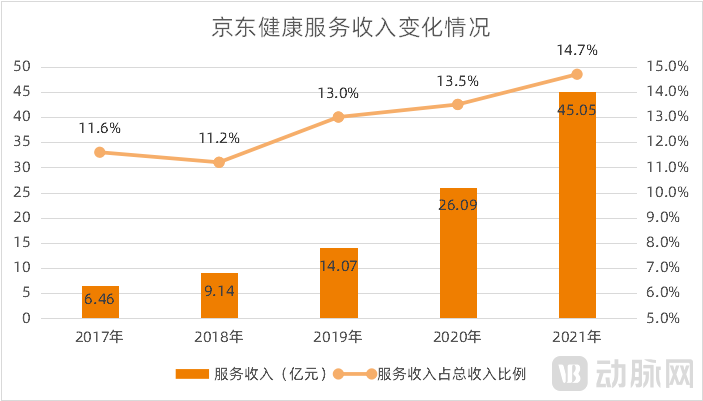
Changes in JD Health’s Service Revenue. Data source: Annual performance reports and prospectus; chart compiled by VCBeat
In 2021, JD Health’s service revenue reached RMB 4.505 billion, a year-on-year increase of 72.7%, accounting for 14.7% of its total revenue. A review of this trend reveals that the proportion of service revenue has been rising year by year in recent years.
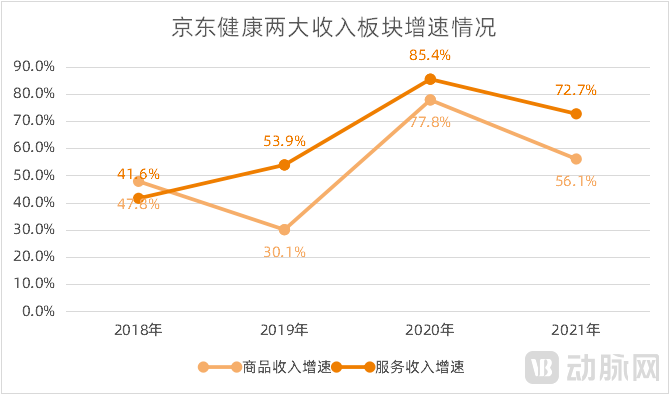
Growth Rates of JD Health’s Two Major Revenue Segments. Data Source: Annual Performance Reports and Prospectus; Chart Compiled by VCBeat
A comparison of the revenue growth rates between the two major segments also reveals that since JD Health was spun off from JD.com for independent operations in 2019, its service revenue has consistently grown at a faster rate than its product revenue.
These data all underscore the importance of service attributes within JD Health’s overall business. Leveraging the resource advantages of JD.com, JD Health naturally exhibits strong e-commerce characteristics. However, its performance reports are sending a significant signal: the proportion of revenue from pharmaceuticals and health products is declining, while service capabilities are gaining increasing emphasis and have already assumed a prominent position in overall financial performance.
For pharmaceutical and health product sales, costs will grow at a similar pace to revenue growth. In its 2021 performance report, JD Health noted that operating costs increased from RMB 14.5 billion in 2020 to RMB 23.5 billion in 2021, representing a 62.4% year-on-year increase. This was primarily driven by the increased volume of pharmaceutical and health products sold through JD Pharmacy, which is consistent with the growth of its retail pharmacy and health services business.
Services, however, are different. As a healthcare company with an internet technology DNA, JD Health can drive scalable revenue growth with limited costs, given that digital technologies constitute its primary cost base.
Therefore, overall, the gross profit margin on pharmaceutical sales is low, whereas services offer substantial growth potential, which may explain why JD Health is placing increasing emphasis on its service offerings.
In its performance reports over the past two years, JD Health has not separately disclosed the gross margin trends for its two major revenue segments. However, a set of data from its prospectus reveals the disparity: from 2017 to 2019, the gross margin for product sales remained stable at around 15%, while the gross margin for service revenue exceeded 98%. This significant gap underscores the advantage of service revenue.
It is not just JD Health; industry insiders believe that the entire pharmaceutical retail sector is exploring a transition from being a “product provider” to a “service provider.” However, JD Health’s definition of “services” is broader, serving not only end consumers but also relevant stakeholders across the healthcare industry chain.
In its 2021 performance report, JD Health also stated that it will continue to open up its “retail pharmacy + healthcare services” ecosystem capabilities, further expand cooperation with upstream and downstream partners in the industry chain, and achieve mutual growth with more partners by continuously enhancing its supply chain and healthcare service capabilities.
JD Health’s service revenue primarily consists of income generated from its online platform, digital marketing, and other services. In other words, it covers a broad scope, encompassing all business activities except for the sales of pharmaceutical and healthcare products. Specifically, what are the main drivers behind the growth in service revenue? And where do future growth opportunities lie?
Digital Marketing and Platform Commissions Drive Service Revenue Growth
According to the performance report, in 2021, the growth in JD Health's service revenue was mainly driven by two factors: an increase in digital marketing service fees and an increase in commissions and platform usage fees.
In terms of digital marketing, JD Health has expanded its network of pharmaceutical industry partners by leveraging its capabilities in building online and offline drug supply chains and configuring medical and health services.
JD Health has established strategic collaborations with multiple multinational pharmaceutical companies, becoming a key partner for them in expanding online channels and accelerating digital operations. In 2021, JD Health partnered with renowned pharmaceutical firms such as UCB China, Sanofi China, Guilin Pharmaceutical, Novartis, Gilead Sciences, and BeiGene. Beyond the aforementioned online launches of new specialty drugs, these collaborations also explored various digital marketing initiatives.
For example, JD Health launched Patient Care Centers to help pharmaceutical companies improve patient medication adherence through continuous patient management and follow-up. By the end of 2021, it had rolled out 12 Patient Care Centers covering specialties such as diabetes, hepatitis, and clinical nutrition, encompassing more than 24 diseases. JD Health has also partnered with CROs and pharmaceutical companies to establish Clinical Trial Patient Recruitment Centers, which not only facilitate patients’ search for clinical trial projects on its online platform but also accelerate and enhance the efficiency of new drug development.
Regarding platform commissions, JD Health has seen overall growth in operational data. Amid this “rising tide lifts all boats” scenario, the number of third-party merchants and their sales volumes have increased, generating higher commission revenue.
As of the end of 2021, JD Health’s annual active users reached 123 million, a net increase of 33.56 million compared to 2020. Benefiting from its large and growing base of active users, more merchants have joined JD Health; these merchants complement JD Health’s self-operated business, further enriching product categories and thereby more comprehensively meeting user purchasing needs. In 2021, JD Health also continued to upgrade its digital operating system for merchants, continuously enhancing their marketing and operational capabilities to help improve merchant performance.
As of the end of 2021, JD Health’s online platform hosted more than 18,000 third-party merchants, representing a 50% year-on-year increase in the number of merchants.
Furthermore, JD Health’s omnichannel business is expanding its service coverage and enhancing operational efficiency through various means. As a key product in its omnichannel strategy, “JD Express Medicine Delivery” meets users’ needs for purchasing medications at home via merchant self-delivery, platform delivery, and same-city delivery, thereby extending the service radius for local merchants. By the end of 2021, JD Health had partnered with 50,000 pharmacy stores, providing round-the-clock medication purchase services in more than 300 cities.
When Will Internet Medical Service Revenue Make the List?
Based on the performance structure shown in the annual report, the “other services” category within JD Health’s service revenue covers a broad scope, encompassing internet medical services, smart healthcare, and digital health services, whose revenues are not disclosed separately.
JD Health’s development in internet healthcare has consistently drawn significant attention from the industry, with the company dedicating substantial resources to this sector. In 2021, JD Health primarily strengthened its internet healthcare footprint by expanding coverage, enhancing professional expertise, and integrating products.
To provide patients with comprehensive interventions spanning prevention, treatment, and rehabilitation, JD Health primarily delivers its services through specialized medical centers. In 2021, JD Health launched nine new specialized centers, including the Infectious Diseases and Liver Disease Center, the Brain Nutrition Center, and the Skin Repair Center. By the end of 2021, the total number of specialized centers had reached 27. These centers also facilitate access to high-quality medical resources, with external physician teams covering more than 15,000 hospitals.
In terms of professionalism, JD Health established the “Internet Healthcare Expert Committee” in 2021, inviting academic leaders from 27 specialized centers and more than 30 chief and associate chief physicians from numerous Grade A tertiary hospitals across China to serve as members of the inaugural committee. Meanwhile, JD Health collaborated with experts in fields such as diabetes and psychiatry to play an in-depth role in formulating the “Chinese Expert Consensus on Remission of Type 2 Diabetes” and the “Expert Consensus on Internet Diagnosis and Treatment for Psychiatric Specialties,” thereby presenting its years of exploratory experience through more professional theoretical outcomes.
In terms of product integration, JD Health has incorporated full-scenario medical services into JD Family Doctor and expanded its penetration across various lifestyle scenarios in 2021. For instance, it launched “Phone Family Doctor” and video consultation features supporting multi-participant interactions, providing more convenient access for groups unfamiliar with or unable to easily use mobile internet devices. Smart devices equipped with JD Family Doctor services have been deployed on select high-speed rail trains, offering travelers 24/7 remote medical guidance.
As a result of a series of initiatives, the average daily volume of online consultations at JD Health Internet Hospital exceeded 190,000 in 2021.
Furthermore, JD Health has jointly established and operated internet hospitals with several Grade A tertiary hospitals, including the First Affiliated Hospital of Henan University of Chinese Medicine, Peking University Shougang Hospital, the First Affiliated Hospital of Tianjin University of Traditional Chinese Medicine, Cangzhou Central Hospital, and Taicang First People's Hospital.
Why Have No Standalone Financial Results Been Reported Despite Significant Investment in Internet Healthcare? VCBeat Believes This Is Primarily Because Internet Healthcare Serves Both as a Revenue Source and a Service Capability.
As a service capability, the revenue growth driven by internet healthcare has manifested in other dimensions. For instance, patient care centers jointly established by JD Health and large pharmaceutical companies incorporate internet healthcare services as a key component. Convenient follow-up consultations and patient monitoring efficiently assist pharmaceutical companies in patient management and driving medication “repurchases.” In this context, internet healthcare services are integrated into digital marketing strategies, with fees borne by the pharmaceutical companies. After utilizing these internet healthcare services, some patients have medication needs, and the resulting drug sales are reflected in product revenue.
As a revenue source, the service delivery of internet healthcare itself faces significant challenges: although patient adoption habits are improving rapidly, the overall penetration rate of internet healthcare among patients remains insufficient. Apart from a strong willingness to pay for access to highly sought-after specialists who are difficult to book offline, patients exhibit limited willingness to pay for consultations with general physicians (referring specifically to fees for medical services alone, excluding bundled “medical + pharmaceutical” packages). Furthermore, awareness and willingness to pay for disease management services remain weak. These issues are not isolated to any single company but represent common challenges facing the entire industry.
Therefore, if the performance data of internet healthcare is viewed from the aforementioned dimensions, it would not appear high; moreover, given that JD Health’s service revenue amounts to billions, the proportion of internet healthcare revenue within this figure would appear even smaller.
When will internet medical service revenue be reported separately in JD Health’s financial statements? Given the continuous expansion of its “retail pharmacy + healthcare services” ecosystem, improvements in the professionalism of medical services and patient experience, and the overall growth of the internet healthcare industry, that day is likely not far off.
Overall, with product revenue growing at a scale of tens of billions and high-margin service revenue maintaining strong growth momentum, JD Health’s overall operational performance is on a sound development trajectory.
On the day of the release of its 2021 performance report, JD Health also announced a plan to repurchase up to HK$3 billion worth of its shares from the open market over the next two years. The announcement indicated that the company remains confident in its current and long-term business development, has sufficient financial resources to carry out the share buyback, and will maintain a sound financial position.
Since 2021, the Hong Kong stock market has been generally sluggish. This move by JD Health not only demonstrates its sound operational and financial status but also boosts investor confidence. Following the release of its earnings report and the aforementioned announcement, JD Health’s share price surged on March 29, closing with a gain of 17.88%.
What will be the next growth drivers for JD Health as it continues to expand its various business segments? It remains to be seen.