

China's First Domestic 9-Valent HPV Vaccine Developer Reaches Market Debut — Just One Step Away from a Billion-Dollar Opportunity
“Nine-valent vaccine received, Huabei balance paid off, car and house purchased…”
In recent years, social media platforms have been flooded with similar posts “showing off” one’s ability to secure the nine-valent HPV vaccine, suggesting that its perceived importance now rivals that of owning a car or a house. Behind these witty captions lies the urgent desire among Chinese citizens to get vaccinated against HPV, as well as the predicament of “a vaccine in short supply.”
Currently, Merck is the sole manufacturer of the approved nine-valent HPV vaccine in China, with Zhifei Biological Products serving as its exclusive domestic distributor. Despite hundreds of millions of women being eligible for vaccination, the annual batch release volume amounts to only a few million doses, resulting in a severe supply shortage. This scarcity extends beyond the nine-valent vaccine; both the bivalent and quadrivalent HPV vaccines are also in short supply. According to data from the International Papillomavirus Society and the Chinese Cancer Foundation, the full-course HPV vaccination rate among the Chinese population remained below 1% by the end of 2020.
Faced with the scarcity of the 9-valent HPV vaccine, some resort to lottery systems, while others travel to Hong Kong and Macau solely for vaccination... The 9-valent HPV vaccine, already “prized for its rarity,” has become even more elusive behind multiple layers of barriers.
Today, Recbio, the first domestically produced nine-valent HPV vaccine stock, officially listed on the Hong Kong Stock Exchange. Its share price remained stable after opening, gaining a foothold in the volatile Hong Kong stock market.
Domestic HPVNine-valentHow Far Away Are Vaccines? A Look at China’s “HPV9-valentCurrent R&D Progress of RecBio, the “First Vaccine Stock”
3-Year Loss of 800 Million:
The Vaccine Industry: “Small but Beautiful,” with a “Fast and Fierce” Cash Burn Rate
Despite substantial financing funds in the pre-IPO stage and significant capital raised after its public listing, Jiangsu Ruike Biotech Co., Ltd.’s cash burn rate has kept pace with its fundraising progress.
Prior to its initial public offering, Jiangsu Ruike Biotech Co., Ltd. completed four rounds of financing over the past three years, raising a total of more than RMB 2 billion. The investors included prominent firms such as Legend Capital, Temasek, Sequoia Capital China, Oriental Fortune Capital, Clearpool Capital, CMB International, and Prime Capital.
Following the listing, Recombinant Biotech expects to allocate nearly half of the funds raised (approximately 47.3%, equivalent to HK$318 million) to further optimize, develop, and commercialize its HPV vaccine pipeline, particularly its core product, the recombinant 9-valent HPV vaccine REC603.
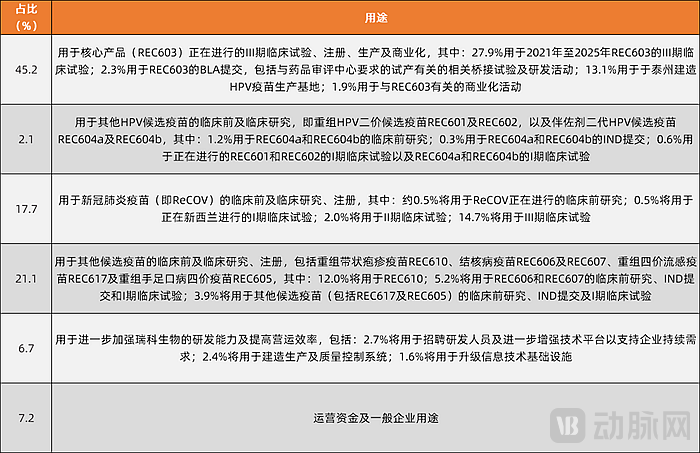
Use of Proceeds from This Fundraising, Compiled Based on Prospectus Information
According to the prospectus, the losses for 2019, 2020, and the nine months ended September 30, 2021, were RMB 138 million, RMB 179 million, and RMB 520 million, respectively. Among these, Recombinant Biotech’s R&D expenses amounted to RMB 63.3 million, RMB 130.5 million, and RMB 371.8 million, respectively.
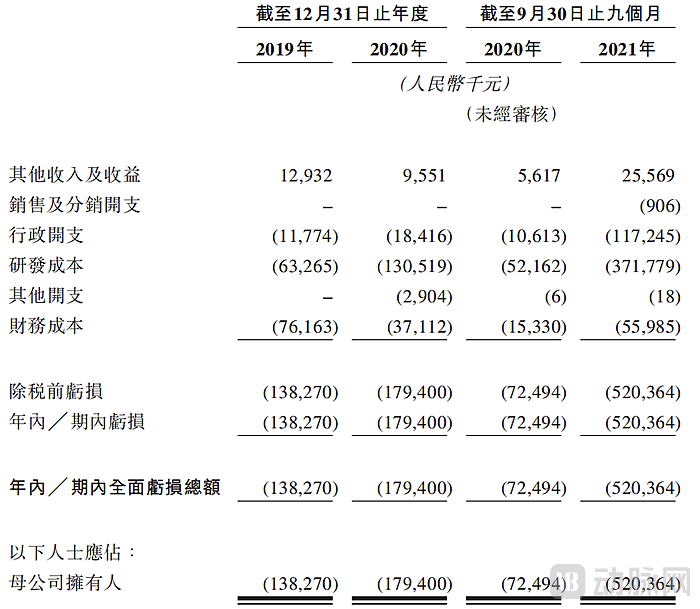
Revenue Data of Jiangsu Ruike Biotech During the Reporting Period, Source: Prospectus
The rapid increase in R&D costs is directly proportional to Recomb Biologics’ expanding product pipeline, including clinical trial expenses, pre-IND expenditures, and costs for raw materials and consumables. It is foreseeable that as Recomb Biologics continues to advance candidate vaccines into additional or late-stage clinical trials, its R&D costs will rise substantially.
"Iron Triangle" Technology Platform and "IPD" System,
Breaking Down Barriers Across the Entire Vaccine Development Process
Compared to the high R&D and production barriers in the biopharmaceutical industry, vaccine development and manufacturing also face significant industry barriers characterized by high thresholds and substantial challenges.
Generally, vaccines can be categorized into whole-pathogen vaccines (traditional vaccines) and subunit vaccines. Subunit vaccines primarily include recombinant protein vaccines, viral vector vaccines, and nucleic acid vaccines. According to a report by Frost & Sullivan, subunit vaccines accounted for approximately 55.4% of China’s vaccine market in 2020, and this proportion is projected to further increase to 86.6% by 2030. Driven by continuous technological advancements and breakthroughs, China’s vaccine market is expected to grow from RMB 75.3 billion in 2020 to RMB 333.3 billion in 2030, representing a compound annual growth rate (CAGR) of 16.0%.
Among all subunit vaccines, recombinant protein vaccines are among the most effective, safest, and relatively affordable options. Currently, recombinant protein vaccines have been applied in several disease areas, including hepatitis B, cervical cancer, and herpes zoster.However, the immune response elicited by this type of vaccine may be lower than that induced by inactivated vaccines, live attenuated vaccines, or toxoid vaccines; therefore, adjuvants are often required to induce a robust protective immune response.
Adjuvants are substances used to assist antigen responses and stimulate or suppress immune responses. The primary functions of adjuvants include enhancing vaccine immunogenicity, modulating the nature of immune responses, and reducing the amount of antigen required as well as the number of injections needed for immunization. As they are designed for use in healthy populations, adjuvants require advanced manufacturing technologies and more stringent regulatory standards.
The manufacturing processes involved in novel adjuvants are complex, and the quality control standards are extremely high; only a few companies are capable of achieving this.Historically, only aluminum adjuvants have been widely used in vaccine development, while other novel adjuvant technologies remain dispersed across various companies. To date, only five novel adjuvants—AS01, AS03, AS04, CpG 1018, and MF59—have been employed in FDA-approved vaccines, with their respective components having been in the public domain for over 20 years.
Most vaccine companies lack the commercial-scale manufacturing capacity for adjuvants and must rely on a limited number of qualified suppliers to procure approved adjuvants, which favors the expansion of vaccine companies with in-house adjuvant production capabilities.
Accordingly, Recombio has developed a novel adjuvant platform, becoming one of the few companies capable of developing adjuvants that benchmark against all such FDA-approved counterparts. As a result, Recombio is not dependent on any specific adjuvant supplier. Leveraging this platform, Recombio is also able to discover and apply novel adjuvants in next-generation vaccine candidates.
In addition, Jiangsu Ruike Biotech Co., Ltd. has also developed a protein engineering platform and an immunogenicity evaluation platform.
Protein engineering platforms can provide antigen optimization solutions for the development of subunit vaccines based on interdisciplinary research.Determining the structural basis of antigenicity, understanding immune protection mechanisms, and guiding rational immunogen design are key steps in vaccine development. This platform enables Jiangsu Ruike Biotech Co., Ltd. to rapidly target and produce pathogen-derived antigens. Furthermore, the company’s protein engineering platform can elicit immune responses across different expression systems. Through this diverse range of expression systems, Jiangsu Ruike Biotech Co., Ltd. is able to select and apply the most suitable expression system for vaccine development.
To elucidate the immune protection mechanisms against emerging and re-emerging infectious diseases, immune evaluation is a critical step in the discovery and development of subunit vaccines. ThroughImmune Evaluation Platform, Recombinant Biotech can select the optimal antigen and adjuvant combinations, thereby enhancing the immunogenicity of candidate vaccines. As early as 2004, the core team of Recombinant Biotech began establishing an immunological evaluation platform, becoming one of the earliest teams in China to possess such a capability. Through this platform, Recombinant Biotech has become one of the first companies in China capable of conducting pseudovirus neutralization assays, ELISPOT, and intracellular cytokine staining (ICS) tests.
Through its “iron triangle” technology platform, Jiangsu Ruike Biotech Co., Ltd. has achieved synergies in antigen design and optimization, adjuvant development and manufacturing, and the determination of optimal antigen-adjuvant combinations. This approach has addressed core challenges in vaccine research and development as well as industrialization, thereby establishing a robust technological barrier for the company.
In addition to three independent yet synergistic technology platforms, Recombinant Biotech has established a comprehensive Integrated Product Development (“IPD”) system., covering the entire lifecycle of vaccines from the R&D stage to commercialization, to efficiently manage the operational system. Based on this, Jiangsu Ruike Biotech Co., Ltd. has established an Integrated Product Management Team within its senior management team. This team is responsible for formulating the company’s short-term and long-term R&D goals, prioritizing different R&D projects and allocating resources, and making key judgments during the R&D process. Leveraging the “IPD” system, Jiangsu Ruike Biotech Co., Ltd. is able to advance the preclinical development of multiple vaccine projects and effectively conduct multiple clinical trials simultaneously.
By integrating the “IPD” system with the “Iron Triangle” technology platform, Jiangsu Ruike Biotech Co., Ltd. has not only overcome technical barriers in vaccine development but also achieved the efficient concurrent advancement of multiple pipeline projects, thereby accelerating product commercialization with maximum efficiency.
Comprehensive portfolio of 12 vaccine products,
Core product is poised to become one of the first domestically approved nine-valent HPV vaccines in China
Leveraging its technological platforms and systems, Jiangsu Ruike Biotech Co., Ltd. has established a pipeline of 12 candidate vaccines covering a broad spectrum of diseases, including cervical cancer, COVID-19, adult tuberculosis, herpes zoster, hand-foot-and-mouth disease, and influenza. The diseases targeted by its products include five of the top ten most burdensome diseases listed in the World Health Organization’s Global Burden of Disease report, as well as three of the disease areas covered by the top five best-selling vaccine products globally in 2020.
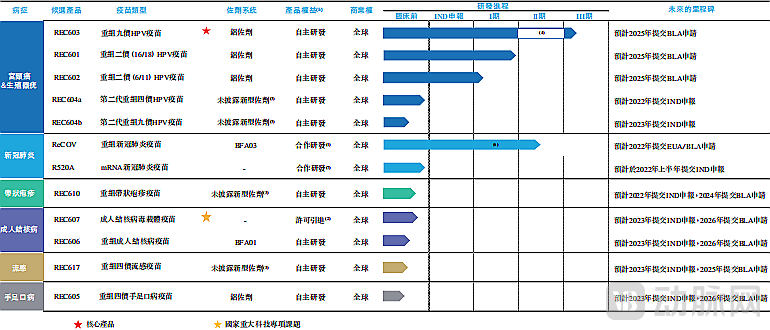
Product Pipeline, Source: Prospectus
Among these, the vaccine segment that Jiangsu Ruike Biotech Co., Ltd. has strategically prioritized is HPV vaccines. However, HPV vaccination has already been “widespread” in China for four to five years. Currently, Recbio’s most advanced HPV vaccine candidate is still in Phase III clinical trials, and its market launch is expected to take some additional time.Once the three-dose regimen is completed and effective antibodies are generated, the HPV vaccine can provide protection for over ten years. Should we be concerned about the future market sales volume of HPV vaccines?
The answer is no. In the coming years, China will continue to face a substantial supply gap for HPV vaccines. According to data from Frost & Sullivan, the full-course vaccination rate for HPV vaccines in China was less than 1% by the end of 2020. It is projected that by 2025, there will still be 234 million women aged 9 to 45 in China who have not received the HPV vaccine. Assuming a three-dose regimen per person, an additional 702 million doses would be required beyond the existing production capacity.
Perhaps it was the glimpse of this huge unmet market that led domestic vaccine companies to flock to the HPV track. However, there are currently very few domestically produced HPV vaccines that have been officially approved for marketing. Has the race for domestically produced HPV vaccines already become “overcrowded before approval”?
Currently, there are three main types of commercially available HPV vaccines worldwide: the bivalent, quadrivalent, and nonavalent HPV vaccines. In December 2014, the U.S. FDA approved the first nonavalent HPV vaccine, which targets HPV types 6, 11, 16, 18, 31, 33, 45, 52, and 58. The nonavalent HPV vaccine generally provides comprehensive protection, preventing approximately 90% of cervical cancer cases, and is widely regarded as the most effective HPV vaccine.
There are five HPV vaccines currently on the market in China: Wantai BioPharm’s bivalent HPV vaccine, Zerun Biotechnology’s bivalent HPV vaccine, GSK’s bivalent HPV vaccine, and Merck’s quadrivalent and nonavalent HPV vaccines. Since the approval of China’s first HPV vaccine in 2017, the market has continued to expand. In 2020, the HPV vaccine market reached RMB 13.5 billion, and is projected to reach RMB 69 billion by 2030, with a compound annual growth rate (CAGR) of 17.7%.
Among these, the only approved 9-valent HPV vaccine accounted for more than 48.5% of the total HPV vaccine market share in 2020. The 9-valent HPV vaccine is expected to hold the largest market share within the HPV vaccine market by 2030. In addition, the 2-valent HPV vaccine market is also projected to grow rapidly, as the 2-valent HPV vaccine is more affordable and accessible to populations in lower-tier markets with limited purchasing power.
In the face of this rapidly expanding market, China currently has 17 HPV vaccines undergoing clinical trials. Among the companies developing nine-valent HPV vaccines, in addition to Jiangsu Ruike Biotech Co., Ltd. (Reco Biotech), are Bowei Biologics, Kangtai Biological Products, Wantai BioPharm, and Zerun Biologics. Except for Zerun Biologics’ related pipeline, which is in Phase I clinical trials, all other pipelines are in Phase III clinical trials. Reco Biotech’s core product, REC603 (recombinant nine-valent HPV vaccine), is expected to become one of the first nine-valent HPV vaccines approved in China.
According to the disclosure in Jiangsu Ruike Biotech Co., Ltd.’s prospectus, the Phase III clinical trial of REC603 completed the enrollment of 12,500 subjects in October 2021, and the three-dose regimen is scheduled to be completed in the first half of 2022. However, due to the extended duration of clinical studies for vaccine products, the primary endpoint of this clinical trial will not be reached until 2025. This also implies that the earliest possible timeline for the commercialization of REC603 would be 2026.
Moreover, due to the conduct of large-scale Phase III clinical trials,Ruike Biotech’s R&D investment is expected to rise significantly in 2022, with substantial clinical trial expenditures maintained over the coming years. In the short term, Ruike Biotech remains unable to escape its “cash-burning” status.
In addition to the rapid advancement of its HPV pipeline, Jiangsu Ruike Biotech Co., Ltd. is also accelerating its COVID-19 vaccine pipeline.
Currently, 32 vaccines have been approved worldwide (including 11 recombinant protein vaccines), and 179 COVID-19 vaccine candidates are in clinical development (including 61 recombinant protein vaccines). Among the vaccines under development, more than 100 utilize diverse mechanisms.
According to public information, among all recombinant protein COVID-19 vaccines currently in commercialization or clinical trials, Recovax by Jiangsu Ruike Biotech Co., Ltd. is the only vaccine featuring a precise combination of NTD and RBD as immunogens.Although ReCOV has a novel mechanism of action, given the complex and crowded landscape of COVID-19 vaccines on the market, more pragmatic considerations include whether it can be manufactured cost-effectively while ensuring safety and efficacy, whether it is stable and easy to transport, and whether its costs are controllable.
In terms of production capacityReCOV utilizes CHO cells, ensuring high scalability and superior quality in production. Currently, Recombinant Biologics’ GMP-compliant manufacturing facility supports an initial annual vaccine production capacity of 100 million doses, with the potential to expand to 300 million doses per year in the future.
In terms of stabilityAs a lyophilized formulation, ReCOV remains stable for at least three months at room temperature and is expected to remain stable for at least 24 months under standard cold-chain conditions. This robust stability makes ReCOV suitable for large-scale vaccination campaigns in developing countries and regions with hot climates and limited cold-chain logistics and infrastructure.
In terms of costThe high yield per unit of fermentation and scalability give ReCOV a cost advantage, enabling its global promotion. Furthermore, Recombinant Biotech employs a proprietary novel adjuvant in ReCOV, allowing for scalability without reliance on any external adjuvant suppliers.
During the Phase II/III clinical trials in the Philippines, Jiangsu Ruike Biotech Co., Ltd. stated that ReCOV demonstrated robust cross-neutralizing activity against multiple Variants of Concern (VOCs), including Omicron and Delta. However, no specific data have been disclosed to date.
If ReCOV indeed demonstrates superior efficacy in preventing Omicron variants, given the severe situation of the new wave of the epidemic in China, ReCOV still has a significant opportunity to secure a place in the market in the future.
In addition to the HPV and COVID-19 vaccines, which have gained significant popularity in recent years, Jiangsu Ruike Biotech Co., Ltd. has also established a product pipeline that includes vaccines for herpes zoster, tuberculosis, influenza, and hand, foot, and mouth disease.
1) Recombinant zoster vaccine:
In the REC610 (a recombinant zoster vaccine) pipeline, Jiangsu Ruike Biotech Co., Ltd. has developed a corresponding adjuvant system to enhance immunogenicity. Furthermore, the company plans to apply its specialized production technologies for COVID-19 vaccines to REC610, achieving synergistic manufacturing during the commercialization phase. Currently, REC610 is in the preclinical research and development stage, with an Investigational New Drug (IND) application scheduled for submission to the National Medical Products Administration in 2022.
2) Recombinant adult tuberculosis vaccine:
REC607 is a viral vector-based candidate vaccine for adult tuberculosis. Through a technology transfer agreement with the Shanghai Public Health Clinical Center, Jiangsu Ruike Biotech Co., Ltd. has acquired the proprietary technologies and patents granting it exclusive global development rights. The project was designated as a National Science and Technology Major Project in 2018. Currently, REC607 is in the preclinical development stage, with plans to submit an Investigational New Drug (IND) application to the National Medical Products Administration (NMPA) in 2023 and a Biologics License Application (BLA) in 2026.
3) Recombinant Quadrivalent Influenza Vaccine:
REC617 is an early-stage recombinant quadrivalent influenza vaccine. Jiangsu Ruike Biotech Co., Ltd. is developing novel adjuvants to enhance its tolerability, immunogenicity, duration of protection, and cross-protective efficacy. The company plans to submit an Investigational New Drug (IND) application for REC617 to the National Medical Products Administration (NMPA) in the first half of 2023, and to submit a Biologics License Application (BLA) to the NMPA in 2025.
4) Multivalent Hand, Foot, and Mouth Disease Vaccine:
Leveraging protein engineering technology, Jiangsu Ruike Biotech Co., Ltd. has developed a multivalent hand, foot, and mouth disease vaccine (REC605). REC605 offers broader serotype coverage against EV71, CA16, CA10, and CA6, as well as enhanced protective efficacy. The company plans to submit an Investigational New Drug (IND) application for REC605 to the National Medical Products Administration (NMPA) in 2023, and a Biologics License Application (BLA) in 2026.
Overall, although Jiangsu Ruike Biotech Co., Ltd. has demonstrated outstanding performance with its nine-valent HPV vaccine candidate REC603, the product closest to commercialization is actually its COVID-19 vaccine, ReCOV, given the prolonged clinical development timeline of REC603. Over the next three to five years, the company will continue to maintain high levels of R&D investment; therefore, the rational allocation of capital to priority pipeline candidates will be key to its near-term development.
Back to the opening question: domestically produced HPV vaccinesNine-valentHow Far Away Are Vaccines, Really?
From a market perspective, the global vaccine market size increased from USD 27.5 billion in 2016 to USD 39.9 billion in 2020, accounting for 3.1% of the total global pharmaceutical market, with a compound annual growth rate (CAGR) of 9.7%. Driven by emerging subunit vaccines and market growth in developing countries, the global vaccine market is projected to reach USD 129.2 billion by 2030, at a CAGR of 12.5%.
In 2020, China was the second-largest vaccine market globally, accounting for more than one-fifth of the global market. Driven by increased accessibility of subunit vaccines, favorable policies, technological innovations in vaccines, and heightened public awareness of vaccination, the output value of China’s vaccine market grew from RMB 27.1 billion in 2016 to RMB 75.3 billion in 2020, representing a compound annual growth rate (CAGR) of 29.1%. It is projected to reach RMB 333.3 billion by 2030, with a CAGR of 16.0%.
The intense and substantial market demand has naturally fueled endless enthusiasm among capital investors and enterprises. Through Recombinant Biotech, we can observe its extensively diversified pipeline layout. The company’s step-by-step, methodical, and comprehensive advancement of its pipeline also signals a future ripe with abundant successes.
Domestically Produced HPVNine-valentHow Far Are We from a Vaccine? Just the Last Mile.