

Westlake University's Dr. Tao Liang Reveals TFPI as the Intestinal Receptor for Hypervirulent C. difficile Toxin B, Pioneering a New Paradigm for Diagnosis, Treatment, and Research of CDI
On March 17, 2022 (Beijing Time), the team led by Tao Liang from the School of Life Sciences at Westlake University, in collaboration with the team led by Shi Yigong, published their latest research findings in Cell under the title “TFPI is a colonic crypt receptor for TcdB from hypervirulent clade 2 C. difficile.”

Paper Screenshot
Studies have identified tissue factor pathway inhibitor (TFPI) as the host receptor for toxin B from hypervirulent strains of Clostridioides difficile that is associated with pathogenesis.This study provides scientific theoretical support for understanding the pathogenic mechanisms of hypervirulent Clostridioides difficile infections, as well as the evolution and mode of action of clostridial large toxins. Meanwhile, it offers an important theoretical basis for the prevention of such infectious diseases and the discovery of novel therapeutic approaches, thereby indirectly advancing the fields of toxicology, pathology, and epidemiology.
*Clostridioides difficile*, a Gram-positive anaerobic spore-forming bacterium ubiquitous in the human environment, is one of the major pathogens responsible for nosocomial intestinal infections, particularly diseases such as pseudomembranous colitis. According to incomplete statistics, *C. difficile* accounts for approximately 15%–25% of antibiotic-associated diarrhea cases, 50%–75% of antibiotic-associated colitis cases, and 95%–100% of pseudomembranous colitis cases. However, awareness of *C. difficile* infection remains insufficient across various sectors in China.
Dr. Tao Liang has been researching how Clostridioides difficile invades the human body and causes disease since 2013. After nine years, he achieved another major breakthrough by identifying the host receptor associated with the pathogenesis of toxin B from hypervirulent strains of Clostridioides difficile. Therefore,How did Tao Liang’s team identify the breakthrough point regarding receptors associated with pathogenesis? How did they gradually overcome thorny issues in scientific research? How do they balance the relationship between basic research and translational outcomes? What key considerations are involved in translating a scientific achievement into practical applications?
On this occasion, VCBeat’s Orange Fruit Bureau held a dialogue with Professor Tao Liang from the School of Life Sciences at Westlake University. Professor Tao shared numerous valuable insights related to scientific research and the translation of research findings into practical applications. We have compiled and summarized his extensive experience and perspectives in an effort to address the aforementioned questions.
Below, Enjoy:
How to Identify Therapeutic Targets Among Pathogenesis-Related Receptors?
Clostridioides difficile is the primary cause of healthcare-associated intestinal infections. In the United States, there are approximately 500,000 cases and 15,000 deaths annually. Attention to and demand for interventions targeting Clostridioides difficile are relatively high in Europe and the United States.
My original research focus was on the interactions between pathogenic bacteria and their hosts. When I conducted research at Harvard Medical School from 2013, our laboratory’s primary research emphasis was on bacterial toxins. Clostridioides difficile is a pathogen that relies mainly on bacterial toxins as its key virulence factor. Influenced by multiple factors, I chose C. difficile as a major subject for in-depth investigation, and I have now been pursuing this line of research for nine years. Therefore, prior to undertaking this study, I had already accumulated preliminary knowledge and experience, driven by societal needs.
From the perspective of the research itself,Receptors are the decisive factors determining whether host tissues, organs, and cells are susceptible to a specific pathogen, and they often determine the differences in pathological manifestations. Therefore, identifying the host receptors for pathogens is key to understanding the pathogenic mechanisms of infectious diseases. In the case of Clostridioides difficile infection, since its pathogenicity depends on the toxin TcdB, identifying the host receptor for TcdB is crucial to understanding the mechanism of C. difficile infection.
*Clostridioides difficile* has five major phylogenetic clades, including types I, II, III, IV, and V. Among these, clade II is referred to as the hypervirulent clade due to its high pathogenicity. TcdB is the primary virulence factor of *C. difficile*. Strains of clade II specifically express two TcdB variants (TcdB2 and TcdB4), which utilize receptors distinct from those used by classical TcdB. We performed a CRISPR/Cas9 screen for TcdB4 and identified tissue factor pathway inhibitor (TFPI) as its receptor. Furthermore, we determined the structure of the TcdB4–TFPI complex using cryo-electron microscopy, thereby defining the common receptor-binding region of TcdB.
TcdB variants are classified into two categories: one that recognizes Frizzled (FZD) and another that recognizes TFPI. TFPI is highly expressed in intestinal crypts, and recombinant TFPI protects colonic epithelium from TcdB2/4-induced damage. These findings establish TFPI as the colonic crypt receptor for TcdB of clade 2 Clostridioides difficile and reveal a novel pathogenic mechanism of C. difficile infection.
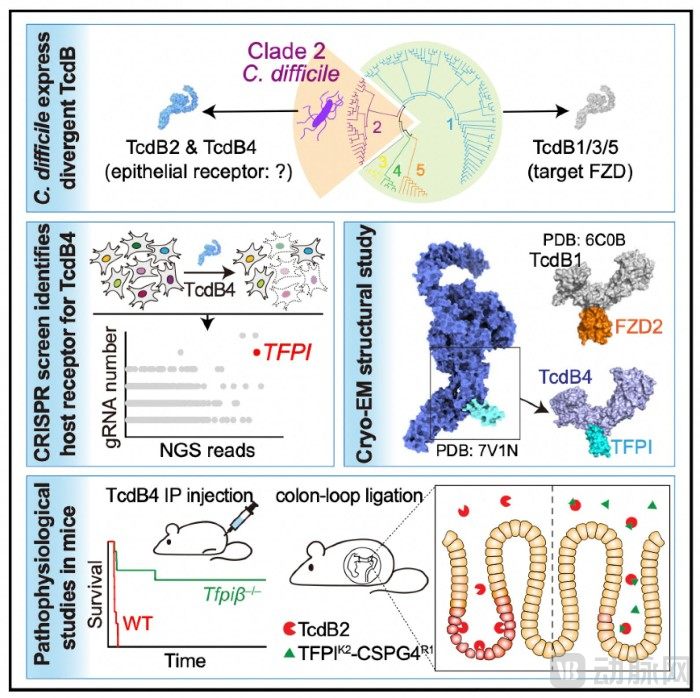
Image Illustration
How to Tackle Thorny Problems in Scientific Research Step by Step?
Certainly, every scientific research project has its challenges, but for me, the most difficult part is not knowing where the solution to the problem lies.
In the early stages of a project, the most challenging phase is convincing yourself to pursue this research direction and believing that it can be successfully tackled. By the middle to late stages, as you gradually gain clarity on the direction and identify solutions, the difficulty significantly diminishes. All you need is to maintain unwavering belief in your ability to solve the problem and strive with all your might to achieve your goal. While there are diverse strategic approaches, having faith and perseverance is paramount.
Therefore, it is essential to first adopt the right mindset.. Be prepared to conduct extensive tentative and exploratory work in the early stages of research. Because making errors is a very normal part of the scientific research process, trial and error is inevitable; scientific research is the process of finding the correct answer through countless attempts.
Second, flexibly and correctly select research methods.We will integrate various cutting-edge scientific research methods with our practical realities to iteratively refine our strategies, rather than rigidly adhering to a single approach regardless of its viability.
Finally, actively explore new things and technologies while emphasizing interdisciplinary research.Our research team comprises researchers and experts from disciplines such as bioinformatics, cellular and molecular biology, animal studies, and pathology. Each member brings unique strengths, fostering the generation of diverse ideas and facilitating mutual learning. In the future, we aim to broaden our team’s expertise to cover additional fields, including biopharmaceuticals and artificial intelligence.
How to Balance the Relationship Between Basic Research and Technology Transfer?
Clostridioides difficile-associated diarrhea (CDAD) is a disease characterized by a prolonged course and a high tendency for recurrence. Inappropriate treatment can lead to life-threatening complications such as toxic megacolon and sepsis. Currently, the Chinese guidelines for CDAD recommend metronidazole, vancomycin, and fecal microbiota transplantation as treatment strategies. Research into the pathogenic mechanisms of Clostridioides difficile can, to some extent, drive advances in epidemiology, toxicology, and pathology. For the industry, having basic research as a foundation enables more targeted exploration of therapeutic approaches for diseases caused by Clostridioides difficile.
For example, by studying the receptor for TcdB (the major virulence factor of Clostridioides difficile) and its binding mechanism, we can design various therapeutics targeting the binding site and interface, including antibodies, vaccines, and immune molecules.This is a highly targeted, clear, and purposeful process for designing disease treatment methods.
Furthermore, from a clinical perspective, the detection of any pathogen is not directed at an individual but rather at a population.Only by understanding the population distribution and spatiotemporal factors of pathogenic bacteria, and accurately identifying the causative agents, can we precisely detect and classify these pathogens and provide targeted treatment for patients. This approach will facilitate the detection and diagnosis of microbial diseases.
For example, there are eight subtypes of toxin B produced by *Clostridioides difficile*, and the clinical manifestations induced by different toxin subtypes vary. Some subtypes trigger more severe inflammation, while others lead to diarrhea or edema. In our article published in *Cell*, we focused on the human invasion pathways of toxin B subtypes 2 and 4. Supported by this research, clinical testing can achieve more precise disease detection. Moving forward, we will build on these findings to develop diagnostic methods targeting the pathogenic factors of different subtypes and explore additional translational projects.
Therefore, returning to the question at hand, I believe that basic research is the cornerstone of scientific and technological translation. Both achievement translation and clinical treatment are based on the theoretical foundation of basic research.The outward extension of basic research encompasses various translational projects, including clinical treatment modalities and preventive screening measures.
From Scientific Breakthrough to Commercialization: Key Considerations
Market translation tends to prioritize the ability to solve immediate, practical problems, whereas basic research often involves sustained exploration into the fundamental nature of issues. In some projects, there is a close link between basic research and commercialization; such projects are generally considered more likely to yield translational applications. While other research initiatives may require a longer timeframe to achieve translational outcomes, this does not diminish their importance, as basic research itself holds immense intrinsic value.
Therefore, I believe that we should first adopt a dialectical perspective on the gap between basic research and translational outcomes, tailored to different research projects, rather than applying a one-size-fits-all approach.
Furthermore, issues such as the rush to address individual problems, excessive hype around certain projects, and the rejection of time-consuming yet innovative initiatives warrant attention in bridging scientific research innovation with technology transfer, as these trends can lead to a certain degree of waste in market resources.
Scientific research should be grounded in logical reasoning and approached with a more rational attitude, rather than being pursued blindly or viewed through an emotional or passionate lens. This approach can help avoid or mitigate such issues to some extent. From the current perspective, I believe that China’s market is gradually maturing.