

Saluda Medical Celebrates Dual Milestones: World’s First Closed-Loop SCS System Evoke® Receives FDA Approval and Company Secures $125 Million in New Funding

Saluda Medical
Developer of Chronic Pain Treatment Devices
Recently, Saluda Medical, an Australian medical device company, announced that its Evoke® Spinal Cord Stimulation (SCS) System for the treatment of chronic pain has received approval from the U.S. Food and Drug Administration (FDA) and will be fully launched in 2023.This is the world’s first closed-loop spinal cord stimulation system controlled by ECAP (Evoked Compound Action Potential).
Saluda Medical is a company developing neuromodulation medical devices. Founded in 2013, it originated from the Implant Systems team established by John Parker at Data61, part of Australia’s Commonwealth Scientific and Industrial Research Organisation (CSIRO), in 2009.
The implant system team developed closed-loop neural feedback technology, which was patented by Saluda Medical in 2014.
Specialization Matters: In Addition to a Top-Tier Technical Team, Saluda Medical Boasts a Seasoned Management Team.Jim Schuermann, the current President and Chief Executive Officer, is a top-tier marketing executive with an MBA from Golden Gate University. He joined Saluda Medical in 2020, having previously served as Chief Business Officer at Avedro, where he led the company’s initial public offering prior to its acquisition by Glaukos in 2019.
Today, Saluda Medical has a leadership team of 11 members,With the exception of founder John Parker, Chief Technology Officer Peter Single, and Vice President Dean Karantonis, who were original members of the Data61 implant system team, the other eight executives held positions at different companies prior to joining Saluda Medical, yet each possesses decades of experience in managing medical device companies.
Traditional SCS devices provide effective analgesia without medication, but have limitations
Chronic pain is defined as pain that persists for three months or longer. It is more difficult to treat than acute pain, and some have likened it to an "undying cancer." There are over 540 million people suffering from chronic pain worldwide, with more than 100 million affected in China alone.
Pharmacological analgesia remains the mainstream approach to pain management, but it is associated with adverse effects., for example, opioids are highly addictive, while non-steroidal anti-inflammatory drugs (NSAIDs) can cause gastrointestinal damage and hepatic dysfunction. Due to these adverse effects, 43%–79% of patients seeking medical care are dissatisfied with current pain management options.
Spinal Cord Stimulation (SCS) technology originated from the gate control theory proposed by Melzack and colleagues in 1965. This theory posits that certain cells in the spinal cord act like gates, blocking pain signals from reaching the brain, thereby preventing the perception of pain. Melzack also proposed that electrical stimulation is a significant method for pain inhibition.
Following the proposal of the gate control theory, spinal cord stimulation (SCS) technology rapidly advanced and entered clinical practice, helping a significant proportion of patients with chronic pain to avoid the burden of long-term analgesic use.
Currently, the vast majority of spinal cord stimulation (SCS) technologies on the market utilize open-loop SCS systems, in which electrical stimulation parameters (such as frequency, pulse width, and amplitude) are set by the surgeon at the time of implantation, requiring patients to return to the hospital for adjustments every 3 to 12 months.
Although this technology has undergone decades of development, it still has limitations:
First, the distance between the stimulation electrode and the nerve varies with respiration and heartbeat, whereas the electric field intensity generated by open-loop spinal cord stimulation (SCS) electrodes cannot adjust in response to such distance changes.
Secondly, the therapeutic efficacy of open-loop SCS is highly dependent on physician expertise and patient follow-up.
Finally, open-loop SCS still has some unscientific issues with stimulator power management. For example, in 2014, Medtronic voluntarily recalled a batch of neurostimulators due to power-related problems.
These issues have led to approximately 30%–50% of chronic pain patients in clinical practice reporting suboptimal outcomes with spinal cord stimulation (SCS) therapy. To address this situation, numerous medical device companies have begun exploring the clinical application of closed-loop SCS technology, among which Saluda Medical is a notable example.
Saluda Medical Launches World’s First Closed-Loop SCS Device
A Decade in the Making: Saluda Medical’s Sole Product, the Evoke System, Utilizes Closed-Loop Spinal Cord Stimulation (SCS) Technology to Treat Chronic, Refractory Pain in the Trunk or Limbs.
Like traditional open-loop SCS devices,Evoke is also a small implantable device that delivers mild electrical currents to the nerves, blocking pain signals from reaching the brain.
What differs is that,The Evoke System is the first closed-loop spinal cord stimulation (SCS) system capable of sensing neural responses to stimulation. By recording each patient’s unique response to stimulation, the system automatically adjusts stimulation intensity within microseconds based on feedback, making over 100 adjustments per second to ensure optimal electrical stimulation.。
What constitutes the optimal range of electrical stimulation may vary from patient to patient; therefore, during the initial trial, patients can try different stimulation ranges under medical supervision.
Since 2018, Saluda Medical has secured multiple patents, including novel methods for estimating the distance between nerves and electrodes, as well as automated approaches for controlling neural stimulation. These breakthrough technologies form the foundation of Saluda Medical’s development.
Earlier this year, Saluda Medical received the Australian Frontier Research Award in recognition of its medical innovations in neuromodulation.
Clinical Results: 89.5% Effective Pain Relief, Evoke Approved for Market Launch
As the world’s first closed-loop SCS device controlled by ECAP, it was not easy for the Evoke System to obtain FDA clearance.
Saluda Medical stated that it achieved a breakthrough in 2014 with a new technology for measuring evoked compound action potential (ECAP) fluctuations induced by physiological activity, and developed the first fully implantable closed-loop spinal cord stimulation (CL-SCS) system in 2015.
In late 2015, Saluda Medical initiated the Avalon clinical study. The Avalon study was a prospective, multicenter, single-arm study that, over a two-year period, demonstrated the significant efficacy of ECAP-controlled open-loop SCS technology in providing long-term pain relief for patients.
March 2019—Three years before receiving FDA clearance, Saluda Medical announced that it had obtained the CE mark, commercially launched the Evoke System in Europe and performed the first commercial implantation of Evoke in the Netherlands.
Dr. Harold Nijhuis from the Netherlands, who performed this procedure, stated, “I have been closely following this product since before its market launch. It is gratifying to see the introduction of a closed-loop spinal cord stimulation (SCS) device capable of automatically measuring the spinal cord’s response to stimulation, which will significantly improve the lives of patients with chronic pain.”
In January 2022, Saluda Medical published the long-term results of its double-blind, Class I EVOKE randomized controlled trial (RCT) in JAMA Neurology, a study that pioneered several firsts in the field of spinal cord stimulation.
The EVOKE study was the first double-blind, randomized controlled trial in the field of spinal cord stimulation to support a PMA (Pre-Market Approval); it was the first trial in this field to conduct follow-up for up to 36 months; and it was the first to systematically evaluate the difference in efficacy between ECAP-controlled closed-loop SCS and open-loop SCS.
The study screened a total of 134 patients with chronic, refractory back and leg pain, who were equally divided into two groups to receive either open-loop SCS or the Evoke System.
Double-blind trials show:
Evoke System Provides Better Pain Relief
Evoke Demonstrated Superior Analgesic Efficacy Compared with Open-Loop SCS in the First Year at Equivalent Analgesic Dosages
89.5% of Evoke patients experienced significant pain relief, which was statistically superior to open-loop SCS
Evoke delivers optimal neural stimulation intensity to patients for two years, whereas open-loop SCS devices become largely ineffective after one year.
The Evoke System Delivers a Higher Quality of Life
70.9% of Evoke Patients Achieved Clinically Significant Mood Improvement
Over 50% of Evoke patients proactively reduce or even discontinue opioid use
76.4% of Evoke Patients Experienced Improved Sleep
85.5% of Evoke Patients Experienced Improved Health-Related Quality of Life
Not only that,Evoke patients no longer needed to return for follow-up visits to adjust device parameters after nearly one year., significantly reducing the workload for both doctors and patients.
“Spinal cord stimulation has historically relied on patients’ subjective feedback to optimize therapy, but the approval and market launch of Evoke have fundamentally changed this landscape. Closed-loop SCS technology will redefine the SCS experience for both patients and physicians,” said Timothy R. Deer, MD, CEO of the Virginia Spine and Neuro Center.
FDA clearance holds profound significance for Saluda. Jim Schuermann, President and Chief Executive Officer, stated, “The FDA’s approval of the Evoke System marks a major milestone for Saluda, one that stems from more than a decade of advanced research and development, as well as years of patient-centric corporate positioning.”
New $125 Million Funding Secured; Next Step: Expanding the Commercial Footprint
Recently, Saluda Medical has not only celebrated the regulatory approval and market launch of its product but also completed its latest round of private equity financing, raising $125 million, with Redmile Group as the lead investor. With the world’s only closed-loop spinal cord stimulation (SCS) device, Saluda Medical has undergone five rounds of financing over the past eight years, accumulating a total of $249.5 million in funding.
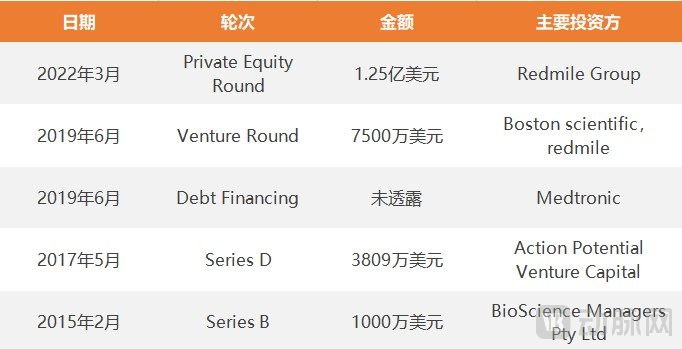
Saluda MedicalCompany's Historical Financing (Data fromcrunchbase)
According to reports,This RoundThe financing will be used for the large-scale commercialization of the core product, Evoke System., and further solidify Saluda Medical's leadership in the emerging field of neuromodulation therapies.
Since Melcack first proposed the use of spinal cord stimulation (SCS) for pain management in 1965, the major international manufacturers of spinal cord stimulators—Medtronic, Boston Scientific, Abbott (St. Jude Medical), Nevro, and Nuvectra—have all received FDA approval. In China, the only approved product in this field is the implantable spinal cord stimulator manufactured by PINS Medical.
According to the “Report on the Implantable Spinal Cord Stimulator Industry” released by NewSijie, approximately 100,000 spinal cord stimulator implantation procedures are performed worldwide each year, and the global market size for SCS is only in the low billions of U.S. dollars, indicating that this market pie is inherently small.
Currently, Medtronic, Abbott, and Boston Scientific—three publicly listed companies—have virtually monopolized the domestic and international markets., with both Boston Scientific and Medtronic having previously invested in Saluda Medical. However, the most significant difference between Evoke and existing products is that it utilizes closed-loop spinal cord stimulation (SCS) technology, which measures the spinal nerves' feedback to stimulation and adjusts the stimulation in real time.
However, as population aging intensifies and the technology matures for commercialization, the global market potential for spinal cord stimulators will be unleashed.