

Avive Solutions: Accelerating the Golden Four Minutes for Cardiac Arrest with Connected AEDs

Avive Solutions
Medical Device Developer
At the 2021 UEFA European Championship, Danish player Eriksen suffered cardiac arrest on the pitch,
At the 52nd second, the AED device arrived at the scene;
At 1 minute and 36 seconds, after medical personnel performed cardiopulmonary resuscitation (CPR), they initiated defibrillation using an automated external defibrillator (AED);
At the 13th minute and 36th second, Eriksen was carried off the pitch on a stretcher; by that time, he had already regained consciousness.
The aforementioned actions constitute a “textbook” execution of the cardiac arrest Chain of Survival: “recognition and activation of the emergency response system – cardiopulmonary resuscitation (CPR) – defibrillation – basic and advanced emergency medical services – advanced life support and post-cardiac arrest care,” with the timely use of an automated external defibrillator (AED) playing an indispensable role.
What Is an AED? A Simple Explanation: The Life-Saving Device for Sudden Cardiac Arrest (SCA).
Out-of-hospital cardiac arrest carries an extremely high mortality rate, with survival odds as low as one in ten.In the United States, approximately 400,000 people experience cardiac arrest each year, with a resuscitation success rate of about 10%.This is despite the vigorous promotion of AEDs in the United States over the past two decades; prior to this, the survival rate for cardiac arrest resuscitation was only 1.2% (data from the American Heart Association).
The reason why AEDs are hailed as life-saving devices for cardiac arrest is that80% of cardiac arrests are caused by ventricular fibrillation (VF), and defibrillation is the only effective method to prevent sudden death from VF.The working principle of an AED is to help patients terminate ventricular fibrillation and restore normal heart rhythm through rapid-discharge electrical shocks.
Cardiac arrest is like having one foot in the grave, but it is not beyond redemption. If cardiac arrestIf an AED is used within one minute, the patient’s survival rate can be as high as 90%., resuscitation performed within 4 to 6 minutes can achieve favorable outcomes, hence the term "Golden Four Minutes."
AED (Automated External Defibrillator) is very simple to use; it is a portable device designed specifically for laypersons., the device operated by professional physicians in hospitals is called a manual defibrillator.
Different AEDs operate in slightly different ways, but they generally follow the same basic workflow: An AED typically has two electrodes, which are placed respectively below the right clavicle and below the left axilla. Once the AED detects that the electrodes are properly positioned, it automatically begins analyzing the heart rate. If a shock is deemed necessary, a fully automatic AED will instruct bystanders to stand clear of the patient and then deliver the shock automatically, whereas a semi-automatic AED will prompt the user to press a button to deliver the shock, thereby terminating life-threatening arrhythmias.
The United States was one of the first countries in the world to enact legislation on the installation of automated external defibrillators (AEDs) in public places. In 1995, the U.S. launched the “Public Access Defibrillation Program” through legislation, marking the beginning of widespread AED adoption. Over nearly two decades, the density of AEDs in the United States increased significantly, reaching 317 units per 100,000 people. In comparison, Japan, which began promoting AED use during the same period, achieved a density of 555 units per 100,000 people.
While life-saving devices like automated external defibrillators (AEDs) are certainly more beneficial in greater numbers, improving survival rates from cardiac arrest requires more than just increasing AED availability. Barriers such as public education levels, societal attitudes, and AED technology also play critical roles.
These barriers are being overcome one by one.
While the AED Industry Pursues Hardware Upgrades, Three Young Entrepreneurs Take a Different Path by Focusing on Software
Avive Solutions is a medical device company founded in 2017, headquartered in California, USA, focused on addressing emergency response to out-of-hospital cardiac arrest.They are currently bringing to market a connected AED equipped with Avive’s pioneering software platform.
Avive’s three founders, Rory Beyer, Sameer Jafri, and Moseley Andrews, met at an industry conference focused on preventing cardiac arrest. After the conference, the three young entrepreneurs instantly connected and decided to establish a company dedicated to improving survival rates from cardiac arrest.
Sameer Jafri began his mission to combat cardiac arrest at an early age, founding the non-profit Saving Hearts Foundation while still a student at the University of California to provide free cardiac screenings for high school students.
The other two co-founders, Rory Beyer and Moseley Andrews, are alumni of the Mechanical Engineering program at the Massachusetts Institute of Technology (MIT). They were exposed to the concept of next-generation automated external defibrillators (AEDs) during their university years. After graduation, Rory worked as a product design engineer at Apple, while Moseley specialized in the design of surgical instruments.
“Over the past two decades, millions of automated external defibrillator (AED) units have been installed across the United States; however, survival rates for out-of-hospital cardiac arrest have not increased as significantly as expected.“Avive’s co-founder and president, Sameer Jafri, said, ‘Other AED companies have addressed this issue by adding more and more hardware; while the hardware has become increasingly sophisticated, they have overlooked’”The Real Issue—Better hardware is merely an added feature for users of automated external defibrillators (AEDs), while the truly urgent challenge lies in increasing the frequency of AED use. At times, people are unable to locate an AED immediately when an emergency occurs, a problem that software can address.。”
Avive Connect AED Seamlessly Integrates with 911 Platforms; “4-Minute City” Initiative Launched Ahead of the Product
Drawing on their respective experiences, they developed the Avive Connect AED, which integrates both hardware and software.
First, in terms of hardware, Sameer stated, “An excellent AED must be one that anyone can operate; it must be both affordable and convenient.” Therefore, the Avive Connect AED is designed to be compact enough for an adult male to hold in both hands, making it even portable for everyday carry.
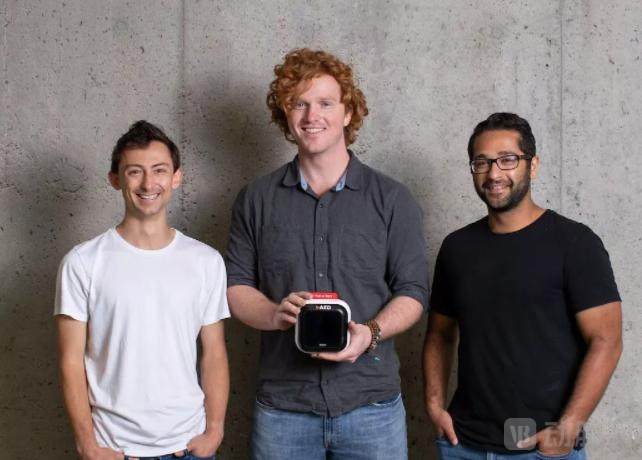
AviveThe three founders andAvive Connect AED
Next is the software aspect highlighted by Avive.
According to a presentation by Avive at the 2020 American College of Cardiology Annual Scientific Session,The AED they developed is equipped with a novel AI algorithm for classifying arrhythmias., determining whether defibrillation is required for the current heart rate based on classification. The American Heart Association (AHA) provides certain recommendations for the classification algorithms of AEDs, stating that a qualified AED should be capable of recognizing each of 12 specific cardiac rhythms.Avive claims its judgment accuracy exceeds 99%, exceeding the performance recommendations of the AHA.
Avive also integrates its AED with its proprietary emergency response platform, which connects to 911 public safety answering points through a partnership with RapidSOS.
RapidSOS is an emergency response platform that enhances the efficiency of information exchange between law enforcement and callers through various rapid-response mechanisms.
“The sooner cardiac arrest is treated, the better. However, the average emergency response time in the United States is seven minutes, and even 14 minutes in rural areas. By then, it is already too late for emergency intervention. An AED must be obtained before the ambulance arrives,” said Sameer.
However, not everyone knows clearly where AEDs are located or how to use them. The emergency response platform established by Avive is designed to address this issue.
Because the Avive Connect AED is connected to the network, 911 emergency call centers can know the location of each AED. When someone calls 911 to report a cardiac arrest, nearby AEDs will emit an audible alarm to attract the attention of people around them. People then use the patient map displayed on the AED to deliver it to the patient's side.
Meanwhile, 911 dispatchers can view event information provided by the AED through the RapidSOS Portal software, including the AED’s location and the patient’s vital signs data. Based on this information, they can guide bystanders in operating the device, ensuring that bystanders can quickly and effectively use the AED.
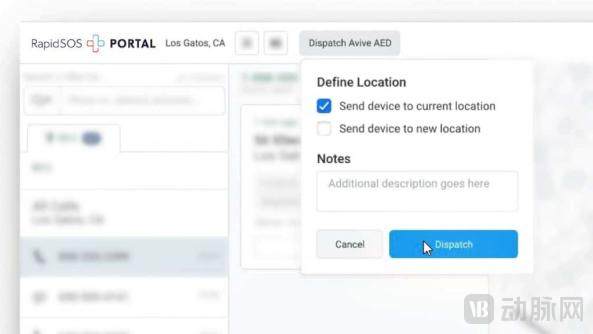
RapidSOS Portal Software Interface
Currently, the Avive Connect AED is still under FDA review and has not yet been approved for sale in the United States.However, Avive has launched the “4-Minute City (4MC)” initiative, aiming to break down cultural and economic barriers to AED usage.
Some studies have found that income, language, and social class all influence AED utilization rates. When selecting “4-minute cities,” Avive fully takes these factors into account to deploy its limited AEDs in optimal locations.
The “4-Minute City Initiative” aims to foster a culture in which automated external defibrillators (AEDs) are deployed within four minutes of witnessing a cardiac arrest. Upon the market launch of the Avive Connect AED, Avive will install hundreds of AEDs in communities with high incidences of cardiac arrest designated as “4-Minute Cities,” and conduct training on cardiopulmonary resuscitation (CPR) and AED operation to cultivate an emergency response culture among local residents.
Currently, Jackson County, Tennessee, and Cumberland County, Pennsylvania, in the United States have joined the 4-Minute City initiative.
Given the FDA’s lengthy review cycle, Avive, an AED device company founded in 2017 with no products yet on the market, has undergone six rounds of financing, raising a total of $69.3 million. Its most recent round was a $22 million Series A financing secured recently, led by Catalyst Health Ventures and Questa Capital Management.
AED Adoption in China Is Underway, with Significant Future Demand Potential
The 2022 Beijing Winter Olympics deployed 187 automated external defibrillators (AEDs), marking the first time in Olympic history that AEDs were made available across all venues. All AEDs were supplied by domestic Chinese brands.
In recent years, national policies have intensified efforts to increase the deployment of automated external defibrillators (AEDs). Proposals for widespread AED adoption were voiced at China’s national legislative sessions in both 2021 and 2022. Currently, China’s AED penetration rate stands at fewer than two units per 100,000 people, lagging significantly behind developed countries.
In addition to social awareness and policy, technology is also a major factor constraining the development of China’s AED industry.。
Ten years ago, AEDs in China were heavily reliant on imports, with Philips, ZOLL, and Nihon Kohden capturing a significant market share. The price of a single AED ranged from 40,000 to 90,000 yuan, and not only were the devices expensive, but the consumables required for ongoing maintenance were also costly.
However, the technological iteration of AEDs is slow, and there are very high technical barriers.There are few new entrants among international AED brands, while domestic AEDs have basically achieved import substitution, with the market share of Chinese-made AEDs continuing to rise.
According to data from a 2021 research report by Huachuang Securities, Philips holds the largest share of the domestic AED market at 26%, followed by the Chinese manufacturer Mindray Medical at 18%, and ZOLL Medical at 16%, with other brands accounting for 40%.
The trend of internet-based healthcare has also driven the development of IoT-enabled remote management devices. For instance, Jiuxin Medical launched the JOUnet AED management system, which features an AED map. Alternatively, users can access City Services within WeChat Pay and search for “Emergency Center” to locate nearby AEDs.
Major Chinese cities such as Shenzhen, Hangzhou, and Beijing have already implemented policies for AED deployment, while policies in other provinces and municipalities are forthcoming.Policies, products, and technology will all drive growth in the AED market. Moreover, as the majority of AED deployments are government-funded, there is a stronger preference for procuring domestic brands, which provides a natural advantage to Chinese manufacturers.