

Huawei Accelerates Healthcare Expansion as Revealed in Its Latest Annual Report
On March 28, Huawei released its 2021 annual report. As expected, impacted by chip sanctions, revenue from its consumer business—once accounting for half of Huawei’s total revenue—declined sharply, reaching RMB 243.431 billion in 2021, a year-on-year decrease of 49.6%. This also directly led to an overall contraction in revenue, with total revenue for 2021 amounting to RMB 636.807 billion, down 28.6% year on year.
In its annual report, Huawei devoted substantial space to showcasing the latest progress in its five major business segments: ICT infrastructure, cloud computing, digital power, consumer devices, and intelligent automotive solutions. Within this extensive business ecosystem, healthcare products and solutions also hold a place. Although the annual report does not yet disclose the specific financial contributions of healthcare-related activities, they are already integrated across four of the company’s business segments.
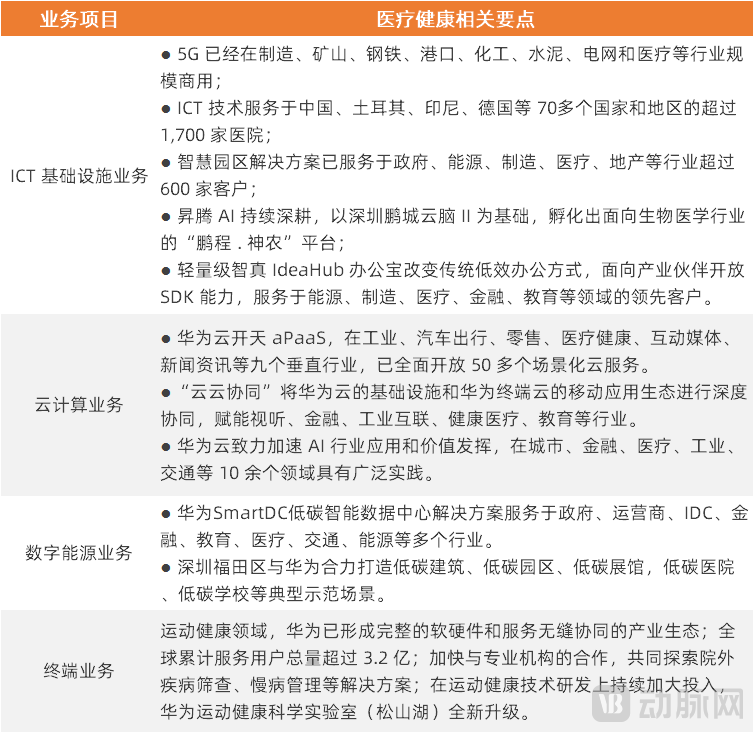
Huawei’s Main Business Segments Involving Healthcare; Source: Huawei 2021 Annual Report, compiled and charted by VCBeat
As shown in the figure above, Huawei’s ICT infrastructure, cloud computing, digital power, and terminal businesses all encompass healthcare-related content. In terms of target customers, the company offers sports and health services to consumers (C-end), while providing products and solutions to healthcare enterprises, medical institutions, research organizations, and health authorities on the business side (B-end).
In the face of severe challenges posed by the external environment, intensifying research and innovation is an imperative path for Huawei. At the business level, given the vast market potential in healthcare technology, will Huawei expand its footprint in the healthcare sector? An analysis of its annual report offers some insights.
In the health and medical-related sections of its 2021 annual report, Huawei devoted a significant portion to showcasing the layout and strategic planning of its sports and health business. Within its consumer devices segment, Huawei is building an all-scenario smart lifestyle for consumers, centered around five key scenarios: smart office, sports and health, smart home, smart mobility, and audio-visual entertainment, with sports and health serving as a crucial component.
From Consumer-Grade to Medical-Grade: Multiple Products Obtain Medical Device Registration Certificates
According to Huawei’s annual report, a complete industrial ecosystem featuring seamless synergy among hardware, software, and services has been established in the sports and health sector. In 2021, Huawei implemented a full-stack upgrade strategy for its Sports and Health business, integrating three core competitive advantages: breakthrough hardware sensing technologies, newly upgraded software algorithms, and more comprehensive digital health services.
Among the sports and health products launched by Huawei, the HUAWEI WATCH GT Runner professional running watch adopts the industry’s first patented suspended antenna design, improving GPS antenna performance by 135% compared to traditional designs. A range of smart wearable devices, including the HUAWEI WATCH GT 3, Children’s Watch 4 Pro, and Band 6, offer consumers comprehensive and diverse options. Features such as heart rate monitoring, blood oxygen saturation measurement, blood pressure monitoring, sleep tracking, stress monitoring, and ECG detection enable users to stay informed about their health status in a timely manner.
According to the annual report, in the third quarter of 2021, Huawei ranked first globally in shipments of smartwatches and fitness bands. By the end of 2021, Huawei’s cumulative global shipments of smart wearable devices had exceeded 100 million units. In the sports and health sector, Huawei has served a cumulative total of over 320 million users worldwide. The Huawei Health app provides users with comprehensive data management, scientific exercise training, and professional health management services, boasting 83 million monthly active users globally.
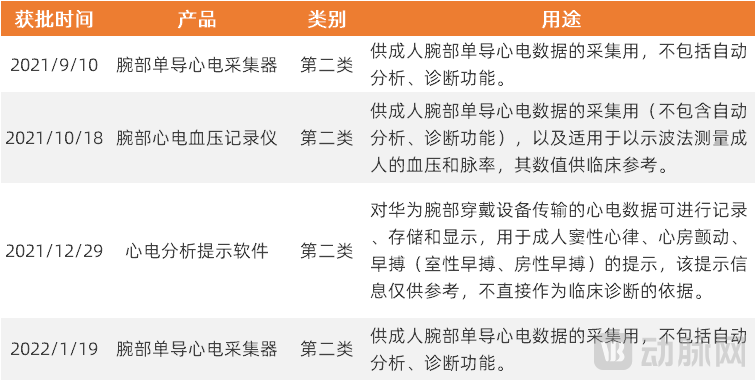
Huawei’s Products That Obtained Medical Device Registration Certificates in 2021; Source: National Medical Products Administration, Compiled and Charted by VCBeat
Since 2021, Huawei has obtained medical device registration certificates for four additional products. Among them, the HUAWEI WATCH D wrist ECG and blood pressure monitor was launched in December 2021. Transitioning from consumer-grade to medical-grade standards, Huawei’s sports and health products are expanding into a wider range of application scenarios, serving not only to display health data to users but also as a clinical reference.
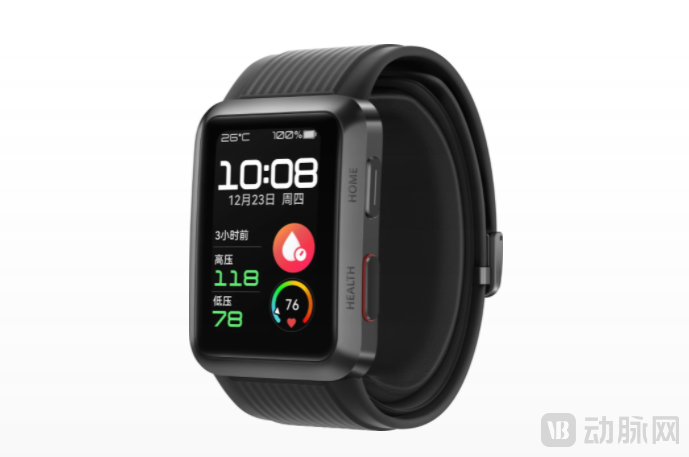
HUAWEI WATCH D Wrist ECG and Blood Pressure Monitor, Image source: Huawei official website
Seeking New Opportunities in the Sports and Health Sector
On February 27, at Huawei Consumer Business Group’s Spring Launch Event, Richard Yu, CEO of Huawei Consumer Business Group, emphasized that an all-scenario smart lifestyle is the long-term strategy for Huawei’s consumer business over the next five to ten years. Evidently, as an integral part of this all-scenario smart lifestyle, sports and health will also constitute a mid-to-long-term strategic focus for the business.
To support subsequent product development, Huawei continues to strengthen its medical and technological research in the field of sports and health. The annual report revealed that Huawei is accelerating collaborations with professional institutions to jointly explore solutions for out-of-hospital disease screening and chronic disease management. This approach not only significantly improves the efficiency of out-of-hospital disease screening but also helps users identify health risks more promptly.
Currently, Huawei has partnered with over 60 professional medical institutions to conduct health research collaborations based on the HUAWEI Research innovation platform. These collaborations encompass diverse health management studies, including research on heart health, sleep apnea, respiratory health, and blood pressure health. Notably, six findings from the heart health study were presented at the 2021 European Society of Cardiology (ESC) Congress, gaining recognition from the international medical community. By the end of 2021, the number of users participating in the heart health study had reached 3.8 million, with more than 15,000 individuals identified as high-risk, and the accuracy rate for atrial fibrillation screening achieved 94%.
Huawei has also been continuously increasing its investment in the research and development of sports and health technologies. In 2021, the Huawei Sports & Health Science Laboratory (Songshan Lake) was upgraded to build a technological innovation platform for the sports and health industry, focusing on product research, standard setting, testing and certification, demonstration and experience, and industrial incubation.
At Huawei’s annual report press conference, Rotating Chairman Guo Ping stated that years of continuous U.S. sanctions have imposed significant difficulties on Huawei. This is particularly evident in the consumer smartphone business, where chips must deliver high computing power, low power consumption, and compact form factors; Huawei continues to face challenges in securing such components. While actively engaging with relevant parties to explore sustainable solutions for its smartphone operations, Huawei is also expanding into new sectors—including wearables, sports and health, and whole-home smart solutions—and will seek new growth opportunities within these emerging scenarios.
In the B2B sector, Huawei opens its technology platforms or provides solutions to various entities. In 2021, Huawei fully integrated technologies such as 5G, cloud computing, and artificial intelligence to enhance the quality and efficiency of digital transformation for medical institutions, pharmaceutical and medical device enterprises, and government departments. Additionally, Huawei collaborated with health-tech companies to promote the research, development, and implementation of innovative solutions.
Building Full-Scenario Smart Hospitals for Healthcare Institutions
For medical institutions and health administrative departments, Huawei can provide solutions such as digital hospitals, regional health informatization, and tiered diagnosis and treatment.
According to the annual report, Huawei’s ICT technical services covered more than 1,700 hospitals in 2021. At the Second People’s Hospital of Guangdong Province, Huawei applied advanced technologies such as cloud computing, 5G, and Wi-Fi 6 across various domains and process nodes—including medical care, teaching, research, and management—to create a fully scenario-based smart hospital. In May 2021, a paper detailing the construction plan and preliminary achievements of this fully scenario-based smart hospital was published in Nature Medicine, a subsidiary journal of Nature.
The paper notes that since 2018, Guangdong Second Provincial General Hospital has integrated artificial intelligence (AI) technology into hospital management. However, due to the limitations of 4G networks at the time, AI technology was not able to achieve its full potential. To address this issue, Guangdong Second Provincial General Hospital partnered with Huawei Technologies Co., Ltd. to leverage 5G technology and build a comprehensive, all-scenario smart hospital.
5G networks, characterized by low latency, high capacity, and high bandwidth, help hospitals improve operational efficiency and enhance the patient care experience. Supported by 5G connectivity, pre-hospital emergency physicians on ambulances can conduct remote video consultations with in-hospital emergency teams without any lag, share medical data, and eliminate waiting times, thereby enabling patients to truly achieve “hospital admission upon boarding the ambulance.” In 5G-enabled smart hospital wards, devices such as smart wristbands, smart infusion pumps, smart disinfection robots, and logistics robots facilitate closed-loop ward management and the Internet of Everything (IoE). Furthermore, 5G technology provides smoother connectivity for internet hospitals.
Guangdong Provincial Second People’s Hospital has long prioritized the application of technological capabilities, having established China’s first internet hospital—the Guangdong Internet Hospital—and pioneered a new model of healthcare service delivery. The all-scenario smart hospital undoubtedly enables more comprehensive efficiency improvements across services, clinical care, and management. In this regard, Professor Tian Junzhang, Secretary of the Hospital’s Party Committee and corresponding author of the aforementioned article, pointed out that the panoramic smart hospital built using 5G technology offers viable directions for future hospital development in medical care, teaching, scientific research, and management.
Furthermore, Huawei has opened up its capabilities in cloud computing, AI, and computing technologies to collaborate with medical technology companies in developing highly specialized niche products for clinical applications.
In 2021, Huawei and Weizhuo Zhiyuan jointly launched the intelligent medical imaging system “Yuepianbao.” The system is characterized by its ability to not only leverage 3D intelligent imaging technology for intuitive and precise lesion localization but also facilitate remote consultations and real-time two-way interaction for physicians, thereby significantly enhancing the efficiency of case discussions, teaching rounds, remote consultations, and doctor-patient communication.
In this collaboration, Huawei leveraged its technological strengths in cloud computing, AI, and computing power, while its Smart Screen terminals supported telemedicine through intelligent synergy and superior audio-visual conferencing capabilities. Meanwhile, Vizyon Medical applied its R&D expertise in medical AI, cloud computing, holographic visualization, and intelligent surgical navigation robots.
In September 2021, Suzhou Weiqing launched an AI-assisted diagnostic system for fundus lesions. Powered by Huawei’s cloud computing and artificial intelligence solutions as its “smart brain,” the system delivers high-definition imaging with ultra-wide-angle coverage and fully automatic stitching. It assists physicians in real-time visualization of peripheral fundus lesions and enables precise diagnosis and treatment even with pupils as small as 1.5 mm and under extremely low-light conditions. By simply, rapidly, and non-invasively restoring the true texture of images, the system provides ophthalmologists with information more conducive to accurate diagnosis, thereby reducing the rates of missed and misdiagnoses.
Accelerating New Drug Development and Gene Sequencing
In addition to healthcare institutions, Huawei is also accelerating its expansion into the upstream technology sector of medical health.
Huawei’s annual report shows that the Ascend AI basic software and hardware platform has been continuously upgraded, leveraging the high-performance computing power of artificial intelligence computing centers to build large models and incubate new applications. In 2021, based on the Pengcheng Cloud Brain II in Shenzhen, the “Pengcheng Pangu” large model was incubated, along with the “Pengcheng Shennong” platform tailored for the biomedical industry.
It is reported that “Pengcheng Pangu” is a fully open-source Chinese pre-trained language model with 200 billion parameters, released in May 2021. In September 2021, Huawei Cloud built upon this foundation to launch the Pangu Drug Molecule Large Model, a pre-trained large model specifically designed for the field of drug research and development, aiming to help pharmaceutical companies usher in a new paradigm of AI-assisted drug discovery.
Huawei Cloud, in collaboration with the Shanghai Institute of Materia Medica of the Chinese Academy of Sciences, jointly trained the Huawei Cloud Pangu Drug Molecule Large Model to empower AI-driven drug design across the entire process. Leveraging Huawei Cloud’s one-stop medical R&D platform, EIHealth, the Pangu Drug Molecule Large Model has learned the chemical structures of 1.7 billion drug molecules. In terms of drug generation, it achieves deep representation of unique information of small-molecule compounds, computational analysis and matching with target proteins, and prediction of biochemical properties of new molecules, thereby efficiently generating novel drug molecules. In terms of drug optimization, it enables targeted optimization of screened lead compounds.
According to Huawei’s annual report, in 2021, Professor Liu Bing’s team at the First Affiliated Hospital of Xi’an Jiaotong University achieved significant progress in the development of broad-spectrum antibacterial drugs based on the Huawei Cloud Pangu Drug Molecule Large Model.
The “Pengcheng Shennong” platform leverages artificial intelligence to accelerate the screening and development of novel drugs. It includes modules for protein structure prediction, small molecule generation, prediction of target–small molecule interactions, and the design and efficacy evaluation of novel antimicrobial peptides. Pharmaceutical companies and medical research institutions can utilize the AI capabilities provided by “Pengcheng Shennong” to expedite the screening and creation of new drugs. Taking antimicrobial peptides as an example, by leveraging the platform’s amino acid sequence generation capability in conjunction with existing antimicrobial peptide datasets, tens of thousands of candidate peptide sequences can be generated in a short period. Subsequent biological experiments and clinical validation can then significantly accelerate the discovery of novel antimicrobial peptides.
Furthermore, at the 2021 Xipu Conference, Huawei Cloud and Sinohealth signed a strategic cooperation agreement to jointly build an aPAaaS platform tailored for the pharmaceutical industry.
On this empowerment platform, Sinocare opens up its master data capabilities and intelligent algorithms for the pharmaceutical industry, Huawei Cloud contributes its AI-driven drug R&D platform, and Huawei Terminal Cloud provides HMS Core, the core component for applications. Other ecosystem partners can also share their respective capabilities on the platform, enabling the development of more new scenarios and high-value industry applications based on this industrial empowerment platform.
In the field of gene sequencing, Huawei has collaborated with West China Hospital of Sichuan University to achieve a major breakthrough.
In September 2021, West China Hospital of Sichuan University, Huawei Technologies Co., Ltd., and Cyler Gene jointly released a multi-omics data accelerated analysis platform, announcing that the turnaround time for 30X human whole-genome sequencing (WGS) germline variant analysis had been reduced from 24 hours to 7 minutes.
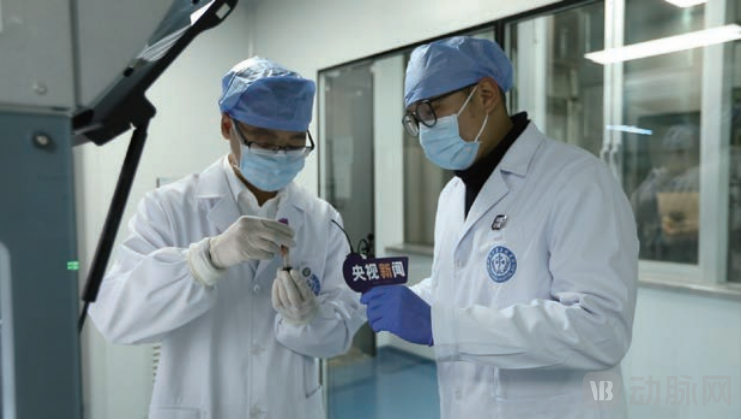
Gene Sequencing Solution Jointly Launched by West China Hospital and Huawei, Image Source: Huawei 2021 Annual Report
In this tripartite collaboration, West China Hospital leveraged its leading academic and industrial advantages in multimodal omics data analysis and gene applications; Huawei demonstrated its technical expertise in high-performance data storage and advanced genetic data management systems; and Sai Le Gene applied its industry experience in GPU-accelerated bioinformatics data analysis.
It is understood that this marks the first time globally that human whole-genome analysis has been advanced to the minute-level era, holding significant importance in the field of multi-omics data analysis.
Empowering Digital Transformation in the Pharmaceutical and Medical Device Distribution Sector
In addition, Huawei has expanded its business into the pharmaceutical and medical device distribution sector, facilitating the digital transformation of commercial distribution companies.
In November 2021, Sinopharm Group signed a strategic cooperation agreement with Huawei Technologies Co., Ltd. The two parties will advance comprehensive collaboration across the entire health industry value chain, exploring innovative integration in areas such as digital transformation, new retail in pharmaceuticals, intelligent pharmaceutical manufacturing, and the convergence of medical and elderly care services.
In October 2021, Jointown Pharmaceutical Group entered into a strategic partnership with Huawei. Leveraging its proven expertise in digital transformation and aligning with Jointown’s corporate strategy, Huawei will provide comprehensive support for Jointown’s digital transformation initiatives, drive technological innovation, and help establish an industry benchmark. Meanwhile, both parties will explore new business cooperation models tailored to the current operational landscape of the pharmaceutical industry, thereby enhancing Jointown’s brand influence and market share.
Huawei’s ICT infrastructure and smart device businesses have expanded globally, with its healthcare-related operations being no exception.
According to Huawei’s 2021 Annual Report, Huawei’s ICT technical services cover hospitals in more than 70 countries and regions, including China, Turkey, Indonesia, and Germany. In Germany, Huawei’s all-flash storage solutions help ensure the efficient and stable operation of hospitals’ core business systems, safeguarding the security of medical data throughout its entire lifecycle. In countries such as France and Singapore, Huawei helps hospitals improve diagnostic and treatment efficiency as well as patient experience by providing converged campus network solutions.
According to the revenue sources disclosed in Huawei’s annual report, its primary revenue outside China comes from the Europe, Middle East, and Africa (EMEA) region, followed by the Asia-Pacific region, and lastly the Americas. In the healthcare industry, Huawei focused on expanding its business in Thailand within the Asia-Pacific region in 2021.
In 2021, Huawei signed a two-year Memorandum of Understanding (MoU) with the Department of Medical Services (DMS) of Thailand to launch enhanced smart services by leveraging Huawei’s technological strengths. By integrating digital technologies such as 5G, artificial intelligence, big data, and cloud computing, the initiative aims to elevate the standard of local medical services. Under the MoU, Huawei will collaborate with the National Cancer Institute and Rajavithi Hospital, both affiliated with the DMS, to help improve their operational efficiency and enhance the quality of healthcare services.
Currently, Huawei has provided the IdeaHub Huiyibao to the National Cancer Institute (NCI) Hospital in Thailand, integrating it with the telemedicine software of the Thai Ministry of Public Health. Using the IdeaHub and 5G networks, physicians can conduct doctor-to-doctor telemedicine consultations with colleagues at rural community hospitals. Additionally, patients can use the Ministry’s telemedicine app from home to engage in patient-to-doctor remote consultations with specialists in major cities. This eliminates the need for patients to travel long distances to urban hospitals for examinations, saving them time and money while reducing person-to-person contact during the pandemic.
“Going global” is one of the options for enterprises in the healthcare sector after they have reached a certain scale. Leveraging its existing overseas business layout, Huawei has already established a solid foundation for its healthcare-related operations abroad.
Huawei’s annual report also highlighted a set of noteworthy figures: in 2021, despite a decline in revenue, R&D expenditures reached RMB 142.7 billion, accounting for approximately 22.4% of its full-year revenue; both the absolute amount and the proportion hit new highs over the past decade. Over the last ten years, Huawei has cumulatively invested more than RMB 845 billion in R&D, with annual investments in basic research exceeding RMB 20 billion in recent years. In 2021, the company had approximately 107,000 employees engaged in research and development, representing about 54.8% of its total workforce.
While the heightened emphasis on R&D is partly driven by changes in the external objective environment, research and innovation have always been Huawei’s most powerful internal engine for growth. Although annual reports do not disclose R&D spending specifically allocated to the healthcare sector, it is certain that advancements in overall R&D capabilities will drive improvements in specialized fields such as healthcare.
Overall, Huawei’s healthcare-related business spans multiple domains, including medical AI, healthcare informatization, and health technology. In addition to its robust technological capabilities, Huawei has established comprehensive coverage spanning from enterprise services to consumer businesses, and has proposed the “Cloud-Cloud Synergy” strategy, which deeply integrates Huawei Cloud’s infrastructure with the mobile application ecosystem of Huawei Terminal Cloud. Data silos are prevalent in the healthcare sector. Regarding Huawei’s business involvement, can out-of-hospital data generated by wearable devices and in-hospital data generated by smart hospitals be better connected through “Cloud-Cloud Synergy”? If feasible solutions can be developed to address practical challenges, this will further strengthen Huawei’s competitive advantage.
Globally, it is no longer novel for tech giants to venture into healthcare. However, cautionary tales from some of these companies demonstrate that robust technological prowess does not guarantee success in cross-industry healthcare initiatives. In the realm of medical technology, there are countless instances where advanced technologies lack appropriate application scenarios or fail to adequately align with clinical needs.
The healthcare industry has high professional barriers. Huawei Technologies Co., Ltd. has already collaborated with numerous medical technology companies, combining its technological advantages with their specialized expertise. To achieve greater impact in the future, Huawei will continue to expand its ecosystem and onboard more high-quality partners.