

The Future of Orthopedic Spinal Surgery Robots: Reflections from a Senior Surgeon at a Top-Tier Hospital

Great Robotics
Surgical Robot Developer
Why Does Orthopedics, Often Hailed as the "King of Surgery," Seem to Lag Behind in the Era of Booming Surgical Robot Adoption?
Over the past decade, the use of robotic systems in surgery has increased significantly. Robotic-assisted surgery has been widely adopted as part of routine practice in general surgery, urology, and gynecology, and has even been incorporated into standardized residency training programs. In contrast, many orthopedic surgeons still rely on freehand techniques for screw placement, plate fixation, joint replacement, and endoscopic minimally invasive procedures. Their workflow appears to have changed little compared with that of orthopedic surgeons in the previous century, except that plates are of newer models, screws are of newer designs, joint implants feature new bearing surfaces, and some novel minimally invasive surgical techniques have emerged.
From an international perspective, orthopedic robotic products have begun to be promoted and deployed, particularly in spinal surgery. Zimmer Biomet’s ROSA Spine, Globus Medical’s ExcelsiusGPS, and Medtronic’s Mazor X have all been widely adopted in clinical practice. Stryker has also acquired Mobius and its Cardan robot, aiming to further integrate them into a unified minimally invasive spinal surgery robotic platform. Currently, the latest development trend among foreign manufacturers is the integration of “intraoperative 3D imaging + surgical robots + artificial intelligence + proprietary consumables,” with plans to provide comprehensive platform solutions.

Global Distribution of Orthopedic Robotic Surgery Institutions Image source: biomedcentral.com
In China, spurred by Tinavi Medical Technologies—the first publicly listed surgical robotics company—spinal robotics firms have emerged in large numbers. However, no domestic robotic system with a comprehensive platform solution has yet been seen to rival international brands. Furthermore, while the advantages of robotics are mainly reflected in precision, minimally invasiveness, and reproducibility, currently commercialized orthopedic robots are not yet capable of performing efficient, end-to-end surgical procedures. Most are limited to providing navigational assistance for spinal pedicle screw placement or assisting with certain steps in joint replacement surgeries.
The trend toward performing internal medicine procedures surgically and minimizing the invasiveness of surgical operations defines the future of surgery. While robotic systems in joint surgery have primarily improved implant accuracy, integrating technologies such as discectomy endoscopy and arthroscopy with robotics enables patients to benefit from both minimally invasive approaches and precise implantation. Combining these techniques with robotic technology will allow more patients to benefit; however, these minimally invasive techniques have a high threshold, requiring more systematic technological integration, training, and updates in clinical skills. General surgery, urology, and gynecology and obstetrics have already taken the lead in minimally invasive robotic surgery by leveraging laparoscopic robotic systems, whereas orthopedics still requires further efforts. Currently, traditional treatments still constitute the majority of clinical practice. Physicians at major hospitals from the new generation are actively participating in the research and development of next-generation robotic products, which represents a significant opportunity for the advancement of orthopedics in China.
Companies currently active in the orthopedic spinal surgery robot market include Brainlab (CIRQ), Curexo (CUVIS-spine), Globus Medical (ExcelsiusGPS), Medtronic (Mazor X), TINAVI Medical Technologies (TiRobot), Zimmer Biomet (ROSA One Spine), and Stryker (Mobius - Cardan). Driven by this trend, the number of patents related to spinal surgery has surged in recent years.
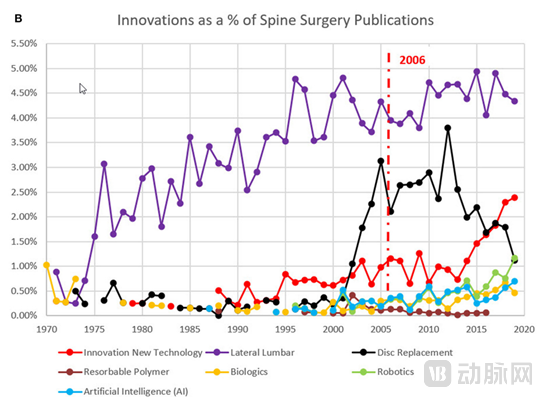
Figure: Number of Innovative Patents in Spinal Surgery in the United States and EuropeImage source: researchgate.net
Safe and effective spinal surgery relies on precise imaging foundations, typically based on high-precision 3D imaging combined with real-time localization techniques to guide robotic arms for surgical navigation and even assist in surgical procedures.
During surgical procedures, spinal robots offer several advantages, including reducing surgeon fatigue and tremors, while enhancing accuracy and precision by providing stability to instruments through fixed working angles. Furthermore, they can effectively reduce the frequency and duration of intraoperative fluoroscopy, thereby lowering radiation exposure for both surgeons and patients. Currently, spinal surgery robots are evolving from screw placement navigation to semi-automatic needle insertion, with the next step being the development of full-process surgical robots, particularly those for minimally invasive orthopedic surgeries. It is understood that companies have already begun developing such full-process endoscopic minimally invasive orthopedic surgical robots, including Great Robotics in China and Stryker abroad.
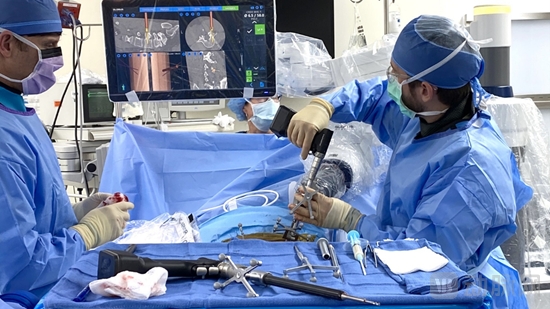
Screw Placement in Robot-Assisted Endoscopic Spinal Fusion Surgery Image Source: semmes-murphey.com
Spine surgeons currently regard spinal fusion (vertebral fixation) as the “last resort and most critical intervention.” Internal fixation is primarily indicated for spinal instability or following traditional open surgeries that cause substantial compromise to preexisting spinal stability.
The question arises: do so many spines truly require internal fixation?
In the era of advanced endoscopic minimally invasive techniques, only a small subset of cases may require internal fixation with pedicle screw placement, as the majority of the spine’s stabilizing structures remain intact. Nevertheless, current mainstream orthopedic surgical navigation robots continue to emphasize the precision and advantages of screw placement. It is undeniable that while screw placement has been a foundational and important technique over the past several decades, it is not the sole approach. With the development of technologies such as endoscopic lumbar interbody fusion, endoscopic instrumentation, and Oblique Lateral Interbody Fusion (OLIF), the reliance on screw-based fusion may gradually diminish or be deferred in the future.
Dr. Yeung, the pioneer of endoscopic spine surgery in the United States, published his first article, “Away from Fusion,” in The Spine Journal in December 2015. An analysis of Dr. Yeung’s preliminary review, which involved a 5- to 10-year follow-up of 58 patients, revealed that approximately 36% of patients avoided spinal fusion surgery (pedicle screw fixation). However, 100% of patients expressed satisfaction with the decision to delay fusion as their initial surgical option. He recommends that patients initially opt for endoscopic decompression as a “bridging procedure.” This diagnostic and therapeutic approach helps alleviate pain and improve patients’ quality of life. This is analogous to arthroscopic treatment serving as a bridging procedure for osteoarthritis, reflecting the principle that not every patient requires immediate joint replacement.
In recent decades, various minimally invasive surgical techniques have been introduced to minimize approach-related tissue trauma while optimizing perioperative care and long-term functional outcomes. Currently, new-generation surgical robot systems for minimally invasive spine surgery are emerging both domestically and internationally, reigniting interest in this field. Minimally invasive spine surgery requires precise maneuvers and certain repetitive tasks under the guidance of high-precision intraoperative imaging, making it particularly well-suited for robot-assisted procedures.
Future-generation spinal robotics technology must not only excel in pedicle screw placement but also demonstrate advanced capabilities in minimally invasive surgical localization, channel establishment, endoscopic decompression, and endoscopic fusion. Integrated with next-generation end-effectors and optical/magnetic tracking systems, these innovations are progressively simplifying spinal surgical procedures.
Endoscopic Spine Surgery. Endoscopic spine surgery is an advanced form of minimally invasive spinal surgery designed to provide patients with faster recovery times and less recurrent pain compared to traditional spinal surgical approaches. In most cases, endoscopic procedures can be performed under local anesthesia instead of general anesthesia, thereby reducing the overall medical risk for elderly patients or those with comorbid internal medical conditions that may increase surgical risk. Although endoscopic spine technology presents greater technical challenges, it yields excellent postoperative outcomes.
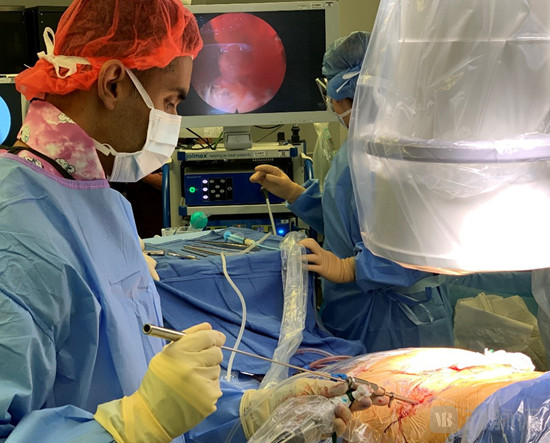
Endoscopic Spine Surgery Image Source: outpatient-spine-surgeon.com
Artificial Disc Replacement. The debate between fusion and replacement has persisted, with some scholars arguing that fusion is obsolete, particularly in the cervical spine. This is because data clearly demonstrate that artificial cervical disc replacement outperforms fusion across many outcome measures. By mimicking the viscoelastic properties of natural intervertebral discs, artificial discs can improve the biomechanics of the prosthetic device.
3D Printing. 3D printing technology has numerous applications in spinal surgery. In 2019, the Hospital for Special Surgery in New York City established a partnership with LimaCorporate to launch a vendor-based additive manufacturing 3D printing facility for personalized orthopedic implants. 3D-printed cages offer customized dimensions and morphology; engineers have designed systematic cage solutions that utilize precise mapping and preoperative surgical planning to restore appropriate height and alignment. Companies such as RTI Surgical have developed Fortilink Interbody Fusion 3D-printed implants for the treatment of degenerative disc disease. The latest advancements in orthopedic 3D printing enable in situ 3D printing, which better aligns with clinical needs.
Mixed Reality. Three neurosurgeons at Johns Hopkins Hospital performed the first spinal fusion surgery on a patient using an augmented reality system, causing a stir in the spine field for Augmedics. The company’s FDA-cleared Xvision Spine System enables surgeons to visualize 3D spinal anatomy intraoperatively, allowing them to navigate instruments and implants while maintaining visual contact with the patient. The integration of mixed reality technology holds significant potential in preoperative assessment, doctor-patient communication, remote consultations, enhancing patient safety, improving postoperative outcomes, and reducing complications.
Artificial Intelligence. Artificial intelligence holds immense potential in the healthcare sector. It can assist in surgical decision-making and the interpretation of imaging studies. This technology will not replace surgeons but will augment their data processing capabilities, enabling the formulation of optimal treatment pathways for patients.
Regenerative Medicine. Regenerative medicine in the field of spinal care is still in its infancy. One treatment approach is Discseel, in which surgeons inject fibrin into torn intervertebral discs to seal tears within the annulus fibrosus.
Telemedicine. The COVID-19 pandemic compelled many specialists to temporarily postpone surgeries in early 2020 and shift to telemedicine consultations. Patients are now comfortable with this technology and expect spine surgeons to offer remote consultations and virtual surgical planning. The new generation of spinal robotics may also be equipped with 5G-enabled remote surgery solutions, allowing for the performance of remote procedures on patients.
Robotic technology will truly become the future of spinal surgery when it becomes a practical and effective option for all hospital surgeons. For instance, enhancing the precision and density resolution of cone-beam CT (CBCT) imaging, fusing preoperative MRI/CT images with intraoperative CBCT, and combining these with spinal endoscopy can significantly improve safety and expand further applications.
The most critical feature of future spinal robots may be the concept of versatility, akin to platform-based systems such as the da Vinci Surgical System. These systems must be capable of performing a wide variety of procedures and ideally offer greater compatibility with implant manufacturers, covering nearly all aspects of spinal surgery—from minimally invasive to open techniques—and extending beyond merely pedicle screw placement. The core principles of contemporary spinal surgery involve decompression, deformity correction, and stabilization. For spinal robotic systems to thrive, they must provide comprehensive, end-to-end involvement in all stages of surgical procedures and demonstrate broad applicability.
The cost of surgical robots must be reduced. Only when spinal robots are sold at more reasonable prices, incur reasonable usage costs, and are applied to a variety of procedures—including cervical, thoracic, and lumbar spine surgeries, as well as other orthopedic operations—can they achieve widespread adoption. In the Chinese context, particular consideration must be given to the capacity of medical insurance coverage.
If force-feedback-based instruments are developed, robots could be employed to automatically perform the decompression phase of surgery, thereby reducing operative time and blood loss, and potentially enabling widespread application in the surgical correction and rehabilitation of spinal deformities.
Surgical efficiency must be high; if multi-arm collaboration can enhance surgical efficiency and success rates while reducing complications, it would be an excellent option.
Between 2001 and 2010, approximately 3.6 million spinal fusion procedures were performed in North America, with the total estimated cumulative cost exceeding $287 billion. More than 40% of adults aged 40 years and older suffer from spinal disorders. Current medical approaches, particularly in China, should focus not only on improving surgical outcomes but also on reducing costs.
Given that surgical robots are expected to increasingly reduce operative time, patient hospital stays, fluoroscopic exposure, and revision surgery rates in the future, the potential economic savings associated with the use of robotics in spine surgery can be projected. In light of these trends, the global market for spinal surgical robots was estimated to grow from USD 26 million to USD 2.77 billion by 2022. Furthermore, if half of all fusion procedures are initially treated with endoscopic non-fusion minimally invasive techniques, the estimated size of the minimally invasive spine surgery market will expand even further.
Within China’s healthcare ecosystem, the future adoption of minimally invasive endoscopic spinal surgery robots will popularize minimally invasive procedures, facilitate stepwise treatment, improve therapeutic outcomes, and reduce iatrogenic injury. This will help alleviate the overall financial burden on both the national medical insurance system and individuals.
Recently, the National Healthcare Security Administration issued a request for comments on fee structures for orthopedic “surgical robots” and 3D printing–assisted procedures. The document categorizes orthopedic surgical robots into four broad classes based on their clinical value contribution: (1) planning-type; (2) navigation-type; (3) partial surgical assistance; and (4) full-process surgical robots/teleoperated surgical robots. The proposed fee schedule increases progressively from Category 1 to Category 4, aiming to steer the development of orthopedic surgical robots toward comprehensive, systematic, minimally invasive, platform-based solutions.
In recent years, we have witnessed extensive hype surrounding various surgical robot solutions that integrate technologies such as augmented reality, telemedicine, machine learning, data analytics, and artificial intelligence. At present, many regard these advancements as mere commercial hype rather than offerings of genuine clinical benefit. Similar skepticism greeted the advent of personal computers, smartphones, 5G technology, autonomous driving, and the metaverse. Only time will reveal the true answer; however, it is evident that these innovations hold significant potential to fundamentally transform our work and daily lives, as they represent the footprints of technological progress in our era. Likewise, I am confident in the future development of next-generation minimally invasive spinal surgery robots.