

A Blue Ocean Market Beckons Scientists: Global Giants Expand, Domestic Innovators Rise in Smart Laboratory Sector

Xrazor Technology
Standardized Platform, Product, and Solution Provider
A few years ago, artificial intelligence and internet-based healthcare were the focal points of China’s medical industry. At that time, smart laboratories remained an obscure corner, never touched by the spotlight. Yet in every era, there are always those who, like “ducks that first sense the warming spring waters,” perceive the shifts in season and zeitgeist even in the chilly early winter. Pharmaceutical companies and medical device manufacturers, closely tied to laboratory settings, quickly recognized these changes and began to strategically position themselves.
Multinational corporations such as Beckman, Abbott, Roche, Siemens, and Agilent have already established comprehensive smart laboratory ecosystems. In China, as the pharmaceutical industry and medical device R&D have become highly sought-after sectors in the capital market, upstream smart laboratory solutions are beginning to emerge, bringing increasing visibility to local Chinese innovators.
The advancement of digitalization and automation is gradually leading the transformation of the healthcare industry. Meanwhile, every segment of the healthcare value chain is being reshaped by these technologies, creating new demands and opportunities, with laboratories serving as a key setting for this transformation. To understand the current state of development and challenges facing smart laboratories in China, and to identify growth opportunities, VCBeat has engaged in discussions with several domestic smart laboratory practitioners, hoping to provide valuable insights for industry professionals.
With the advancement of biotechnology, market demand for drug development, biological experiments, and testing has surged. Meanwhile, routine laboratory operations still largely rely on manual procedures, involving significant repetitive and mechanistic tasks. This has led to high labor costs, low experimental efficiency, and uncontrollable data quality.
For instance, at the automation level, automated control systems generally lack the capability for end-to-end process automation; equipment automation is largely closed to external systems, failing to provide essential quality parameters and process condition data. Some enterprises have yet to fully implement Manufacturing Execution Systems (MES) and automated batch control. At the digitalization level, functional areas such as financial management, supply chain and inventory management, and customer relationship management in pharmaceutical companies are not deeply integrated with production processes, and the exploration of next-generation technologies like the Internet of Things (IoT), big data, and cloud computing has not yet become widespread.
A variety of digital and automated technologies have created opportunities for the transformation of laboratories.
Digital laboratories leverage advanced real-time data analytics and continuous process verification to monitor trends, prevent deviations or out-of-specification events, and optimize scheduling.These laboratories have transitioned from manual data entry to automated data transfer between instruments and general Laboratory Information Management Systems (GLIMS).
Improve laboratory efficiency by reducing manual documentation and automating and optimizing planning and scheduling, thereby enhancing the utilization of personnel, equipment, and materials. It is understood that digital enablement can reduce costs by 25% to 45% for general chemistry quality control laboratories. The potential savings for general microbiology laboratories range from 15% to 35%.
Automated laboratories utilize robots, collaborative robots, or more advanced automation technologies to perform all repetitive tasks, such as sample preparation and delivery.Additionally, laboratory automation places greater emphasis on high-throughput experiments to generate more results while ensuring the consistency and stability of the data. Application scenarios include microbiological testing, biochemical and immunological diagnostics, and molecular diagnostics.
Automated laboratories can be built upon a digital foundation, thereby delivering greater value and achieving higher cost savings. These laboratories enhance productivity through the automation of sampling and sample delivery tasks, as well as sample preparation tasks, and by reducing equipment maintenance costs via remote monitoring and failure prevention. Furthermore, automation minimizes the need for sampling and related logistical tasks performed outside the laboratory.
Through exchanges with industry professionals, we have observed that laboratory scenarios are gaining increasing visibility among various market stakeholders, driven by the following factors:
First, the loopholes in China's drug regulatory field have raised higher requirements for the digital management of pharmaceutical companies.In 2018, numerous domestic pharmaceutical companies were inspected and penalized for issues related to data integrity and reliability, such as falsified production records, exposing loopholes in China’s drug regulatory system. Regulatory policies have also imposed higher requirements on the digitalization capabilities of pharmaceutical enterprises. Furthermore, Chinese pharmaceutical companies still largely operate under traditional production models, with manual record-keeping prevailing across research and development, manufacturing, and distribution. External events have thus served as the catalyst initiating digital transformation within the pharmaceutical industry.
Second, the COVID-19 pandemic has also prompted pharmaceutical companies to increase their investment in digital transformation.On the one hand, a significant influx of capital into the pharmaceutical industry in the short term has enabled pharmaceutical companies to invest in digital infrastructure. On the other hand, various efficiency challenges exposed during the pandemic have strengthened their willingness to undergo digital transformation. The pharmaceutical industry is developing rapidly, with increasingly higher demands for R&D speed. The integration of digital technologies can accelerate the research, development, and commercialization processes within the pharmaceutical sector.
Third, the leapfrog development of underlying technologies has provided researchers with a wider array of tools.Digital technologies, represented by the Internet of Things (IoT), big data, cloud computing, and artificial intelligence, have laid the foundation for the emergence of smart laboratories. Automation technology addresses how data is generated, while digitalization handles the collection, quantitative description, recording, and analysis of data. Digital technologies enable laboratories to build a more direct and efficient intelligent platform, breaking away from the traditional flat interactions between people and their environment or between people and objects, thereby achieving efficient management of personnel, safety, environment, and equipment within the laboratory.
Zeng Yingzhe, a partner at Mingshi Capital, stated at an event that laboratory digitalization in China is still in its nascent stages, making it difficult to estimate its market size using existing tools. In addition to traditional LIMS and ELN systems, many new tools are continuously emerging. From the perspective of the pharmaceutical industry, the global market size is approximately $1.5 trillion, and it continues to maintain an annual growth rate of 7%–8%. Laboratory digitalization has played a significant role in sustaining this growth within such a large market. Furthermore, other sectors, including life sciences, materials science, and food safety, all require laboratory digitalization services. Therefore, the market size for laboratory digitalization in China is substantial.
However, this vast market has long been dominated by foreign giants. Major corporations such as Abbott, Siemens, Roche, and Beckman have leveraged decades or even centuries of accumulated expertise to establish a strong reputation for quality assurance both domestically and internationally, thereby earning customer preference.
2On January 1, 2022, the newly revised Law on Progress in Science and Technology officially came into effect. For the first time, national laboratories were highlighted as a key component of China’s strategic scientific and technological capabilities, ranking first among such entities.A Brand-New Race Is Quietly Underway. Statistics show that as of April 2022, nearly 100 “provincial laboratories” across China had been officially unveiled or entered the preparatory phase. The mushrooming emergence of these laboratories is undoubtedly another boon for the laboratory support tools industry.
With the advent of an innovation boom in China’s life sciences sector, coupled with challenges posed by the COVID-19 pandemic—such as disruptions to overseas supply chains and concerns over product safety—the localization of tools for the bioscience support industry has become imperative. According to incomplete statistics, domestic companies currently active in laboratory automation and laboratory digitalization include the following:
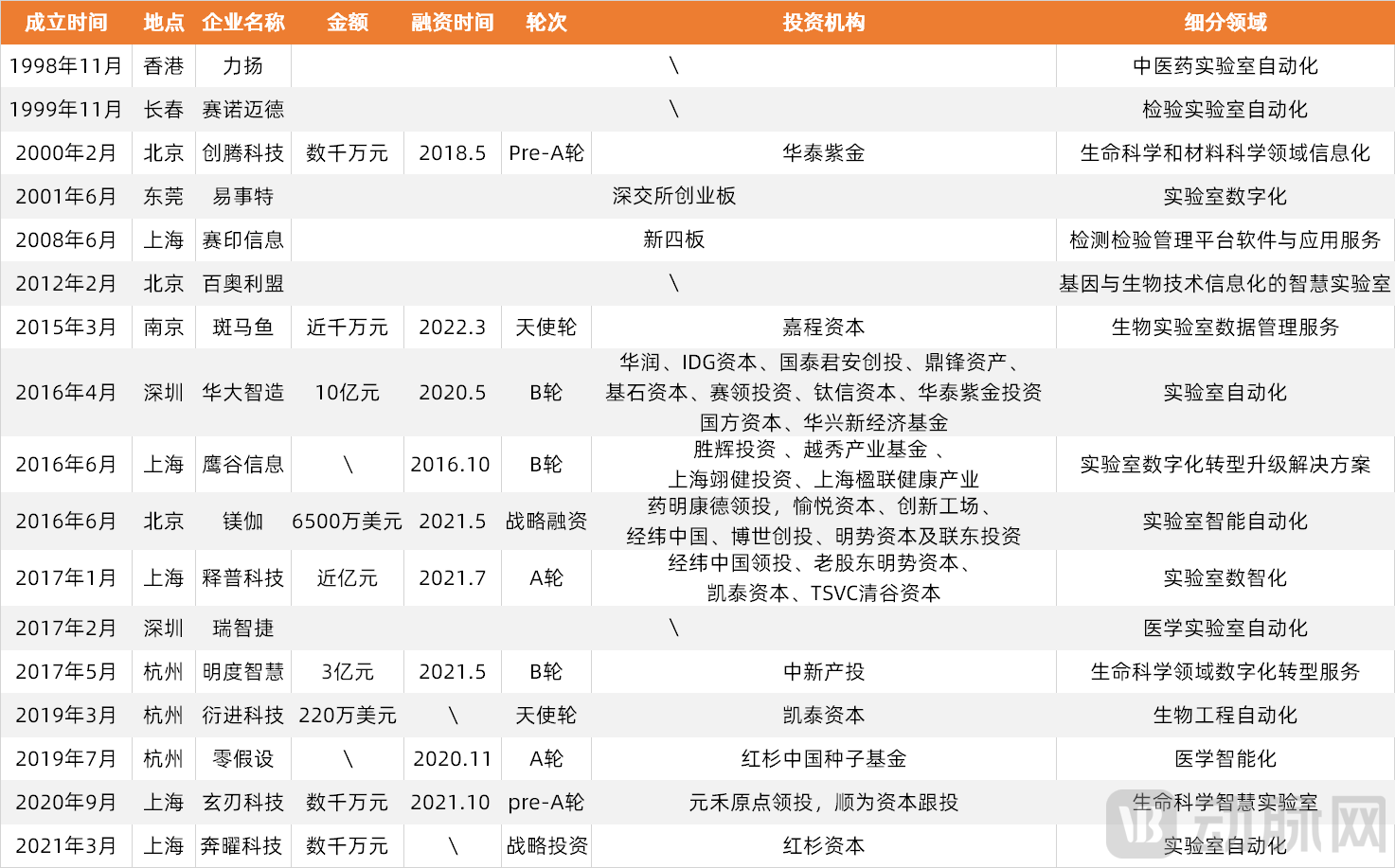
Post-2020 marks a period of vigorous growth for smart laboratories, with multiple companies completing new rounds of financing.
Established in 2020,Xrazor TechnologyXrazor Technology has completed two rounds of financing, totaling nearly RMB 100 million. Specializing in laboratory automation, Xrazor Technology leverages its core team’s extensive experience in product development and team management within the robotics industry to provide standardized products and solutions tailored for the life sciences sector. Its products are widely applied in healthcare, drug discovery, in vitro diagnostics (IVD), biobanking, and genetic engineering, significantly enhancing experimental efficiency and quality.
Focused on Laboratory DigitalizationShipu TechnologyShipu Technology completed two rounds of financing in March and July 2021, respectively. The company has been selected for the global top-tier accelerators Y Combinator and Microsoft Accelerator. Leveraging AIoT, an IoT-based digital intelligence platform, and artificial intelligence technologies, Shipu Technology ensures safety and compliance in laboratories across various industries, improves efficiency, reduces costs, and empowers data-driven decision-making. Its clients are widely distributed across sectors such as biopharmaceuticals, inspection and monitoring, research institutes, and smart regulation. The company helps customers achieve automation and intelligent management across the five key elements—personnel, equipment, materials, methods, and environment—thereby comprehensively enhancing operational efficiency.
Just this past March, benchmarking against Benchling'sZebrafishCompleted an angel round of financing exclusively invested by Jiacheng Capital. ZFISH focuses on building a life science R&D data platform, aiming to boost the efficiency of life science research and development by strengthening the mining of data value. After more than a year of research and development, ZFISH has initially completed the construction of Yilan Notes, which now has main modules such as project management, experimental records, registration center, and inventory, covering most usage scenarios in biological laboratories. In 2022, ZFISH will launch the cloud version of Yilan Notes and gradually add features for online biological tools, data processing, and report generation.
In addition to gaining recognition from the capital market, some companies have also achieved new breakthroughs in their products. For example, since 2016, laboratory automation technology and product developmentMGI TechAt the 2021 International Conference on Genomics (ICG), MGI launched the next-generation automated sample preparation system, MGISP-Smart 8, achieving significant breakthroughs in flexibility and intelligence. This launch further enhanced MGI’s portfolio of laboratory automation equipment and expanded the application scenarios for automated production lines.
2021,MegaRoboChina’s first independently developed, general-purpose intelligent automated biological laboratory—Kunpeng Laboratory Phase I—has officially been completed at the Life Science Park in Changping District, Beijing. Meanwhile, MEGA is also deploying automated biological laboratories with diverse functionalities in Shanghai and Suzhou, which are expected to become operational in 2022.
For any field aiming to build itself up from scratch and achieve significant growth, various problems are bound to arise along the way, and smart laboratories are no exception. So, what key challenges do these innovative enterprises face?
Customers' diverse needs require enterprises to provide more robust underlying technologies.He Xueying, founder of Xrazor Technology, stated that different life science laboratory scenarios entail distinct usage requirements, with the greatest challenge lying in how to plan and design modular equipment to meet customers’ non-standard needs. Xrazor Technology’s approach is to achieve this gradually and continue advancing it by leveraging standardized module combinations to adapt to and satisfy the demands of diverse scenarios.
Wang Jiaying, Senior Investment Manager at Haochen Capital, once shared two key challenges in automation at an event:First, technical challenges, it is difficult for robots to fully replicate human movements. This requires not only the development of many precision structural designs but also the application of technologies such as AI and algorithms, enabling robots to possess visual and cognitive capabilities as well as self-adjustment abilities.Second, the accumulation of industry and process know-how.For instance, the types of samples that robots need to process are highly diverse, with varying physicochemical properties (such as different densities, fineness, viscosities, and corrosiveness). A comprehensive process database must be accumulated to ensure the stability and reliability of the robots, thereby enabling more flexible delivery. This scenario involves substantial “soft” expertise and accumulation, meaning it is not something any random robotics company can simply enter and execute.
“Overall laboratory research methodologies and data management approaches remain quite traditional..” Jia Shuxin, founder of ZFISH, stated candidly that this traditional approach leads to unclear and uncontrollable experimental processes, as well as non-standardized results with questionable reliability. This is one of the reasons why traditional drug development cycles are long and costs are high. Furthermore, improving data management tools and methodologies can serve as an effective means to enhance inter-laboratory collaboration efficiency.
Scarcity and High Turnover of Interdisciplinary TalentAs global markets demand greater agility in the research and development (R&D) and supply chains of pharmaceuticals and medical devices, the traditionally high-cost R&D sector faces new challenges, driving the biotechnology and pharmaceutical industries to become increasingly capital-intensive. Companies’ talent needs are no longer limited to professional expertise in life sciences, biotechnology, and pharmacy; they also require professionals skilled in data science, artificial intelligence (AI), and software/hardware engineering to accelerate drug development. “With high-throughput automation, massive volumes of data require robust information systems for management. The coordinated development of data analysis, computation, and visualization is essential. Achieving this requires interdisciplinary talent with expertise in both biology and informatics,” said Zhao Jingya, Investment Manager at Jiacheng Capital.
The overseas smart laboratory market, led by the United States, is rapidly advancing in its deployment of digital and automated laboratories and is currently in a growth phase. For instance, Benchling, a prominent U.S. provider of laboratory digitalization solutions, completed its Series E and F funding rounds in 2021 and is preparing for an IPO on the New York Stock Exchange. Benefiting from a robust economic environment, the United States possesses sufficient resources and conditions to explore uncharted territories; although failures may occur, there is ample capital to allow for fresh starts. In light of this, domestic innovators can follow suit by leveraging the technologies and product designs of foreign counterparts, optimizing and upgrading them to meet localized needs, thereby avoiding the repetition of past mistakes.
As the pace of life accelerates and the winds grow stronger, we must stand ever more firmly. Only through unwavering consistency can we go far. In terms of uncovering customer needs, China is still in its infancy, requiring greater effort to refine underlying technologies. Only by building a solid technological foundation can we meaningfully pursue domestic substitution and drive optimized innovation.
To gain a comprehensive understanding of the current development status of smart laboratories in China and analyze the underlying challenges, VCBeat will host a three-part series titled “Behind the Transformation of Smart Laboratories.” The series will invite relevant enterprises and investment institutions to share their insights, jointly exploring the current landscape, industry value, market service systems, and new investment opportunities in the smart laboratory sector, thereby providing valuable references for more industry professionals.
[Smart Laboratory] Issue 1
Event Time: April 7, 2022, 20:00–21:00
Guest Speakers: Jia Shuxin, Founder of ZFISH; Zhao Jingya, Investment Manager at Jiacheng Capital

We extend our sincere gratitude to ZFISH, Xrazor Technology, and Jiacheng Capital for their strong support of this article.