

Yi Piao Nan Qiu Files IPO Prospectus Highlighting the Critical Role of Technical Managers in China's Tech Transfer Ecosystem
In the past one to two years, the state hasTechnology Manager. has become increasingly intense.
According toVCBeat Orange BureauStatistics show that among the 49 policies introduced in 2021 concerning the translation of scientific and technological achievements, 17 of them“Strengthen the Training of Technology Managers”Listed as a key focus.
Local governments, in particular, place considerable emphasis on technology transfer professionals. It is reported thatShanghai, Jiangsu, Guangzhou, Shenzhen, Hangzhou, Chengdu, Chongqingregions have all issued relevant regulations in 2021 to strengthen the training of technology transfer managers, andInclude technical managers in the “14th Five-Year Plan” Catalogue of Urgently Needed Talent Development.
In fact, this is an inevitable trend, becauseThe Times Have Raised New Demands on the Market.
Currently, driven by policy incentives and market guidance, an increasing number of scientists are stepping out of their laboratories and into the marketplace. However, this transition is far from easy. For the vast majority of scientists, determining how to better engage with the market and successfully translate their research achievements into commercial applications are highly specific and thorny challenges—ones that often lie beyond their existing capabilities.
Therefore, on the arduous journey of translating discoveries from the laboratory to the market, scientists need a “guide,” and this “"The Guide" is the technology manager.
But surprisingly,Compared with top-tier scientific research talents, professional technology managers are in extremely short supply in China.This is reflected not only in absolute numbers but also in the quality of talent, specifically the professional competence of technology transfer managers, which lags significantly behind that of Europe and the United States.
How, then, can we break through the current impasse? What role do technology transfer professionals actually play in the commercialization process? Why are they so “rare” in China? And what are the distinctive characteristics of their counterparts abroad? To answer these questions,VCBeat Orange BureauConducted in-depth analysis.
How Is a Technology Manager Defined?
For most people, the term “technology transfer professional” may be relatively unfamiliar. The official definition states that“Natural persons, legal persons, and other organizations that engage in brokerage services—such as intermediation, commission agency, or representation—to facilitate technology transactions for others with the aim of promoting the commercialization of technological achievements, and receive reasonable commissions in the technology market.”
Literally, technology transfer professionals may appear to be performing the role of “intermediaries,” but in reality, it is far more complex than that.
The complete process of technology transfer and commercialization is quite complex, involving“Needs assessment, expert matching, technical evaluation, market research, business planning, legal agreements, site visits, tripartite agreements, ongoing communication”...and many other matters. Although many steps are similar to those involved in working with real estate agents, the operational complexity of each step is significantly higher than that of property leasing.
Therefore, a qualified technology transfer professional is often required to be proficient in at least three languages, namelyMarket Language, Technical Language, and Government Language。In other words, technology managers must not only understand technology and be well-versed in market operations, but also stay abreast of first-hand policies from relevant departments such as those overseeing science and technology, as well as industry and information technology.
The reason for imposing such stringent requirements on technology managers stems from theiran indispensable role in the process of translating scientific research into practical applications.
In fact, technology transfer managers are involved throughout the entire process of practical technology commercialization, rather than being limited to the intermediary role of matchmaking. From project research and development to implementation, technology transfer managers possess the most comprehensive understanding of the projects they handle. Their command over both technology and market dynamics directly determines whether scientific and technological achievements can be successfully commercialized.
Take the initial phase of a project as an example. Once an invention is made, technology transfer professionals will intervene during the invention disclosure stage to discuss with the inventors and map out their business canvas. Based on market research, they will clarify what pain points the product or service addresses, which customer segments it targets, what its unique selling proposition is, how it can effectively build relationships with customers, how to foster deep and sticky customer relationships, and what the revenue streams are.
In the early stage,Technology transfer professionals should provide direction for the commercialization of scientific research achievements,In addition to addressing technical challenges, it also involves a substantial number of market and business issues. At the core, it is oftenConduct customer discovery and market research, as this is a key element in confirming the direction of the technology and its market value.
As the project advances, technology transfer professionals will pay closer attention to the growth of startups. Therefore, their role will no longer be as simple as providing information to startups, but will instead focus onA complete set of commercialization guidance for technologies and access to market resource networks.
It is worth noting that technology transfer professionals typically operate as part of a team, which generally includes an intellectual property and technology assessment team, a technology licensing and negotiation team, and an investment and development team. For a mature technology transfer professional or institution, the ability to link and leverage external resources is often even more critical, serving as a significant indicator of their strength.
Why Are Technical Managers So Hard to Find?
If the proportion of European technology managers is used as the standard,For every 100 researchers, four technology transfer professionals should be allocated.Based on current data, China’s workforce of technology transfer professionals remains weak, with a substantial talent gap.
This “gap” is significantly impacting the current market for translating scientific research outcomes in accelerated running. According to data, from 2019 to 2022,China has ranked first globally in the number of patents for three consecutive years,However, China’s current conversion rate stands at less than 10%, with fewer than 5% achieving true commercialization, representing a significant gap compared to developed countries in Europe and the United States.
So, why has China failed to demonstrate the expected “demographic dividend” in the realm of technology transfer professionals? There are roughly five core reasons.
First, the market is still in its nascent stage, and the profile of technology transfer professionals remains ill-defined.
As early as the early 1980s, technical personnel from Shanghai and various towns in the Yangtze River Delta had already begun to move around; at that time, they were collectively referred to as"Technology Broker", primarily serving agents and other brokerage businesses.
In December 2017, the official source first cited"Technology Transfer Officer"This new designation entails not only a change in name but also a gradual expansion of its scope of capabilities, driven by the rapid advancement of the industry. Its service offerings have evolved from focusing on a single segment to covering the entire technology transfer process.
However, as the domestic technology transfer market is still in its early stages and pathways for innovative commercialization have not yet been clearly mapped out,"Technology Transfer Officer"This user profile is still being continuously refined.
Second, most existing technology managers are “latecomers” to the field and lack professional expertise.
Currently, domestic research institutions and medical centers have established internal technology transfer departments and appointed so-called “technology managers.” However, these personnel are primarily transferred from existing staff within the institutions, resulting in a limited understanding of technology transfer and relatively weak professional expertise. Consequently, they are often confined to performing basic administrative tasks and are unable to engage deeply in the core aspects of the technology transfer process.
Extending to the market, although these professionals possess a certain level of expertise compared to in-house “technology transfer managers,” they are often barred from research institutions and universities due to institutional constraints, making it difficult for them to access core project resources.
Third, the training system is inadequate, and there is a lack of top-tier mentors.
The most core and fundamental solution to the talent issue is “education,” but in this regard, China appears significantly weaker and more lagging compared to developed countries.
There are two primary reasons for this:One is a systematic training system,This cannot be resolved by merely offering a few training courses; rather, it requires building a comprehensive talent development program from the ground up, starting from first principles.Another is the scarcity of top-tier mentors,First, from a domestic perspective, China currently lacks specialized talent in this field. Even where such expertise exists, the primary focus of these professionals is not directed toward this area. Furthermore, due to the impact of the pandemic in recent years, it has been challenging to recruit and strategically plan for the acquisition of top-tier international talent in technology translation and commercialization.
Fourth, the industry has extremely high entry barriers, yet career advancement pathways are exceedingly narrow.
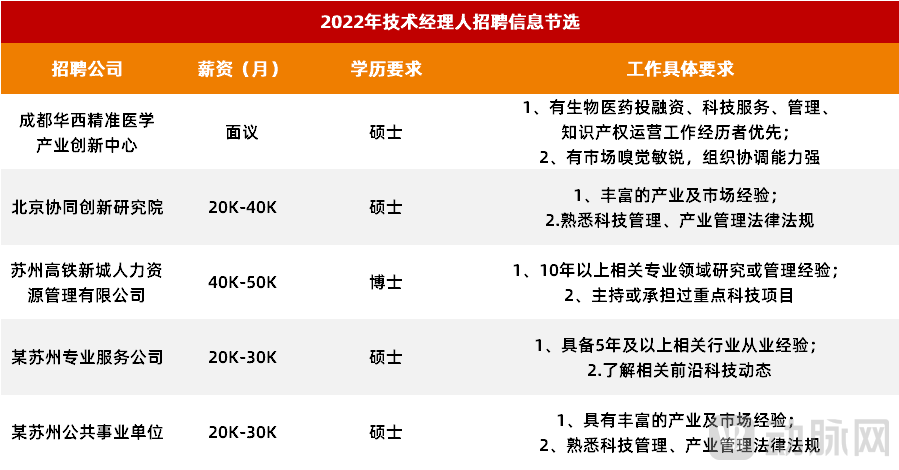
Based on the current recruitment market, the requirements for "technology managers" are extremely stringent.First, in terms of academic qualifications, with a master’s degree as the minimum requirement, and candidates are generally expected to have graduated from top-tier overseas universities or domestic institutions classified under Project 985 or Project 211;Secondly, in terms of work experience,Must have 5 years or more of experience in translational work;Finally, in terms of capabilities,“Technology managers” must not only understand technology but also the market, which means they must integrate core competencies in product development, market assessment, market strategy, investment, and finance.
However, the inequality lies in the fact that while the market places high demands on them, it fails to provide a clear path for their professional development. Currently, technology transfer professionals have not been formally incorporated into the national vocational qualification system, resulting in the absence of streamlined channels for professional evaluation. This means that, as an emerging occupational group, technology transfer professionals have lacked appropriate avenues for title promotion for a considerable period. Consequently, many technology transfer professionals in the market remain in a state of "limbo."
Fifth, commissions are hard to come by; a single deal cannot sustain one for an entire year.
The "difficulties" herein encompass four dimensions:The first is the low success rate,It is reported that the conversion rate of scientific and technological achievements in China is less than 10%, and the reasons for this are not limited to technology transfer professionals;The second is the long transaction cycle,The commercialization of scientific and technological achievements is inherently a relatively protracted process; compounded by other objective factors, it takes technology transfer professionals anywhere from six months to two or three years to realize returns.The third is that the returns are relatively low,Technology transfer professionals often have to manage multiple scientific research achievements simultaneously just to make ends meet.
How to Stand on the Shoulders of Giants?
It is undeniable that challenges surrounding technology transfer professionals do exist, but we are continuously making attempts and efforts to address them.
First, in terms of policy guidance.China has successively promulgated and implemented core policies such as the Law on Promoting the Transformation of Scientific and Technological Achievements and the Plan for Building a National Technology Transfer System. In 2020, the Ministry of Science and Technology also issued the Outline for Competency-Level Training of National Technology Transfer Professionals (Trial), requiring the establishment of a standardized training system for technology managers that covers all stages, including cultivation, management, and assessment.
Secondly, in terms of the intensity of training.Currently, there are numerous training programs for technology managers in the domestic market, with deep involvement from the government, universities, and enterprises.
Then, in terms of building the professional title system.In October 2019, Beijing launched its first-ever professional title evaluation for technology brokers. By January of this year, the initial list of individuals awarded professional titles in the technology brokerage field was officially made public in Beijing, with 94 individuals passing the review for engineer-level professional technical qualifications and 109 passing for assistant engineer-level professional technical qualifications.
Finally, in terms of positive incentives.Research institutions and medical centers in China have begun to establish specialized, innovation-oriented positions dedicated to technology transfer. Performance-based compensation is increasingly skewed toward technology transfer personnel who make outstanding contributions, with their share reaching as high as 30%.
However, given the current practical realities, certain limitations persist. Therefore, it may be worthwhile to turn our attention to the United States, where the technology transfer professional market is already quite mature, and examine what they have done right in developing this workforce.
First, start with policy to quickly establish industry planning and talent profiles.
Over the 31-year period from 1980 to 2011, the United States successively enacted and promulgated the Bayh-Dole Act, the Stevenson-Wydler Technology Innovation Act, the Federal Technology Transfer Act, and the Technology Transfer Commercialization Act.16 Laws and Regulations Related to Technology Transferto standardize the technology transfer service system and accurately define the profile of technology managers.
Second, leverage universities as the starting point to maximize market vitality.
In 1980, the U.S. Congress passed the Bayh-Dole Act, which stipulated that ownership of scientific research projects funded by the government would belong to universities, while imposing on them the responsibility to promote the specialization and commercialization of research outcomes within a specified timeframe, thereby creating market value. Subsequently, following the model of Stanford University’s Office of Technology Licensing established in 1970, U.S. higher education institutions began to extensively build technology transfer offices. In 1989, the Association of University Technology Managers (AUTM) was founded, cultivating a large workforce of university-based technology transfer professionals.
Third, attach importance to assessment and evaluation, selecting the best of the best from the pool of technology transfer professionals.
It is reported that many U.S. universities invest heavily in their Technology Transfer Offices (TTOs), including the recruitment and training of technology managers. Data show that many U.S. universities are quite “generous” in operating their technology manager programs, with annual expenditures exceeding tens of millions of dollars.
Of course, this investment should not be in vain, which has led to an increased emphasis on the performance evaluation of technology managers. It is worth noting that world-renowned universities primarily conduct performance evaluations focused on their Technology Transfer Offices (TTOs). In terms of evaluation entities, these assessments are typically carried out by the university itself or industry associations. They evaluate metrics such as the volume and rate of invention disclosures and patent grants, as well as the number and monetary value of patent licenses and assignments, and then make internal adjustments based on the results.
Fourth, safeguard the rights and interests of technology transfer professionals and accord them due respect.
In a comprehensive technology transfer process, the inventor first discloses the invention to a technology manager, who conducts a thorough assessment to determine its patentability and commercialization potential. Subsequently, the technology manager engages with companies and enterprises to discuss collaboration intentions, executes technology transfer agreements, and oversees subsequent marketization efforts while providing consulting services. Finally, the technology manager relays market feedback and other relevant information back to the inventor.
Under this model, the professional rights and interests of technology transfer managers are legally protected, enabling them to fully demonstrate their expertise during the commercialization process, which will inevitably enhance the success rate of technology transfer.
Data show that, between 1996 and 2015, the transfer and commercialization of technological innovations contributed to the U.S. gross domestic product (GDP) byNearly $591 billion.Additionally, in 2016, the United StatesMore than 1,000 healthcare-related startups have been established.Provided to the patientNearly 800 commercial drugs derived from university research.None of this would have been possible without the efforts of technology transfer professionals working behind the scenes.
"The Road Is Long and Arduous: While Striving for Precision, One Must Also Allow Time to Take Its Course"
Translating scientific research achievements into practical applications is not easy, especially in the medical field, where it becomes even more challenging.
Fortunately, our exploration of the translation pathway is gradually accelerating, and we have achieved certain results at this stage. However, the road ahead remains long, and as we progress, we will encounter increasingly numerous and complex challenges.
Therefore, in addition to precisely addressing issues, it is also necessary to exercise patience by first expanding the pool of professional technology transfer managers, thereby allowing this operational model to gradually mature.