

Domestic Medical Lasers Strike Back: Four Key Trends Unlocking Growth Opportunities

MIL MED TECH
Laser-Based Minimally Invasive Medical Device Developer

FIB Medical lasers
Developer, Manufacturer, and Distributor of Surgical Equipment

Blueray Medical
High-end Medical Device R&D Manufacturer
In 2021, medical laser companies that had remained silent for years stepped into the spotlight to embrace their moment of glory.
In March 2021, global medical device giant Boston Scientific acquired the laser surgery business of Lumenis for $1.07 billion; in October 2021, Candela, a leading company in aesthetic energy-based devices, went public on the NASDAQ; in June 2021, So-Young acquired Qizhi Laser for RMB 791 million...
Although financing events in China’s medical laser sector have been scarce in recent years, a cohort of companies represented by MIL MED TECH, Nanjing Baifu Laser Technology Co., Ltd., and femtosecond laser manufacturersIndependent R&D, Innovation, and Proprietary Core TechnologiesEmerging medical laser companies have risen one after another, securing successive rounds of financing in 2021. Behind them standYuan Yi Capital, Oriental Fortune Capital, Ruiyi Capital, Yizhuang Capital, Northern Light Venture Capitalincluding a host of leading investors, also haveLikai MedicalThis is how established medical device manufacturers are doubling down.
Capital is the smartest; it always follows the scent to where the resources are most abundant. Words may deceive, but capital does not.
Why is the medical laser sector worth watching? Which emerging companies are standing out in this space? What are the future development trends of the industry? VCBeat conducted interviewsFIB, MIL MED TECH, Nanjing Baifu Laser Technology Co., Ltd., AlphaMed, Blueray Medicalsuch as medical laser companies andYizhuang Capital,Oriental Fortune Capitalventure capitalists, with the aim of addressing these questions.
Looking back at China, during the 1980s and 1990s, the Chinese public was largely unfamiliar with the application of laser therapy for diseases across various medical specialties, including dermatology, and the field of laser-based disease treatment in China was nearly nonexistent. In contrast, Western developed countries had already achieved near-universal adoption of laser technology, with widespread use even in veterinary medicine. It can be said that domestically produced medical lasers only began their development “from scratch” approximately two decades ago, leaving a substantial gap to be bridged. Yet, it is precisely within this gap that lies a market with immense potential.
Although China’s adoption of medical laser applications started relatively late, a number of innovative enterprises have been catching up rapidly in recent years, rivaling industry giants in certain technological domains and even surpassing their overseas counterparts. As multiple domestic medical laser companies secure financing, the medical laser sector is ushering in a new competitive landscape.
Luo Shouhong, Partner at Yizhuang CapitalIndicates,The core issue in the laser medical industry lies in the scarcity of enterprises that possess independently developed, innovative technologies. Consequently, Yizhuang Capital’s primary consideration is the technical background of the core team—specifically, whether R&D capabilities are held firmly by the founding team. The secondary consideration is the team’s business acumen. While weak commercialization capabilities can be strengthened at a later stage, poor business sense among the founders will result in an inability to retain top talent, even if such individuals are successfully recruited.
Zhang Feng, Investment Director at Oriental Fortune CapitalIt was stated that domestically produced medical lasers are in a relatively early stage of development, with broad future prospects. Currently, China’s laser medical equipment market is dominated by imports, with a low localization rate for key devices. Meanwhile, the market penetration of medical laser products in China remains low, indicating that the market requires further development and education; thus, challenges and opportunities coexist. Additionally, to avoid potential intellectual property disputes, investors prioritize companies with capabilities in foundational technology research and development when selecting projects.
Who Will Dominate the Medical Laser Industry in the Future? VCBeat Has Compiled a List of Emerging Chinese Medical Laser Companies to Present the Landscape of Domestic Enterprises and Technologies. If You Are an Entrepreneur in This Field, Please Contact the Author. The Following List Is Sorted Alphabetically by Company Name:
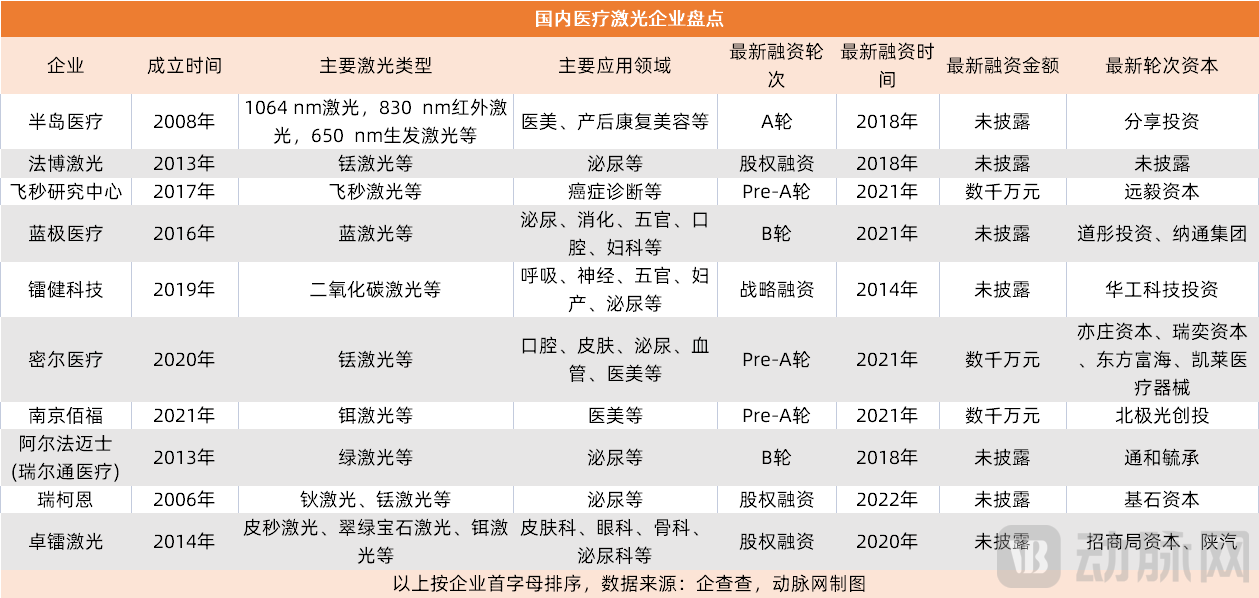
Why Did Chinese Medical Laser Companies Experience a Collective Funding Boom in 2021?
From the perspective of the market environment, domestically produced medical lasers have low penetration rates, offering significant growth potential.In the medical field, the application of lasers is becoming increasingly widespread. Areas such as ophthalmology (e.g., myopia correction, retinal repair), surgery (laser scalpels), internal medicine, gynecology, otolaryngology, cardiology, and dermatology have all become applicable domains for laser medical devices. According to data from Forward Economics, an average of 10–15% of surgical procedures in developed countries utilize laser surgical instruments to replace traditional scalpels or other surgical tools. However, the current medical laser market in China is dominated by imports, with a low penetration rate for domestically produced medical lasers. According to forecasts by the consulting firm Frost & Sullivan, the domestic medical laser market size in China will exceed RMB 30 billion in 2022, indicating immense market potential.
From the product perspective, high cost-effectiveness has become the trump card for medical laser companies to "dominate the market."The issue of “high-priced imported devices” faced by medical institutions in China is also encountered by their counterparts abroad, particularly in Latin America and Africa. The exorbitant prices lead to significantly high procurement costs for hospitals and medical facilities, which indirectly hinders the market promotion of aesthetic laser equipment. In contrast, domestically produced laser devices offer controllable costs and affordable pricing; with comparable quality and efficacy, their prices are only a fraction of those of imported machines. Leveraging their high cost-performance ratio, Chinese laser manufacturers have broken through the dominance of established players from the United States, Japan, and Germany, emerging as a formidable new force in the industry.
From the perspective of the policy environment, the continuous introduction of relevant policies and the broader context of domestic substitution have laid a solid foundation for the development of medical laser enterprises.Since the issuance of the Outline of the National Medium- and Long-Term Program for Science and Technology Development (2006–2020) in 2006, which first listed laser technology as a frontier technology prioritized for development in China, supportive policies for the laser industry have been progressively introduced. Key policy documents, such as the 12th Five-Year Plan for the Development of National Strategic Emerging Industries (2012), the Special Plan for Scientific and Technological Innovation in the Field of Advanced Manufacturing during the 13th Five-Year Plan Period (2017), and the Action Plan for the Development of the Basic Electronic Components Industry (2021–2023) (2021), have all provided important guidance on technological advancements and industrial development within the laser sector. The state has placed the development of the medical device industry at a strategic height, introducing various policies to support independent research and development and “import substitution.” Driven by these continuous policy efforts, an increasing number of high-quality domestically produced medical laser devices have entered the market, and the market share of domestic brands continues to expand.
According to a market research report by Allied Market Research, the global laser medical market is projected to reach $12.586 billion in 2023. In terms of global market share for laser medical devices, North America accounts for approximately 35%, Europe and the Middle East for about 25%, the Asia-Pacific region for roughly 20%, and China for around 15%. Compared with developed countries, China’s laser medical industry still lags behind in scale, core technologies, and promotion and application.
Which domestically produced lasers possess original R&D capabilities? What are their primary disease application scenarios and representative companies?
Thulium laser,The output wavelength is 1940 nm, with a wavelength range of 1.75 μm to 2.22 μm. Positioned near the strong absorption peak of water, it exhibits an exceptionally high absorption coefficient for water and is the only laser that can be completely absorbed by water. Thulium laser has a very shallow tissue penetration depth—only 0.2 mm—thereby achieving both efficient vaporization and precise cutting.
withPrecise operation, minimal intraoperative bleeding, clear surgical field, rapid postoperative recovery, low incidence of postoperative complications, and high safety profile in the treatment of elderly high-risk patients.such advantages. As a medical laser technology, thulium laser was approved by the FDA for clinical use in 2004, received CE certification from the European Union in the same year, and was approved for entry into the Chinese market in 2005. In recent years, it has undergone rapid development and widespread application in clinical practice. It is mainly applied toUrology, Stomatology, Dermatologyand other treatments. Representative companies include:MIL MED TECH, FIB.
Erbium Laser,It is a solid-state pulsed laser with a wavelength of 2.94 μm, which coincides precisely with the peak absorption wavelength of water. Since human skin tissue contains a high water content, it exhibits strong absorption of light at 2.94 μm. In contrast, subcutaneous tissues and muscle tissues, which are rich in pigmented components, have very low absorption rates for this wavelength. Consequently, the erbium laser can accurately deliver therapeutic energy and biological information to the skin tissue, achieving effective treatment outcomes without affecting the surrounding tissues.
possessingSafe grinding, minimal thermal damage, no anesthesia required for most treatments, short healing period, and low side effectssuch advantages. The erbium laser was first approved by the U.S. Food and Drug Administration (FDA) in 1994 for the treatment of soft and hard tissues in the oral cavity. It is primarily used in dermatological and dental treatments, with representative companies includingNanjing Baifu Laser Technology Co., Ltd., Zhuolei Laser.
Holmium Laser,It is a solid-state pulsed laser that uses the rare earth element holmium as the lasing ion, with a wavelength of 2.1 μm and a high absorption coefficient in water. The absorption depth of holmium laser in tissue is less than 0.4 mm, resulting in shallow penetration that enables precise cutting without damaging surrounding tissues.
possessMild postoperative reaction, good adaptability, effective hemostasis, and few complicationsand other advantages. Mainly applied inUrological Therapy, representative companies includeRaykeen。
Blue Laser,It was discovered by scientists in the early 1990s. In 2014, three Japanese physicists were awarded the Nobel Prize in Physics for the invention of blue lasers and blue LEDs.
havingRapid vaporization, effective hemostasis, minimal thermal tissue damage, compact device size, and low noiseand other advantages. It is mainly applied inUrological Therapy, with representative companies includingBlueray Medical。
Green Laser,With a wavelength of 532 nm, this laser is generated by frequency-doubling the 1064 nm beam of a neodymium:yttrium-aluminum-garnet (Nd:YAG) laser through a potassium titanyl phosphate (KTP) crystal. It is a type of laser that is highly absorbed by oxyhemoglobin but not by water. The green laser has a penetration depth of only 0.8 mm, resulting in minimal thermal conduction and no significant damage to surrounding tissues. It forms a 1–2 mm coagulation layer on vaporized tissue, which helps prevent postoperative tissue edema, necrosis, and slough formation. The coagulation zone seals blood vessels, providing effective hemostasis and reducing the absorption of irrigation fluid. The green laser simultaneously vaporizes and occludes tissue capillaries, achieving vaporization and hemostasis concurrently with virtually no bleeding. It is the laser type with the highest energy conversion efficiency during surgical procedures.
PossessingMinimally invasive, bloodless or with minimal bleeding, broad indications, few side effects, short hospital stay, minimal impact on postoperative sexual life, and no surgical risk for high-risk patients with comorbidities such as heart disease, hypertension, and diabetes.such advantages. It is mainly applied inUrological Therapy, with representative companies includingAlphaMeds。
Femtosecond laser,It is the shortest pulse achievable by humans under experimental conditions, with an extremely brief duration of only a few femtoseconds, thousands of times shorter than the shortest pulses obtained using electronic methods. FeaturingUltra-high peak power, precise targeted focal positioning, and minimal tissue damageand other advantages. It is mainly applied inOphthalmic Treatment, with representative companies includingFemtosecond Research Center FAR。
In addition, there are alsoNd:YAG laser, diode laser, 1470 nm laserlaser. Due to the limited length of this article, further elaboration will not be provided.
In the preceding section, we reviewed emerging domestic medical laser companies. Through our communications with them, VCBeat has identified four key characteristics shaping the future development of the medical laser sector.
Customizing Laser Light Sources Based on Clinical R&D Needs from a Clinical Perspective
Laser medicine is, at its core, rooted in healthcare; everything must be driven by clinical needs.
The common technologies urgently requiring breakthroughs in the current medical laser industry should include laser light sources, front-end beam delivery systems, and human-computer interaction designs that are highly customized according to indications, surgical requirements, and physicians’ operational habits.
Dai Yixiang, Founder of MIL MED TECHIt stated: “Regardless of whether laser medical devices operate on the principles of selective photothermolysis, photomechanical effects, or photochemical effects, they all rely on the interaction between target tissues and laser beams with specific wavelengths, power levels, frequencies, and pulse widths. Therefore, the first step must be to customize the corresponding laser light source based on clinical R&D requirements. Conversely, seeking indications for off-the-shelf lasers is akin to looking for nails with a hammer in hand, making it impossible to fully meet clinical needs. The front-end light delivery system and human-machine interaction design further determine the user-friendliness of laser medical devices for physicians. During product design and clinical validation, laser medical engineers must extensively consult with clinicians and patients, and iteratively refine handpieces, fiber optic consumables, auxiliary devices, user interfaces, and footswitch logic, in order to truly develop products that are easy for doctors to use and well-received by patients.”
From a technical perspective, precision, minimal invasiveness, and non-invasiveness will become the development trends of minimally invasive surgical technology.
Throughout the history of surgical development, the first generation of medical devices emerged in the era of "cold instruments" (passive devices), which directly treated lesions through open surgery using mechanical energy. Despite drawbacks such as large incisions, significant bleeding, and prolonged recovery, these surgical instruments provided physicians with a crucial therapeutic modality, ushering human disease treatment into the era of surgical intervention.
Sixty years ago, surgical instruments entered the era of thermal devices (active equipment and instruments). By leveraging the properties of electrical energy, they overcame many limitations of mechanical energy, such as constraints in energy transmission pathways and low energy density. This advancement not only reduced instrument size but also enabled conversion into various other forms of energy, thereby giving rise to minimally invasive surgical techniques. These techniques have achieved significant clinical benefits, including minimal trauma, reduced bleeding, and faster recovery, making active surgical instruments the most important category of medical devices in contemporary surgery.
With the transformation of modern medical paradigms, the application of laser medicine is shifting forward from disease diagnosis and treatment to disease prevention, leading the evolution of clinical practice by prioritizing precision, minimally invasive techniques, and non-invasive approaches as key technological breakthroughs.
AlphaMesh CEO Qian Jinghongstated: “We believe that the high energy density, directionality, monochromaticity, and coherence of lasers will propel laser surgical technology to lead medical devices into the next era—the Era of Laser Surgery. This will usher in the widespread adoption of non-invasive procedures and deliver unprecedented clinical outcomes, such as ultra-low thermal damage, minimal bleeding, tiny incisions, or even completely non-invasive interventions. Leveraging the unique physical properties of lasers, such as selective absorption, surgical laser technology enables precise cutting and even vaporization of specific tissues, achieving minimally invasive effects. Furthermore, through various modulation techniques, lasers such as femtosecond lasers can utilize photomechanical effects to perform cold, cell-level precision cutting without causing thermal damage, empowering surgeons to perform extremely delicate procedures that were previously unimaginable.”As an active participant in China's minimally invasive surgery sector, Alpha Medical, together with its subsidiary Ruitong Medical, is committed to building a comprehensive, multi-dimensional ecosystem of surgical laser energy technologies. The company aims to provide clinicians with laser surgical systems that are comprehensive, highly efficient, and cost-effective.”
From an R&D perspective, new technologies integrating medicine and engineering will empower medical lasers.
Medical devices span multiple sectors, including healthcare, machinery, and electronics, constituting a high-tech industry characterized by multidisciplinary integration, knowledge intensity, and capital intensity. The convergence of medicine and engineering has become a major trend in the development of medical devices, and this holds true for the field of medical lasers as well.
Fan Yubo, Dean of the School of Biological Science and Medical Engineering, Beihang UniversityIt was pointed out that promoting the interdisciplinary integration and collaborative innovation between medicine and engineering is a key factor in breaking through the “bottleneck” of innovation in China’s medical device industry. It was further recommended that, fundamentally, R&D investment in innovation within the medical device sector should be increased; efforts to cultivate leading innovative talents in biomedical engineering should be strengthened; and cross-disciplinary and cross-industrial integration with fields such as electronics, mechanics, materials science, software, and information technology should be enhanced. Additionally, greater emphasis should be placed on integrating industry with education and science with education in the medical device field.
Xu Jia, General Manager of FIB“It was stated that, with the advancement of related disciplines such as chemistry and biology, various biological probes and targeted labeling technologies have rapidly developed. The integration of laser optics, materials science, nanotechnology, and biotechnology is continuously creating new opportunities for medical diagnosis and treatment.”
In terms of sales channels, going global has become the market choice for many domestic medical laser companies.
Many medical laser companies have chosen to expand directly into overseas markets, primarily for two reasons.
First, overseas approval requirements are more lenient than those in China, resulting in a shorter certification timeline. According toJia Yangchun, Founder of Nanjing BaifuIntroduction: Domestic medical laser devices face challenges in obtaining regulatory approval, characterized by high difficulty and prolonged cycles. In China, laser medical devices are classified as Class III devices, subject to stringent review processes that typically require 2–3 years for certification. In contrast, overseas markets generally grant approval within 1–2 years. The lower regulatory barriers in these international markets enable companies to rapidly scale up product distribution and generate revenue.
Second, the high cost-effectiveness of domestically produced medical lasers creates a competitive advantage for global expansion. Some Chinese laser manufacturers have independently developed core components, reducing costs and increasing gross profit margins, thereby gaining a cost-performance edge over imported medical laser devices. Compared with foreign giants’ equipment, which often costs hundreds of thousands to millions of dollars, “Intelligently Made in China” medical laser devices offer superior performance at lower prices, delivering greater value for money. This provides Chinese enterprises with a distinct advantage in going global.
Of course, some enterprises are driven by commercial strategic needs, adopting a dual-wheel drive to initiate the second curve of growth.