Barty Medical Secures Nearly RMB 200 Million Series D Funding to Advance Commercialization of Next-Gen Constrained Drug-Coated Balloons
Barty Medical
Vascular Interventional and Implantable Device R&D Manufacturer
On June 10, Barty Medical announced the completion of its Series D financing round, raising nearly RMB 200 million. The round was led by China East Ventures, with participation from institutions including Zhejiang Province’s “4+1” Biopharmaceutical and High-End Medical Device Industry Fund, Yifeng Capital, and Zhongyiren Capital. Existing shareholder Junxingjian Capital continued to increase its investment.
In the current investment and financing environment for medical devices, a vascular interventional company has completed nearlyA RMB 200 million financing round is not common.
Public information shows that Barty Medical was established inIn 2015, headquartered in Hangzhou, the company primarily focused on cardiovascular and peripheral vascular interventions. Its product portfolio currently covers vascular access devices, balloon dilation catheters, drug-coated balloons, and more.
According to the information disclosed by the company, this financing will be primarily used for the commercial promotion of third-generation constrained drug-coated balloons, the establishment of clinical evidence, and the research and development of subsequent innovative products.
Rather than the financing amount itself, the industry is more focused on the technological direction Barty Medical has bet on.
In recent years, as markets for coronary stents and peripheral interventions have gradually matured, industry competition has been evolving from single-product rivalry to platform-based and systematic strategic layouts. Constrained drug-coated balloons represent one of the key areas of focus for Barty Medical.

FromFrom the “Implant Era” to “Intervention Without Implants,” Drug-Coated Balloons Are Gaining Increasing Attention
Balloon angioplasty is the most fundamental technique in endovascular intervention.
Although early conventional balloons could open stenotic vessels, the restenosis rate was high. The subsequently introduced drug-eluting stents (DES) significantly improved therapeutic efficacy through sustained drug release, gradually becoming an important strategy in coronary intervention.
However, the stent will remain in the blood vessel long-term after implantation.
So in the past few years,“Leave Nothing Behind (intervention without implantation)” is gradually becoming an important direction in the field of vascular intervention. Physicians aim to minimize the impact of permanent implants on the long-term structure and function of blood vessels while restoring blood flow.
Drug-Coated Balloon (DCB) It was against this backdrop that rapid development took place.
Its mechanism involves loading drugs onto the surface of a balloon, delivering the drugs to the diseased vessel wall through a single dilation, thereby inhibiting neointimal hyperplasia while avoiding permanent stent implantation.
Currently, drug-coated balloons are widely used in the treatment of in-stent restenosis, small vessel disease, peripheral artery disease, and dialysis access stenosis.
As technology continues to mature, the focus of drug-coated balloon development has shifted from“Whether there is a drug” has shifted to “how to improve expansion quality, reduce vascular injury, and enhance drug delivery efficiency.”


Barty Medical's Bet on“What is the difference with ‘constrained drug-coated balloons’?”
The product that garnered the most attention in this financing announcement is Barty Medical’s independently developedMatrix Super PTX Peripheral Constrained Drug-Coated Balloon.
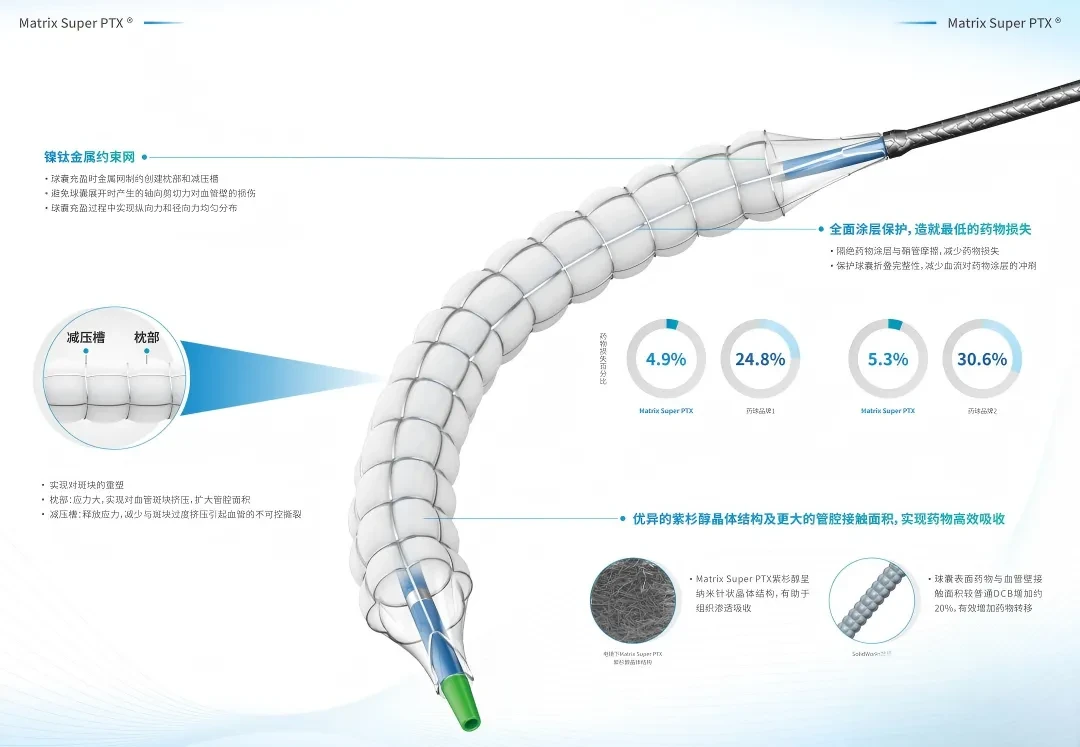
In the industry, conventional drug-coated balloons are generally regarded as first-generation products, while drug-coated balloons incorporating special structures such as scoring and cutting elements are considered second-generation products. Constrained drug-coated balloons are referred to by some industry experts as third-generation drug-coated balloons, with the core objective of further optimizing lesion preparation and dilation efficacy beyond drug delivery.
Public information shows that this product wasApproved for market launch by the National Medical Products Administration in 2024, it is referred to in public records as China’s first approved peripheral constrained drug-coated balloon.
Compared with traditional drug-coated balloons, the most significant difference of constrained drug-coated balloons lies in their expansion mechanism.
During conventional balloon dilation, the pressure exerted on the diseased vessel is often uneven, which may lead to complications such as dissection and elastic recoil in complex lesions.
Constrained balloons, through their specialized structural design, control the balloon dilation process, making it more manageable and reducing local stress concentration.
According to publicly disclosed information,Matrix Super PTX employs a nitinol-constrained structure to address both lesion preparation and vessel protection, in addition to drug delivery.
In other words, conventional drug-coated balloons place greater emphasis on“Drug delivery,” while constrained drug-coated balloons attempt to further address the mechanical issues during dilation.
This is also an important reason why special balloon technology has continued to attract attention in recent years.

Coronary Artery Products Enter Clinical Phase, Next Step Targets Larger Market
In addition to its already commercialized peripheral products, Barty Medical is also advancingMatrix Crush Coronary Constrained Drug-Coated Balloon Project.
Publicly available information indicates that the product has completed enrollment for its registration clinical trial.
Compared with peripheral vessels, the market size of coronary intervention is larger, but the technical threshold and competition intensity are also significantly higher.
For a long time, drug-eluting stents have dominated coronary intervention therapy, and the relevant clinical evidence system is already well-established.
Therefore, if drug-coated balloons are to further expand their indications for lesions in large coronary vessels, it is necessary to accumulate more comprehensive long-term follow-up data and demonstrate that their efficacy and safety meet clinical needs.
From the perspective of industry development patterns, such innovative products often require a prolonged period of clinical validation and market education.
With sufficient clinical evidence to support its use, both its scope of application and market potential are expected to expand further.

Drug-Coated BalloonTrackAlready entered"The Phase of 'Striving for Differentiation'"
Over the past few years, drug-coated balloons have remained one of the most dynamic niche segments in China’s vascular intervention field.
As products continue to gain approval and volume-based procurement is implemented, the competitive landscape of the industry is also evolving.
Currently, companies with a presence in the drug-coated balloon market in China include Acotec Medical, Dingke Medical, Genesis MedTech, MicroPort Endovascular, and others.
Among them, Acotec has established an early presence in the peripheral drug-coated balloon sector; Dingke Medical has built a relatively comprehensive product portfolio centered on specialized balloons; while JetMed and MicroPort Endovascular continue to expand their peripheral intervention product lines.
In such a market environment, merely possessing drug-coated balloon products is no longer sufficient to establish a competitive advantage.
Clinical data, product differentiation capabilities, cost control levels, and the development of commercialization systems are becoming new focal points in corporate competition.
For Barty Medical, whether constrained balloons can establish a genuine technological barrier may be more worthy of attention in the coming years than the amount of financing itself.
On the surface, this is a nearlyA financing round of 200 million yuan.
However, if we focus on the product and market segment, we will find that the core concern of the market is actually the technological route of constrained drug-coated balloons.
Over the past decade, domestic vascular intervention companies have gradually completed their evolution from product followers to independent developers, and further to explorers of original technological pathways. Today, an increasing number of enterprises are seeking breakthroughs in areas where clinical needs remain insufficiently met, whether in drug-coated balloons, specialized balloons, or bioresorbable devices.
For Barty Medical, this round of financing will provide support for subsequent R&D and commercialization.
For the industry as a whole, whether constrained drug-coated balloons can ultimately gain broader clinical recognition is perhaps more worthy of sustained observation than the financing event itself.

Report on Competition Project Outcomes
Medtronic Leads, Lilly Follows! This Wuxi Medical Device Company Secures Another $100 Million in Financing
World’s First + Over RMB 1 Billion in Financing in Six Years! Medical Device Unicorn Surges Forward
200 Million Yuan in Series C Funding Officially Announced: Why Is Capital Frequently Betting on This Company?
No Chasing Trends, Already Ahead! $500 Million in Overseas Funding Secured, Chinese Companies Lead the New Race