

Huiyi Health Files IPO Prospectus: Deepening AI+Healthcare Applications with Clinical Decision Support and Real-World Data Platforms
EY’s “Life Sciences 4.0 Report” once described the Future Value (FV) of life sciences using the formula FV=ID, meaning that Future Value equals “Innovation” raised to the power of “Data.” Integrating, governing, and sharing data, and applying it to medical services such as precision medicine, disease prediction, and healthcare cost containment, yields immeasurable value.
As a representative enterprise in medical AI, Huimei Technology has achieved comprehensive governance of medical data by addressing the various pain points and barriers in its development and application. This has significantly enhanced the level of data development and utilization, promoted the transformation of industry data into assets and products, and supported subsequent medical management applications through its various AI-CDSS solutions. Currently, Huimei’s medical AI solutions have been implemented in nearly 400 large and medium-sized hospitals across China. By integrating with Hospital Information Systems (HIS) and consolidating diverse internal data sources—including Laboratory Information Systems (LIS), Radiology Information Systems (RIS), imaging, and pathology—these solutions establish an intelligent protective shield for medical quality and patient safety.
CDSS, short for Clinical Decision Support System, is a system designed to support clinical decision-making. Leveraging medical knowledge graphs and AI technologies, CDSS integrates various hospital information systems to capture comprehensive patient diagnostic and treatment data within the hospital. It provides healthcare professionals with corresponding decision-making suggestions and recommendations at different stages of clinical care. As a mature application scenario of AI technology in the healthcare sector, CDSS has gained widespread adoption among numerous hospitals and has become a key focus of the National Health Commission as part of healthcare infrastructure initiatives. Currently, it plays a significant role across the entire value chain of in-hospital decision-making, including early disease detection and screening, as well as physicians’ diagnosis and prescription recommendations.
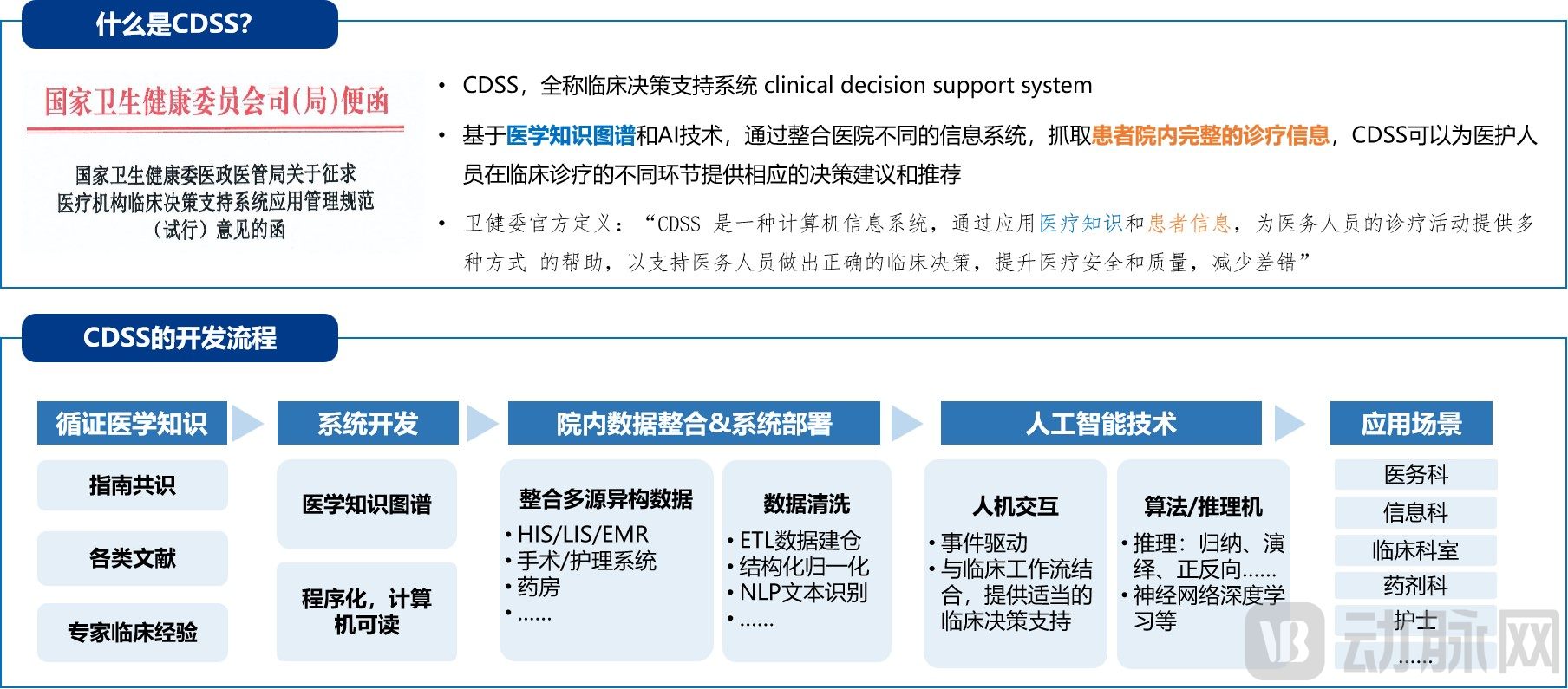 CDSS Based on Medical Knowledge Graphs and Artificial Intelligence: Enhancing Clinical Decision-Making Efficiency Through Integration with Hospital HIS Systems
Currently, clinical data is the most widely utilized type of data in hospitals. According to VCBeat’s year-end review report on data management, approximately 21.9% of tertiary hospitals have initiated application research and development based on clinical data. There is also significant potential for enterprise involvement in this area; text-based Clinical Decision Support Systems (CDSS) trained on knowledge graphs have already been widely implemented in hospitals. In terms of Real-World Studies (RWS), regulatory authorities have incorporated real-world evidence into their approval processes.
In terms of standardized diagnosis and treatment, the research platform, built on Huimei AI-CDSS, helps physicians reduce missed diagnoses and misdiagnoses, thereby enhancing the capability and efficiency of clinical care. For instance, in predicting patients’ risk of acute kidney injury (AKI), the Huimei AI Engineering Laboratory first develops an AKI prediction model by performing data preprocessing, feature engineering, machine learning, model training, and model evaluation. The model is then deployed at target hospitals, where multi-source heterogeneous data are integrated and cleaned, and hospital-wide integration and monitoring are implemented.
In specific clinical applications, the AKI prediction model intelligently mines inpatient medical records to identify risk factors for acute kidney injury (AKI), such as the use of nephrotoxic medications and the presence of shock. For patients assessed as being at high risk for AKI, the system issues real-time alerts to physicians. It also intelligently identifies patients meeting the diagnostic criteria for AKI based on the definition and staging standards recommended by KDIGO, thereby facilitating early clinical recognition and diagnosis of AKI and enabling comprehensive hospital-wide screening and management of AKI-related disease risks. This approach provides more usable research data and cases that meet enrollment criteria for clinical research.
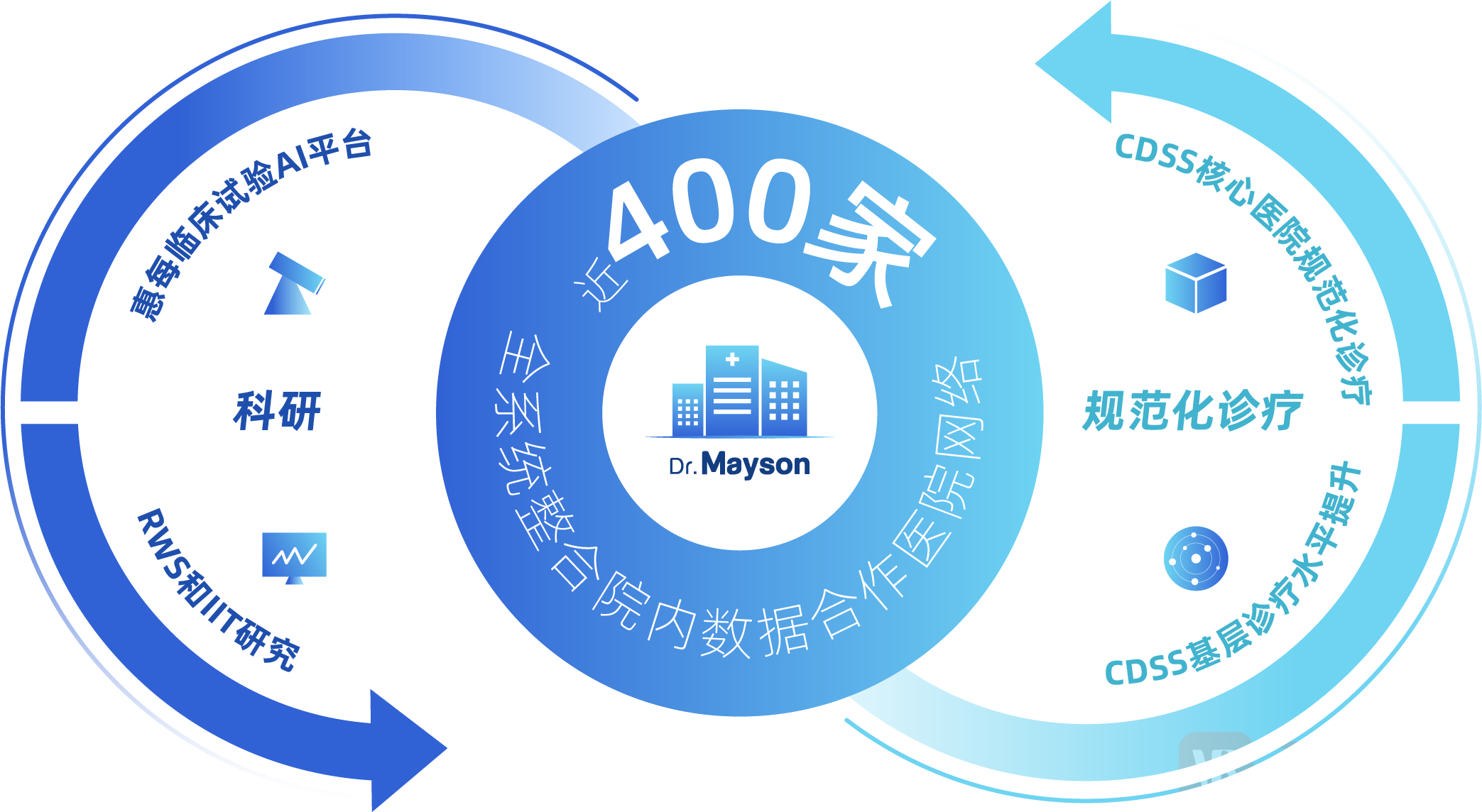
Although clinical informatization has accumulated a substantial volume of usable data during the preparatory stages, including data collection, storage, and governance, real-world data currently face the challenge of multi-source heterogeneity, leading to numerous issues such as data consistency and continuity.
Faced with vast amounts of medical data and the diverse research needs of clinical departments, if researchers still rely primarily on manual methods for data collection and organization, they encounter problems such as heavy workloads, low efficiency, high error rates, and difficulties in sharing and utilizing the collected data.
Driven by both policy and technology, and leveraging an extensive hospital collaboration network, Huimei Technology has deeply integrated its Clinical Decision Support System (CDSS) with clinical workflows. It has further advanced the application of clinical data in clinical research, currently assisting multiple hospital researchers in conducting multicenter and single-center prospective studies, retrospective studies, and other research projects.
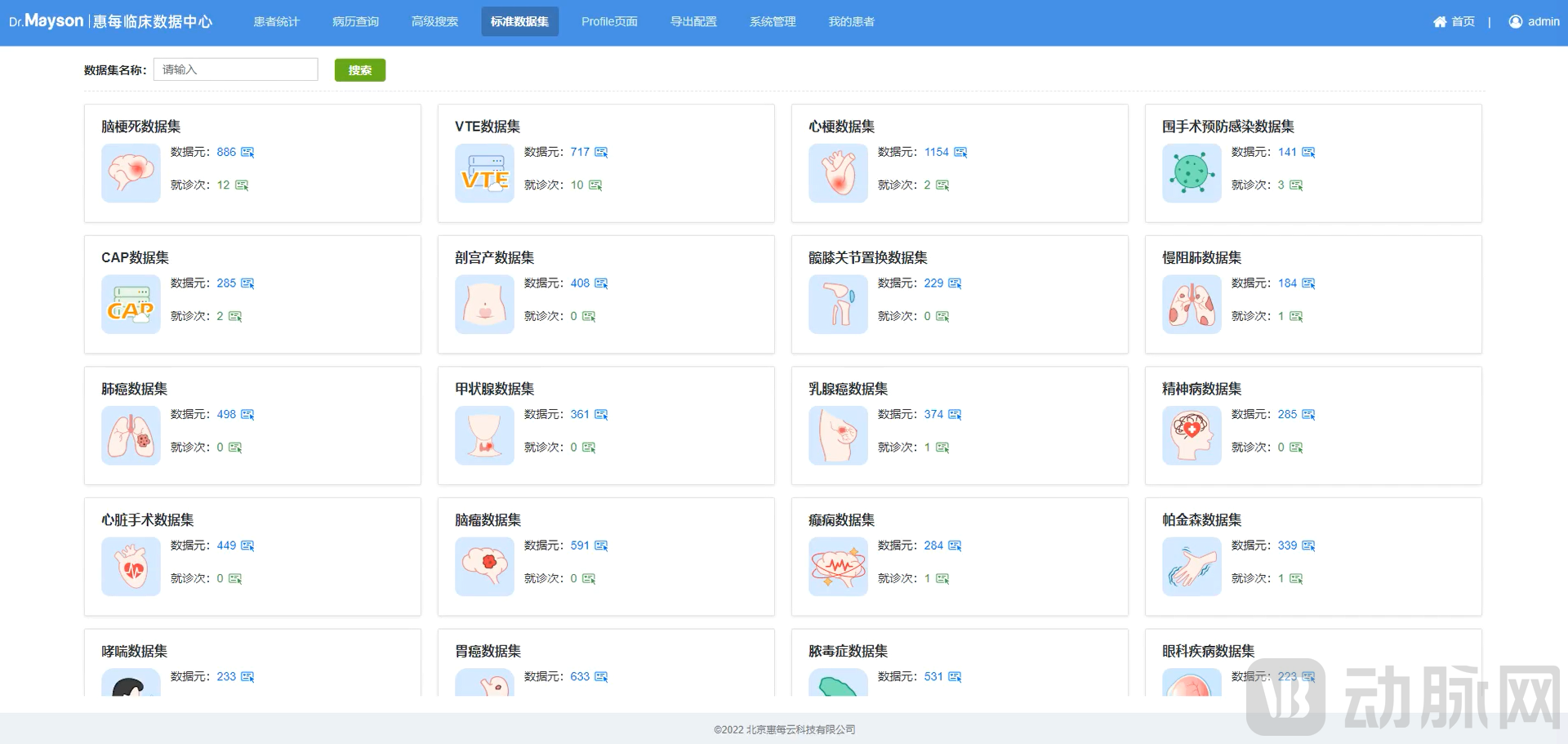
To address the aforementioned data management challenges, the research platform’s data center has established 34 disease-specific datasets comprising nearly 10,000 data fields across 51 single-disease categories. Covering multiple domains such as oncology, cardiology, and respiratory medicine, these resources effectively meet researchers’ data application needs and facilitate the efficient conduct of scientific projects, including retrospective and prospective real-world studies. Meanwhile, the platform provides intelligent data services for clinical data applications by automatically collecting and cleaning electronic medical record data generated during patient diagnosis and treatment, integrating this information into the corresponding disease-specific datasets to accumulate a more comprehensive repository of patient records. Furthermore, the platform enables automated auditing of patient data, thereby enhancing the accuracy of clinical research data collection and supporting the high-quality, high-efficiency execution of real-world studies.
Leveraging AI-CDSS, advanced data capabilities, and a dedicated research support team of over 60 professionals, our scientific research platform delivers end-to-end services for research projects through the powerful combination of AI enablement and expert personnel. This empowers the conduct of real-world studies and facilitates the discovery and expansion of new indications. Throughout its continuous development and innovation, Huimei Technology remains committed to the principle that “quality is life,” striving to harness the advantages of CDSS to serve hospitals and physicians (researchers) and safeguard patient safety.
Note: The research (and implementation) protocols for the aforementioned scientific research projects (or topics) have been reviewed and approved by the Medical Ethics Committee. Hospital investigators, in collaboration with Huimei Technology, medical institutions, pharmaceutical companies, and other partner organizations, conduct the relevant studies with the informed consent of the subjects.
Reference: VCBeat, Zhao Hongwei“EY Life Sciences 4.0 Report: When the Human Body Becomes the Largest Database, Who Will Take the Lead?”