

Biosion Secures Eight Global Licensing Deals in Rapid Succession: A Blueprint for Chinese Biotech's International Expansion
In February this year, the setback of sintilimab, jointly developed by Innovent and Eli Lilly, in entering the U.S. market drew widespread regret within the industry. Meanwhile, this incident also highlighted the U.S. FDA’s stringent emphasis on “innovation” in addressing unmet clinical needs and the mandatory requirement for “global multi-center clinical trials” in new drug review and approval.
Without meeting any of the above conditions, it is difficult for domestic Chinese pharmaceutical companies to expand overseas. Therefore, the success or failure of “going global” is often regarded as the most direct reflection of a Chinese pharmaceutical company’s international competitiveness. Meanwhile, “license-out” has become a key benchmark for evaluating a pharmaceutical company’s strength in innovative R&D on the global stage.
The number of Chinese companies that have successfully achieved license-out deals remains limited. According to data from Meibo Capital, between 2017 and 2019, the number of domestically developed innovative drug pipelines going global through license-out arrangements in cross-border transactions did not exceed 10 each year. From 2020 to 2021, the volume of license-out transactions rose rapidly but still failed to surpass the threshold of 50 deals. Among these, only six transactions involved assets at the preclinical stage, accounting for 15% of all license-out deals.
We can see that,There remains a significant gap between the momentum of license-out transactions, which reflect the innovative capacity of domestically developed new drugs, and that of license-in deals for introducing international pipelines.This indicatesDomestic Innovative DrugsStill in global cooperationinActively exploring new drugs, particularly those in the preclinical stage.
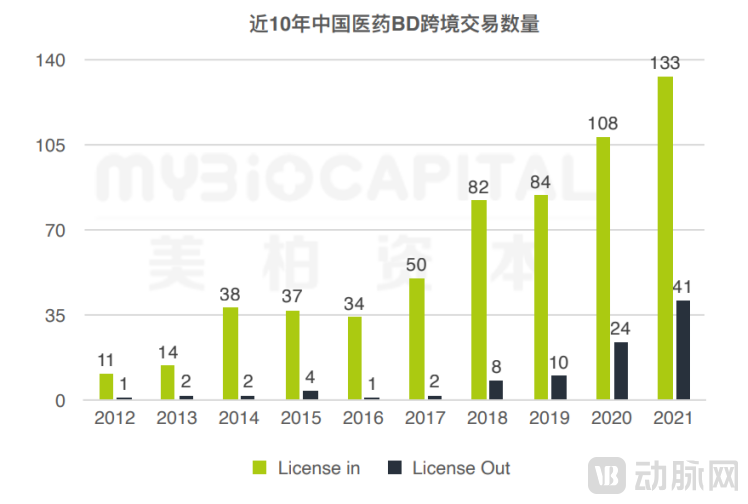
(Image source: Mayborn Capital’s “2021 Annual Report on China’s Pharmaceutical Business Development Transactions
The potential demonstrated by the pipelines of most domestic pharmaceutical companies, along with the achievements in preclinical development of innovative drugs, has yet to gain recognition from international pharmaceutical firms. These efforts are currently insufficient to attract interest from leading global players, indicating that Chinese pharmaceutical companies still have significant room for improvement in their capabilities for developing innovative drugs.
Yet, what constitutes a global license-out deal that severely tests a pharmaceutical company’s in-house innovative drug R&D capabilities appears remarkably straightforward for Biosion, an emerging biotech firm. Recently, VCBeat noted that Biosion has announced another major license-out transaction. Based on the disclosed information, we have found that the company has secured eight global development collaborations within just a few years. What has this emerging biotech done right? What new thinking and strategies has it demonstrated in the development of innovative drugs?
Biosion was founded in 2017 and is headquartered in Nanjing, Jiangsu.A global biotechnology company with independent R&D capabilities, dedicated to developing innovative antibody-based therapies to benefit patients in the treatment of immune and oncological diseases.
On March 30, Biosion announced another milestone in its license-out efforts—the company has entered into a license-out agreement with Pyxis Oncology (NASDAQ: PYXS), a U.S.-based oncology biotechnology company, granting Pyxis exclusive global rights (excluding Greater China) for the development and commercialization of Biosion’s drug candidate BSI-060T. Under the terms of the agreement, Biosion will receive$10 milliondown payment, and in addition will be eligible to receive a total amount of up to$222.5 million(approximately RMB 1.4 billion) in milestone payments, as well as royalties amounting to a double-digit percentage of sales. According to VCBeat, Pyxis Oncology plans to submit an Investigational New Drug (IND) application to the FDA for BSI-060T (currently renamed PYX-106) in the second half of 2022 to expedite the initiation of Phase I clinical trials.
According to the official website of Biosion, in addition to the drug candidate BSI060T, the company has also included in the past two yearsBSI-045B、BSI-04702, among others7successfully reached agreements with multiple listed pharmaceutical companies in China and abroad regarding its drug pipelineGlobal Collaborative DevelopmentTransaction, granting it development rights and exclusive commercialization licenses for certain regions.
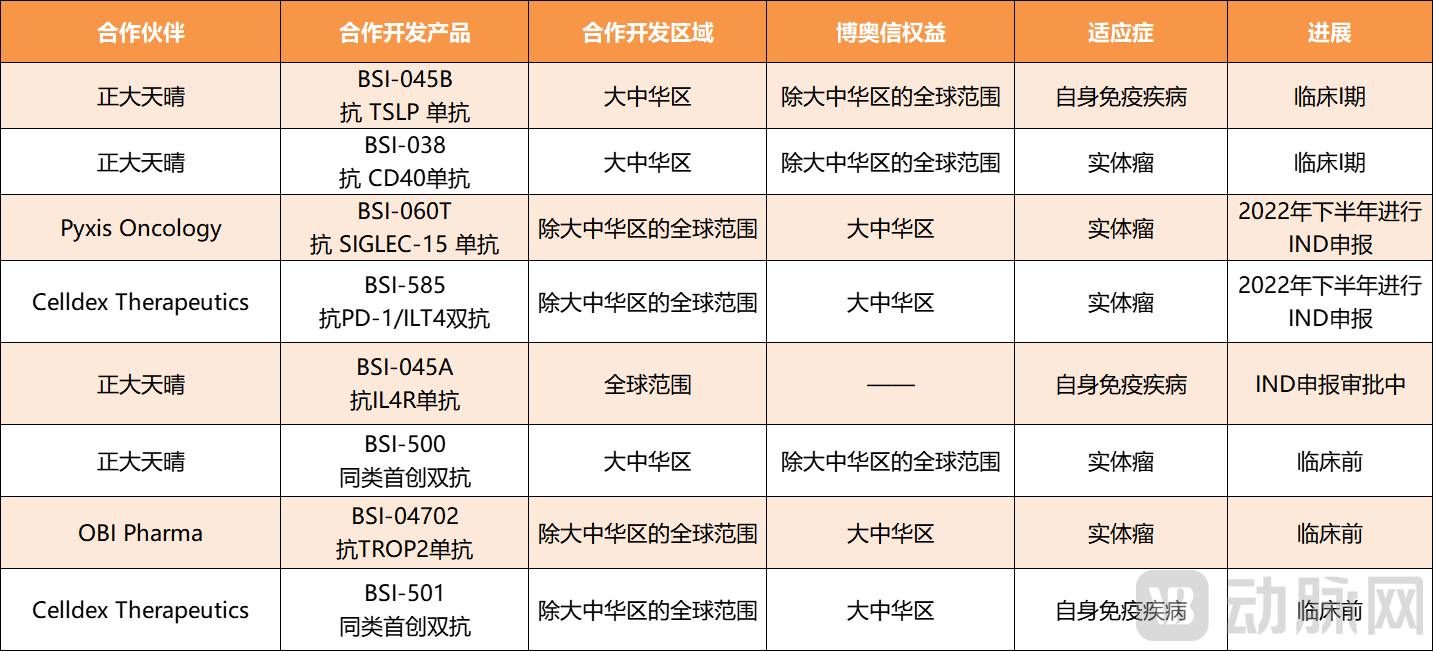
Biosion has secured global co-development and commercialization rights for eight product pipelines in recent years.
The frequent global license-out deals undoubtedly demonstrate Biosion’s strong R&D capabilities, representing international recognition of the company. Furthermore, we have observed that Biosion’s collaborations are primarilyPreclinical Research PhaseAchieving transactions for assets at this stage is highly challenging, as the high risks inherent in the early stages of new drug development make it difficult for startups to gain market trust. This fully demonstrates Biosion’s capability in developing “First-in-Class/Best-in-Class” antibody drugs and underscores its recognition by the international market.
We also observed that although the projects announced by Biosion are all in early stages, their transaction amounts are relatively substantial, which indirectly highlights the potential commercial value of these new drug programs.
Achieving multiple product pipeline license-outs in a short period—does this mean that Biosion’s business model is dedicated to developing early-stage new drug pipelines specifically for “license-out” purposes? Not at all. In fact, this precisely reflects Biosion’s distinctive strategy of “leveraging external resources to amplify its own strengths.”Based on the global market, we collaborate with worldwide partners to co-develop our promising new drug pipeline.This strategic layout enables Biosion to leverage the team strength of its outstanding strategic partners, thereby accelerating pipeline development. Meanwhile, these license-out collaborations generate substantial cash flow for Biosion, achieving self-sustaining “blood creation.” This dual-engine growth model, driven by both financing and transactional revenue, allows the company to focus on immunology and oncology, developing more new drug pipelines with significant clinical value.
Therefore, unlike typical biotech companies that face significant development risks due to having only one or two product pipelines, Biosion has successfully established a portfolio of more than 20 drug development pipelines through this distinctive strategic approach.Among them, the self-developed product BSI-045B (an anti-TSLP monoclonal antibody) has initiated global Phase I clinical trials for atopic dermatitis and severe asthma, with multiple pipeline products expected to enter clinical development in 2022.
Although the overseas expansion capabilities of most biopharmaceutical companies in China still need to be strengthened, there is no doubt that the wave of “going global” will only intensify, representing an inevitable trend in the development of China’s biopharmaceutical industry. The Chinese government has already implemented a series of supportive policies to encourage the globalization of innovative pharmaceutical enterprises. For instance, in January this year, nine departments, including the Ministry of Industry and Information Technology and the National Development and Reform Commission, jointly released the 14th Five-Year Plan for the Development of the Pharmaceutical Industry. This plan lists “high-quality innovation” and “comprehensive acceleration of internationalization” as specific objectives, pointing out the need to cultivate a batch of world-renowned brands and foster a group of pharmaceutical companies with globalized R&D and production layouts.
Therefore,Enhancing global market competitiveness has become a critical driver for the next phase of development in the pharmaceutical industry, and it is also the key breakthrough currently urgently needed by domestic biotech companies.Despite the numerous challenges currently faced, the pace at which Chinese innovative pharmaceutical companies expand into global markets will by no means slow down.
Lessons from the past serve as guides for the future. Although Innovent Biologics and Eli Lilly encountered setbacks in their global expansion, they have left us with valuable exploratory experience. The successful internationalization of BeiGene and Legend Biotech offers development pathways worthy of in-depth study by the industry. However, for the vast number of startup biopharmaceutical companies, the successful experiences of certain startups in innovating and going global may hold greater inspirational value. Having secured eight global co-development deals in a short period, what strategic considerations has Biosion adopted in formulating its global expansion strategy?
Developing breakthrough innovative antibody drugs to benefitGlobal Patientsis the vision of Biosion. Therefore, from its inception, the company established “In Global For Global(Globally Based, Globally Oriented) Market Positioning and Development Strategy—Focusing on the Discovery and Development of Innovative Drugs, as Well as Global Clinical Development and Commercialization.
So, what exactly does the “In Global For Global” market positioning and development strategy refer to?VCBeat believes that this development model is mainly reflected in three aspects:
First, differentiated R&D project initiation and innovative discovery in response to the global drug landscape:In the initiation and discovery of innovative drug projects, Biosion aligns with the global landscape of drug development and focuses on product differentiation. Rigorous assessments are conducted at the outset of project initiation to ensure advancement, innovation, and feasibility. An “International Advisory Team,” composed of renowned scientists, clinicians, and professors from top-tier research institutions such as Memorial Sloan Kettering Cancer Center (MSKCC), the Pancreatic Cancer Precision Medicine Center at Johns Hopkins University (PMCEJH), and George Washington University (GWU), evaluates projects based on unmet global clinical needs. Their comprehensive assessments cover multiple dimensions, including selection of clinical indications, evaluation of target pathways, feasibility of clinical trials, and the global distribution and competitive landscape of targets.
Second, preclinical and international multicenter clinical trials for global drug development:Currently, in the conduct of global preclinical studies and international multicenter clinical trials, most biotech companies face a common challenge: the involvement of multiple countries in international multicenter clinical trials significantly complicates regulatory submissions and the design of clinical trial protocols. For instance, prior to initiating an international multicenter clinical trial for a drug candidate, companies must prepare submission materials that comply with international standards during the preclinical phase of drug development to lay the groundwork for subsequent global trials. Once the international multicenter clinical trial is formally underway, companies must also address additional clinical operations subject to stringent international requirements and high standards. Therefore, to successfully expand into global markets, pharmaceutical companies must ensure that their R&D and operational teams responsible for clinical trials are highly proficient in international standards, trial quality control, and global regulatory registration.
To ensure the comprehensive and effective implementation of the “In Global, For Global” model, Biosion’s global biologics development team, led by Dr. Hugh Davis, ensures that every stage of the company’s projects—from initiation and molecular discovery through preclinical development to clinical trial applications—is executed in accordance with this globally oriented approach, thereby providing robust support for Biosion’s global business development initiatives. Previously serving as Global Vice President of Innovative Biologics Development at Janssen, Dr. Davis is an expert in the early-stage development of innovative biologics. He has led a team of over 200 professionals in successfully advancing eight biologics to market approval, accumulating extensive global drug development experience across China, the United States, Europe, and Japan. In addition to Dr. Davis, members of Biosion’s development team hail from senior executive roles at renowned multinational pharmaceutical companies such as Johnson & Johnson, Merck, Novartis, and Sanofi. Leveraging their comprehensive expertise spanning product strategy, drug development, clinical and regulatory planning, research operations, and quality control, this international team consistently and efficiently accelerates the global development progress of Biosion’s pipeline products.
Third, business development and industrial alliances targeting the global pharmaceutical market:In terms of international business expansion, Biosion maintains close cooperation and communication with multinational pharmaceutical companies and international research institutions. Headquartered in Nanjing, Jiangsu Province, Biosion has established subsidiaries in the United States, Australia, and other regions to support its global antibody drug development through international multi-center clinical trials and worldwide business development.
Recently, Biosion has successively recruited senior executives such as Joel Edwards, former Vice President of Ionis Pharmaceuticals, and Dr. Ye Xinliang, former Vice President of CStone Pharmaceuticals, to lead teams in driving global business development. Their arrival has brought to Biosion collaborative experience involving over $5 billion in transaction value and management expertise across more than 20 global drug projects. Leveraging the rapid strategic deployment of its Business Development (BD) team in partnership and co-development initiatives, Biosion has laid a solid foundation for swiftly establishing global commercial operational capabilities. This has significantly facilitated recent license-out transactions, playing a pivotal role in advancing Biosion’s global pipeline development.
Overall, Biosion has taken a strategic lead in early-stage project initiation, drug development, and business development. From the outset of its corporate development, the company positioned itself for globalization and established an international elite team with strong professional capabilities and extensive industry experience. Therefore,Biosion has been able to secure multiple global partnership deals, relying not only on the advanced experience of its international team but also on its global orientation from the outset.
A close examination of Biosion’s “In Global, For Global” development model reveals that for Chinese pharmaceutical companies to successfully innovate and expand overseas, gaining recognition from international markets,It is not enough to merely globalize the development of an innovative drug pipeline; more importantly, companies must establish robust global capabilities from the outset by implementing a strategic global positioning across four key dimensions: team, think tank, network, and operations.
Whether actively forging close collaborations with international pharmaceutical companies to pursue global business development and industrial alliances, or establishing strong ties with international research institutions and clinical hospitals to lay the groundwork for future international multicenter clinical trials, these are key strategic imperatives for Chinese pharmaceutical companies seeking to expand into global markets.
We also reiterate that at the core of any successful corporate strategic layout lies people. To attract top global talent and build a truly international, high-performing team, it is not only dependent on the leader’s own capabilities and charisma, but more importantly, on whether the company can establish an inclusive, diverse culture and a globalized framework rooted in worldwide operations.
At its inception, should a company pursue innovation tailored for China or for the global market? Should it focus on the domestic market or cast its gaze worldwide? In today’s climate of intense “involution” in the development of homogeneous targets within China, perhaps more biopharmaceutical companies should turn their attention to the broader overseas markets—a necessary path for future leading pharmaceutical enterprises. Biosion’s development strategy—“In Global, For Global”—may well be worth our consideration.