

Parkinson's Day: Can 8 Million Patients Find Personalized Treatment in the Digital Healthcare Era?
Hand tremors, paralysis, dizziness, bodily rigidity, and loss of speech control—he tried every means to conceal his symptoms, yet he could not escape the reality that he had entered the realm of disease. Ultimately, by using a remote control to regulate an electrode implanted in his brain, he learned to live between two distinct states, thereby discovering the true joy and meaning of life...
Helmut Dubiel, formerly a professor of sociology at the University of Giessen, uses resilient prose in Hello, Parkinson’s to depict his real-life experience after being diagnosed with Parkinson’s disease.
Today is World Parkinson’s Day, marking over 200 years since the disease was first identified.
Parkinson’s disease is all around us, representing the second most common neurodegenerative disorder after Alzheimer’s disease. Data indicate that the prevalence of Parkinson’s disease among individuals aged 65 and older in China is 1.7%. Experts from the World Health Organization predict that the number of Parkinson’s patients in China will reach 8 million by 2030.
However, the grim reality is that there is still no cure for Parkinson’s disease; it can only be managed symptomatically through medication or surgery.
On one hand, there is significant heterogeneity among individual patients, with each person presenting unique symptom profiles and disease severity. In the past, due to limited progress in effective disease research and the lack of technologies for quantitative assessment of treatment efficacy, patients were unable to receive truly personalized treatment plans.
On the other hand, as Parkinson’s disease progresses to its middle and late stages, it severely impairs patients’ quality of life, leading to loss of self-care ability and imposing a substantial burden on patients, their families, and the national medical insurance system. However, traditional diagnosis of Parkinson’s disease relies primarily on patient-reported symptoms and visual observation by specialists, making it heavily dependent on physicians’ clinical experience. In China, there are only 300–400 Parkinson’s disease specialists, resulting in a significant shortage. The doctor-to-patient ratio stands at 1:3,000, reflecting a severe imbalance. Consequently, misdiagnosis and missed diagnoses are common during the early stages of the disease.
Since the outbreak of the COVID-19 pandemic, patients with Parkinson’s disease have faced greater challenges in their daily lives, medical consultations, and disease management. Therefore, leveraging innovative technologies to upgrade diagnostic and therapeutic approaches for central nervous system disorders—by developing products such as AI-based digital health tools, digital biomarkers, and clinical decision support systems—has become key to addressing standardization issues, improving diagnostic efficiency and accuracy, preventing misdiagnosis and missed diagnoses, enabling personalized treatment, and bridging the shortage of high-quality medical professionals.
How Can Integrated Diagnosis and Treatment of Parkinson's Disease Be Achieved?
In response to the long-standing challenges in Parkinson’s disease treatment, numerous innovators—beyond pharmaceutical companies—have begun developing targeted solutions. These include a range of innovative approaches such as wearable devices, neurosurgical robots, medical devices for neurological disorders, eye-tracking therapy, and cloud-based disease management platforms.
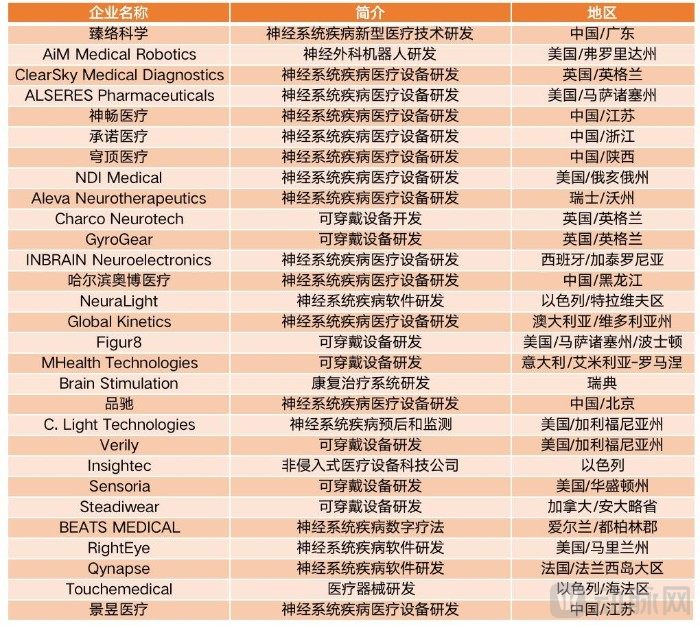
Global Parkinson's Disease Treatment Companies
Note: Due to time and information constraints, the statistics may not be exhaustive.
Among the explorers of treatment regimens for Parkinson’s disease, one can even spot Verily, which spun out of Google.To combat Parkinson’s disease, Verily partnered with Radboud University in the Netherlands to launch a personalized Parkinson’s disease project and introduce the Verily Study Watch for research and clinical trials, aiming to investigate how to help patients manage their daily lives.
GYENNO Technologies Co., Ltd. (hereinafter referred to as “GYENNO Science”), an innovative medical technology company based in China, shares the same determination to address the pain points in the diagnosis and treatment of Parkinson’s disease.Founded in 2013, GYENNO Technologies chose to enter the field of Parkinson’s disease, which was then a blank slate in terms of market and research, despite having only five employees at its inception, and launched the “GYENNO RuiCan + YiDongLi” project.
Years have passed.In December 2021, GYENNO Sciences signed a cooperation agreement with Huazhong University of Science and Technology., jointly establish the Intelligent Digital Medical Technology Center for Neurological Diseases, focusing on scientific research breakthroughs in areas such as human movement, behavior, and physiological sensing technologies and their multimodal information fusion methods; digital biomarkers for neurological diseases and novel diagnostic assessment technologies; data-driven digital therapeutics for neurological diseases; and novel neuromodulation technologies. Prior to this, as a globally leading innovative technology company in the field of Parkinson’s disease,GYENNO has established a global collaboration with Bastiaan R. Bloem, Member of the Academia Europaea and Professor of Neurology at Radboudumc, further exploring how to leverage China's innovative medical technologies to achieve global patient and clinical benefits.
Nowadays,GYENNO has independently developed a series of innovative products by applying cutting-edge AI and digital technologies, while integrating an online-to-offline closed-loop personalized chronic disease management system to advance the diagnosis and treatment of Parkinson’s disease.
In terms of innovative diagnostics,GYENNO Science has developed a wearable technology-based system for the quantitative assessment and auxiliary diagnosis of Parkinson’s disease, designed for clinical examinations and scientific research.““RuiPing,” “HEIMDALL” for quantitative assessment and assisted diagnosis of Parkinson’s disease based on machine vision technology, and “RuiYun,” a multimodal multi-omics clinical data management and intelligent analysis system for Parkinson’s disease.
Among these, the “HEIMDALL” system is currently the world’s first and only technical framework capable of delivering comprehensive intelligent scoring for the MDS-UPDRS scale using a single machine vision technology. In addition to covering in-hospital scenarios, this technical framework also extends to out-of-hospital settings, enabling patients to undergo regular scale assessments from home simply by using a smartphone. The launch of this system not only effectively fills an international gap in this technology but also addresses challenges such as cumbersome clinical visit processes and fragmented follow-up care for Parkinson’s disease.
The “Ruiyun” multimodal multi-omics clinical data management and intelligent analysis system for Parkinson’s disease effectively enhances the efficiency of top-tier hospitals while addressing the challenges faced by county-level hospitals. It is reported that “Ruiyun” currently supports five national key R&D programs related to Parkinson’s disease and covers 217 Grade A tertiary hospitals across China, making it the most mainstream and widely adopted multimodal multi-omics clinical data platform for Parkinson’s disease in the country.
In terms of innovative therapies,Targeting out-of-hospital scenarios, GYENNO Science has developed “RuiXing,” the world’s first gait-assistance device capable of automatically detecting freezing of gait in Parkinson’s disease and providing real-time intervention; “RuiCan,” China’s first smart rehabilitation device that assists Parkinson’s patients with eating and quantifies hand symptoms; “RuiMian,” a professional evaluation system for nocturnal motor symptoms and sleep quality in Parkinson’s disease; and the “YiDongLi” APP platform for chronic disease management of Parkinson’s disease. Furthermore, leveraging its comprehensive closed-loop technology system refined over many years, the company is exploring digital therapeutics for Parkinson’s disease.
On the occasion of World Parkinson’s Day, GYENNO Science’s self-operated specialized internet hospital for Parkinson’s disease, “GYENNO Internet Hospital,” officially launched. Leveraging comprehensive, continuous, high-dimensional, multimodal data that integrates subjective and objective metrics—generated through GYENNO Science’s independently developed innovative hardware and software solutions—the platform provides a more robust, evidence-based foundation for clinical decision-making in specialized online healthcare. This advancement moves beyond the limitations of traditional internet models characterized as “purely service- and process-oriented platforms,” enabling a closed-loop system that delivers effective online diagnosis and treatment, personalized chronic disease management, and medication procurement services for patients.
At its inception, “Zhenluo Internet Hospital” was already the specialized internet hospital platform with the most extensive coverage of China’s top Parkinson’s disease experts. It is reported that during World Parkinson’s Day, more than 40 renowned Parkinson’s disease experts from across China convened on this platform to provide free charitable consultations to patients.
Dr. Ren Kang, founder of GYENNO Sciences, told VCBeat:“We have been deeply engaged in the academic and technical aspects of this field for nearly a decade, with the ultimate goal of realizing our envisioned future scenario for diagnosis and treatment. In this model, patients undergo comprehensive assessments at offline Parkinson’s disease clinical centers using artificial intelligence (AI)-based wearable devices and machine vision technologies. Experts then formulate precise, comprehensive treatment strategies by integrating objective data with AI-assisted decision support. After leaving the hospital, patients benefit from innovative digital interventions that alleviate symptoms and improve quality of life. By leveraging wearable technology, machine vision, digital biomarkers, and mobile health platforms, we establish continuous symptom monitoring and remote follow-up without the need for home visits. This enables a closed-loop system encompassing dynamic interventions, personalized adjustments to treatment strategies, and medication delivery services. Our unwavering commitment to maximizing patient benefits has always been the driving force behind our progress.”
The Next Five Years of Parkinson's Disease
Five years ago, when discussing development plans, Dr. Ren Kang stated that GYENNO Science aims to provide a complete service loop for Parkinson’s disease patients across four dimensions: assistance, intervention, assessment, and rehabilitation.
Today, whether confronting the vast frontiers of brain science or addressing the gaps in new technology research and product development for Parkinson’s disease, GYENNO Science has established Parkinson’s disease as its entry point into central nervous system disorders. Leveraging AI-driven digital technologies, deep clinical collaborations, and legally compliant internet diagnosis and treatment qualifications, GYENNO Science has built a comprehensive, integrated management loop for Parkinson’s patients. This closed-loop system seamlessly combines online and offline services, in-hospital and out-of-hospital care, and software and hardware solutions, covering diagnosis, assessment, treatment, rehabilitation, and personalized chronic disease management.
Returning to the initial question: Can 8 million Parkinson’s disease patients find the optimal treatment regimen in the era of digital health?
From the perspective of GYENNO’s scientific exploration, future-oriented healthcare—centered on patient benefit, driven by clinical scenarios, supported by academic research, and grounded in technology—will undoubtedly tangibly alleviate disease symptoms, optimize treatment outcomes, and improve quality of life for patients, while simultaneously reducing the burden of disease.