

Pear Therapeutics Reports 24-Fold Surge in Digital Therapeutics Revenue Driven by reSET and reSET-O

Pear Therapeutics
Developer of Digital Healthcare Solutions
Backed by top-tier investment firms such as SoftBank and Temasek, having developed the world’s first FDA-approved digital therapeutic product, and being one of the earliest pioneers in the digital therapeutics field... Pear Therapeutics (hereinafter referred to as “Pear”), adorned with numerous accolades, recently released its first post-IPO earnings report.
In December 2021, Pear completed its merger with the SPAC company Thimble Point Acquisition Corp., officially listing on the Nasdaq. In its inaugural annual report, Pear disclosed that in 2021, sales revenue from its prescription digital therapeutics (PDT) products increased 24-fold, primarily driven by higher bulk sales of reSET and reSET-O, the company’s first two FDA-approved products.
Viewed solely from the perspective of revenue scale, Pear’s product revenue in 2021 was only $3.748 million, with total revenue reaching $4.208 million, indicating a relatively small size. Nevertheless, the sales growth rate has, to some extent, validated the commercial value of its products. Meanwhile, Pear has 14 additional products in the research and development pipeline, which will serve as drivers for future growth.
Since 2021, digital therapeutics have developed in China with remarkable momentum. The growth trajectory of Pear Therapeutics may also offer valuable reference for domestic companies.
Pear has three products approved by the FDA and available on the market: reSET for substance use disorder, reSET-O for opioid use disorder, and Somryst for the treatment of chronic insomnia.
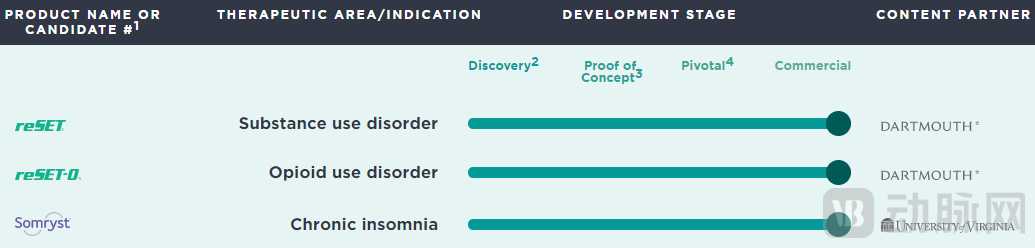
Three Digital Therapeutics Products Launched by Pear, Image Source: Pear Official Website
The annual report shows that the sales revenue of the three products reached $3.748 million in 2021, a 24-fold increase from $149,000 in 2020. Among them, reSET and reSET-O accounted for the majority of Pear’s revenue growth; Somryst, approved for market launch in March 2020, did not begin commercialization until the fourth quarter of 2020, contributing minimally to growth.
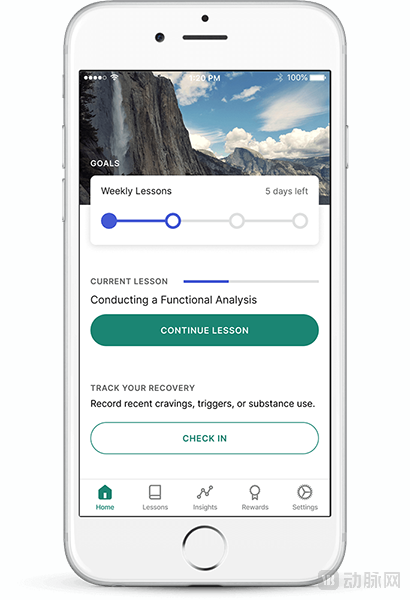
Patient Interface of reSET-O, Image Source: Pear Official Website
Prior to 2021, Pear’s revenue was primarily derived from collaborative research, development, and commercialization agreements. Over the past year, Pear has engaged in intensive business collaborations to promote PDT.
In April 2021, Pear Therapeutics entered into a partnership with Northwell Health, a large healthcare group. Through the substance use disorder treatment program at its Zucker Hillside Hospital, Northwell Health will provide patients with reSET and reSET-O. Amid the impact of the COVID-19 pandemic, Northwell Health accelerated the transition of its traditional outpatient care to a telehealth model. To enhance service quality, Northwell Health decided to integrate digital therapeutics into this model, aiming also to improve treatment retention rates through these digital interventions.
Kaiser is also one of Pear’s partners. In 2021, the Kaiser Washington Health Institute launched a study to evaluate different approaches to implementing reSET and reSET-O in routine primary care practice. The project will also assess the effectiveness and sustainability of implementation strategies from both provider and patient perspectives during the use of digital therapeutics at Kaiser Washington’s primary care clinics.
By the end of 2021, multiple large addiction health systems, medical groups, and medical research centers had deployed Pear’s PDTs, including ChristianaCare, Crossroads, and M Health Fairview, in addition to Northwell Health and Kaiser.
Meanwhile, Pear also accelerated its coverage of organizations such as PBMs, Medicare, and Medicaid agencies to rapidly expand product reach.
In 2021, Pear partnered with PBM company Serve You Rx to include three products—Reset, Reset-O, and Somryst—in Serve You Rx’s formulary as part of its pharmacy benefit management for members.
Regarding government programs, the Ohio Department of Mental Health and Addiction Services provides reSET and reSET-O to eligible patients through Opioid Response Grants, allowing them to access these services during outpatient treatment. In 2021, Massachusetts became the first state to include all Medicaid beneficiaries in the coverage for Prescription Digital Therapeutics (PDTs); reSET and reSET-O were added to the non-drug product list of the Massachusetts Medicaid program, MassHealth, effective November 1, 2021.
Subsequently, in January 2022, the Oklahoma Health Care Authority also reached an agreement with Pear Therapeutics to provide reSET and reSET-O to patients enrolled in the Oklahoma Medicaid program.
Currently, more than 30 organizations are providing Pear’s PDT products to patients through formularies, coverage benefits, or bulk purchasing.
Regarding the operational achievements attained in 2021, Corey McCann, President and CEO of Pear, stated that 2021 was a pivotal year for both Pear and the entire Prescription Digital Therapeutics (PDT) field. This is because Pear gradually validated through practice that providers are willing to prescribe PDTs, patients are receptive to them, and payers are willing to cover the costs. In 2021, Pear achieved breakthroughs in all three areas.
As a company that combines digital technology with drug development attributes, Pear’s commercialization strategy also attempts to merge the commercial approaches of tech companies and life sciences companies. Pear has now established two commercialization models: one follows the commercialization path of life sciences companies by adopting a sales-oriented approach, using key account management to expand into Integrated Delivery Networks (IDNs), health systems, teaching hospitals, and large addiction clinics; the other follows the commercialization path of tech companies, leveraging a virtual care platform to directly engage with clinicians and patients.
Meanwhile, Pear’s PDT integration platform can collect data throughout the patient treatment process, delivering value to stakeholders such as clinicians and payers. On one hand, clinicians can offer patients treatment options beyond routine outpatient care, thereby improving patient adherence. On the other hand, payers can leverage Pear’s data collection and analytics capabilities to gain a better understanding of PDT, using these insights to enhance treatment outcomes and reduce healthcare costs.
Specifically, Pear primarily implements its commercialization strategy through the following four aspects.
First, increase investment to build awareness of PDT among patients, clinicians, and payers.
As a pioneer in PDT, Pear has both the necessity and the responsibility to conduct early market education, targeting key stakeholders including patients, clinicians, and payers. To this end, Pear has established teams for sales, marketing, patient and clinician services, and medical affairs.
In 2021, Pear’s selling, general and administrative expenses amounted to $67.6 million, an increase of $11.4 million compared with 2020. Of the incremental expenses, $5.3 million was attributable to higher personnel costs driven by the expansion of the commercialization team, and $5.0 million was incurred for marketing and advertising. This indicates that Pear made substantial investments in building its commercialization team and conducting market education.
According to annual report data, Pear has trained more than 690 clinicians and issued over 14,000 prescriptions in 2021. Since the launch of its first PDT product, Pear has enabled more than 700 clinicians across 32 states to write over 20,000 prescriptions for reSET and reSET-O.
It is reported that over 20 million people in the United States suffer from substance use disorder, with approximately 1.6 million individuals affected by opioid use disorder annually. More than 75,000 deaths each year are attributed to opioid use disorder, while chronic insomnia affects roughly 30 million Americans.
In terms of the size of the patient populations targeted by the three PDT products, Pear’s prescription volume is not high, and the number of physicians currently influenced remains limited. However, compared with its overall prescription volume, 2021 saw a breakthrough increase, indicating that Pear is beginning to establish influence among physicians. In the future, as commercialization advances, physicians who have already achieved positive outcomes with PDT will influence more patients and other physicians.
Second, further validate clinical value to attract more payers.
One set of data in the annual report deserves particular attention: The majority of Pear’s product revenue comes from bulk purchases by three customers, accounting for 34%, 23%, and 10% of total revenue, respectively. All three major customers are state governments or institutions. This means that commercial insurance, which dominates the U.S. healthcare payment system, has not yet become a primary payer for Pear; this will be a key area for Pear to focus on breaking through.
Payers are willing to pay for a new therapy only if it offers superior therapeutic efficacy and reduces medical costs. Yet Pear still faces two major challenges:
First, both reSET and reSET-O are adjunctive therapies that must be used in conjunction with standard care. This implies that direct medical costs comprise the total expenses of standard care plus Prescription Digital Therapeutics (PDT), representing an incremental cost over standard care alone. To demonstrate the value of PDT, it is essential to show a reduction in healthcare costs on a broader scale.
Secondly, unlike pharmaceuticals, the therapeutic process of PDT may be subject to interference from numerous external factors, whereas clinical trials are conducted under controlled conditions and within limited populations. Whether PDT products can achieve the therapeutic effects observed in clinical trials when exposed to various uncertain and potentially interfering factors in the real world, or whether they can deliver consistent outcomes when used across a broader patient population, remains to be investigated. These are not only challenges for Pear Therapeutics but also critical issues requiring attention from the entire PDT industry.
In the face of challenges, Pear must further demonstrate the health economic value of its Prescription Digital Therapeutics (PDT) and conduct ongoing real-world studies to provide evidence regarding the durability of beneficial clinical outcomes and the scalability of its use across broader patient populations.
Thus, in 2021, Pear published four papers based on real-world studies.
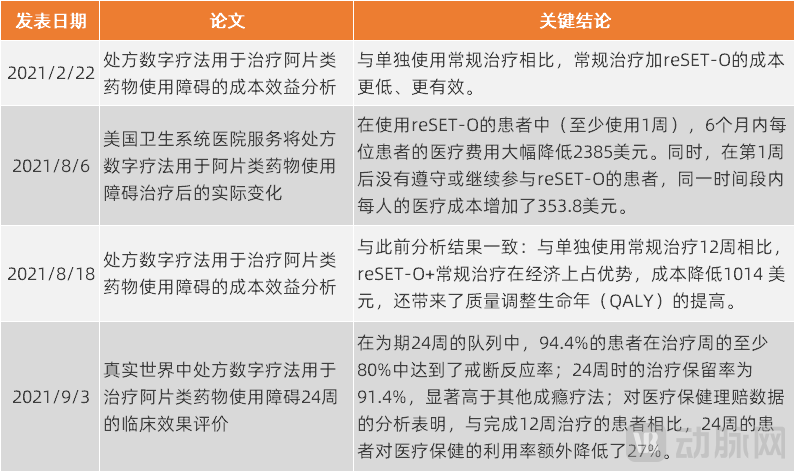
Research Findings Published by Pear Based on Real-World Studies of PDT, Source: Pear and Academic Journal Official Websites
These studies demonstrate the safety, efficacy, and health economic value of the PDT product reSET-O from multiple dimensions. For instance, compared with conventional treatment alone, conventional treatment combined with reSET-O is more cost-effective and efficacious. Among patients who used reSET-O (for at least one week), medical costs per patient decreased by $2,385 over six months; whereas among patients who did not adhere to or continue using reSET-O after the first week, medical costs per person increased by $353.80 during the same period.
The single-prescription treatment course for reSET-O is 12 weeks, and Pear has also investigated the outcomes of continued reSET-O therapy. Specifically, among patients treated for 24 weeks, 94.4% achieved abstinence rates during at least 80% of the treatment weeks; the treatment retention rate at 24 weeks was 91.4%, significantly higher than that of other addiction therapies. Additionally, healthcare utilization was further reduced among patients in the 24-week cohort.
In May 2021, Pear also released two sets of analytical data. One study estimated the expected market impact of reSET-O over a five-year period, based on payer data regarding healthcare resource utilization, retreatment rates, and cost scenarios. The analysis indicated that the use of reSET-O could reduce total healthcare costs, with further cost reductions achieved as utilization rates increase.
Another study using machine learning to analyze real-world patient data showed that patients using reSET-O had a 60% reduction in emergency department and hospitalization visits, with estimated healthcare costs reduced by $1,749–$2,654 over six months compared to patients not using reSET-O.
Encouragingly, in February 2022, reimbursement for PDT achieved a significant breakthrough. The Centers for Medicare & Medicaid Services (CMS) established a new Level II HCPCS code to describe PDT, which became effective on April 1. There is often considerable uncertainty regarding insurance coverage and reimbursement for newly approved products. As a key decision-maker in reimbursement for new products, CMS determines whether and to what extent a new product is covered and reimbursed by Medicare, with commercial insurers typically following CMS’s lead.
Therefore, the new CMS codes represent a milestone for healthcare providers, payers, and patients, marking another step forward in establishing insurance and payment standards in the field of photodynamic therapy (PDT).
With active internal demonstration of product value and support from favorable external conditions, Pear is expected to accelerate its engagement with payers.
Third, improve infrastructure to enhance convenience for both doctors and patients.
To enhance convenience for both patients and healthcare providers, Pear launched the patient service platform PearConnect, establishing it as a one-stop PDT service platform. PearConnect comprises four components: the PDT application for patients, the Pear MD clinician interface, an end-to-end patient service center, and a data analytics system that integrates data on patient engagement, adherence, and clinical outcomes.
Clinicians can use Pear MD to monitor and understand patients’ progress in participating in PDT, as well as to collect and analyze clinical outcomes. The service center provides support to patients who have been prescribed PDT, including informational and technical assistance for using the PDT program and the virtual care platform. The data analytics system collects and analyzes data on patient engagement, adherence, and clinical outcomes, generating insights for clinicians’ reference and supporting the development of personalized PDT interventions.
Although PDT can be administered remotely, it requires a physician’s prescription, adding a mandatory step for both doctors and patients and thus becoming one of the constraints limiting its broader adoption. Therefore, Pear has begun piloting direct patient engagement through its virtual care platform, enabling patients to obtain prescriptions without visiting a physician.
In April 2022, Pear announced plans to provide PDT to patients via telehealth services. Pear’s first telehealth initiative is a collaboration with PursueCare, a provider of telehealth-based addiction treatment services, to deliver continuous addiction recovery care to patients. Under this partnership, PursueCare offers medication-assisted treatment (MAT), counseling services, medication delivery, home screening, and targeted case management. Products from Pear and PursueCare are currently available in select markets across 12 states where PursueCare operates, with plans to expand to additional states.
These initiatives will make it more convenient for patients to obtain prescriptions and follow-up services, while also improving ease of use for physicians, thereby facilitating the expansion of PDT coverage.
Fourth, it hosts third-party PDT products and also provides platform services.
In addition to its proprietary products, Pear aims to incorporate more PDT products from other companies into the Pear MD clinician interface and other core technical infrastructure. This will also provide patients with a wider range of PDT options, enabling more individuals to access safe and effective digital therapeutics. In the past, Pear has accumulated experience in navigating regulatory review processes and built a scalable platform, laying the foundation for hosting over 100 additional PDT products.
Based on its 2021 performance, commercial channel development, and product portfolio, Pear Therapeutics set its 2022 performance targets: achieving $22 million in revenue and reaching 50,000–60,000 prescriptions. This represents a fourfold increase in total revenue compared to 2021.
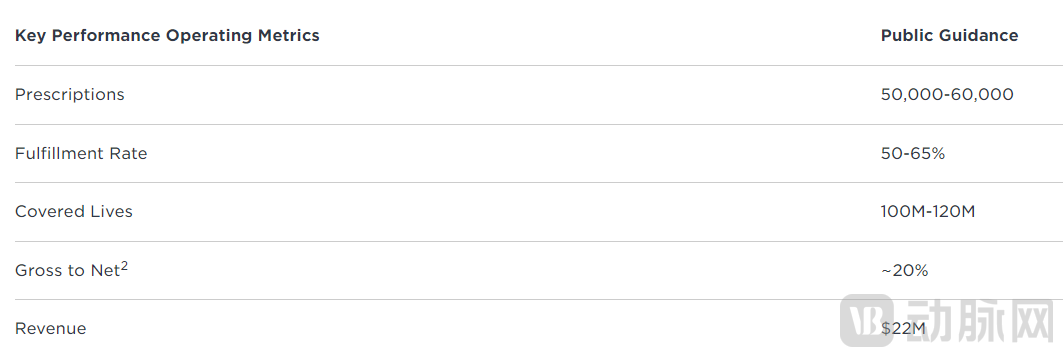 Pear’s 2022 Key Performance Indicators, image source: Pear official website
Pear’s marketed products have limited indications and patient populations, and with market education still ongoing, there is likely still a gap to achieving its performance targets. In 2022, in addition to strengthening various commercialization strategies, Pear needs to accelerate breakthroughs in its pipeline products.
Currently, Pear has 14 products in the R&D pipeline, covering alcohol use disorder, schizophrenia, anxiety disorders, depression, bipolar disorder, and post-traumatic stress disorder in the field of mental health; acute and chronic pain, migraine, multiple sclerosis, and epilepsy in the field of neurological disorders; as well as irritable bowel syndrome, oncology, and cardiovascular diseases.
It is evident that Pear has proactively planned for expanding its disease and patient coverage. Meanwhile, a series of recent developments indicate that the company is accelerating the market launch of its new products.
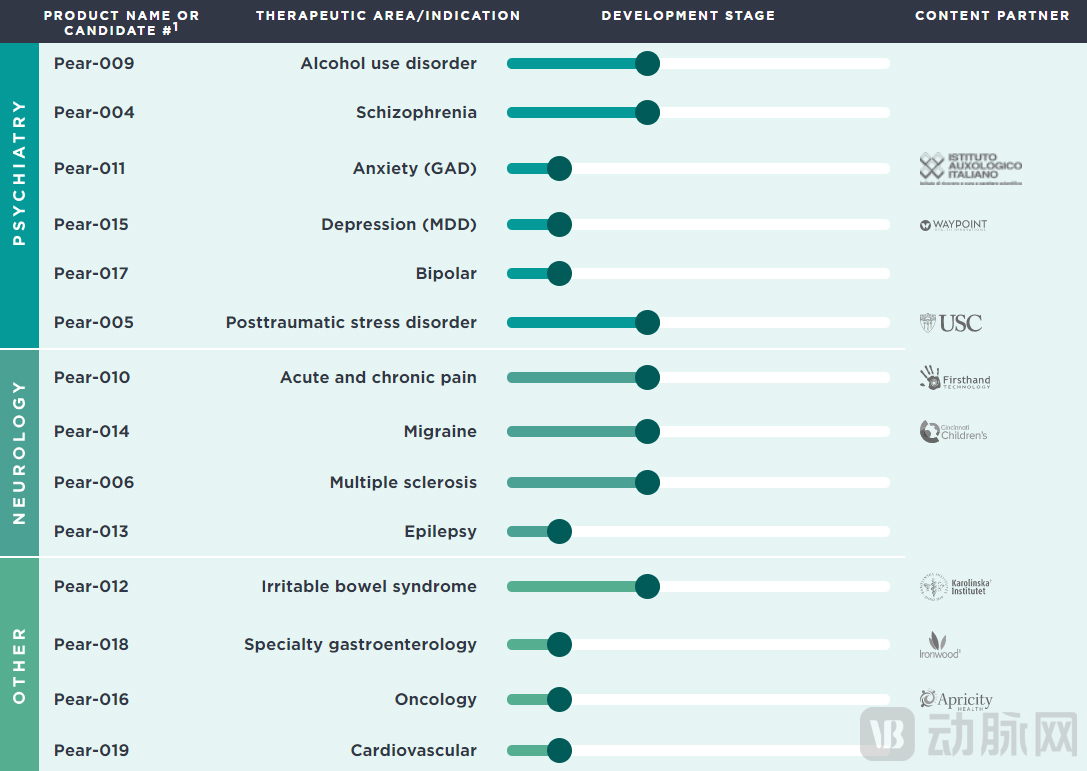 Pear’s Product Pipeline in Development. Image source: Pear official website
In November 2021, Pear’s reSET-A for the treatment of alcohol use disorder (AUD) received FDA Breakthrough Device Designation, marking the second such designation awarded to Pear following reSET-O.
In accordance with FDA regulations, a Breakthrough Device must meet two key criteria: it contributes to more effective diagnosis or treatment of life-threatening or irreversibly debilitating diseases or conditions; and the device employs breakthrough technology, for which no approved alternative devices are available, or it offers significant advantages over existing approved alternatives. Products designated as Breakthrough Devices are eligible for priority review.
Alcohol is one of the most commonly abused substances in the United States. Alcohol Use Disorder (AUD) is a clinical diagnosis characterized by alcohol abuse or addiction, leading to adverse social, occupational, and health consequences; however, attempts to control or cease alcohol consumption can result in physical impairment. Surveys indicate that in 2019, approximately 14 million adults in the United States had AUD, yet fewer than one in ten individuals with 12-month AUD received treatment.
It is estimated that 95,000 people die annually from alcohol-related factors, making alcohol the third leading preventable cause of death in the United States. However, treatment options for patients with alcohol use disorder (AUD) are limited; fewer than 2% of AUD patients receive pharmacotherapy for AUD, and there are currently no FDA-approved medical devices or digital therapeutics specifically indicated for AUD patients in the U.S.
Receiving Breakthrough Device designation has laid the foundation for a more expedited approval of reSET-A in the future.
In December 2021, Pear Therapeutics added two depression treatment products through acquisitions and licensing agreements. One product delivers cognitive behavioral therapy (CBT) to patients via standardized symptom assessments, videos, interactive tools, and algorithms, providing treatment for depression of varying severity levels. The other product addresses residual symptoms of depression through a combination of modules including behavioral activation, cognitive restructuring, sleep and relaxation techniques, mindfulness, physical activity, anxiety reduction, and long-term goal setting, thereby serving as a therapeutic option for recurrent depression. Preliminary clinical study results for both products have been released, but neither has yet been submitted to the FDA for approval.
Pear intends to leverage these two new assets to expand its depression candidate product portfolio for the treatment of mild, moderate, severe, and treatment-resistant depression.
Chris Guiffre, Chief Financial Officer and Chief Operating Officer of Pear, stated that achieving the 2022 performance targets would enable Pear to better invest in reSET-A for the treatment of AUD (Alcohol Use Disorder), as well as two new products in the depression sector. Mr. Guiffre believes that these two indications hold significant market potential and can create synergies with the company’s existing portfolio in the mental health field.
In 2022, will Pear be able to maintain its rapid growth and achieve its established targets? In the coming months, let us continue to pay close attention to further developments at Pear.
Similar to the United States, digital therapeutics (DTx) in China are experiencing rapid growth. Particularly since 2021, an increasing number of investment firms and innovative companies have turned their attention to DTx and entered the field. According to the “White Paper on Digital Therapeutics in China 2.0” released by VCBeat’s VBInsight, there were 73 DTx enterprises in China as of September 2021, including those that had not yet obtained medical device registration certificates. Classified by primary indications, these companies already cover popular areas such as mental disorders and neurological diseases.
In contrast, digital therapeutics in China started later, with product development, clinical implementation, and reimbursement mechanisms all still in the early stages of exploration. Therefore, the rapid growth of Pear Therapeutics can offer valuable insights for Chinese companies.
First, it is essential to clarify whether the product is positioned as prescription-only or over-the-counter (OTC), as this determines distinct commercialization strategies and payers. Currently, China does not have specific approval policies for digital therapeutics; instead, they are regulated under the existing approval frameworks for medical software. Therefore, from a regulatory perspective, there is no strict distinction between prescription and OTC categories at present. Nevertheless, companies still need to define the strategic direction for their products.
If a product is positioned as a prescription digital therapeutic, the company needs to focus on reaching healthcare institutions and physicians to influence their decision-making. If the product is positioned as an over-the-counter digital therapeutic, it must not only reach physicians but also influence patient decisions. For such products, patients may become the primary payers; however, healthcare institutions, other social health organizations, large enterprises, and other entities with corresponding needs may also serve as payers.
Given the current landscape of digital therapeutics (DTx) in China, it is more appropriate to start with over-the-counter (OTC) DTx. Once their efficacy is better validated and a broader willingness to pay is established, the industry can gradually transition toward prescription DTx. For prescription DTx, only medical insurance and commercial insurance—with their stronger payment capabilities and larger-scale procurement—will have the incentive to pay.
Secondly, there is a strong emphasis on research and validation of product safety and efficacy. The term “therapy” in digital therapeutics fundamentally distinguishes them from chronic disease management and general health management. The former requires more rigorous data to demonstrate therapeutic effects. In addition to clinical trial data required for regulatory approval, long-term real-world evidence is also critical. Efficacy data warrants attention from payers, patients, and physicians alike.
It is important to note that the efficacy data are not unilaterally released by the company and potentially embellished, but rather derived from rigorous retrospective analyses conducted through academic research and presented via authoritative channels such as peer-reviewed journals and academic conferences.
Finally, amid the current surge in digital therapeutics, some voices argue that its conceptual value outweighs its practical application, expressing skepticism about its future prospects. Although China does not yet have a fully developed ecosystem for digital therapeutics, the evolution of any tangible innovation is never achieved overnight.
Currently, in addition to significant corporate investment in digital therapeutics, there has also been policy-level response. For example, in 2022, Hainan Province included “exploring pilot trials of digital therapeutics” as one of the key tasks in its 14th Five-Year Plan for digital health development. This marks the first time digital therapeutics have been incorporated into a provincial-level plan, sending a positive signal from policymakers to the industry. Therefore, while maintaining a rational perspective within the industry, the determination to actively explore and innovate must not wane.