

Raysens Medical: A Rising Chinese CGM Innovator Challenging Global Giants with Affordable, High-Performance Continuous Glucose Monitoring

Oriental Fortune Capital
Professional Venture Capital Management Firm
Diabetic Patients Have Long Suffered from Finger-Prick Blood Glucose Testing.
Traditional blood glucose monitoring uses fingerstick glucometers.(Blood Glucose Monitoring,BGM), but it has long been criticized for its drawbacks, such as the pain associated with fingerstick punctures and the limited presentation of blood glucose information.Finger-prick swelling may soon become a thing of the past, as the latest Continuous Glucose Monitoring (CGM) technology is poised to usher in a digital revolution in blood glucose health management.
CGM can continuously provide round-the-clock blood glucose data for several days, facilitating a comprehensive understanding of patients’ glycemic fluctuations and representing a new trend in blood glucose monitoring. It offers advantages such as convenience, rapidity, and painlessness.
Furthermore, CGM offers the advantages of helping to identify periods of suboptimal glycemic control during intensive glucose-lowering therapy, elucidating the impact of uncontrolled fasting or postprandial glucose on overall daily glycemia, and pinpointing key drivers and critical time windows of glucose variability.
Technological innovations are set to disrupt a vast market. According to data from Frost & Sullivan, the CGM markets in the United States and Europe were valued at USD 2.7 billion and USD 1.2 billion, respectively, in 2020, and are projected to reach USD 15.4 billion and USD 7.8 billion by 2030. In China, the CGM market size was USD 140 million in 2020, with a compound annual growth rate (CAGR) of 73.2% from 2015 to 2020. Driven by an expanding product portfolio and heightened health management awareness among residents, China’s CGM market is expected to maintain robust growth. Based on U.S. penetration rates, it is estimated that China’s CGM market could reach approximately RMB 17.8 billion by 2030.
Global Blood Glucose Monitoring Market Size
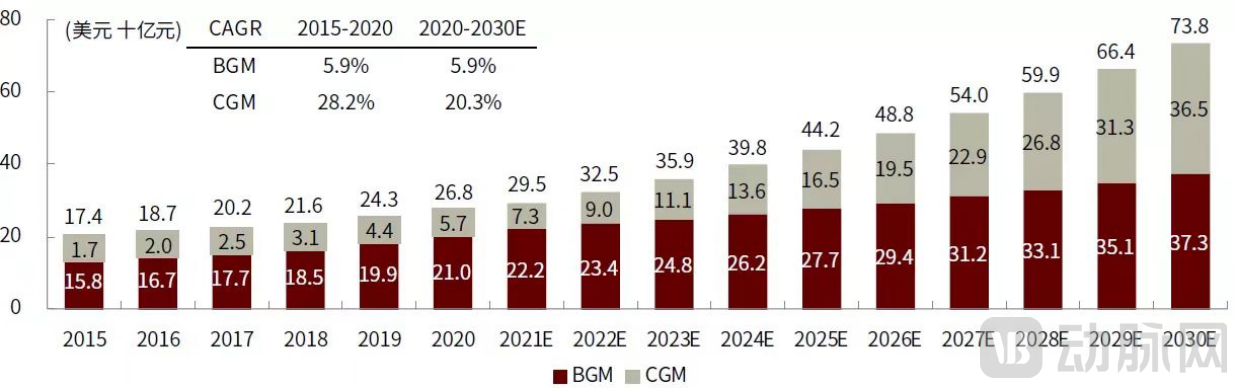
Source: CIC Consulting, CICC Research Department
Although CGM is beneficial, the domestic market was previously dominated by imported brands such as Abbott, Dexcom, and Medtronic, and their prohibitive prices deterred countless patients with diabetes.
Technology makes life better, and the health innovations it brings should benefit everyone. Fortunately, there is a distinct group within China’s healthcare industry: individuals who hail from top universities, characterized by their focused minds and pure intentions. Their professionalism enables them to get straight to the heart of medical issues; their compassion allows them to resist the allure of profit and return to the fundamental mission of serving patients; and their relentless pursuit of knowledge empowers them to break through traditional thinking and pioneer innovative healthcare solutions.
A wave of domestically innovative CGM companies has emerged,Suzhou Ruigan Medical Technology Co., Ltd. (hereinafter referred to as “Ruigan Medical”)is part of this wave of innovation.
Ruigan Medical was established in February 2021 and is aA High-Tech Company Specializing in the R&D and Manufacturing of Biosensors and Medical Devices. The company is oriented toward healthcare and focuses onResearch and development, and manufacturing of biosensors, including continuous glucose monitoring (CGM) systems and minimally invasive biosensors (e.g., ICU intracranial sensors, coronary fractional flow reserve [FFR] sensors).and for use inNon-invasive Biosensors for Consumer Electronicsetc.
Founder: Liu YuWith nearly 20 years of R&D management experience at large multinational medical device companies, he previously worked in Bayer’s Diabetes Care division, focusing on the R&D and industrialization of continuous glucose monitoring (CGM) systems. As the technical lead for the global sensor team, he spearheaded a worldwide team of over 100 professionals to develop CGM technologies at an internationally leading level. He established overseas production lines with an annual capacity ranging from several million to tens of millions of sensors, and has completed pilot-scale production as well as multiple clinical trials in Europe and the United States.
Core team members hail from renowned medical device companies such as GE Healthcare, Philips Healthcare, Bayer Diabetes Care, and BD Medical, bringing 10 to 30 years of industry experience. They possess extensive expertise in the research and development of medical devices, the design and manufacturing of electrochemical, biological, and physical sensors, algorithm development, and the R&D of polymer materials.
Under the leadership of Liu Yu, RaySense Medical has forged ahead with determination, establishing a 2,500-square-meter facility in Shishan, Suzhou High-Tech Zone, complete with cleanroom workshops, sterile testing laboratories, and sensor laboratories. The establishment of the sensor production line has provided a robust technical environment for product R&D. Currently, RaySense Medical holds multiple core invention patents inGlucose oxidase sensors, dehydrogenase sensorsandBiological Pressure Sensor TechnologyPossesses a substantial reserve of technical expertise.
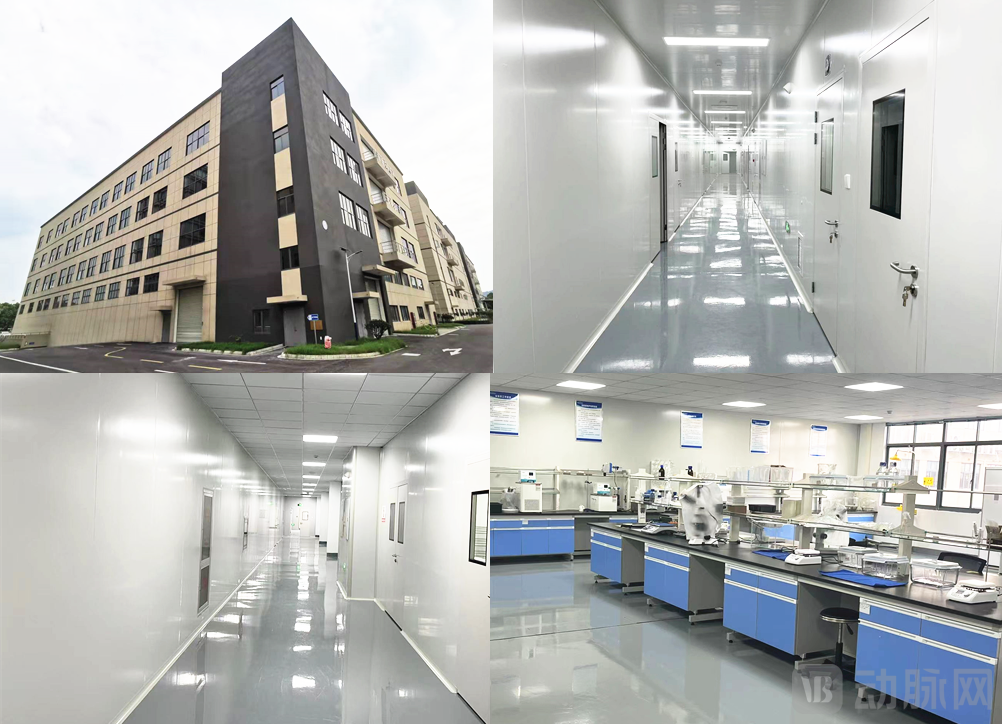
Real Photos of Ruigan Medical's Factory
A CGM system consists of a sensor probe, a transmitter, and a receiver, offering relatively flexible wearing and data reception options. The CGM sensor probe enables the implantation of a microsensor into the subcutaneous tissue. Trace amounts of glucose in the interstitial fluid continuously pass through the dialysis membrane on the sensor probe into the enzymatic reaction layer, where they undergo a chemical reaction with enzymes to generate electrical signals. These electrical signals are then converted into blood glucose readings and transmitted via the transmitter to the receiver.
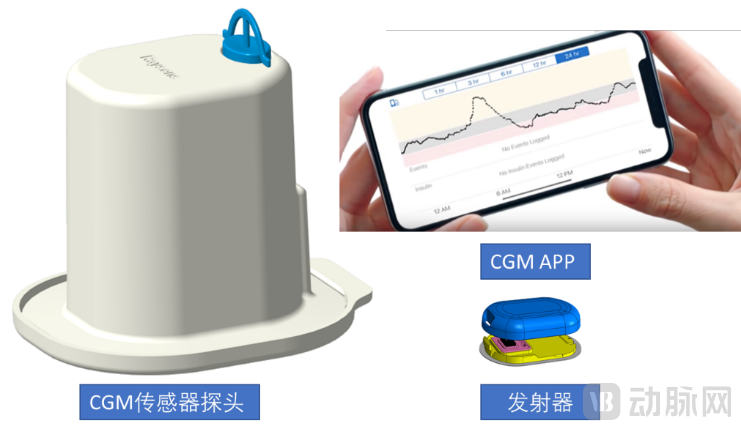
Raigeek CGM Product Image
Although CGMs are compact, they face three major technical barriers, namelySensors, outer membrane, and algorithms.The sensor is the most critical component of continuous glucose monitoring (CGM) systems and also the most technically challenging part.
According to Liu Yu, in response to the aforementioned three major technical barriers, Ruigan has also developed three corresponding core technological solutions.
In terms of sensor design, Ruigan has adopted a flexible electrode design featuring a compact, high-precision three-electrode configuration, with relatively controllable manufacturing processes and low costs;
In terms of outer membrane design, Ruigan employs a semi-permeable biofilm, with innovations in both the structural design and materials of the semi-permeable biofilm. This approach significantly extends the usable lifespan while reducing initialization time, granting Ruigan’s CGM the longest wear duration among domestic products.
Regarding calibration-free algorithms, a two-phase approach comprising sensor status analysis and measurement is innovatively introduced. The status analysis phase enables real-time monitoring of sensor conditions and employs adaptive algorithms to ultimately achieve calibration-free operation.
With targeted optimizations and solutions, Ruigan’s performance stands out—its MARD value, widely recognized in the industry as a key reference metric for product accuracy, is comparable to that of Dexcom’s CGM products, which represent the industry benchmark.
Beyond the initial R&D challenges, ensuring consistency and stability in CGM products has become a collective hurdle for the industry to overcome following large-scale commercial production. Ruigan has independently developed its sensor production line and established a precision manufacturing system. Featuring a 2,500-square-meter facility equipped with cleanrooms, sterile testing laboratories, and sensor labs, along with advanced production and testing equipment, this system provides quality assurance for standardized manufacturing and pre-delivery inspections.
Through a comprehensive strategic approach, RaySense’s CGM yield has reached international standards. With an annual production capacity exceeding tens of millions of units, the process achieves high yields and is well-suited for large-scale manufacturing.
The reading method of Ruigan CGM isReal-time Reading, rather than the retrospective mode of the Abbott FreeStyle Libre. The difference between the two lies in the fact that the latter’s retrospective reading involves the CGM collecting and storing data at a certain frequency, which is then played back and displayed after manual retrieval via a reader or smartphone; whereas the former’s real-time reading not only records data at set intervals but also monitors blood glucose levels at the current moment and provides alerts for dangerous fluctuations. This feature is particularly important for patients at risk of hypoglycemia.
The company has filed multiple invention patent applications and has strategically positioned itself in core technologies such as calibration-free CGM methods, CGM systems, and sensor biofilms.
"Thanks to the mastery of core technologies and a mature, independently developed sensor production line, Ruigan's CGM production costs have become controllable, thereby creating room for price reductions."
“Traditional blood glucose meters (BGMs) incur a daily cost of approximately RMB 7–20, whereas currently marketed continuous glucose monitoring (CGM) systems range from RMB 32 to 70 per day. Ruigan’s CGM can reduce the usage cost to the level of traditional BGMs, offering exceptional cost-effectiveness,” introduced Liu Yu. “Product pricing is only one aspect; sales channels are equally critical. In the future, we will expand our product sales through domestic over-the-counter (OTC) online platforms such as Tmall and JD.com, OTC offline channels via partnerships with chain pharmacies, hospital channels targeting healthcare professionals (HCPs), and overseas markets.”
“Currently, the CGM industry is still in the market education phase, with multinational corporations such as Abbott and Medtronic leading these efforts. Although several domestic companies have obtained NMPA certifications, the overall landscape suggests that all players are starting from the same baseline, making Raycome’s future prospects promising.” Discussing the company’s future goals, Liu Yu stated, “The company’s development is progressing steadily according to plan. We expect to obtain the NMPA medical device registration certificate in 2024, and our short-term sales target after commencing commercial production is to reach hundreds of millions of yuan.”
In August 2021, Ruigan Medical completed a tens-of-millions-yuan angel financing round, exclusively invested by Oriental Fortune Capital, a leading domestic venture capital fund.RuiGan Medical is currently raising tens of millions of yuan in its next funding round to support upcoming CGM clinical trials.