

Emergex Submits IPO Prospectus for Its Fully Synthetic T Cell Microneedle Vaccine Platform with Potential Decade-Long Primary Immunity

Emergex Vaccines
Vaccine Developer
Oral and injectable administration are currently the two most prevalent routes of drug delivery. However, oral administration suffers from low absorption and bioavailability, as well as significant adverse effects on organs such as the liver. In contrast, injectable administration involves direct injection into human tissues and blood vessels, which is associated with considerable pain and poor patient compliance.
With the development of biomedical technology, a novel drug delivery method known as microneedle drug delivery has emerged.
Microneedles are micron-scale, needle-like fine structures fabricated using micro-electro-mechanical systems (MEMS) technology, with lengths typically ranging from 25 to 1000 micrometers. The microneedle drug delivery system is a minimally invasive transdermal drug delivery system that combines the dual characteristics of subcutaneous injection and transdermal patches. Its mechanism of action involves drugs entering the skin through microchannels formed by microneedles penetrating the stratum corneum, thereby facilitating transdermal permeation and delivering the drug to specific depths within the skin.
Microneedles can penetrate the stratum corneum without stimulating pain nerves, allowing drugs to reach a specified depth in the skin and be absorbed into the subcutaneous capillary network. This enhances drug permeation while avoiding pain and skin damage. Therefore, microneedles help improve drug delivery efficiency and patient compliance. Furthermore, microneedle-based drug administration provides stable and controllable dosing.
Microneedles have a wide range of applications and can be used for transdermal delivery of small molecules, biologics, vaccines, and intracellular DNA/RNA. Currently, the main research directions for microneedles focus on vaccines, diabetes, dermatological conditions, and medical aesthetics.
Given the numerous advantages of microneedles and their broad market prospects, Emergex Vaccines (hereinafter referred to as “Emergex”), a company dedicated to the research and development of microneedle patch vaccines, was established in 2016.
Emergex is a clinical-stage biotechnology company developing a portfolio of innovative CD8+ T cell-adaptive vaccines against viral and bacterial infectious diseases. Emergex’s vaccines are 100% synthetic and formulated for microneedle delivery, enabling the administration of highly conserved immunogenic peptide fragments derived from influenza viruses to antigen-presenting cells in the skin, thereby eliciting robust and durable T cell-mediated immune responses.
In fact, the term “Microneedle” was first reported in the literature as early as 1921. In 1976, Gerstel and Place first proposed the concept of using hollow microneedle arrays for transdermal drug delivery. This approach employed needle arrays with lengths ranging from 5 μm to 100 μm to penetrate the stratum corneum, loading drugs into the hollow needles for delivery into this layer. The first microneedle patent was granted in California, USA.
However, due to technological limitations, it was not until the 1990s, when microelectromechanical systems (MEMS) technology witnessed unprecedented development, high-precision semiconductors and microelectronic devices emerged, and manufacturing capabilities for micro- and nanoscale devices rapidly advanced, that microstructured devices such as microneedles became a reality.
Emergex’s core team possesses extensive knowledge and experience in nanomedicine, glycobiology, drug development, and other fields related to microneedles, laying a solid foundation for the company’s research, development, and clinical advancement of microneedle-based vaccines.
Dr. Thomas Rademacher, Co-Founder and Chief Executive Officer, is an Honorary Professor of Molecular Medicine at University College London (UCL). He is recognized as one of the pioneers of biotechnology in the early 1980s, particularly in the fields of recombinant proteins, monoclonal antibodies, and glycobiology. With extensive expertise and experience in glycobiology and nanomedicine—fields closely related to microneedle research and development—he co-founded Oxford GlycoSciences (listed in 1998) and the nanomedicine company Midatech Pharma (listed in 2015). In addition to his entrepreneurial ventures, as an academic scientist, he holds more than 50 patents and has authored over 200 publications.

Co-founder and CEO: Thomas Rademacher
Chief Medical Officer Athanasios Papadopoulos has over 20 years of experience in the clinical development of drugs and vaccines. He previously held senior leadership positions at multinational pharmaceutical companies Novartis and Sanofi, where he led the clinical development of the vaccines Dengvaxia (for dengue fever) and Bexsero (for meningitis).
Chief Scientist Dr. Phillip Williams is a nanotechnology expert with extensive experience in the development of gold nanoparticles. As Chief Scientist at Midatech Pharma, he participated in the production and validation of the world’s first scalable manufacturing process for ultra-small gold nanoparticles.
It is reported that the Emergex vaccine combines several of its proprietary technologies.
First, the Emergex vaccine is made from synthetic MHC class I-presented peptides.Emergex has successfully generated first-generation libraries of human-specific MHC class I CD8+ peptide “ligands” for dengue fever, influenza, Zika virus, hepatitis B, and Francisella tularensis. MHC class I molecules present intracellular peptides (protein fragments) to CD8+ T cells. If these T cells detect abnormalities—such as viral proteins presented on the cell surface by MHC class I molecules during viral infection—they will kill the pathogen-infected cells.
The “ligand library” contains encrypted peptide data designed to instruct the immune system to increase the frequency of pathogen-specific T cells, thereby elevating the baseline level of pathogen-specific immunity.. Upon subsequent exposure to pathogens, the immune system will be pre-programmed to respond more rapidly and deploy a greater number of pathogen-specific T cells.Emergex claims that T cell-mediated immunity has been proven to last for decades, so T cell-priming vaccines are expected to provide broader and more durable immune responses.
Secondly, the Emergex vaccine utilizes a gold nanoparticle-based carrier system.Emergex combines selected peptide fragments with a gold nanoparticle carrier system to produce ultra-small particles with a diameter of less than 5 nanometers, which are ideal for transdermal immunization via microneedle skin patches, offering a less invasive alternative to traditional injections.
In short, Emergex’s microneedle vaccine utilizes gold nanoparticles to deliver peptides (essentially viral codes) to human cells, thereby stimulating T-cell-mediated defense against the virus.
In terms of design, traditional vaccines are primarily administered via injection.Emergex Vaccines utilizes a microneedle patch design, with the patch being only the size of a fingernail and covered in microscopic needles. Upon contact with the skin, these microneedles can deliver the vaccine into the human body within seconds.
Moreover, existing vaccines require cold-chain storage, whereas this patch can be stored at room temperature for over three months. This facilitates more convenient vaccination and helps alleviate the healthcare burden in countries or regions with limited cold-chain infrastructure.
The advantages of the Emergex vaccine can be briefly summarized in the following five points:
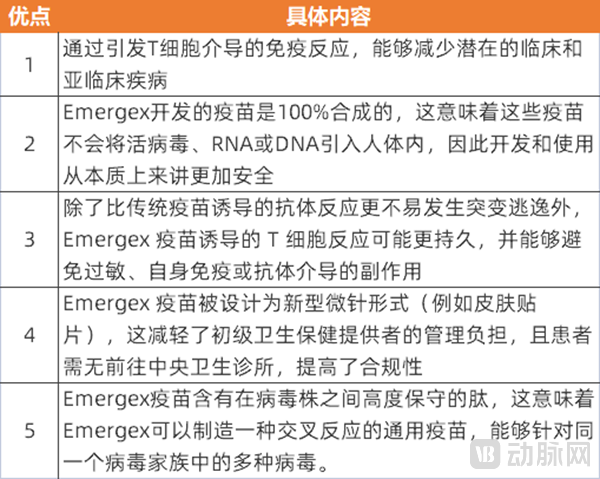
Among the various product pipelines currently being developed by Emergex, research on microneedle vaccines for SARS-CoV-1/SARS-CoV-2 coronaviruses and dengue fever is the most advanced.
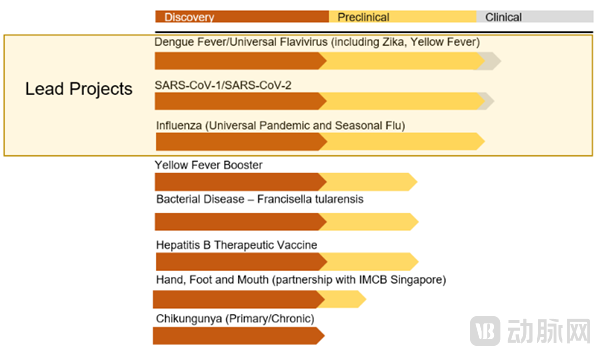
Product Pipeline (Image source: Emergex official website)
It is reported that Emergex’s vaccine is designed to prime naïve CD8+ T cells to generate virus-specific cytotoxic T lymphocytes (CTLs; CD8+ T cells) that kill virus-infected cells, thereby preventing viral replication and disease, reducing symptoms, and limiting transmission between infected and uninfected individuals. Therefore,Compared to current vaccine technologies that primarily rely on antibodies, Emergex’s T-cell priming vaccine has the potential to more effectively target rapidly mutating viruses (such as SARS-CoV-2) and eliminate the need for seasonal booster vaccinations. Furthermore, Emergex’s vaccine targets highly conserved antigens, thereby enabling cross-reactive immunity against SARS-CoV-1 and all SARS-CoV-2 variants, thus providing broad immune protection against both pandemic viruses.
On November 15, 2021, Emerge announced that it had received approval from the Swiss regulatory authority for a Phase I clinical trial to evaluate the safety and tolerability of its candidate vaccine against SARS-CoV-2 (the virus causing COVID-19). The Phase I trial of the COVID-19 vaccine is a double-blind, randomized controlled study involving two groups (high-dose and low-dose) of 13 volunteers each, and was launched on January 3, 2022. Interim results are expected to be released this June. In addition to providing data on safety and tolerability, Emergex will also present early data on CD8+ T cell-mediated immune responses.
Meanwhile, the Phase I clinical trial (NCT04935801) of Emergex’s dengue candidate vaccine is currently underway in Switzerland.
In addition, Emergex is developing universal influenza vaccines, universal filovirus vaccines (targeting viruses including Ebola and Marburg), a yellow fever booster vaccine, and a chikungunya virus vaccine. It is also collaborating with Singapore’s IMCB to develop a vaccine to address the emerging threat of hand, foot and mouth disease (HFMD).
Leveraging its vast market, professional team, and highly competitive technology, Emergex has completed four rounds of financing since its inception, earning strong favor from both the government and investors.
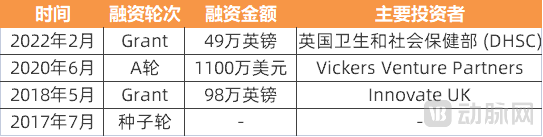
Emergex Funding Overview (Source: Crunchbase)
The application areas of microneedles can be broadly categorized into the pharmaceutical sector and the non-surgical medical aesthetics sector. In Europe and North America, microneedle technology is predominantly applied in biopharmaceuticals and medical devices, whereas in Japan and South Korea, it is more commonly utilized in the field of medical aesthetics.
In China, the microneedle industry started relatively late. Due to regulatory gaps in domestic policies and standards for microneedle technology, limited in-depth understanding of the technology, and the fact that the domestic medical aesthetics market generates cash flow more readily than the broader medical sector, the development trajectory of China’s microneedle industry has gradually shifted toward non-surgical aesthetic applications.
Among the energy-based aesthetic procedures that consistently account for a significant market share, radiofrequency (RF) microneedling has become a practical technique in the field of dermatological aesthetics, owing to its advantages such as high efficacy, cost-effectiveness, minimal invasiveness, rapid recovery, and safety. It is widely favored by individuals seeking aesthetic improvements.
In recent years, the market size of China's microneedle industry has shown a year-on-year increase. According to incomplete statistics, the market size of microneedles in China was approximately RMB 128 million in 2020, and it is expected to exceed RMB 200 million in 2022. The future prospects of China's microneedle market are very broad.
However, China’s microneedle industry will not be confined solely to medical aesthetics. As domestic understanding, technology, and policy frameworks continue to mature, Chinese microneedle companies are expected to leverage the cash flow generated from the medical aesthetics market to introduce microneedle technology into the realm of serious medical applications.