

Kr Pharmtech Advances Next-Generation Pathology with Multiplex Immunofluorescence Platform for Tumor Microenvironment Analysis Following NGS Era
At the beginning of 2022, Professor Bian Xiuwu, an academician of the Chinese Academy of Sciences, first proposed “Next-Generation Diagnostic Pathology(next-generation diagnostic pathology)” concept and provided a detailed elaboration.
Next-generation diagnostic pathology is grounded in pathological morphology and clinical information. It is characterized by innovative, cutting-edge, interdisciplinary technologies, including molecular testing and bioinformatics analysis, intelligent sample preparation and process quality control, AI-assisted diagnosis and remote consultation, as well as in vivo lesion visualization and “non-invasive” pathological diagnosis. By incorporating multi-omics and cross-scale integrated diagnosis into pathology reports, it aims to deliver the “definitive diagnosis” of diseases, predict disease progression and outcomes, recommend treatment regimens, and assess therapeutic responses, thereby establishing a new “gold standard” for disease diagnosis.
Specifically in the field of oncology diagnosis and treatment, next-generation diagnostic pathology has evolved from qualitative diagnosis (determining whether lesions are benign or malignant) and histological classification toward predictive diagnosis (assessing evolutionary tendencies and prognosis) and molecular subtyping (identifying genetic and protein abnormalities), thereby driving pathological diagnosis to become more efficient and precise.
In fact, next-generation diagnostic pathology is not new in the field of oncology. Since the concept of “precision medicine” was proposed in 2015, it has sprouted and rapidly developed alongside the genomics era, giving rise to a large number of tumor NGS companies.
Nowadays, as the clinical value of multi-omics research and tumor immune microenvironment (TME) research gains widespread recognition, precision oncology diagnosis isThe evolution from next-generation sequencing (NGS) to next-generation pathology (NGP), represented by multiplex fluorescent immunohistochemistry (mIHC) technology.
Forward-looking enterprises are already driving the further maturation and clinical translation of next-generation diagnostic pathology. As an advocate of next-generation pathological technologies, Kuoran Biomedical Technology (Shanghai) Co., Ltd. is working to integrate the upstream, midstream, and downstream segments of the multiplex fluorescent immunohistochemistry industry chain. Centered on multiplex fluorescent immunohistochemistry technology, the company has launched a comprehensive solution for panoramic analysis of the tumor immune microenvironment.
Amid the Immunotherapy Boom, mIHC Technology for Analyzing the Tumor Microenvironment Is Gaining Significant Attention
The approach to tumor diagnosis and treatment has roughly undergone three stages. The first stage was characterized by traditional therapies, primarily surgical resection, radiotherapy, and chemotherapy. The second stage saw the rise of targeted therapy, which spurred the emergence of next-generation sequencing (NGS) technology. The third stage witnessed major breakthroughs with immunotherapy in certain types of cancer. Tasuku Honjo from Kyoto University and James P. Allison from the University of Texas at Austin jointly received the 2018 Nobel Prize in Physiology or Medicine for their “discovery of cancer therapy by inhibition of negative immune regulation.”Multiplex Fluorescent Immunohistochemistry for Analyzing the Tumor Microenvironment Has Attracted Worldwide Attention.
The focus of pathological diagnosis in oncology is rapidlyShifting from Targeted Therapy to Research on the Tumor Immune Microenvironment.
As the scientific community’s understanding of tumor initiation and progression deepens, clinical approaches to cancer diagnosis and treatment have evolved from focusing solely on tumor cells themselves to emphasizing the interactive relationship between tumors and surrounding tissues. It is now recognized that “tumor initiation and progression result from the mutual influence and co-evolution of tumor cells and their microenvironment.”Research on the tumor immune microenvironment has become a beacon of hope for advancing cancer diagnosis and treatment.
As research into the tumor immune microenvironment becomes the foundation of precision oncology diagnosis and treatment, existing pathological diagnostic techniques have revealed certain limitations and are unable to meet the demands of next-generation diagnostic pathology.
For example, immunofluorescence can only label 2–3 markers, making it difficult to accurately characterize the true features of the complex tumor microenvironment; immunohistochemistry allows multi-marker labeling through serial sectioning, but it cannot accurately analyze the correlations between individual proteins and cells, permitting only qualitative interpretation subject to human subjectivity; flow cytometry and genetic testing can obtain abundant information at the cellular and genetic levels, but lack the in situ spatial contextual relationships of the acquired data.
In other words, research on the tumor immune microenvironment is driving oncology diagnosis and treatment toward next-generation pathology, making it imperative to upgrade and iterate existing pathological diagnostic technologies.Multiplex Fluorescent Immunohistochemistry: A Technology Developed to Address the Limitations of Conventional Methods in Studying the Tumor Immune Microenvironment"Kuoran Gene told VCBeat."
Multiplex Fluorescent Immunohistochemistry: A Global Hotspot Technology in Recent Years with Significant Research Advances in Tumor Therapy, Neuroscience, Stem Cell Research, and Organ Transplantation, Paving New Directions for Precision Diagnosis and Treatment of Various Diseases
In 2021, in Akoya Biosciences’ white paper titled “Spatial Phenotyping: Novel Biomarkers for Characterizing Solid Tumors and Predicting Response to Immunotherapy,” multiplex fluorescent immunohistochemistry was referred to as“Next-Generation Pathology Technology”。
In the field of oncology, multiplex fluorescence immunohistochemistry enables panoramic analysis of the tumor immune microenvironment. It allows for the simultaneous labeling of 7–9 biomarkers on a single tissue section, facilitating quantitative assessment of cellular phenotypes and activities, comprehensive characterization of the tumor immune microenvironment, and mapping of in situ spatial information among cells.
Existing research results indicate that multiplex fluorescence immunohistochemistry can significantly enhance detection sensitivity, detect low-abundance samples, and achieve a comprehensive and objective analysis of tumor immune profiling in patients.Tumor Microenvironment Detection Based on Multiplex Fluorescent Immunohistochemistry Technology Enables Deeper Insight into Tumorigenesis Mechanisms, Enhances Prediction of Therapeutic Response, and Precisely Identifies Patients Likely to Benefit from Immunotherapy.
James P. Allison, the 2018 Nobel Laureate in Physiology or Medicine and an immunologist, has long championed the application of multiplex fluorescence immunohistochemistry in research on the tumor immune microenvironment, publishing landmark findings in breast cancer, melanoma, pancreatic cancer, and other fields.
However, at present, even in overseas regions with highly advanced oncology diagnosis and treatment research, multiplex fluorescent immunohistochemistry has not yet been applied in clinical practice. Clinical trials and prospective studies are underway, placing the technology at a critical juncture for clinical adoption. In China, amidst the booming NGS research,In 2020, Kuoran Biomedical pioneered the clinical translational research of multiplex fluorescent immunohistochemistry technology in China.Overall, the gap between China and other countries in multiplex fluorescent immunohistochemistry research is not significant, and opportunities have already emerged.
Currently, Kuoran Genomics has established a comprehensive multiplex fluorescent immunohistochemistry technology platform, encompassing multi-marker staining, multispectral imaging systems, and image analysis systems, and has developed seven diagnostic products.
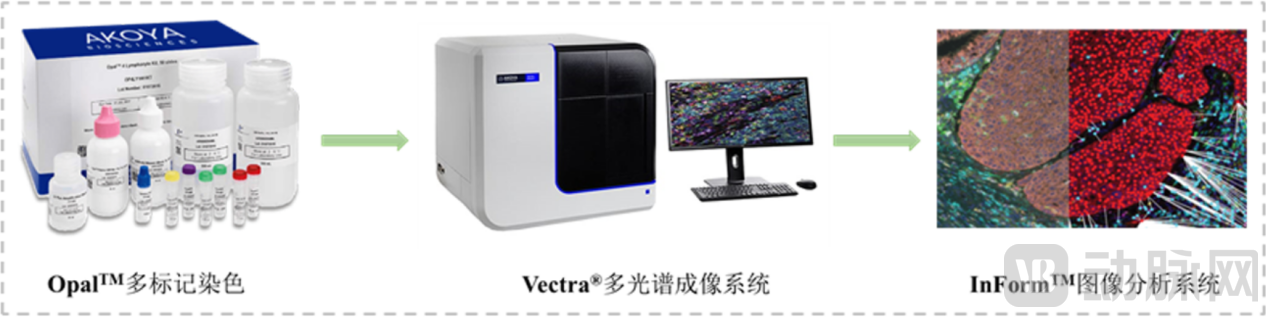
Three Major Breakthroughs in Kuoran Gene’s Multiplex Fluorescent Immunohistochemistry Technology Platform
Among them,Opal™ Multiplex Staining TechnologyOvercomes the limitations of antibody species source conflicts, enabling simultaneous multiplex biomarker labeling on paraffin sections, thereby conserving scarce sample material; additionally, the high-intensity fluorescent signals are stable and resistant to quenching.Increase detection sensitivity by 1,000-fold.
Vectra®Multispectral Imaging SystemEquipped with high-precision spectral overlap unmixing technology, it can accurately scan and record all information on a single paraffin section, enabling ultra-high-speed batch analysis.Improved the signal-to-noise ratio, detection accuracy, and efficiency of images.
InForm™ Image Analysis SystemAble toIntelligent Recognition of Tissue and Cell Types for Precise Quantitative Evaluation of Tissue Morphology, through in-depth data mining, conducting correlation analysis, multi-target co-expression positivity rate analysis, cell density analysis, spatial distance analysis, spatial infiltration analysis, and inter-group differential analysis.
Leveraging its multiplex fluorescent immunohistochemistry technology platform, Kuoran Genomics has launchedComprehensive Analysis Solution for the Tumor Immune Microenvironment, comprehensively analyze the infiltration of cytotoxic T cells, exhausted T cells, macrophages, B cells, NK cells, cytokines, and immune checkpoint receptors within the tumor immune microenvironment; thoroughly evaluate patient prognosis and therapeutic efficacy of immunotherapy; and elucidate the relationships and clinical molecular mechanisms linking the tumor immune microenvironment to tumorigenesis, progression, recurrence, metastasis, and drug resistance.
Clinical trials have demonstrated that Kuoran Gene’s comprehensive solution for tumor immune microenvironment analysis shows strong concordance with the PD-L1 (22C3, 28-8, SP142, SP263) IHC “gold standard” in assessing PD-L1 protein expression levels, and can assist physicians in formulating more precise medication and treatment strategies from the perspective of the tumor immune microenvironment.
Although some domestic companies have already introduced multiplex fluorescent immunohistochemistry technology to provide downstream research services and pharmaceutical company services, Kuoran Genomics believes thatThe key competitive factors for Chinese enterprises in multiplex fluorescence immunohistochemistry technology lie in integrating the upstream and downstream industrial chains and promoting regulatory compliance of the technology.
Upstream in the industry chain, Kuoran Gene is advancing the registration and filing of instruments, software, and key raw materials such as antibody-conjugated fluorescent dyes, thereby reducing the cost of multiplex fluorescence immunohistochemistry technology while raising the company’s technical barriers. In the midstream segment, Kuoran Gene has formed an industrial alliance with leading pathology centers and research institutions in China. Downstream, the company provides scientific research services, pharmaceutical enterprise services, and clinical diagnostic services.
In terms of regulatory compliance, Kuoran Genomics will provide services in the form of Laboratory Developed Tests (LDTs) while actively pursuing National Medical Products Administration (NMPA) approval for its multiplex fluorescence immunohistochemistry technology, with the aim of promoting it as an In Vitro Diagnostic (IVD) product in the future.
In the context of next-generation pathological diagnostics, a key characteristic is the intersection of multiple cutting-edge technologies and multidisciplinary integration. If next-generation sequencing (NGS) represents the first phase of next-generation tumor pathology, multiplex fluorescent immunohistochemistry can be regarded as the second phase, driving greater precision and efficiency in tumor pathology and aligning with the trend in oncology diagnosis and treatment shifting from focusing solely on tumor cells to examining the tumor microenvironment.
““In the future, multiplex fluorescent immunohistochemistry will complement technologies such as NGS, jointly driving the evolution of tumor pathology diagnosis toward greater comprehensiveness, precision, and efficiency.”
Kuoran Genetics focuses on translational research and applications in precision medicine, dedicated to providing one-stop molecular diagnostic solutions for multiple application scenarios. The company is focusing on next-generation diagnostic pathology, covering the entire process of tumor initiation and progression—from genes and proteins to metabolism—and has deployed technologies such as NGS, multiplex fluorescent immunohistochemistry, and mass spectrometry to help address long-standing challenges in the precise diagnosis and treatment of cancer.
Kuoran Genomics operates tumor molecular diagnostics and tumor immune microenvironment testing through a dual “services + products” model. It pioneered the clinical application of NGP (Next-Generation Pathology) combined with NGS (Next-Generation Sequencing), currently has six IVD products in its registration pipeline, serves over 500 hospitals and research institutions across China, and has established a large-scale genomic database.
Next, multi-omics and multi-technology integrated diagnostics will be rapidly adopted by clinicians. Multiplex fluorescent immunohistochemistry will accelerate its clinical implementation, enabling the labeling of more biomarkers, significantly enhancing machine recognition and visualization capabilities, and providing multidimensional insights into the relationship between tumor cells and the tumor immune microenvironment.
However, like many emerging technologies, multiplex fluorescence immunohistochemistry still faces challenges such as lack of regulatory compliance, high costs, and the absence of standardized interpretation of results. Kuoran Biomedical Technology (Shanghai) Co., Ltd. stated, “Moving forward, industry stakeholders—including companies and associations—need to drive the establishment of corresponding industry and pricing standards, the publication of relevant guidelines and expert consensus statements, and the localization of upstream raw materials and instruments.”