

ConcertAI Files for IPO Following $150M Series C Funding Round, Cementing Its Status as a Real-World Data Unicorn

ConcertAI
Medical Research Tool Provider
In May 2011, the U.S. consulting firm McKinsey published a research report titled “Big Data: The Next Frontier for Innovation, Competition, and Productivity,” declaring that the era of big data had arrived.
In this report, McKinsey predicts that big data will accelerate development in the following five areas: the public sector in the European Union, location-based services, U.S. retail, manufacturing, and U.S. health care.
A decade has passed. As we witness big data shining brightly in sectors such as retail, education, and media, what about healthcare?
Real-World Data (RWD): Not a Substitute for, but a Complement to, RCTs
Real-world data (RWD) is recognized as one of the big data assets in the healthcare industry. The U.S. Food and Drug Administration (FDA) defines RWD as all clinical data collected outside of traditional clinical trials.
In traditional drug development, randomized controlled trials (RCTs) are the “gold standard” for evaluating drug safety and efficacy. However, RCTs involve limited participant populations and are conducted under idealized conditions, often resulting in a gap between trial outcomes and real-world clinical practice.
The emergence of real-world data (RWD) has bridged the data gap between ideal efficacy and real-world effectiveness. Sources of RWD include electronic health records, insurance claims, medical imaging (CT, MRI), disease and drug registries, and wearable devices such as smartphones and smartwatches.
Real-world data studies encompass a broader and more diverse patient population than randomized controlled trials (RCTs), offer flexible study durations and sample sizes, and incur significantly lower costs than traditional RCTs.
Real-world data (RWD) is an emerging and popular concept, but using medical data to address healthcare challenges is by no means a novel approach. This methodology had already been applied in medical research prior to the formal introduction of the RWD concept. In recent years, with the development of electronic databases in healthcare institutions and advancements in data extraction and analytics technologies, RWD research has become more widespread.
For RWD companies, possessing a sufficiently large database is no longer novel; the key to “turning waste into wealth” lies in structuring unstructured medical data. Clearly, AI is adept at handling big data.
Not Overkill: ConcertAI Delivers Regulatory-Grade RWD to Users
ConcertAI is a healthcare SaaS company that provides SaaS platforms and real-world data (RWD) solutions to life sciences companies and healthcare institutions.
ConcertAI was founded by Jeff Elton and Romesh Wadhwani in 2018. Headquartered in Boston, United States, its parent company is the AI enterprise SymphonyAI Group.
Jeff Elton, one of the founders, has been deeply engaged in the fields of artificial intelligence and real-world data (RWD) for many years. He stated, “No one can deny that randomized controlled trials (RCTs) are the gold standard for clinical research; however, no one can guarantee ideal treatment outcomes for patients in non-standard settings. RWD serves as the best complement to RCTs.”
Although RCTs have limitations, RWD is not a panacea either. The quality of massive but disorganized databases is often suboptimal. What constitutes high-quality data? While official guidelines are not yet available, the industry generally holds that high-quality RWD should possess relevance and reliability. Relevance means the data should be pertinent to current clinical questions; reliability means the data sources should be complete, accurate, and traceable.
Different application scenarios entail different data quality requirements: data used for analyzing pharmacy sales volumes and informing development strategies are subject to less stringent data quality standards than those required for regulatory reviews by agencies such as the U.S. Food and Drug Administration (FDA) and European medicines regulators.
In the field of real-world data (RWD), various registered administrative bodies (such as the China National Cancer Registry and hospital case system databases) have long been regarded as sources of high-quality data, making them a key focus for RWD providers.
ConcertAI has incorporated data from over 600 biomarkers, more than a dozen electronic health record (EHR) systems, 20% of Medicare cases, and 1,300 cancer clinics. The company states that the quality of its data has reached regulatory-grade standards.
Offers three categories of data products, four types of services, and one SaaS platform based on real-world databases.
ConcertAI categorizes its data services into three types: RWD360™, Patient 360, and Genome 360.
RWD360™ encompasses millions of patient electronic medical record (EMR) data from various academic and cancer care institutions, including the CancerLinQ database developed in collaboration between ConcertAI and the American Society of Clinical Oncology (ASCO). RWD360 is the most comprehensive oncology real-world data (RWD) solution in the U.S. industry.
Patient360 is a database covering five major types of cancer that can be directly used for research, while Genome360 covers a large number of mutation sites detected by NGS.
“It has become a consensus among physicians that individuals with different biological characteristics (such as Black and White individuals, or males and females) may respond differently to treatments. Doctors adjust prescriptions for different patients based on their clinical experience, and real-world data (RWD) makes such ‘precision-targeted’ predictions more accurate,” said Jeff Elton, Founder and CEO of ConcertAI.
Raw real-world data (RWD) is unstructured; therefore, an intermediate step of building a predictive model is required to forecast treatment outcomes for new patients with distinct characteristics. ConcertAI has developed more than 150 artificial intelligence models to bring structure to the data.
In addition to predicting patient treatment outcomes, RWD is also applied to address challenges encountered in traditional clinical trials, such as assessing the gap between real-world effectiveness and ideal efficacy in specific populations, as well as the discrepancy between real-world adverse events and those observed in clinical trials.
Genome 360 also provides biomarker testing data to elucidate trends in biomarker changes within the same patient subgroup; it further enables patient stratification based on genetic mutation sites, thereby facilitating target identification for novel anti-tumor agents.
In addition to data services, ConcertAI also provides commercial solutions to pharmaceutical companies to help them select development strategies. By analyzing data from patient surveys and brand reports, ConcertAI identifies factors that hinder drug sales and helps companies choose the optimal distribution channels for their products.
For patients, ConcertAI has launched its STAR service, which identifies the most suitable treatment options. According to reports, ConcertAI accelerates treatment initiation by 8% and reduces treatment duration by 18% for oncology patients.
ConcertAI can also customize data according to user needs. For example, when researchers seek to determine the real-world treatment efficacy rates for patients with early-stage triple-negative breast cancer, ConcertAI collaborates with them to extract the required data by analyzing large volumes of electronic medical record (EMR) and clinical genomics data.
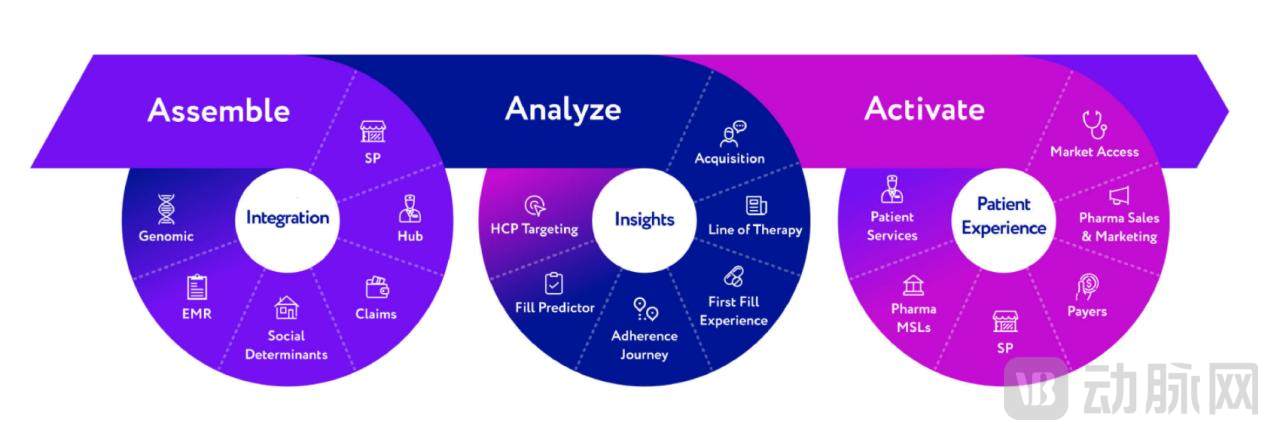
ConcertAI’s Corporate Layout. Image source: ConcertAI official website
Currently, ConcertAI’s primary user base consists of pharmaceutical companies, medical sales and marketing firms, and regulatory agencies (such as the FDA).
Since 2020, ConcertAI has maintained a long-term partnership with Janssen, the pharmaceutical division of Johnson & Johnson, providing Janssen with holistic views of patient treatment pathways and supporting clinical trial design, among other services. Additionally, ConcertAI collaborates with Pfizer to study the treatment experiences of patients with hematologic malignancies.
In June 2021, ConcertAI entered into a five-year collaboration with the FDA, leveraging ConcertAI’s real-world database and the eurekaHealth platform to investigate the effectiveness and safety of current oncology treatments in key subpopulations.
EurekaHealth is a SaaS platform launched by ConcertAI in early 2020. The platform integrates all of ConcertAI’s databases—including RWD360, Patient360, and Genome360—with AI modules, enabling users to obtain answers directly through keyword searches.
Chief Executive Officer Jeff Elton stated, “The eurekaHealth platform is the first in the real-world data (RWD) industry to integrate all databases and AI technologies, enabling users to analyze data across different databases. For pharmaceutical companies, this can streamline processes and reduce R&D time by approximately 50%.”
In August 2021, ConcertAI partnered with the US-based Quality Cancer Care Alliance (QCCA) to provide QCCA patients with optimal treatment options. QCCA is an alliance comprising more than 20 independent clinics.
Beyond its commercial endeavors, ConcertAI has launched the ERACE initiative, leveraging real-world data (RWD) to analyze disparities in cancer treatment across different racial groups. Currently, the majority of participants in this initiative are professors from oncology medical schools.
According to ConcertAI, over the past three years, the company has established partnerships with more than 45 life sciences companies and contract research organizations (CROs) to provide SaaS solutions for all stages of drug development. It has currently been involved in the market launch of approximately 40 new drugs, reducing drug development time by about 25% and shortening treatment duration by 10%.
Recently, ConcertAI completed a $150 million Series C financing round, led by Sixth Street.
The RWD Industry Is Still in Its Ascendant Phase, with Both Opportunities and Pain Points Coexisting
According to data from iResearch’s “2021 China Medical SaaS Industry Research Report,” the size of China’s medical SaaS industry reached RMB 3.7 billion in 2020, with an industry growth rate exceeding 30%, while the overall SaaS market size amounted to RMB 53.8 billion.
Currently, the domestic medical SaaS industry in China covers a wide range of fields, including internet hospitals, pharmaceutical companies, and pharmaceutical retailers; however, there are few medical SaaS enterprises focused on real-world data (RWD).
The Pain Points of RWD Enterprise Development Are Mainly Two: Issues with the Data Itself and a Lack of Industry Standards.
First, although a massive amount of information is generated during medical processes, its usability is low; for instance, missing or disorganized data can interfere with final outcomes. Moreover, the development of informatized healthcare in China, such as electronic medical records, has a relatively short history, dating back to the 2009 healthcare reform, and information cannot be shared across different medical institutions.
Secondly, there are no well-defined standards for data quality in the real-world data (RWD) industry either domestically or internationally, and ensuring patient privacy during big data collection remains a challenge.
However, the market demand for RWD is substantial, spanning the entire drug development lifecycle: early drug discovery – optimization of clinical trial design – indication expansion – market access – post-marketing studies, as well as regulatory requirements at the government level.
From a policy perspective, China has successively introduced policies related to real-world data (RWD) since 2017 to support the development of the RWD industry, such as the “Guiding Principles for Real-World Evidence to Support Drug Development and Review (Trial)” issued by the National Medical Products Administration in 2020.
Leading international SaaS companies involved in RWD analysis include IQVIA, among others.
Domestic SaaS companies involved in RWD include Yidu Cloud, LinkStar Technology, and others.
The Future of RWD: Where Is It Headed?