

Intem Medical Pioneers Five High-End Minimally Invasive Surgical Devices Made in China, Tapping into a Billion-Dollar Market
Traditional surgical procedures are transitioning from open surgery toward precision, minimally invasive, and intelligent approaches.
According to data from Qianzhan Industry Research Institute, the number of minimally invasive surgical procedures per million population and the penetration rate of such surgeries in China increased from 4,248 cases and 28.5% in 2015 to 8,514 cases and 38.1% in 2019. In the future, with the implementation of relevant policies, patients’ pursuit of better medical outcomes, and improved awareness and acceptance of minimally invasive surgery among physicians, minimally invasive surgical devices—represented by laparoscopic surgical systems, laparoscopic staplers, and polymer clips—are poised to enter a golden period of development.
The "Report on the Development Scale and Investment Prospect Trends of China's Minimally Invasive Treatment Market (2020-2026)" shows that the market size of minimally invasive medical surgical instruments in China grew from RMB 9.6 billion in 2015 to RMB 18.5 billion in 2019. Since 2015, the compound annual growth rate (CAGR) of the market size of minimally invasive medical surgical instruments in China has been 14.02%, and it is expected that by 2025, the market size will exceed RMB 50 billion.
Driven by trends such as the single-use of consumables and the increasing penetration of minimally invasive procedures, a surge of innovative minimally invasive surgical instruments and consumables, predominantly developed by domestic enterprises, has emerged. The market for minimally invasive surgical instruments and consumables demonstrates significant development potential and broad prospects.
Intem (Wuhan) Medical Technology Co., Ltd. (hereinafter referred to as “Intem”) is a high-tech enterprise that VCBeat recently learned focuses on the innovative R&D, manufacturing, and sales of a full product line of high-end minimally invasive surgical instruments.By integrating clinical expertise in minimally invasive surgery with cutting-edge industrial design and precision manufacturing, Interm Medical is dedicated to developing innovative, high-end instruments for minimally invasive surgery. The company aims to establish the “Interm Model,” characterized by the optimization of commonly used surgical instruments and breakthroughs in innovative devices, thereby achieving domestic superiority in high-end medical devices for minimally invasive surgery.
It is reported that since its establishment, Interm Medical has developed a series of more than 30 products covering eight modules: access creation, dissection, cutting, suturing, ligation, high-frequency electrocoagulation (cutting), anastomosis, and surgical access closure in endoscopic surgery.
Core R&D Capabilities Enable a Multi-Product Portfolio Layout
Smaller incisions, reduced pain, lower risk of infection, and shorter hospital stays and recovery times are the advantages of minimally invasive surgery. For this reason, minimally invasive surgery has always been one of the most prioritized niche sectors for medical device manufacturers and investment institutions.
Intem possesses a profound understanding of the manufacturing, R&D, and sales of minimally invasive and micro-non-invasive surgical solutions. The company’s R&D Director holds a master’s degree in Biochemical Engineering from Huazhong University of Science and Technology. He has spearheaded the design and development of over thirty medical device products and boasts extensive experience in medical device registration and approval, with exceptional capabilities in crafting registration strategies and securing product approvals. Furthermore, he is well-versed in regulatory standards for medical device R&D and production, as well as risk management.
Zheng Bo, the company’s General Manager, holds a Bachelor of Pharmacy from Jiangxi University of Chinese Medicine and an EMBA from Guanghua School of Management, Peking University. He has previously held sales and marketing positions at multiple multinational corporations, including Sales Manager for South China, Regional Manager, and Market Development Manager, bringing extensive expertise in team management and mentorship.
The Director of Production Management, who oversees production process development and manufacturing operations, holds a Master’s degree in Economics from Nagoya University in Japan. He has previously held positions at a large Taiwanese manufacturing enterprise, a state-owned trading company, and a Japanese trading firm affiliated with Toyota Motor Corporation. Proficient in industrial design and machining, he founded Japan Hexin Trading Co., Ltd., specializing in the research and development of precision molds and high-end cutting tools.
Leveraging the professional expertise of its founding team, Interm has developed a comprehensive product portfolio that includes laparoscopic surgical instruments, laparoscopic linear staplers, suturing devices, multi-fire clip appliers with polymer clips, and fascia closure systems. Among these, its modular ultra-minimally invasive thoracoscopic and laparoscopic surgical instruments, integrated steerable laparoscopic staplers, automatic laparoscopic suturing devices, automatic multi-fire polymer vascular clips, and winged grasping fascia closure systems represent either China’s first original innovations or first domestic equivalents.
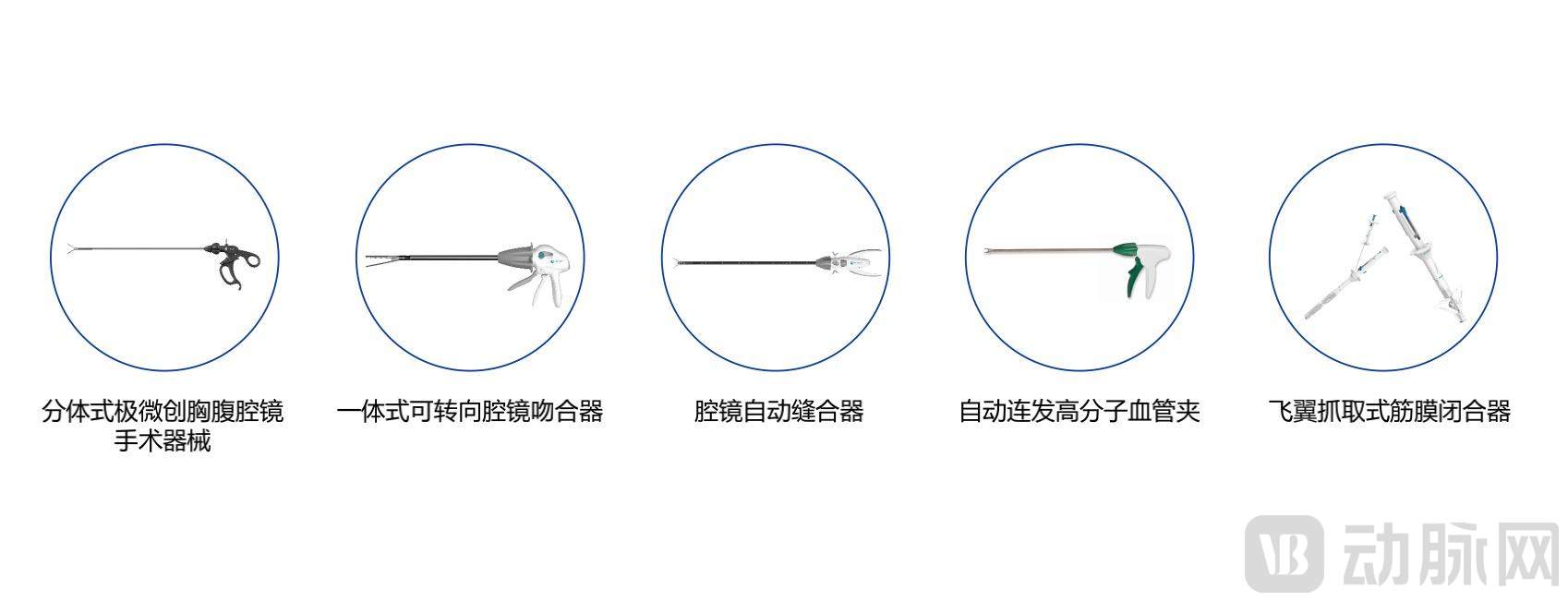
Selected Products from Interm
Thoracoscopic and Laparoscopic Systems Achieve the World’s Thinnest Instrument Shafts, with Ultra-Minimally Invasive Technology Continuously Breaking Through
It is reported that the split-type ultra-minimally invasive thoracoscopic and laparoscopic surgical instruments independently developed by Interm have achieved the world’s thinnest operating shaft, with a diameter of only 2.9 mm. For the first time, these endoscopic surgical instruments enable direct percutaneous puncture without the need for trocars (puncture devices), eliminating the need for suturing post-operatively and resulting in scarless healing.
Furthermore, this product achieves a breakthrough by enabling a single operating handle to freely adapt to various interchangeable tips, including tissue scissors, atraumatic grasping forceps, puncture needles, Maryland dissecting forceps, right-angle dissecting forceps, tissue hooks, grasping forceps, and clip appliers. This design allows for rapid intraoperative tip changes to meet diverse surgical requirements. It facilitates the efficient execution of procedures such as grasping, dissection, cutting, hemostasis, suturing (anastomosis), and ligation, thereby reducing the risk of infection and tissue injury while lowering medical costs.
Regarding the design of the tissue scissors, Interm strives to ensure sharpness and smooth wound edges, eliminating any tearing of tissue or capillaries. The atraumatic grasping forceps feature a specially designed silicone structural layer; this silicone layer reduces pressure on human tissue, providing protection against damage to tissues or organs while ensuring secure grasping.
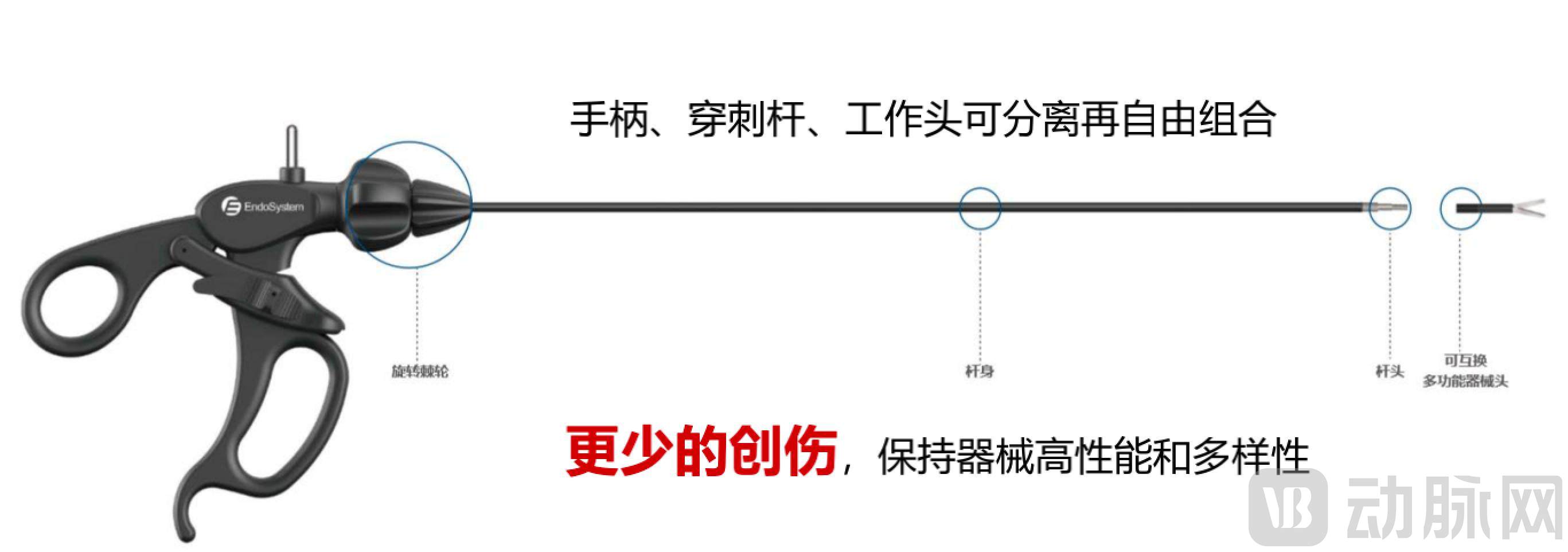
Split-Type Ultra-Minimally Invasive Thoracoscopic and Laparoscopic Surgical Instruments
Zheng Bo told VCBeat:“We aim not only to achieve import substitution with domestically produced alternatives but also to strive for domestic products that surpass their imported counterparts. This is a product independently developed by us. Through a year of promotional exploration, it has evolved from being initially misunderstood to gaining recognition from numerous clinical experts, delivering benefits that are ultra-minimally invasive, more aesthetically pleasing, and more convenient. In the future, we will continue to collaborate with experts to advance the research and development of a ‘full product chain for ultra-minimally invasive procedures,’ including 3mm steerable instruments, flexible instruments, single-port trocars, robotic instruments, and other minimally invasive devices. We aspire to reshape the value chain of clinical surgery, promote the concept of micro-invasive and non-invasive care in China, and become an indispensable part of comprehensive solutions for clinical surgical procedures.”
It is reported that Interm employs micro-nano precision manufacturing technology, integrating over 20 nanoscale processes. In terms of material technology, the company utilizes super-elastic, ultra-dense, implant-grade medical materials and has developed more than 10 types of polymer composites through modification. Notably, the thermosetting materials adopted by the company enable the production of high-strength, wear-resistant load-bearing components. When applied to minimally invasive surgical instruments, these materials enhance operational stability while ensuring that the instruments maintain their quality, rigidity, and elasticity in complex intraoperative environments. This design better aligns with clinicians’ usage preferences and improves surgical outcomes.
World’s First Myocardial Debulking System: Enabling Minimally Invasive Alternatives to Open Surgery
In the field of cardiac surgery, Interm and Huazhong University of Science and Technology jointly developed a minimally invasive treatment system for hypertrophic cardiomyopathy.After multiple process improvements, technical breakthroughs, ex vivo porcine heart simulations, and in vivo experimental testing in pigs, the final version of this product prototype—undergoing seven iterations over three years—was finalized.
In August 2019, this minimally invasive myocardial resection system, featuring novel surgical techniques and instruments, received support from the National Key Research and Development Program for Digital Diagnosis and Treatment Technologies under the Ministry of Science and Technology of China. Following ethical approval for clinical trials, the product has successfully completed the world’s first transapical minimally invasive septal myectomy.
This system, comprising a novel myocardial rotational resection technique and associated clinical devices—both global firsts—has secured 12 patents, including international PCT patents and national invention patents. Related research findings have been published in SCI-indexed journals, paving the way for gradual clinical adoption in the future.
Moreover, Interm has actively participated in pilot programs for medical device regulatory reforms, successfully completing the registration of Hubei Province’s first product under the Medical Device Registrant System pilot program. Since its inception, the company has steadily achieved numerous honors, including “Little Giant of Technological Innovation,” “Optics Valley Gazelle,” and “High-Tech Enterprise.”
How Will the Minimally Invasive Surgery Industry Evolve in the Future?
With the rising penetration rate of minimally invasive surgery, continuous advancements in technologies for minimally invasive surgical instruments—such as endoscopic surgical operating systems, ultrasonic scalpels, disposable trocars, and polymer clips—are ushering the industry into a golden age of development.
In response, Zheng Bo stated:“Last year marked the 30th anniversary of laparoscopic surgery in China. Laparoscopic surgery has evolved from nonexistence to existence, from availability to quality, and from quality to precision. As laparoscopic surgery reaches its thirtieth year, it has entered a high-level plateau in terms of technology; formerly emerging techniques are gradually becoming ‘conventional procedures.’ The development of minimally invasive surgery requires innovation in both technology and instruments. Innovation in surgical instruments will inevitably lead the innovation of surgical techniques.”
On one hand, the pursuit of minimal trauma and superior cosmetic outcomes means that “minimally invasive and non-invasive” approaches represent the evolving direction of minimally invasive surgery. On the other hand, the development of minimally invasive surgery in China remains uneven, with the proportion of such procedures still relatively low in second- and third-tier cities and below. Against the backdrop of tiered diagnosis and treatment, the decentralization of non-complex, non-refractory surgeries to primary care institutions is the future trend. However, how to simplify surgical procedures and shorten the learning curve for surgeons will determine the popularization and development of minimally invasive surgery in primary healthcare settings across China.
In the future, Interm will establish itself as a platform enterprise integrating medical engineering and technology translation, deeply cultivating the field of high-end minimally invasive surgical instruments and leading the development of comprehensive solutions for "minimally invasive and non-invasive" surgeries. Interm plans to develop specialized high-end instruments, including robotic devices, single-port trocars, 3mm articulating instruments, endoscopic suturing devices, percutaneous surgical instruments, and absorbable implants. These innovations aim to address clinical pain points, meet the surgical needs of minimally invasive surgeons, enable more efficient procedural performance, and ultimately facilitate faster patient recovery.