

Douyin Enters the Medical Device Market: The Rise of Influencer-Driven Healthcare Commerce

AliHealth
Medical and Health Services Network Service Provider

Meituan
E-commerce Platform Service Provider
Internet Giants Are Rushing to Enter the Medical Device Market.
Recently, Douyin E-commerce released a public notice on the addition of the "Category Management Specifications for [Medical Devices]" to integrate medical device products previously classified under various categories, thereby establishing medical devices as a standalone category.This means that Douyin is officially stepping up its efforts in the medical device sector, with the influencer economy beginning to penetrate the industry.
Prior to this, internet giants including Tencent, Alibaba, Baidu, Meituan, Kuaishou, Xiaomi, and Pinduoduo had all made moves into the medical device sector:They either take equity stakes in medical device companies through investment or enter the fray directly, committing talent, capital, and distribution channels to carve out their own strongholds in the medical device industry.
Of course, behind the rush to enter the fray lies a calculation of the giants’ own interests. Some aim to expand into new scenarios and products, others seek to fortify the moats around their core businesses, while still others are exploring new pathways for monetizing traffic...
Judging from the results, internet giants have been able to continuously deepen their presence in the medical device sector by leveraging their advantages in massive traffic, technology, capital, distribution channels, and commercial data.For instance, new channels for medical devices opened by platforms such as Douyin, Kuaishou, Alibaba, and Meituan, along with the continuous expansion of medical device product lines by Tencent, Xiaomi, and Baidu through in-house R&D or acquisitions, are all reshaping the landscape of the medical device industry.
Amid the collective strategic moves of internet giants, how is the medical device industry changing? What transformations and opportunities have these developments brought to medical device companies deeply embedded in this landscape? To address these questions, VCBeat has interviewed industry experts and analyzed the strategic layouts of these tech giants to shed light on the answers.
Medical devices are hailed as “one of the most investment-worthy sectors,” owing to their rapid growth and substantial room for expansion.
According to Frost & Sullivan, the market size of China's medical device industry reached RMB 623.5 billion in 2019, maintaining a compound annual growth rate (CAGR) of 20% for six consecutive years, and is projected to exceed RMB 1.2 trillion by 2024.
Faced with a vast market, internet giants are certainly not going to miss out, primarily for two reasons.
· First, the vast market size of medical devices presents an attractive opportunity for internet giants to explore new scenarios, thereby driving additional business through traffic and channel monetization;
· Second, there is immense potential for domestic substitution in China’s medical device market. With nearly 20,000 medical device manufacturers currently operating, industry consolidation remains low, presenting internet giants with opportunities to integrate resources.
Although their specific strategies in the medical device sector differ, the paths taken by internet giants are remarkably similar:That is, they either leverage the traffic on their own platforms to become new channels for medical device manufacturers, or rely on technology, capital, and other resources to build a medical device product line within their own ecosystem through in-house R&D and mergers and acquisitions.
“Many people have cried ‘wolf,’ but the reality is not so exaggerated. Based on our research and observations, the entry of tech giants has, on the whole, actually created more development opportunities for medical device companies,” Sun Xiaodong, a senior investor in the healthcare industry, told VCBeat. The collective entry of internet giants is not that of disruptors, but rather of co-builders.
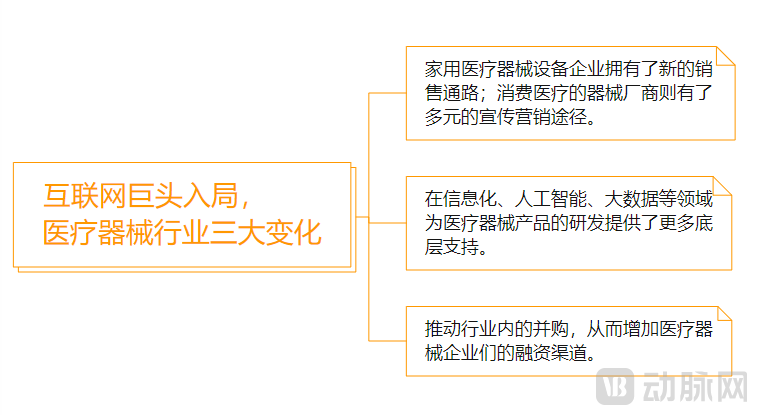
Simply put, the entry of internet giants is primarily aimed at expanding the incremental market—that is, enlarging the market pie rather than dividing it.The core is reflected in three major changes.
First, leveraging the massive user base and daily active users of e-commerce giants, manufacturers of home medical devices have gained new sales channels, while companies in the consumer healthcare sector have accessed diversified promotional and marketing avenues.
“With the decline of the pharmaceutical sales representative community in recent years, simplistic and aggressive promotional models are becoming increasingly difficult to sustain. Therefore, for some medical device manufacturers, there is an urgent need to adopt newer approaches to seize opportunities in marketing and market cultivation, thereby enhancing their credibility among healthcare institutions and brand recognition in the retail market,” said Sun Xiaodong.
Second, the accumulation of expertise by internet giants in fields such as informatization, artificial intelligence, and big data has provided greater foundational support for the research and development of medical device products.
Third, from the perspective of the capital market, as internet giants deepen their involvement, their understanding of the medical device market has become clearer. This trend facilitates mergers and acquisitions within the industry, thereby expanding financing channels for medical device companies and providing new exit strategies for investors entrenched in this sector.
According to Li Jing, Deputy General Manager of a medical device distribution company in Sichuan, the medical device industry was previously a relatively closed sector. As internet-based companies expand across traditional boundaries, cross-sector communication and collaboration among enterprises in various segments will become increasingly frequent.
From this perspective, the industry is undoubtedly on the path toward integrated symbiosis.
Next, this article will elaborate in detail from the two dimensions of channel transformation and cross-industry collaboration on the impact that internet giants have brought to the industry after entering the market.
Dimension 1: Major Transformation in Medical Device Distribution Channels—Opportunities and Challenges Coexist
Following the entry of internet giants into the market, the most pronounced change felt by the medical device industry has been in its sales channels.
“At first, most medical device manufacturers adopted a wait-and-see attitude toward internet platforms. Later, upon realizing that some early adopters among their peers had reaped the benefits of online operations, they also began to gradually explore e-commerce platforms,” Li Jing told VCBeat.“Due to the different ‘DNA’ of each platform, their sales approaches also vary.”
From an industry perspective, Alibaba and JD.com are platform-based e-commerce players. AliHealth primarily onboards third-party sellers, while JD Health focuses mainly on a self-operated model and also engages in procurement and wholesale services for medical institutions. Meituan and Ele.me leverage the O2O (Online-to-Offline) model to bring offline medical device retailers online. Douyin’s current strategy is similar to that of Kuaishou, with its core approach centered on content-driven e-commerce sales through short videos.
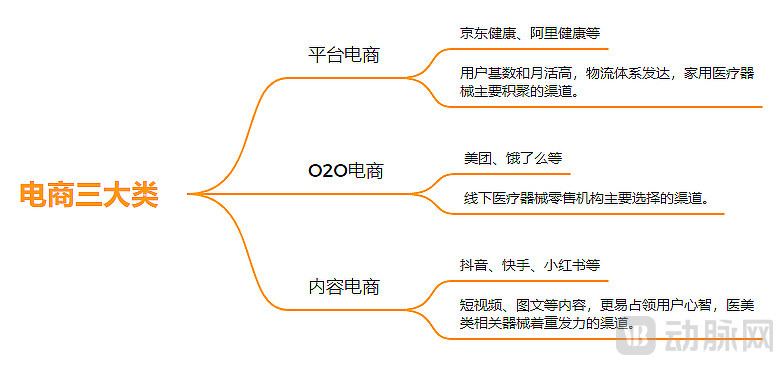
At the operational level, the choice of platform is often related to the product portfolio of medical device companies.In Li Jing's view,JD.com and Tmall are the platforms most frequently chosen by medical device merchants, owing to their large user bases and more mature operational systems.; Ele.me and Meituan primarily serve as online display channels for retail pharmacies selling pharmaceuticals and medical devices, with few device manufacturers establishing a direct presence. However, for manufacturers of consumer healthcare devices, content-driven e-commerce platforms such as Xiaohongshu (Little Red Book), Douyin (TikTok), and Kuaishou represent the most strategically important sectors.
“We attach great importance to Douyin’s new initiatives within our company. Because”Platforms such as Douyin and Xiaohongshu are critically important for capturing user mindshare.“Liu Qian (pseudonym), founder of a medical dressing R&D enterprise, stated, ‘In the initial years of our development, our sales strategies were relatively singular, focusing on approaching hospitals one by one and expanding offline channels such as OTC pharmacy chains. In 2018, we began experimenting with sales on online platforms like JD.com and Tmall, achieving highly encouraging results; our sales volume in just six months surpassed that of the entire year of 2017. This reinforced our strategic resolve to expand from professional hospital-based channels toward an integrated multi-channel approach combining online and offline presence.’”
Yuwell Medical, a home medical device brand, has also reaped the benefits of online sales. Since 2018, Yuwell Medical has actively expanded its online presence. According to its financial reports, the annual growth rate of its online business has exceeded 30%. During the “6·18” shopping festival in 2021, sales of Yuwell Medical’s home medical devices on Tmall and JD.com each surpassed RMB 100 million, with total online sales reaching RMB 260 million.
Cofoe Medical, a publicly listed medical device company, is also vigorously promoting online sales, with its online sales accounting for more than 70% from 2019 to 2021. In March this year, Cofoe Medical stated that the company has completed its layout on major domestic third-party e-commerce platforms, including Tmall, JD.com, Pinduoduo, Vipshop, and Suning.com.
It is evident that multi-channel deployment across multiple platforms has become a common strategy for medical device companies., which also makes them particularly sensitive to the opening-up policies of new platforms, as they seek to secure early positioning. For instance, on Douyin, dozens of medical device manufacturers have already established a presence, including Yuwell Medical, Intco Medical, ResMed, Omron, and Weigao.
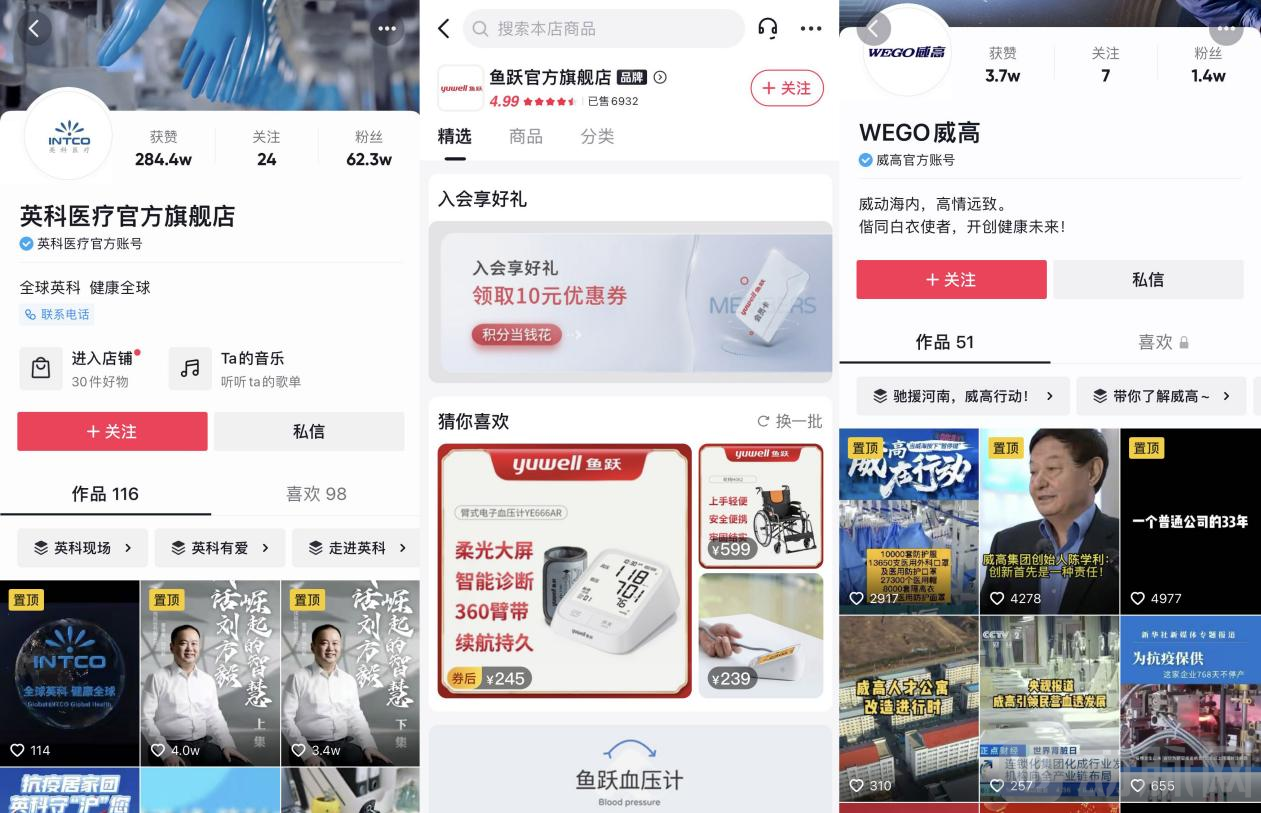 (Screenshots from VCBeat showing the Douyin accounts of Intco, Yuwell, and Weigao)
As e-commerce becomes the new favored channel for medical device companies, online competition is intensifying.According to disclosures by the National Medical Products Administration, the number of filings for online medical device sales across China rose from 20,000 in October 2020 to 73,000 in November 2021. The number of filings for third-party online platforms for medical devices jumped from 209 at the end of 2020 to 347 in 2021, marking the highest growth rate in the past two years.
“The proliferation of online platforms has expanded the options available to medical device companies, but this is not necessarily a positive development. Companies must carefully strategize how to deploy the most effective combination of tactics.“The founders of the aforementioned medical dressing R&D enterprise, Liu Qian, stated, ‘We previously engaged third-party operation agencies to maximize our presence across all online channels, but ultimately found the results to be minimal while costs remained high. After learning from these setbacks, we have adjusted our strategy by building an in-house operations team and focusing primarily on the four platforms best suited to our needs: Tmall, JD.com, Xiaohongshu (Little Red Book), and Douyin (TikTok). Based on the data obtained so far, we have achieved our expected outcomes.’”
“Medical device companies primarily focused on the serious healthcare sector remain heavily reliant on offline channels, paying limited attention to online channels, after all”The sales logic for large-scale medical equipment remains centered on the hospital side.“Sun Xiaodong, a senior investor in the healthcare industry, stated that ‘medical devices such as oxygen concentrators, ventilators, blood pressure monitors, nebulizers, pulse oximeters, glucose meters, thermometers, face masks, and disinfection products are the mainstay of online channels.’”
However, circumstances are never static. As many medical device companies scale up, their product portfolios gradually diversify and may extend into home-life scenarios, with some offering nearly 10,000 different models and specifications. Coupled with the intricate network of upstream and downstream suppliers, the ability to efficiently transmit demand signals and directly engage potential users has become a major pain point for such enterprises.
Therefore, medical device companies must continue to monitor emerging platforms and channels.
Dimension Two: Technological Integration and Capital/Resource Investment—Two Pathways for Cross-Border Collaboration
OverviewInternet giants’ cross-sector collaborations in the medical device field primarily follow two paths: either through technological integration or by investing capital and resources.
“Internet companies largely lack experience in the medical device industry and often need to engage in deep collaboration with established industry players. This actually facilitates cross-sector integration and multidisciplinary cross-pollination from a technical perspective,” said Sun Xiaodong, a senior investor in the healthcare sector.Leveraging their strengths in informatization, artificial intelligence, and big data, internet companies can bring new perspectives and experience to traditional medical devices from a technical standpoint.
Take Tencent as an example. At the CHINC 2021 conference, Zhang Guodong, General Manager of Tencent Smart Healthcare, stated, “Tencent will fully open up its technologies and services in artificial intelligence, big data, and cloud computing. Leveraging its connectivity capabilities in consumer-facing and enterprise-level applications, Tencent aims to promote the integration of advanced technologies with medicine and serve as a digital assistant in the healthcare sector.”
For example, in 2019, Tencent and Philips (China) entered into a partnership to jointly develop an AI-assisted diagnostic system for electronic colposcopy. Specifically, Philips provided real-time video and images to Tencent’s colposcopy-assisted diagnostic system via image transmission protocols, while Tencent’s system delivered real-time auxiliary diagnostic information back to the Philips electronic colposcopy system. Building on this collaboration, the two parties jointly developed an integrated solution combining the electronic colposcopy system with the colposcopy-assisted diagnostic system, enabling clinicians to operate on a unified display and receive real-time auxiliary diagnostic information.
Baidu is also stepping up its efforts. In 2019, Baidu and Neusoft Group announced a partnership, jointly establishing a “CDSS (Clinical Decision Support System) Special Task Force” based on artificial intelligence technologies to promote the application of AI-assisted decision support systems in healthcare institutions.
Compared to technological integration, internet giants are more inclined to invest capital and resources.
In just the past six months, Meituan invested in ConoStent, an innovative surgical robot developer. The company has completed the development of its multi-port laparoscopic surgical robot and is poised to rapidly enter clinical trials. Meanwhile, Baidu invested in Qihao Medical, a medical device developer specializing in otolaryngology. Its two core products are the “Low-Temperature Plasma Radiofrequency Surgical System” and the “Fully Bioresorbable Sinus Drug-Eluting Stent.”
In addition to financial investment, internet giants also provide resource support to their portfolio companies. Take Andon Health, whose stock price has surged recently, as an example. After Xiaomi invested in Andon Health in 2014, it not only injected $25 million into the company but also engaged in deep collaboration with it in areas such as user experience, e-commerce, and cloud services, thereby integrating Andon Health into Xiaomi’s resource ecosystem.
To date, Xiaomi’s investment portfolio has encompassed a range of medical device R&D companies specializing in smart hardware, including Huami Technology, Andon Health iHealth, Miaomiaoce, Be Doctor, and Qiezi Tech.
“Internet giants prioritize fit in their investments“For instance, Xiaomi is particularly bullish on home medical devices, including beauty-related products, all of which can become part of Xiaomi’s product ecosystem. Therefore, unlike pure venture capital firms that focus more on a company’s financial performance within a specific period, internet giants offer companies more financing opportunities and choices,” said Sun Xiaodong, a senior investor in the healthcare sector.
In cross-sector collaborations that integrate technology, capital, and resources, internet giants and medical device companies have forged closer identities as co-builders of an ecosystem, thereby driving the medical device industry toward greater diversification.
As internet giants continue to deepen their involvement,The fervor surrounding online sales and cross-industry collaborations in the medical device sector will continue to intensify. This trend, however, has also given rise to numerous issues.
Amid the online sales boom, instances of medical device companies exploiting regulatory loopholes have occurred from time to time. In August 2021, the Shanghai Medical Products Administration (SMPA) issued a public announcement stating that between September 2019 and July 2020, a leading medical device company repeatedly violated the Measures for the Supervision and Administration of Online Sales of Medical Devices. On its Shanghai flagship store page on Taobao, the company failed to update its filing information and did not display medical device registration certificates, among other issues. The SMPA issued a warning as a disciplinary measure.
To this end, last December, the National Medical Products Administration held a “Symposium on Supervision of Online Sales of Medical Devices” with three internet giants—JD Health, Alibaba, and Meituan—to review the implementation of platforms’ regulatory responsibilities.. This indicates that regulatory oversight is bound to tighten amid the rapid growth of online medical device sales.
In response, internet giants have begun to strengthen their internal infrastructure. For instance, Alibaba has collaborated with drug regulatory authorities to establish the “Red Shield Cloud Bridge” system, enabling regular reporting and rapid coordination to explore models of joint governance between government and enterprises; JD Health has implemented a “smart verification + manual secondary review” mechanism to supervise medical device manufacturers listed on its platform; and Meituan has launched a “Merchant Learning Center” to conduct regular legal education for businesses operating on its platform.
It is worth noting that regulating video e-commerce platforms such as Douyin and Kuaishou is more challenging, as they involve both short-form videos and live streaming, placing immense pressure on content moderation. Taking Douyin as an example, measures adopted to mitigate platform risks include routine inspections to remove non-compliant videos, banning accounts with harmful orientations, and providing a user reporting function. Nevertheless, many influencers on the platform still evade regulation through tactics such as malicious video editing. It should be recognized that medical devices constitute a highly specialized field; any accidents resulting from excessive marketing would inevitably deal a significant blow to the platform. Therefore, how to more effectively regulate the product-promotion activities of Douyin influencers has become a pressing challenge for platforms like Douyin and Kuaishou going forward.
In cross-industry collaborations, whether internet giants can accelerate the domestic substitution of medical devices has become a focal point of industry attention.“Internet giants are currently focusing on miniaturized, home-use devices and equipment. Whether they can provide greater support in terms of technology and capital for certain ‘chokepoint’ technologies and equipment remains to be seen, and this is what we look forward to,” said Li Jing, Deputy General Manager of the aforementioned medical device distribution company.
Since 2021,Calls for “innovative R&D of medical devices, import substitution, and breakthroughs in key technologies” have grown louder within national policy frameworks and the industry.For instance, in early last year, the Ministry of Industry and Information Technology (MIIT) and other agencies drafted the “Development Plan for the Medical Equipment Industry (2021–2025)” (Draft for Comments), which explicitly set out to achieve major breakthroughs in key components and materials for medical equipment by 2025. At the Fourth Session of the 13th National Committee of the Chinese People’s Political Consultative Conference (CPPCC), held shortly thereafter, policymakers once again emphasized the need to concentrate efforts on tackling key core technologies and accelerate the resolution of a number of “chokepoint” issues affecting medical devices.
In summary, as they move forward, internet giants must strengthen oversight of their own platforms to guide the standardized development of the medical device industry, while also devoting greater attention and resources to the research and development of key technologies and equipment. This will help accelerate the trend toward domestic production of medical devices in China, thereby generating additional value growth.
Of course,From the perspective of the medical device industry, achieving greater development requires not only more cross-industry entrants but also advancements in foundational industrial capabilities and the influx of more talent; both are indispensable. Cultivating these systematic capabilities takes time.
In this process, every participant must maintain sufficient perseverance and patience, continuously pursue innovation, and embrace change to ultimately achieve greater breakthroughs.