

Baiyiyuan Bio: Pioneering Regenerative Biomaterials Across Medical and Aesthetic Markets Amid Industry Boom

BAIYIYUAN BIOTECH
Developer of Biomedical Materials
Biomaterials have advanced and evolved alongside humanity’s growing understanding of materials science. From early plant fibers, metals, and ceramics to the synthetic materials developed in the 20th century, generations of scientists have never ceased their research and exploration of biomaterials. Today, with advances in medicine and materials science—particularly the successful development of novel materials—people are no longer satisfied with merely the basic performance of traditional materials. Consequently, the research and development of bio-regenerative materials has become a shared focus among materials scientists.
Shanghai Baiyiyuan Bioengineering Co., Ltd. (hereinafter referred to as “Baiyiyuan”) is a company dedicated to the research and development of novel bio-regenerative materials, as recently reported by VCBeat. Addressing the current state of bio-regenerative material development, Dr. Han Baiyi, founder of Baiyiyuan and an expert with over 30 years of experience in the fields of medicine and biomaterials, told VCBeat: Tissue defect repair and regeneration represent one of the major challenges in modern medicine. Due to the pivotal role of biomaterials, exploration and research into their medical applications have continued unabated since the mid-20th century. In my view, this development can be broadly categorized into three stages.

Development Stages of Biomaterials
FirstGuided by the objective of minimizing foreign body reactions to implanted devices and grounded in biocompatibility studies of industrial materials, the first generation of biomaterials and related products was developed. This category includes bone screws, bone plates, artificial joints, prosthetic heart valves, and intraocular lenses, among others. Such biomaterials remain in clinical use to this day.
SecondlyThese are second-generation bioactive materials characterized by controllable degradability, the ability to grow in tandem with host tissues, and ultimate complete replacement by newly formed tissue. Representative examples of this class of materials include bioactive glasses and bioceramics, which emerged in the mid-1980s and are widely used in orthopedic surgery and dentistry.
Following the evolution from first-generation biomaterials to second-generation bioactive materials, third-generation biomaterials with regenerative-inducing properties have emerged as a current research hotspot since the late 1990s, driven by the rise of regenerative medicine. These materials can endogenously induce cell proliferation and achieve tissue regeneration.
Third-generation biomaterials can be applied in skin defect repair, soft tissue repair, articular cartilage repair, vascular and catheter coatings, medical aesthetics, and other areas, demonstrating significant development potential.
Exploration of the Development Environment for China’s Bio-regenerative Materials Industry
Dr. Han told VCBeat:As the world’s largest developing country, China’s advancements in medicine and biomaterials follow global development trends. Driven by a combination of policy support, economic growth, technological breakthroughs, and rising demand, bio-regenerative materials are poised for a period of rapid expansion in China, offering substantial market potential.
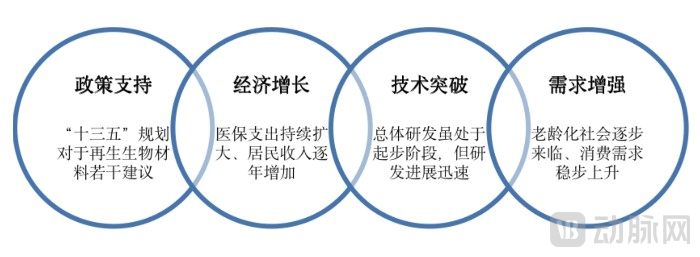
Development Environment of the Bio-Regenerative Materials Industry
What Are the Challenges and Opportunities Facing China’s R&D Enterprises in Bio-regenerative Materials?
Dr. Han told VCBeat:FirstThe bio-regenerative materials industry is a technology-intensive sector characterized by the interdisciplinary integration of biology, medicine, and materials science. Currently, China’s development in bio-regenerative materials remains in its early stages compared to developed countries, indicating significant room for growth in the reserve of diverse technical talent within R&D enterprises. Breakthroughs in material technologies often hinge on the extent of a company’s technological reserves, specifically the quality and quantity of its high-level R&D personnel. As an emerging product of advanced biotechnology, bio-regenerative materials demand strong continuous R&D and innovation capabilities. Sustainable development requires ongoing investment in R&D and technological innovation; only through dedicated operations and cumulative expertise can companies achieve technological breakthroughs and establish competitive barriers.
SecondlyIn China, bio-regenerative materials are classified as Class III medical devices under the national medical device regulatory framework, with high regulatory thresholds established across three dimensions: product market access, manufacturing authorization, and distribution licensing. Companies must undergo rigorous reviews at multiple stages from product development to commercial launch; the approval processes for product registration certificates and manufacturing licenses are time-consuming and challenging, creating significant qualification barriers for new market entrants.
Finally, the development of bio-regenerative materials requires continuous investment in research and development, while brand management and the expansion of sales channels also pose significant challenges for enterprises.
As a player in the bio-regenerative materials industry, what will BAIYIYUAN BIOTECH bring to us?
Dr. Han introduced:As a novel R&D company specializing in bio-regenerative materials, BAIYIYUAN BIOTECH primarily develops decellularized matrix materials with bio-regenerative inductive properties (abbreviated as SIS-ECM) and their derivatives for medical applications. Leveraging years of technological accumulation, the company has established advanced manufacturing processes and rigorous technical standards. The SIS-ECM technology possesses strong platform characteristics, with products suitable for the regenerative repair of all human soft tissues, covering the full spectrum of surgical applications.
Establish the SIS-ECM technology platform, driven by both serious healthcare and consumer healthcare.
Since its inception, BAIYIYUAN BIOTECH has been engaged in the research and strategic deployment of third-generation biomaterials featuring endogenous induction for regenerative repair and the capability to achieve tissue regeneration.After a decade of dedicated efforts and an investment of over RMB 100 million in research and development, the company has successfully established its core technology platform, constructed a production and R&D facility spanning more than 10,000 square meters, and completed Good Manufacturing Practice (GMP) upgrades. Two core products are currently undergoing registration review by the National Medical Products Administration (NMPA). Meanwhile, the company has filed more than 40 invention patent applications, 16 of which have already been granted.
SIS-ECM Technology Platform is a standardized production process and workflow for bio-regenerative materials, established by the company through years of exploration and research. By sourcing specific porcine small intestinal submucosa and employing non-crosslinking technology, immunogenic substances are removed while the three-dimensional structure optimal for cell growth is fully preserved. This approach maximizes the retention of bioactive components that promote cell division, angiogenesis, and tissue differentiation, thereby enabling endogenous induction of regeneration and achieving functional tissue restoration.
Leveraging this technology platform, BAIYIYUAN BIOTECH has developed a portfolio that includes regenerative aesthetic fillers for wrinkle reduction and volumization in the medical aesthetics sector, oral biological meshes with consumer-oriented applications for guided bone regeneration (dental implants), and dural biological meshes for the repair of dural defects in the serious medical care sector.
Leveraging its proprietary technology platform and accumulated R&D expertise, BAIYIYUAN BIOTECH will sustain robust innovation momentum and continuously drive product iteration and innovation. The company will maintain parallel development across multiple product lines while ensuring continuous product iteration.