Boke City Secures NMPA Approval for Game-Based Digital Therapeutics: Launches 'Happy Vision Planet' for Amblyopia Treatment
On April 18, the “Gamified Digital Therapeutics Online Salon and Launch Event for Poker City’s ‘Happy Vision Planet: Visual Training System’” was held online. Hosted by Poker City and organized by VCBeat, the event brought together key opinion leaders, corporate executives, and industry experts from the gaming and healthcare sectors. Through keynote speeches and roundtable discussions, participants jointly explored the application value of gamified digital therapeutics in the medical field and the potential for in-depth collaboration between the healthcare sector and the gamification industry in the future.
This event marked the historic issuance of China’s first digital therapeutic certificate within the gaming industry, while also serving as an in-depth exploration of the potential for integrating gamified digital therapeutics with cognitive medicine under the “new normal.”
Chen Hang, Medical Advisor at Poker City, delivered a keynote speech titled “Happy Vision Planet: Breaking the Monotony and Embarking on an Engaging and Brilliant Therapeutic Journey.” He elaborated on the core aspects of the R&D process for the “Happy Vision Planet” product and presented solutions to address adherence issues. A roundtable forum was jointly attended by Tan Yaxing, Sustainable Development Strategy Advisor at Poker City; Wang Qinmei, Professor, Chief Physician, and Doctoral Supervisor at the Eye Hospital of Wenzhou Medical University, as well as Member of the Cornea Group of the Ophthalmology Branch of the Chinese Medical Association; Ying Li, Council Member of the Zhejiang Nursing Association and Deputy General Manager of Hangzhou Jianhai Technology Co., Ltd.; Qiu Fei, Founder and CEO of Evergreen Venture Capital; Hong Yang, Chairman of Fesenchen Medical Group; and Chen Hang, Medical Advisor at Poker City. The panel discussed the opportunities and future development potential of gamified digital therapeutics in the healthcare sector.
Games Have Become a Key Tool in Digital Therapeutics
Poker City’s attainment of the first digital therapeutics certification in the gaming industry was no accident.
In fact, as early as 2019, Poker City began exploring the integration of gaming and healthcare by collaborating with Fudan University’s Smart City Research Center to investigate the use of card and board games for the early screening of mild cognitive impairment. This research not only yielded academic papers and established a preliminary model but also laid the foundation for Poker City’s subsequent explorations.
Subsequently, Poker City established a dedicated internal research team to explore how the interactivity and engagement of games could help address the issue of low patient adherence in medical rehabilitation. After careful consideration and analysis, Poker City focused its efforts on two key demographics: the elderly and children. In 2021, Poker City launched its gamified digital therapeutics strategy and partnered with the healthcare industry, aiming to explore gamified digital therapeutics in areas such as “game-based diagnosis, game-based treatment, game-assisted patient care, and game-supported medical practice.”
This strategy has facilitated the development of two product pipelines. One is the “Happy Vision Planet” Strabismus and Amblyopia Training and Treatment System, which recently received regulatory approval. This system was co-developed in collaboration with the renowned ophthalmic institution Kelai Shi, Yangzhi Rehabilitation Hospital (Shanghai Sunshine Rehabilitation Center) affiliated with Tongji University—the first municipal-level public rehabilitation hospital in Shanghai—Weimai, and several doctoral experts in ophthalmology. The other pipeline is the “Customized Linked Memory Game,” developed through a partnership between Poker City and Yangzhi Rehabilitation Hospital affiliated with Tongji University, primarily designed for rehabilitative training in elderly patients with mild cognitive impairment.

Poker City's "Happy Vision Planet" Strabismus and Amblyopia Training and Treatment System
By leveraging games to empower exploration in other fields, Poker City has proposed an upgraded “Game+” strategic plan. This initiative seeks to integrate Poker City’s core game design capabilities with the needs of various social sectors, using games to address social issues and enhance participant experience and efficiency. In addition to its flagship “Game+ Healthcare” sector, current initiatives also encompass “Game+ Education,” “Game+ Public Welfare,” “Game+ Science Popularization,” and “Game+ Culture.”
Building on its prior accumulation, Poker City has defined three objectives for its “Games + Healthcare” initiative. First, Poker City aims to empower and reshape the healthcare service ecosystem through gaming, thereby enhancing the efficiency and accessibility of healthcare services: by leveraging the core capabilities of game-based interaction, it seeks to achieve “cost reduction and efficiency improvement” in healthcare delivery, boost service efficiency, and make healthcare services more accessible.
Secondly, Poker City aims to adopt a patient-centric approach to innovate the delivery methods and experience of digital doctor-patient interactions. Most importantly, it leverages gamified innovations to identify and integrate patients’ personalized, diverse, and fragmented health needs, providing practical and implementable solutions.
Finally, Poker City aims to foster the integration of medical services and digital technologies through a comprehensive resource layout. By linking professional medical resources and cultivating cross-disciplinary talent in medicine and digitalization, it seeks to build new models of digital healthcare services and achieve value innovation in medical service delivery.
As an initial foray into the integration of gaming and healthcare, Poker City has placed greater emphasis on leveraging the inherent stickiness of its content to address adherence issues during treatment. The decision to focus on the field of strabismus and amblyopia therapy stems from the fact that this area features well-established therapeutic principles and methods, while also presenting significant challenges related to patient adherence. This combination of factors is one of the key reasons why Poker City chose to enter the market through this specific domain.
“However, games tend to prioritize entertainment value; as long as they are enjoyable, that suffices. In contrast, Software as a Medical Device (SaMD) requires greater attention to its core mechanisms. For instance, it is essential to determine which elements of the entire delivery process exert the strongest therapeutic effects and which are ineffective. This must be supported by corresponding scientific evidence, research findings, and clinical applications. Furthermore, careful monitoring is required for any adverse reactions or even serious medical incidents that may arise during product use. This represents a significant distinction.” Chen Hang, Medical Advisor for the Digital Therapeutics System for Strabismus and Amblyopia developed by Poker City, holder of a Master’s degree in Optometry and Ophthalmology from Wenzhou Medical University, and founder of the Kelai Shi Eye Care Center, also highlighted certain fundamental differences between SaMD and games.
Precisely because of its accumulated experience and deep reverence for the healthcare industry, Poker City has assembled a team for “Games + Healthcare” that is distinct from conventional game development teams. It has introduced external experts from the medical field and integrated mechanisms of medical inquiry and truth-seeking into its daily management. By adopting an open yet rigorous approach, it has established collaborations with multiple medical research institutes, hospitals, and universities, thereby achieving a relatively deep integration of the two industries. Game companies without corresponding experience in medical scientific research will still need time to catch up.
Currently, rehabilitative therapy for pediatric strabismus and amblyopia in China primarily relies on bead-stringing exercises, puncture tasks, and light stimulation. The treatment process is lengthy and monotonous. Even though many medical device manufacturers have introduced more engaging hardware, pediatric patients still struggle to adhere to repetitive training regimens lasting 3–6 months, often performing them perfunctorily during therapy sessions, which compromises therapeutic efficacy. Since early intervention is critical for strabismus and amblyopia, suboptimal treatment outcomes can result in lifelong visual impairments. This necessitates full parental involvement throughout the treatment process, imposing significant time and effort burdens on working parents.

“Happy Vision Planet” Strabismus and Amblyopia Treatment System Based on Multiple Internationally Certified Training Methods
Emphasizing Improved Adherence and Personalized Precision Therapy
Wang Qinmei, Professor, Chief Physician, Doctoral Supervisor, and Member of the Cornea Group of the Ophthalmology Branch of the Chinese Medical Association, stated: “Congratulations to Poker City’s ‘Happy Vision Planet’ software for receiving NMPA approval as the first gamified AI-based therapeutic software. Previously, including parents, people were highly resistant to gaming, fearing it would waste time and hinder academic progress. The approval of a digital therapeutic that combines gaming with medical treatment is a breakthrough of significant importance. With the involvement of professional physicians, children can achieve therapeutic goals while playing games.”
“Happy Vision Planet” Strabismus and Amblyopia Treatment System is based on various internationally certified training methods, integrating multiple photostimulation therapies such as CAM stimulation, red-light stimulation, and fine visual acuity training. Meanwhile, it achieves three-level functional training by combining red-blue dichoptic separation, and effectively improves pediatric compliance through its user-friendly and highly engaging gamified design, helping children complete strabismus and amblyopia rehabilitation training while playing.
The therapy also incorporates an assessment system that evaluates the near visual acuity of the amblyopic eye, thereby matching the optimal training difficulty to achieve refined, personalized treatment. Meanwhile, home-based visual assessments and follow-up rehabilitation tracking via the software have improved the efficiency and accessibility of medical services.
Most importantly, the therapy features real-time attention monitoring and AI-powered error correction. Leveraging the front-facing cameras of widely available tablets and smartphones, the system continuously monitors the patient’s posture and verifies proper eye patch usage during rehabilitation sessions. If any anomalies are detected, the therapy is paused and prompts are provided until the child resumes the correct posture and properly wears the eye patch, at which point treatment resumes.
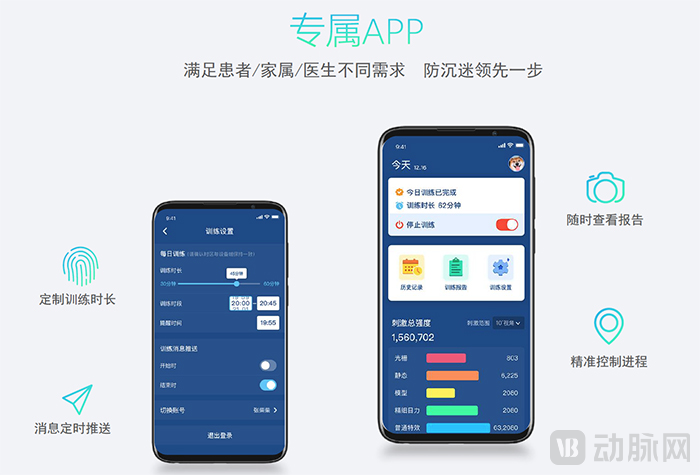
The strabismus and amblyopia treatment system offers comprehensive parental management features.
In addition, the therapy features a dedicated parent-facing mobile application. Throughout the treatment process, detailed statistical reports are pushed to the parent app, covering not only training intensity but also statistics on anomalies detected in the child’s attention monitoring. With such an intelligent assistant, parents can facilitate precise and personalized training progress. Meanwhile, for children who respond well to the training, parents can appropriately reduce their level of involvement, thereby alleviating their burden.
Regarding adherence, Chen Hang shared:“First, we define Happy Vision Planet as a training approach that children prefer. We prioritize improving patient adherence above all else. Why is this the case? Because Happy Vision Planet currently operates in the niche of rehabilitation for pediatric strabismus and amblyopia. Amblyopia rehabilitation is a long-term process, and its efficacy is fundamentally determined by the combination of evidence-based therapeutic principles and consistent patient engagement. Therefore, Happy Vision Planet has made substantial efforts to enhance patient adherence.”
“For the team at Poker City, we have always been at the forefront of researching user behavior. Therefore, to address the issue of patient adherence, we have introduced unique innovations throughout our product. These include engaging game mechanics, real-time attention monitoring, and AI-driven error correction. We have integrated numerous digital product concepts and designed the entire training program from a child’s perspective. Furthermore, throughout the rehabilitation process, treatment outcomes are presented in a more visual format for both parents and physicians, enabling healthcare professionals to promptly adjust personalized treatment plans for patients.”
At the conference, Ye Weizhong, Founding Partner of Daohe Technology Investment, stated: “We pay special attention to cross-disciplinary innovation in the gaming sector, including technological advancements within the gaming ecosystem and leveraging gaming mindsets to empower other industries. I believe the Poker City team has conducted extensive, innovative, and valuable explorations and work in this direction.”
Qiu Jialin, founder of Weimai, stated:“This marks a significant exploration by the gaming industry in the healthcare sector. Since last year, Weimai and Poker City have been jointly exploring the application of gamified digital therapeutics in specialized disease areas, and we look forward to continuing our joyful journey in promoting health together in the future.”
Gao Yunlong, CEO of Zhilan Health, stated“Congratulations to Poker City’s ‘Happy Vision Planet’ for receiving approval from the National Medical Products Administration (NMPA), becoming China’s first approved medical gamification AI software for market launch. As a CDMO and full-service provider in the digital therapeutics sector, Zhilan Health is delighted to witness this significant milestone in the industry.”
From the perspective of serious medicine, further efforts are required to achieve a deeper integration between gaming and healthcare. The recent approval of Poker City’s game-based therapy not only represents a beneficial attempt by China’s gaming industry but also serves as an excellent reference for both the gaming and medical sectors. It is likely to spur more research on the therapeutic applications of games and lead to the broader adoption of games or gamified approaches in medical processes. For the healthcare industry, offering engaging and patient-friendly modalities alongside conventional serious medical treatments constitutes a promising endeavor.
Han Yang, Head of the Sustainable Development Strategy Office at Poker City: hanyang@boke.com
Scan the QR code to watch the live stream replay