

Qiyun Health Strengthens Leadership in Healthcare Big Data with Integration of Text and Imaging Data
Rewinding to February this year, Qiyun Health completed a strategic investment in Daijia Medical, achieving full ownership of the latter.
It is worth noting the backgrounds of the two parties involved in this transaction.
Parties to this transaction,Daijia Medicalis one of China's earliest and largest medical imaging system service providers, with over 300 high-quality clients among Grade A tertiary hospitals and more than 20 years of technological expertise in the field of imaging data;Qiyun HealthSpun off from Das Intellitech (a listed company), it serves as a provider for the construction and operation of urban health and medical big data, with its projects already implemented in multiple cities including Huainan, Baoding, Hengshui, Suzhou, and Chongqing.
This acquisition,This makes it possible for Qiyun Health to carry out large-scale medical big data governance, transitioning from “textual big data” to “imaging big data,” and further expands Qiyun Health’s service capabilities. It provides cities with health services and sustainable operations across multiple dimensions: “supporting government administration, assisting medical practice, facilitating public access, fostering innovation and research, and promoting industry development.”
Looking back at the National New-Type Urbanization Plan (2014–2020) issued in 2014, it was the first time that smart city development was incorporated into national strategic planning, with a goal to build a number of distinctive smart cities by 2020. Driven by this policy, a large number of enterprises flocked to the wave of “smart city” construction. Among them, “Qiyun Health” may be regarded as one of the early entrants into the “smart city” sector, particularly in “smart healthcare.”
As early as 2015, Dashi Intelligence established its Smart City Business Division, with Chen Lin serving as the General Manager. At that time, the division signed a contract for the Huainan Smart Healthcare Project. In 2016, due to a strategic focus on healthcare, the Smart City Business Division was renamed the Smart Healthcare Business Division. In September 2020, the Smart Healthcare Business Division evolved from an internal department of Dashi Intelligence into a subsidiary named “Qiyun Health” (Shenzhen Dashi Qiyun Intelligent Medical Co., Ltd.).
VCBeat interviewed Mr. Chen Lin, President of Qiyun Health. When asked how Qiyun Health had gradually built its competitive advantage, Mr. Chen stated that the company’s growth to its current stature was attributable not only to favorable policies but also to its deep understanding of the underlying needs of cities and medical institutions, as well as its continuous development and exploration of core competencies. To this end, Qiyun Health has made concerted efforts to recruit industry-specific talent.Earlier than 2017RegardingAbsorbed one branchIndustryHeadofTechnical R&D Team,ThisThis has enabled “Qiyun Health” to maintain a significant lead over its peers in the level of medical informatization development.
It is reported that,Currently, Qiyun Health has a team of more than 400 members, with R&D personnel accounting for over half.Chen Lin, President of Qiyun Health, holds a Bachelor’s degree in Economics from Renmin University of China and a Master of Management with Distinction from Massey University in New Zealand. As an entrepreneur, he has previously served as Deputy Director of the Planning and Information Division of the Shenzhen Municipal Health Commission.
Why Have Multiple Cities Chosen Qiyun Health for Implementing Their Healthcare Big Data Platforms? What Strengths Does This Healthcare Big Data Construction and Operation Service Provider Rely On? VCBeat Addresses These Questions Through Insights from Mr. Chen Lin.
Middle-Platform Architecture: Strengthening the Unified Urban Digital Health Foundation
The advent of the pandemic has, in effect, administered a unique examination of the outcomes of smart city initiatives. Certain smart city projects have exposed issues such as data silos, the absence of unified standards, and an inability to support integrated business operations. Consequently, some “mobile population information systems” deployed during the pandemic have failed to perform effectively.
On the other hand, the pandemic has also highlighted the advantages of building “Smart Cities,” particularly “Smart Healthcare.” People have undoubtedly recognized the role of “Smart Healthcare” in epidemic prevention and control. Meanwhile, this has made practitioners truly aware of the development prospects of the Smart Healthcare sector—accounting for only 2.86% of the overall Smart City construction, it remains a blue ocean market with even more promising potential and opportunities.
To address the challenges in building “Smart Healthcare,” we have continuously enhanced the capabilities of our health and medical big data platform. In 2021, Qiyun Health entered into a strategic partnership with a leading domestic internet company,Jointly developed a new-generation national health information platform based on middle-platform architecture, significantly enhancing product service capabilities. It has been initially deployed in Suzhou City, Anhui Province, and Baoding City, Hebei Province.Compared with traditional platforms, the Qiyun Health-based urban health and medical big data platform built on a middle-end architecture offers distinct advantages: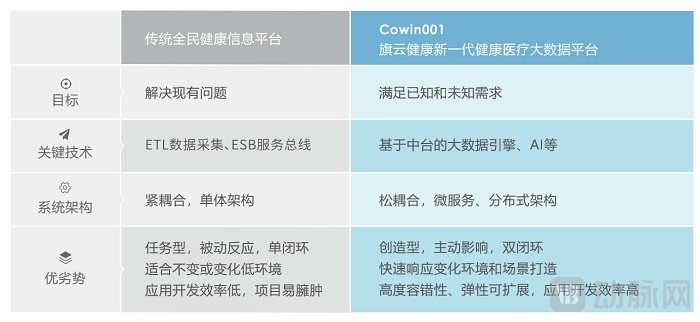
Digital Intelligence Brain: Driving Smart Management of Urban Health
To advance the healthy development of the digital sector, we must persist in fostering new growth drivers through informatization and leveraging these drivers to promote new development. This requires equipping the healthcare industry with the “wings” of digital technology.Further promote the transformation of healthcare institutions’ development model from scale expansion to quality improvement and efficiency enhancement, their operational model from extensive management to refined management, and their resource allocation from material inputs to talent and technology, so as to accelerate the establishment of a high-quality and efficient healthcare service system.thereby promoting the high-quality development of healthcare services.
Based on this understanding, Qiyun Health, from the perspective of urban governance, promotes the innovative integration of “technology + demand” through “digital + health,” facilitating the flow of data resource elements and the restructuring of management and service models, thereby optimizing management structures and enhancing service efficiency. Its practical significance lies in reshaping new models for healthcare and pharmaceutical management services.
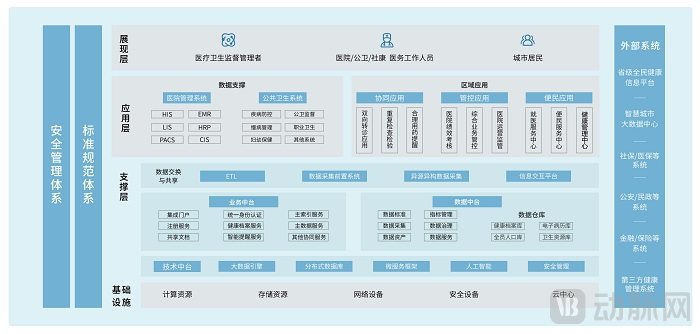
In practice, the development of urban health and medical big data platforms has consistently faced certain challenges, such as suboptimal quality of relevant healthcare data, insufficient data support, and difficulties in supporting application development. Qiyun Health is striving to help cities build precise and extensive health and medical big data assets, creating specialized databases and service components that facilitate efficient application development.
Qiyun Health’s newly launched next-generation healthcare big data platform, built on a middle-end architecture, helps cities address numerous challenges in data collection, data governance, data security, and data application.
Deepening Operational Expertise, Tailoring a Digital Health Industry Ecosystem
Traditional “smart healthcare” projects are generally advanced through a model in which enterprises undertake construction and then hand over operations to the government upon completion. In contrast, “Qiyun Health”As early as 2016, when overseeing the smart healthcare project in Huainan City, Anhui Province, we began adopting the public-private partnership (PPP) model. With the goal of developing health and medical big data and application development and operational services, we jointly invested in, constructed, and operated the project with government-affiliated investment entities.Around 2018, companies in the health and medical big data sector competed to introduce state-owned capital, further validating the foresight of this model—such partnerships not only help ensure regulatory compliance in corporate development but also better assist enterprises in addressing challenges related to data integration and sharing mechanisms during the process of achieving data interoperability.
Currently, the representative projects implemented by “Qiyun Health” include the National Ministry of Finance’s Public-Private Partnership (PPP) Demonstration Project—Huainan Health and Medical Big Data Project, as well as regional health and medical big data platforms implemented in cities such as Baoding, Suzhou, Hengshui, and Chongqing., serving a population of over 30 million. In terms of in-depth expansion into medical institutions, “Qiyun Health” alsowith many hospitals such as the Second Affiliated Hospital of Zunyi Medical University (Grade A tertiary hospital) and TEDA International Cardiovascular Hospital (the third hospital in China to achieve HIMSS Stage 7 certification and the highest-scoring smart hospital)Reached relevant cooperation.
Regarding its future strategic planning, Qiyun Health has a clear vision. ItsLong-Term GoalsIt continues to adhere to its strategic positioning, aiming for “Healthy Cities, Accessible to All,” and serves as a builder and operator of big data platforms for health and medical care.Short-Term Goals, is to rapidly expand the market by establishing close partnerships with more cities based on a mixed-ownership model. In January this year, Qiyun Health completed its first round of strategic financing. In the future, the funds will be primarily used for building up R&D and operations teams, as well as for investment in city expansion.
Qiyun Health also has its own perspective on the development of big data in healthcare. In Chen Lin’s view, this field will witness even more rapid growth in the future:
First,National policies, laws and regulations, as well as the increasing emphasis on big data by local governments, are driving the development of health and medical big data;
Secondly,, health and medical big data only generates value through utilization, yet this process may involve user privacy and information security concerns. The increasing maturity of relevant laws and regulations will further promote compliant development within the industry.
Again, the maturation of technologies such as data governance, data security, privacy protection, and data application, along with further advancements in artificial intelligence, is accelerating industry development.
Finally, the urgent demands in application scenarios such as public benefit, industry empowerment, and epidemic prevention are also driving the health and medical big data industry forward, ultimately forming a virtuous cycle.
Meanwhile, Qiyun Health will continue to uphold its mission of “Healthy Cities, Accessible to All,” striving to establish a firm foothold in this blue ocean market.