

Another Surgical Robot Company Files for HKEX Listing, Backed by Over 30 Top-Tier Institutions—Can It Replicate the Valuation Boom?

Edge Medical
Developer of Robot-Assisted Minimally Invasive Surgical Systems
On April 19, 2022, the Hong Kong Stock Exchange welcomed its second surgical robotics company.
SHENZHEN JINGFENG MEDICAL TECHNOLOGY CO., LTD. (hereinafter referred to as “Edge Medical”) has formally submitted its prospectus to the Hong Kong Stock Exchange, seeking a listing on the Main Board, with Morgan Stanley, CICC, and Citigroup serving as joint sponsors.
Surgical robots have always been the hottest sector in the secondary market. Previously, MicroPort MedBot, the first surgical robot company listed on the Hong Kong Stock Exchange, saw its market capitalization reach RMB 50 billion at one point. Overseas, Intuitive Surgical, the parent company of the da Vinci Surgical System, has a market capitalization exceeding USD 100 billion.
Unlike MicroPort MedBot, which is backed by the MicroPort Medical Group, Edge Medical is a startup founded from scratch in Longgang, Shenzhen, in 2017. Its founders, Wang Jianchen and Gao Yuanqian, are both post-80s PhD holders.
Over the past five years since its founding, Edge Medical has developed a multi-port surgical robot and a single-port surgical robot from scratch, with both major products having entered the clinical trial phase.
Although Edge Medical has not yet achieved profitability and has no products on the market, its prospectus reveals that the company generated no business revenue in the 2020 and 2021 fiscal years. During this period, its R&D expenses amounted to RMB 59 million and RMB 222 million, respectively, while its net losses reached RMB 79 million and RMB 349 million, respectively.
However, this has not dampened investors’ optimism toward Edge Medical. The company’s extensive investor roster includes numerous top-tier domestic healthcare investment firms, such as Sanzheng Health, LYFE Capital, Legend Star, Sequoia China, Vertex Ventures, Chengdu Mingsheng, Yahui Investment, OrbiMed, Kangji Medical, Temasek, Boyu Capital, CICC Pucheng, and Beyond Spring Capital, among dozens of other institutions. Following its latest funding round, Edge Medical’s valuation exceeded USD 1.5 billion.
With backing from numerous top-tier investment firms, can Edge Medical continue to write the market cap legend of surgical robots? As Edge Medical goes public, what changes will occur in China’s surgical robot market? VCBeat (WeChat ID: vcbeat) provides an analysis.
Surgical robotics is a high-barrier, high-growth sector. The foundation for Edge Medical’s capability to develop surgical robots was laid early on.
In a previous interview with Edge Medical, VCBeat learned that the company’s two founders, Dr. Wang Jianchen and Dr. Gao Yuanqian, had already focused their research on surgical robots during their master’s studies at Tianjin University, where they studied under Professor Wang Shuxin, Vice President of Tianjin University, a renowned robotics expert in China and a pioneer in the field of laparoscopic surgical robots.
In 2016, the two were separately sent abroad on public scholarships to pursue further doctoral studies at the Massachusetts Institute of Technology (MIT) and Harvard University; MIT is also the birthplace of the da Vinci Surgical System.
During his joint PhD program at MIT, Dr. Wang Jianchen dedicated himself to researching cutting-edge international surgical robotics technologies and ultimately achieved an independent and comprehensive breakthrough in the development of state-of-the-art single-port surgical robots.
Dr. Wang Jianchen’s decision to return to China and start a business was influenced by his MIT mentor. He once told VCBeat that Professor Hunter, his mentor at MIT, guided him onto the entrepreneurial path. Professor Hunter is a highly renowned professor at MIT, as well as a celebrated American inventor and entrepreneur. He has founded or co-founded a total of 25 startups. Advocating the belief that technology changes the world and should impact society through products, this philosophy profoundly influenced Dr. Wang and directly inspired him to embark on his entrepreneurial journey.
In May 2017, Wang Jianchen arrived in Longgang, Shenzhen, to launch his startup, carrying nothing but a backpack with a few personal belongings. At that time, surgical robots had not yet become a hot investment sector in China, and the number of installed da Vinci Surgical Systems in the country stood at only 67 units.
However, the two individuals, who have been researching in the field of surgical robots for several years, believe that both the Chinese and global markets for surgical robots represent vast blue oceans, with even greater market potential in the future.In the future, surgical robots will become as ubiquitous in operating rooms as industrial robots are in factories.
Fortunately, the growth of China’s surgical robot market has validated their judgment. Both the installed base and the volume of surgeries performed using surgical robots in China are increasing rapidly.
According to Frost & Sullivan, the number of multi-port robot-assisted laparoscopic surgeries performed annually in China increased from 17,979 cases in 2016 to 47,379 cases in 2020, representing a compound annual growth rate (CAGR) of 27.4%. The volume is expected to grow exponentially from 2020 to 2030, reaching 1.3 million cases by 2030, with a CAGR of 39.0%.
The number of installed multi-port laparoscopic surgical robots in China increased from 58 units in 2016 to 189 units in 2020, representing a compound annual growth rate (CAGR) of 34.4%. This figure is projected to reach 3,848 units by 2030, with a CAGR of 35.2% from 2020 to 2030, indicating substantial market potential.
The domestic surgical robot market remains underserved. For a long time, the da Vinci Surgical System has been the sole supplier of four-arm laparoscopic surgical robots in China, with fewer than 10% of tertiary hospitals in the country having adopted the system. Chinese hospitals that have purchased da Vinci surgical robots perform an average of 299 procedures per robot annually, a figure higher than the U.S. average of 240 cases. This indicates that laparoscopic surgical robots are not lying idle in Chinese hospitals but are being widely utilized.
With the upcoming market approval of domestically produced laparoscopic surgical robots from Edge Medical and MicroPort MedBot, these companies will have the opportunity to enter this rapidly growing market.
With the IPOs of a wave of domestic surgical robot companies, Chinese-made surgical robots are entering a golden age of development. What changes will occur in the domestic surgical robot market in the future?
We believe that with the market launch of Edge Medical's single-port surgical robot, competition in the domestic laparoscopic surgical robot sector will enter an era of single-port competition.
Laparoscopic surgical robots are primarily categorized into multi-port and single-port systems. Multi-port laparoscopic surgical robots feature multiple robotic arms, with procedures performed through several incisions. In contrast, single-port laparoscopic surgical robots utilize an integrated single-arm design specifically dedicated to single-port laparoscopic surgery. While single-port minimally invasive surgery further reduces patient trauma, it imposes stringent requirements on the robot’s precision and dexterity.
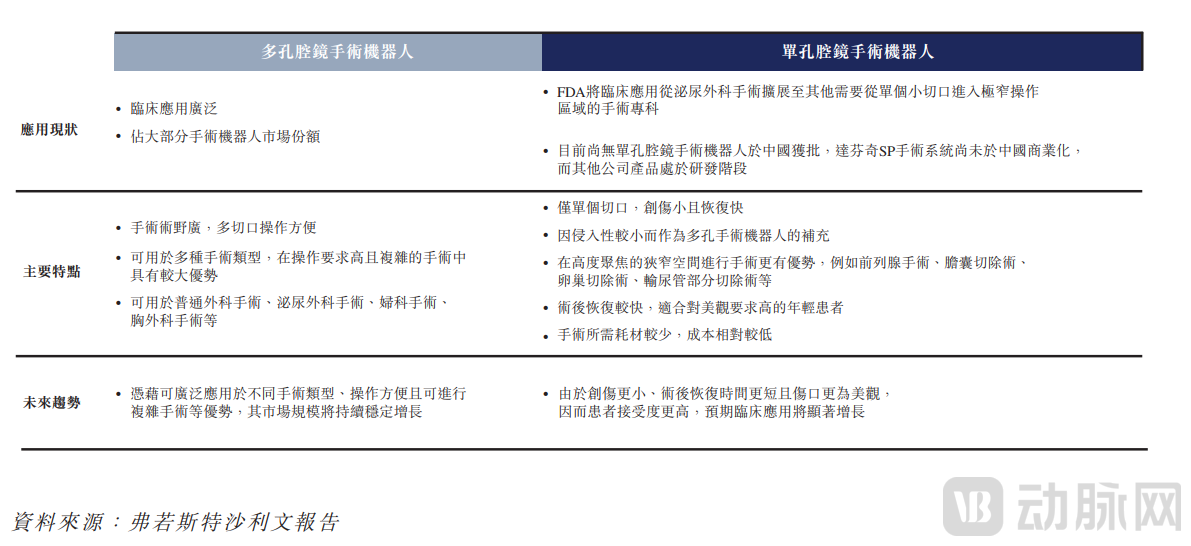
Intuitive Surgical’s da Vinci SP surgical system is the only single-port laparoscopic surgical robot approved by the FDA worldwide, and it was commercialized in the third quarter of 2018. Other companies around the world are also currently developing single-port laparoscopic surgical robots.Currently, there is no single-port surgical robot approved by the National Medical Products Administration (NMPA) in China.
Domestic single-port surgical robots are poised for takeoff. The single-port surgical robots from Edge Medical, MicroPort MedBot, and ShuRui Medical have all entered the clinical trial phase. In the future, Chinese manufacturers are expected to be the first to tap into the incremental market for single-port surgical robots.
Chinese enterprises have each introduced differentiated innovations in single-port surgical robots.
Edge Medical’s single-port surgical robot, the SP1000, stands out for its flexibility. The endoscopic instruments compatible with the SP1000 offer five degrees of freedom, while certain other instruments provide up to seven degrees of freedom, enabling the SP1000 to achieve a high level of dexterity comparable to that of the human hand and wrist, thereby granting surgeons greater control. Furthermore, Edge Medical’s multi-port and single-port surgical robots are mutually compatible and can share the surgeon console and 3D high-definition imaging system (excluding the 3D electronic endoscope).
In terms of imaging systems, Edge Medical emphasizes its low-latency, immersive 3D high-definition visualization. The imaging technology generates high-definition images of patient anatomy with a display latency of no more than 40 milliseconds. The combination of high-resolution stereo endoscopes and an immersive 3D HD imaging system enables surgeons to perform procedures in an environment characterized by clear visuals and reliable precision.

Surui, a company invested in by Medtronic, has developed a laparoscopic surgical robot system that is compatible with both multi-port and single-port surgical procedures, requiring only minor differences in consumables and setup. Furthermore, the external positioning arm of Surui’s single-port laparoscopic surgical robot remains stationary during surgery, relying on internal snake-like surgical instruments to perform operative movements. This design eliminates the risk of external arm collisions—a common issue inherent to multi-port surgical robots.
Another major trend is that domestic surgical robot companies are all moving towards platformization.
Edge Medical’s pipeline closely mirrors that of Intuitive Surgical, featuring multi-port laparoscopic surgical robots, single-port surgical robots, and natural orifice transluminal endoscopic surgery (NOTES) robots for pulmonary interventions, along with high-end minimally invasive medical devices.
MicroPort MedBot has established a presence in multiple surgical robotics sectors—including laparoscopic surgery, orthopedic surgery, cardiovascular interventions, pulmonary interventions, and percutaneous needle procedures—through in-house R&D and mergers and acquisitions.
Only a diversified product portfolio can sustain continuous growth.Intuitive Surgical shipped 1,347 da Vinci surgical systems in 2021, representing a 44% increase from the 936 systems delivered in 2020. Future growth for Intuitive Surgical will be driven partly by increased sales of disposable instruments for surgical robots, resulting from higher procedural volumes with the da Vinci surgical system, and partly by the approval of additional indications for its single-port surgical robot, as well as rising sales of its robotic-assisted bronchoscopy systems.
Edge Medical, which submitted its prospectus, has also laid out a strategy for high-end minimally invasive surgical instruments and launched an intelligent stapler.
High-end minimally invasive surgical instruments were historically the core market for Johnson & Johnson, Medtronic, and Covidien. Evidently, in the new era, the business boundaries between surgical robots and high-end minimally invasive surgical instruments are gradually blurring.Intuitive Surgical is gradually expanding into high-end minimally invasive surgical instruments, while Johnson & Johnson and Medtronic have also launched their own laparoscopic surgical robots. In 2021, Medtronic’s Hugo Robot-Assisted Surgery (RAS) system received CE marking for use in urological and gynecological procedures. Johnson & Johnson had initially planned to initiate first-in-human trials for its Ottava RAS system in the second half of 2022, but this has been postponed to the second half of 2024.
The competitive landscape of the surgical robotics market involves not only leading surgical robotics companies but also a cohort of minimally invasive surgical device manufacturers, who are emerging as key players. This implies that while the top-tier domestic surgical robotics firms will be established over the next decade, the sector is poised to enter a phase of even more intense competition.
Surgical robots represent the fastest-growing yet least penetrated niche within the global medical device market, with the da Vinci Surgical System being the most widely used surgical robot worldwide. In fact, there is no shortage of surgical robot companies globally. Five multi-port laparoscopic surgical robot systems have received U.S. FDA approval or European CE marking, including Asensus Surgical’s Senhance, Avatera Medical’s Avatera, CMR Surgical’s Versius, Meere Company’s Revo-I, and Medtronic’s Hugo. However, none of these products has managed to replicate the success of the da Vinci Surgical System.
Domestic surgical robot manufacturers have overcome the high barriers to R&D and reached the pre-clinical trial stage; the subsequent challenges lie primarily in market education and promotion.
Many professionals in the surgical robotics industry have noted that the global success of the da Vinci Surgical System is attributable not only to its superior technology but also to Intuitive Surgical’s market education strategy, which is equally worthy of emulation. In its early stages, the da Vinci system prioritized educating medical students rather than focusing solely on promoting the technology to senior, influential physicians. As these younger doctors subsequently became the mainstay of surgical practice, they naturally drove the growth in adoption of the da Vinci Surgical System.
In China, market education for the da Vinci Surgical System has also been highly successful. VCBeat has interviewed numerous urologists and gynecologists, who have demonstrated a high level of recognition and acceptance of laparoscopic surgical robots. Surgeons are more inclined to adopt products that are familiar and extensively validated.
In the sales and marketing arena, domestic brands must also transform their image by earning physicians’ trust through professional products and robust performance, thereby shedding the perception of Chinese-made devices as low-quality and low-priced.
Currently, Intuitive Surgical’s products have not yet entered the Chinese market for single-port surgical robots and pulmonary interventional surgical robots. This means that domestic companies need to undertake early-stage market education and persuade physicians to adopt these new surgical tools. Meanwhile, the manufacturing of surgical robots is a highly precise and complex process that requires stringent quality control, as product failures can have severe consequences and entail substantial costs. Domestic surgical robot manufacturers also need to convince physicians of the reliability of quality control and product stability in Chinese-made devices.
Achieving stable, high-quality mass production is also a major challenge.Endoscopic surgery is primarily performed for the oncological resection of tumors; consequently, hospitals offering such procedures are more concentrated and tend to be of higher tiers. Surgical instruments used by physicians during these procedures directly engage in tissue cutting and suturing. Should product quality be substandard, surgical risks would significantly increase. Therefore, physicians maintain exceptionally high standards for the quality of endoscopic surgical tools. Compared with other industries, the pharmaceutical and medical device sector exhibits an extremely low tolerance for defects.
"Surgical robots, as highly precise medical devices, have extremely high requirements for quality control."From R&D to the factory floor, domestically produced surgical robots also require robust and stable manufacturing capabilities. This entails multifaceted challenges, including cost control, quality assurance, and optimization of production processes.
Intellectual property risks may also become a barrier to the market launch of domestically produced surgical robots. According to industry insiders, Intuitive Surgical has established a robust global patent portfolio; however, many startups have overlooked the importance of intellectual property protection in their early stages, which may pose latent risks to the future development of domestically produced surgical robots.
The rapid development and substantial investment in surgical robots in China are unparalleled in many niche segments of the medical device industry. However, capital injection alone cannot give rise to a great company like Intuitive Surgical. In this high-barrier, high-growth sector, only by continuously keeping pace with technological advancements can one secure a foothold in the ever-changing market.