Johnson & Johnson
Medical Device R&D and Manufacturer

MeiraGTx
Developer of Innovative Gene Therapy Products

On April 16, 2026, Johnson & Johnson announced that it would return a core ophthalmic gene therapy, botaretigene sparoparvovec (referred to as bota-vec), to its original developer, MeiraGTx. MeiraGTx repurchased the global rights to this drug for only $25 million.
According to the announcement, the transaction terms also include: Johnson & Johnson is eligible to receive a one-time milestone payment linked to the approval and commercial performance of bota-vec, as well as a high double-digit percentage of global net sales as royalties, which will be calculated starting from mid-2029.MeiraGTx stated that it will submit listing applications to the U.S. and EU as soon as possible, with plans to go public in 2027 if approved.
Data shows that Botaretigene sparoparvovec (formerly known as AAV5-RPGR), developed by MeiraGTx and later licensed to Johnson & Johnson (Janssen Pharmaceuticals), is an investigational AAV5 vector gene therapy specifically designed to treat X-linked retinitis pigmentosa (XLRP) caused by mutations in the RPGR gene.
Bota-vec uses adeno-associated virus type 5 (AAV5) as a vector to precisely deliver a truncated and optimized functional RPGR-ORF15 gene (containing a 378bp deletion to enhance stability) to the photoreceptor cells (rods and cones) of the retina via subretinal injection. Its purpose is to replace the defective RPGR gene in patients, compensate for the genetic functional defect, prevent photoreceptor degeneration, and thereby rescue or maintain vision.
The drug showed positive signals in Phase 1/2 clinical trials and received FDA Fast Track designation. In 2023, Johnson & Johnson acquired its global rights for $415 million.However, in the critical Phase III LUMEOS trial in May 2025, the primary endpoint was not met (no statistically significant improvement in vision-guided mobility at 52 weeks).Although several secondary endpoints (retinal sensitivity, low luminance visual acuity, etc.) showed improvement, the failure of the core efficacy directly led to Johnson & Johnson terminating the collaboration and returning the assets.
Notably, on the same day that MeiraGTx announced the repurchase of bota-vec from Johnson & Johnson, the company also unveiled an urgent financing plan:The company plans to issue 11,111,111 ordinary shares at an offering price of $9.00 per share, expecting to raise a total of $100 million. The proceeds will be mainly used to advance the preparation for the U.S. and EU market application of bota-vec, preparations for potential commercialization, and to sustain the subsequent R&D and operational expenses of the company’s overall pipeline.
However, this "self-rescue financing" did not gain recognition from the capital market; instead, it was seen as a clear signal of the company's tight cash flow and pressured prospects.
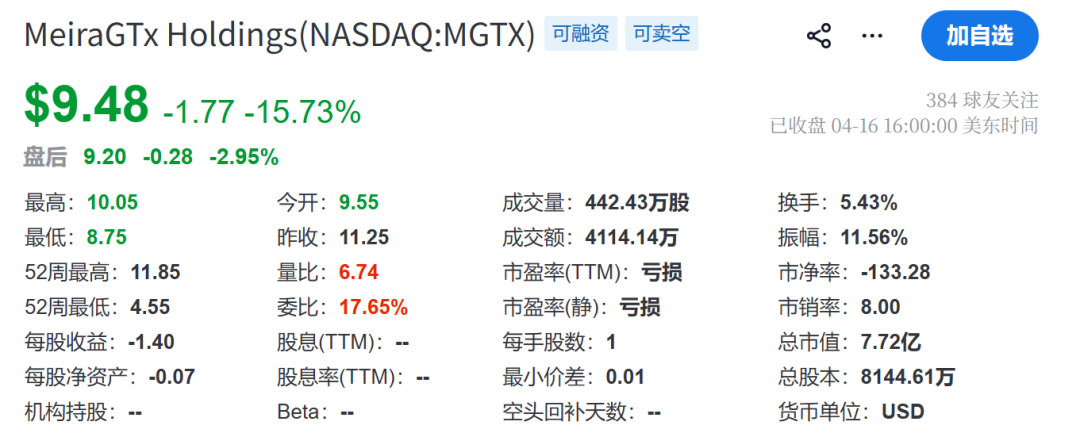
The叠加 of multiple negative factors, such as the Phase III clinical trial failure of the core project, the financial pressure brought by the unsuccessful repurchase of assets from Johnson & Johnson, and the significant dilution of existing shareholders' equity due to the issuance of new shares, have been collectively released.MeiraGTx (NASDAQ: MGTX) experienced a sharp drop in its stock price, plummeting 15.73% to close at just $9.48, with market confidence nearly collapsing.
As the stock price came under pressure, insider trading records within the company also raised strong concerns from outsiders. According to publicly filed documents with the U.S. SEC, executives and directors of MeiraGTx recently engaged in a series of intensive sell-offs:
April 7: Chief Development Officer Naylor Stuart sold 27,700 shares, cashing out approximately $259,000;
March 24: Director and CEO Forbes Alexandria sold 62,000 shares;
From early 2026 to date: Multiple senior executives, including CFO Giroux Richard, have conducted sell operations to varying degrees.
Although some of the reductions were part of a previously established 10b5-1 automatic trading plan, often explained as personal financial arrangements, the collective and intensive selling by senior executives during a period when the company faced multiple negative events—such as clinical failures of core projects, forced asset repurchases, and large-scale share issuance leading to dilution—was still interpreted by the market as a lack of internal confidence. This further exacerbated investor pessimism and selling pressure.
Not long ago, ophthalmology was considered the field where gene therapy could achieve breakthroughs most easily. But now, the failure of bota-vec is bursting the industry bubble—clinical challenges far exceed expectations. The pathology of rare eye diseases like XLRP is complex, and the efficacy, safety, and delivery efficiency of AAV vectors are all questionable; meanwhile, major companies are retreating one after another. Following Johnson & Johnson, Novartis, Vertex, and others have also scaled back their investments in ophthalmic gene therapies; coupled with a tightening of regulatory approvals, the FDA’s attitude toward gene therapy has become stricter, multiple executives have changed, and approval criteria are becoming harder to predict...
Despite the core ophthalmology pipeline being "returned" by Johnson & Johnson and the persistently low stock price, MeiraGTx still holds several game-changing cards.
In November 2025, Eli Lilly and MeiraGTx reached a strategic cooperation worth a total of $475 million: Eli Lilly paid $75 million upfront to obtain the global exclusive rights to its gene therapy AAV-AIPL1 for treating LCA4 congenital blindness. Early clinical trials of this therapy showed "transformative" vision recovery effects (all 11 blind children benefited), which was considered strong recognition of its technical platform and an important source of confidence supporting this $100 million share issuance.
Secondly, MeiraGTx also has a diversified pipeline layout, with its Parkinson's disease and xerostomia treatments entering Phase II clinical trials — Parkinson’s Disease (AAV-GAD): Improves motor function by increasing the inhibitory neurotransmitter GABA in the brain through gene therapy; now in Phase II clinical trials at MeiraGTx. Salivary Gland Repair (AAV-hAQP1): Targets radiation-induced xerostomia and Sjögren’s syndrome; currently in Phase II clinical trials to repair damaged salivary gland function at MeiraGTx.
MeiraGTx Holdings plc (NASDAQ: MGTX) was foundedIn 2015,"Meira" means "giving light" in Hebrew. However, for the shareholders and patients of MeiraGTx, this is the darkest moment.
Johnson & Johnson's asset return, $25 million refund, plus a new round of $100 million dilutive financing, all indicate that the company has reached a critical life-or-death juncture. The next two years will be a decisive window period: Can the AAVAIPL1 collaboration with Eli Lilly smoothly advance to market? Can pipelines like Parkinson’s deliver blockbuster data?
The capital market has always been ruthless and will not indefinitely pay for technological vision. MeiraGTx must use tangible clinical results and commercialization progress to prove that the $100 million financing has bought not just a reprieve, but a truly bright future.
References: Fierce Biotech, MeiraGTx Official Investor Relations Announcement