

Eleanor Health Secures $50M Series C Funding to Expand Innovative, Value-Based Care for Substance Use and Mental Health Disorders

Eleanor Health
Addiction and Mental Health Service Provider
By the end of 2020, 42% of adults in the United States reported symptoms of anxiety or depression. Meanwhile, the U.S. CDC reported that approximately 90,000 people nationwide died from drug overdoses in 2020, a figure five times higher than that in 1999.
Drug abuse has long been a severe public health challenge facing the international community. While medications are originally intended as therapeutic remedies to treat diseases and save lives, their misuse can transform them into “drugs of abuse.” The Criminal Law of the People’s Republic of China defines “drugs” as “narcotic drugs and psychotropic substances under state control that are capable of causing addiction.” Therefore, from a definitional standpoint, drug abuse can be regarded as the misuse of narcotic drugs and psychotropic substances, namely Substance Use Disorder (SUD).
In the 1960s, substance use disorder (SUD) was accepted by the American Medical Association as a disease concept; as a disease, it is treatable.
Eleanor Health is a company that provides mental health and addiction treatment services to patients. Founded in 2019 and headquartered in Massachusetts, United States, the company is led by its two female founders, Corbin Petro and Nzinga Harrison.
Co-founder and CEO Corbin Petro stated, “Approximately 40 million people in the United States struggle with addiction and mental illness each year, yet fewer than one in ten patients with substance use disorders (SUD) and only half of those with mental illnesses receive treatment. It is not that patients refuse treatment; rather, the cost of treatment is prohibitively high while its efficacy remains suboptimal.”
Therefore, Eleanor Health needs to address two issues: ineffective treatment outcomes and high treatment costs.
Medication-Assisted Physiological Detoxification, Group Therapy-Assisted Psychological Detoxification
How to Improve Treatment Efficacy? To Untie the Bell, One Must Seek the Person Who Tied It: This Issue Must Be Addressed by Examining the Nature of Addiction and Its Biological Mechanisms.
Over millions of years of evolution, the human desire for pleasurable substances has been “wired into our DNA.” The human brain possesses a reward system: when pleasurable stimuli act upon the brain, it not only releases neurotransmitters such as dopamine but also encodes these sensations and stimuli, prompting behaviors aimed at seeking out such stimulation. This system constitutes the physiological basis of drug addiction and provides the physiological premise for its pharmacological treatment.
Addiction treatment is typically divided into two phases: the first is physiological detoxification, and the second is psychological abstinence.
In fact, many patients visiting Eleanor Health clinics report: “It initially started as a way to help with sleep or alleviate anxiety, but after experiencing the initial benefits, repeated ‘just one more try’ instances intensified the craving for stimulation, leading to an increasingly higher threshold for pleasure.” Approximately 50% of individuals with addiction also suffer from co-occurring mental health disorders such as depression and anxiety.
Which comes first, addiction or mental illness? It seems like a chicken-or-egg question. However, Corbin Petro, CEO of Eleanor Health, states, “Since the two conditions co-occur, simultaneous treatment is the only way to achieve a cure.”
Eleanor Health has introduced a whole-person care model, ranging from medication-assisted treatment to group therapy.
Medication-assisted treatment is an effective approach for physiological detoxification. Eleanor Health provides comprehensive care for addiction and mental health disorders, allowing patients to choose between in-person and virtual consultations. During virtual visits, physicians transmit prescriptions to local pharmacies for patients to pick up their medications in person. Medications prescribed by Eleanor Health include buprenorphine, naltrexone, and methadone. During the pandemic, considering the difficulties patients faced in obtaining medications due to citywide lockdowns, Eleanor Health prescribed up to a four-week supply of methadone for clinically stable patients.
Medications help patients detoxify and smoothly navigate various physiological withdrawal symptoms, but what causes even greater suffering is the cycle of repeated relapses after detoxification.
The relapse rate for drug addiction is high, at approximately 60%. This is due to the presence of addiction-related memories in the brain. Even after patients have achieved physical detoxification, re-exposure to cues associated with drug use can activate these memories, triggering relapse. For instance, even a medication box can provoke a relapse. However, it is difficult for patients to remain in an idealized environment indefinitely, as the goal of treatment is to facilitate their return to normal life.
During the psychological withdrawal phase, pharmacological interventions have limited efficacy, whereas group therapy proves more effective.
Eleanor decided to have patients engage with the community from the very start of treatment, aiming to reduce stigma and lower relapse rates. Corbin Petro stated, “Individuals who fail to achieve abstinence are often viewed as failures lacking perseverance and self-control. However, we recognize that addiction is a chronic, relapsing disease that has little to do with willpower or self-discipline, and patients should not feel ashamed because of it.”
Eleanor organized a peer support group for patients, bringing together individuals with similar symptoms. Within the group, everyone shares a common identity, and no one feels ashamed of alcohol or drug addiction.
In addition to support groups, Eleanor also provides psychiatric counseling and life assistance. “Some patients with substance use disorders (SUD) are plagued by financial and housing issues, which become the root causes of their drug abuse or alcoholism. We provide patients with Community Recovery Partners (CRP) in hopes of addressing their life challenges,” said Corbin Petro.
All of the above services are available through in-person consultations at Eleanor Health clinics or via remote telehealth visits. Currently, Eleanor Health has established physical clinics in Louisiana, Massachusetts, New Jersey, North Carolina, Ohio, Texas, and Washington.
When Eleanor Health was founded in 2019, CEO Corbin Petro was skeptical of telemedicine, particularly in the fields of mental health and substance use disorder treatment. Patient adherence is a key determinant of treatment efficacy, and remote care appeared to be detrimental to patient adherence.
Before the pandemic, 90% of Eleanor Health’s operations were conducted offline, with telemedicine serving merely as a supplementary tool. In the two short weeks following the outbreak in 2020, Eleanor Health shifted 90% of its services online. To improve patient adherence, Eleanor Health regularly mails urine testing kits to users. “It turns out that telemedicine can be highly effective, but it requires greater effort from Eleanor Health,” said Corbin Petro.
Earlier this year, Eleanor Health published a series of research data on its website, stating that 84% of users showed improvement in substance abuse, 70% experienced reduced depression and anxiety, and emergency department visits and hospitalization rates among members decreased by 84%.
Although Eleanor Health can provide all services online, it has ensured the operation of its physical clinics to address issues such as patients’ lack of remote connectivity devices.
Adopting the VBS payment model, charging based on outcomes rather than volume
Having addressed the issue of treatment efficacy, another major “mountain” to climb is reducing treatment costs.
In 2010, the United States enacted the Affordable Care Act, known as “Obamacare,” which emphasized that healthcare services should prioritize quality over quantity.
In 2019, Eleanor decided to adopt a Value-Based Service (VBS) payment model, under which reimbursement is tied to service outcomes—in layman’s terms, payment is made only upon demonstrated results. This decision was considered radical at the time because, despite years of reform, the Fee-for-Service (FFS) model remained dominant in the U.S. mental health sector.
In the initial months, Eleanor Health operated at a loss because it could not submit sufficient data in a short period to demonstrate treatment efficacy. However, after the outbreak of the pandemic, the Value-Based Services (VBS) model demonstrated advantages that Fee-for-Service (FFS) lacked. “Many programs require testing in physical clinics. After the pandemic, the number of patients visiting physical clinics dropped sharply, eliminating that portion of revenue. In contrast, under the VBS payment model, revenue is secured as long as treatment outcomes are guaranteed,” said Corbin Petro.
From the current perspective, Eleanor’s adoption of the VBS model represents a win-win situation. For patients, it reduces unnecessary costs; for instance, data submitted by Eleanor shows an 84% decrease in user emergency department visits and hospitalization rates. For Eleanor, it ensures revenue stability.
Eleanor’s user base primarily consists of three segments: individual patients, referrals from primary care systems, and members of partnered health insurance companies. To date, Eleanor Health has established partnerships with insurers such as Amerigroup and Optum.
Eleanor believes there is still room for growth among users from health insurance companies and primary care networks.
First, the prevailing practice among U.S. health insurers is to outsource mental health services, resulting in low reimbursement rates and low patient utilization. If insurers were to integrate these services, more patients with substance use disorders would receive treatment.
Furthermore, patients with addiction often avoid seeking medical help due to stigma. Improving the social climate in this regard would encourage a portion of these individuals to seek treatment.
Eleanor Health is projected to surpass 60,000 registered users by the end of 2022 and cover 22 million users from partner health insurance companies.
Eleanor Health Announces Completion of $50 Million Series C Financing Round Led by General Catalyst, with Participation from Town Hall Ventures and Warburg PincusRecently, Eleanor Health announced the completion of a $50 million Series C financing round. The round was led by General Catalyst, with participation from existing investors including Town Hall Ventures and Warburg Pincus. Eleanor Health plans to use the proceeds to develop new partnerships and expand into new markets.
Global Investment in Digital Mental Health Soars as the First Wave of IPOs Emerges
In 2021, driven by the COVID-19 pandemic and its subsequent impact on collective mental health, venture capital investment in the digital mental health sector surged, with a total of 113 financing deals amounting to $3.54 billion for the year.
The mental health sector is broadly categorized into several areas: mental disorders such as depression and anxiety, general mental wellness, substance abuse involving alcohol and drugs, sleep health, and chronic pain. Among these, general mental wellness has the lowest barrier to entry but enjoys the highest popularity.
In 2021, three companies in the digital mental health sector went public: Talkspace, LifeStance, and Pear Therapeutics. Their primary businesses are providing online remote mental health services, an integrated online and offline care delivery platform, and the development of software for digital therapeutics for substance use disorders (SUD), respectively.
In the field of substance use disorders, such as drug abuse and alcohol abuse, globally leading companies include 2Morrow, Click Therapeutics, Monument, OREXO, and Pear Therapeutics, most of which are developers of digital therapeutics. Among them, OREXO is a publicly listed pharmaceutical company, and Pear Therapeutics is also publicly traded. Its developed software product, reSET, is a behavioral therapy-based solution for treating substance use disorders and was the first prescription digital therapeutic authorized by the FDA to improve mental health conditions.
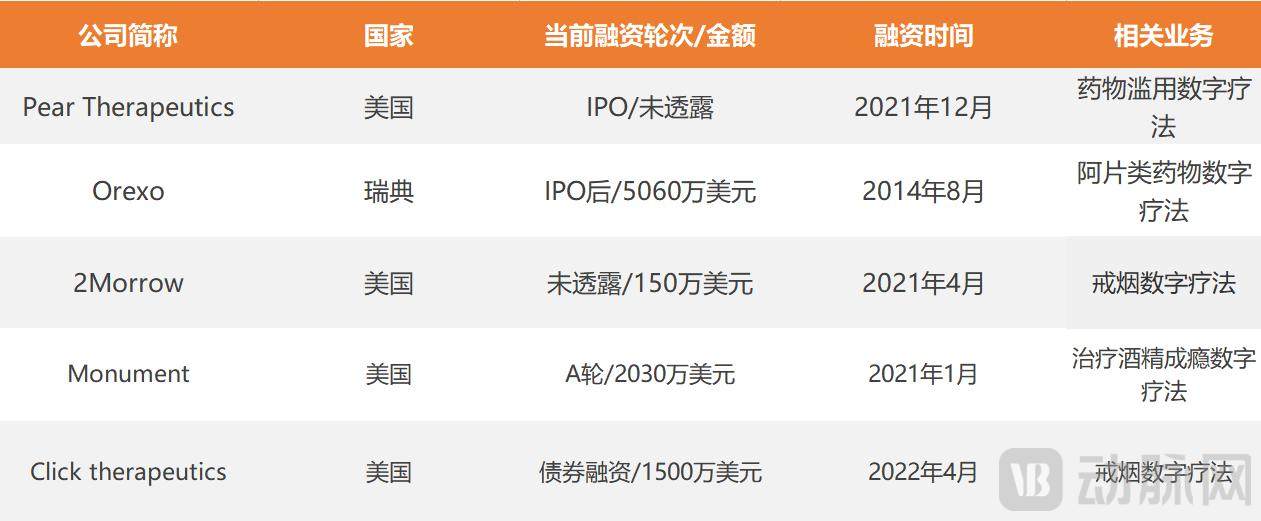
Selected Companies in the Digital Health Sector for Cognition and Behavior
In 2021, total financing for digital mental health in China reached $1.86 billion, aligning with the robust global growth trend in this sector. While foreign mental health companies have established mature B2B markets, their counterparts in China are still in the development stage.
In the treatment of drug addiction, market demand is greater in the United States; in China, companies such as Youwangli Technology are exploring digital therapeutics in the field of addiction.