

Five Ministries Jointly Issue Digital Rural Initiative, Explicitly Proposing Exploration of Grassroots Digital Health Communities
Recently, the Cyberspace Administration of China, the Ministry of Agriculture and Rural Affairs, the National Development and Reform Commission, the Ministry of Industry and Information Technology, and the National Rural Revitalization Administration jointly issued the “Key Points for Digital Village Development in 2022” (hereinafter referred to as the “Key Points”), deploying 30 key tasks across 10 areas.
In addressing the key tasks for developing “Internet + Healthcare,” the Key Work Points explicitly state: “Establish an authoritative, unified, and interconnected national health information platform, and promote the integration of medical and health institutions at all levels into regional national health information platforms. Steadily advance the centralized cloud-based deployment of information systems in medical institutions. Implement the ‘Five Ones’ service initiative for ‘Internet + Healthcare,’ continue to strengthen the construction of telemedicine service networks, and facilitate the downward flow of high-quality medical resources.”Guide localities in exploring the development of grassroots digital health communities.”
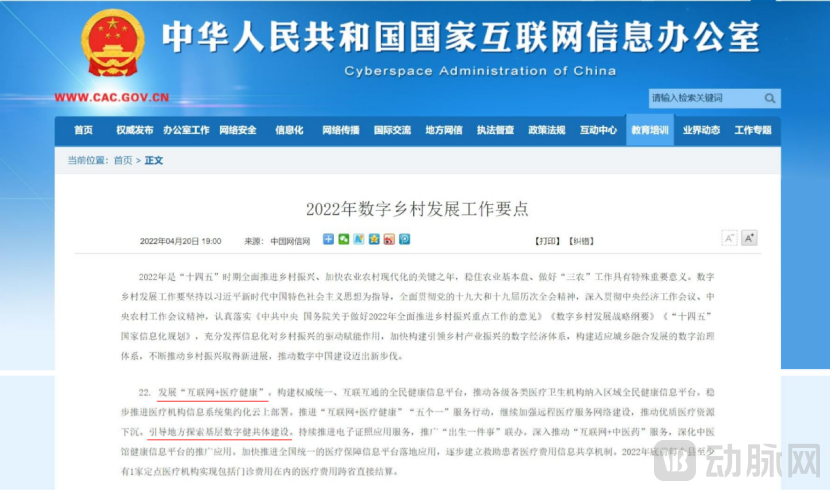
"Key Points for the Development of Digital Villages in 2022"
Notably, the term “Primary Care Digital Health Consortium” appeared for the first time in a document issued by national ministries and commissions, drawing particular attention. How should “Primary Care Digital Health Consortium” be defined and understood? In the process of exploring the development of Primary Care Digital Health Consortia, what successful experiences have been pioneered at the local level?
According to public media reports, the concept of the “Digital Health Community” was first proposed by the digital healthcare platform WeDoctor in 2019 and initially implemented in Henan, Tianjin, Shandong, Fujian, and other regions. During this practical exploration, the “Tianjin Model” and the “Sanming Model,” which were among the first to carry out the construction of Digital Health Communities and define the “Primary Care Digital Health Community,” may serve as valuable references for other regions to adapt according to their local medical and health conditions and characteristics.
On January 6, 2020, the Tianjin Municipal People's Government and WeDoctor signed the "Strategic Cooperation Agreement on Digital Health," reaching an agreement to jointly build a digital health community, among other collaborations. On April 29 of the same year, under the guidance of the Tianjin Municipal Health Commission, the Tianjin Grassroots Digital Health Community—an urban-type healthcare stewardship organization led by Tianjin WeDoctor Internet Hospital and coordinated with 16 districts and 266 primary healthcare institutions across the city—was officially launched for construction.
As a result, Tianjin became the first provincial-level administrative region in China to launch a comprehensive digital health initiative, while WeDoctor emerged as the first digital healthcare platform to explicitly propose and innovatively implement the concept of a “Primary Care Digital Health Community,” following its pioneering development of new models and business formats such as “Internet Hospitals” and “Digital Health Communities.”
The development of the grassroots digital health consortium in Tianjin aims to enhance the operational efficiency and effectiveness of the “three-medical linkage” (integration of medical care, health insurance, and pharmaceutical services) through digital means, establish a health security system covering residents’ entire life cycle and full health journey, effectively improve population health indicators while curbing the growth rate of medical insurance expenditures, and comprehensively promote the development of Tianjin’s digital health industry. After nearly two years of construction and development, the digital health consortium has now achieved full coverage of grassroots medical and health institutions in Tianjin.
By implementing a unified “Four Clouds” platform—comprising cloud-based management, cloud services, cloud pharmacy, and cloud diagnostics—across primary healthcare institutions citywide, along with standardized offline chronic disease management centers, this digital health consortium provides community residents with integrated online-offline medical and health services encompassing prevention, diagnosis, treatment, management, and wellness. Meanwhile, it explores the implementation of payment models such as bundled payments for overall care and case- or capitation-based bundled payments. Under a global budget management framework, it enforces an incentive and constraint mechanism based on the principle of “retaining surpluses and not covering deficits,” alongside a health accountability system, thereby gradually establishing a new-era health security system centered on health.
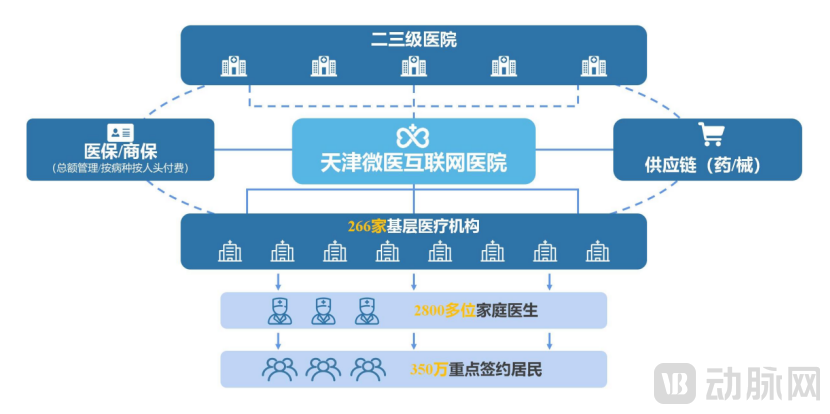
Tianjin’s Model for Building a Grassroots Digital Health Consortium
Public reports indicate that by the end of December 2021, all 266 primary healthcare institutions within Tianjin’s Primary Digital Healthcare Community had completed digital upgrades. This achievement enabled full data integration and interoperability among basic medical care systems, basic public health systems, and family doctor contract signing systems, thereby establishing unified operational monitoring and management for the Healthcare Community.
Meanwhile, leveraging the unified “Four Clouds” platform, primary healthcare institutions within the Medical Community have achieved internal prescription circulation, intelligent prescription review, medical insurance settlement, and centralized drug supply. They have also successively launched home-based medical services, adopting an “online application, offline service” model to provide 58 specialized on-demand home services—such as venous blood sampling, urinary catheterization, and nasogastric tube insertion/replacement care—for individuals with mobility impairments and other special populations requiring home nursing care.
As of the end of March this year, Tianjin’s Primary Care Digital Health Consortium had established standardized chronic disease management centers in collaboration with 50 primary healthcare institutions, jointly managing over 600,000 patients with chronic conditions. Statistical data show that the rate of standardized management for diabetes patients reached 76.68% at pilot primary healthcare institutions within the consortium. Analysis of patient samples managed for more than three months revealed a 21.58 percentage point increase in the blood glucose control rate. Furthermore, primary healthcare institutions implementing capitation-based payment models achieved medical insurance surplus rates ranging from 16% to 31%.
Owing to its outstanding effectiveness and demonstrative impact, the Tianjin Primary Care Digital Health Consortium was ranked first among the “Top Ten New Initiatives to Advance Healthcare Reform and Serve Public Health” at the 2021 National Conference on Promoting Experience in Deepening Healthcare Reform. Meanwhile, the Consortium was included twice, in 2021 and 2022, in Tianjin’s “Internet + Healthcare” demonstration projects, with full coverage of the primary care network across Tianjin expected by the end of 2022.
As a pioneer in China’s healthcare reform, Sanming was the first region in the country to initiate the development of a “Digital Health Community.” Starting in 2018, building on a comprehensive review of its healthcare reform experiences, Sanming City introduced WeDoctor’s digital health technologies to jointly establish China’s first “Three-Medical Linkage” platform, and began gradually exploring a people-centered, digitally enabled “Digital Health Community.”
On October 8, 2021, the Leading Group for Healthcare Reform of the State Council issued the “Implementation Opinions on Deepening the Promotion of Sanming City’s Experience in Fujian Province to Further Reform the Medical and Healthcare System” (hereinafter referred to as the “Implementation Opinions”). The document explicitly proposed advancing the development of medical consortia, strengthening the clinical specialty capabilities of county-level hospitals, improving the family doctor contract service system, enhancing the workforce of village doctors, innovating mechanisms for tiered diagnosis and treatment and coordination between medical care and disease prevention, promoting the downward flow of high-quality medical resources and orderly patient visits, gradually increasing the proportion of patients treated within counties and at primary healthcare institutions, and strengthening performance evaluations of medical consortia centered on people’s health, among other measures.
In November of the same year, to implement the "Implementation Opinions" and carry out key tasks outlined in the "Action Plan for Sanming City’s Implementation of the 'Six Major Projects' to Relaunch Healthcare Reform," including the project to improve the universal health management and care system, the Sanming Healthcare Reform Leading Group formulated the "Work Plan for Fully Leveraging the Complementary Role of Internet Hospitals and Enhancing the City’s Digital Health and Medical Service Capabilities." The plan proposes the construction of a digital platform that is "horizontally comprehensive, vertically integrated, and fully interconnected," aiming to comprehensively enhance Sanming’s digital healthcare service capabilities and drive the relaunch of the "Sanming Healthcare Reform."
In accordance with the aforementioned work plan, Sanming City has introduced WeDoctor to establish a citywide unified “Hospital Internet Digital Service Platform,” serving 12 general hospitals (medical consortia) and their member institutions. This initiative aims to achieve comprehensive connectivity and integration of digital healthcare services in Sanming, lay a solid foundation for building a Digital Health Community, and truly create a digitally enabled Health Maintenance Organization (Digital HMO) with Chinese characteristics.
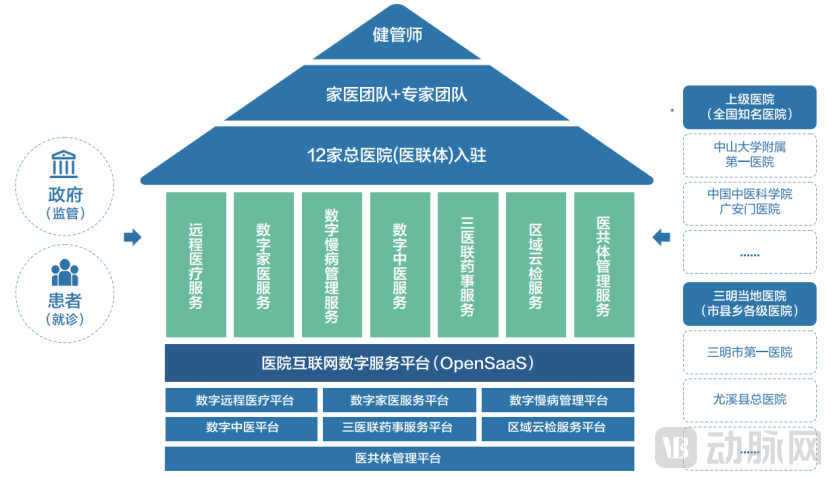
Sanming Digital Health Community Construction Model
According to the latest reports, by leveraging cloud platforms and delivering cloud-based services, WeDoctor is assisting Sanming in further strengthening inter-hospital collaboration. It has joined forces with large Grade 3A hospitals, such as The First Affiliated Hospital of Sun Yat-sen University and Guang’anmen Hospital of the China Academy of Chinese Medical Sciences, to establish the Sanming Digital Specialty Alliance and the Medical-Prevention Integration Alliance. These initiatives aim to promote specialty development at the primary care level and enhance public health services, thereby achieving comprehensive horizontal coverage. Meanwhile, WeDoctor will also support general hospitals (encompassing medical institutions at the city, county, township, and village levels) in delivering family doctor services, chronic disease management, and pharmaceutical care. This effort seeks to standardize and equalize digital healthcare services, providing whole-lifecycle health management for the public and ensuring thorough vertical integration.
Currently, the construction of grassroots digital health communities in Tianjin is becoming increasingly robust, with related health management and care services being smoothly implemented. Meanwhile, the digital health community model has been adapted to local conditions and timing in Sanming City, where the comprehensive health management and care system centered on “people’s health” in Phase 3.0 of the Sanming Healthcare Reform has officially commenced construction.
As can be seen, the digital health community practices in both Sanming and Tianjin are frontier explorations in building a new-era healthcare security system. These initiatives, guided by government strategic directives and tailored to local medical and health system characteristics and conditions, integrate digital healthcare systems. They offer significant reference value for other regions seeking to construct healthcare security systems adapted to their specific local contexts.
With the joint issuance of the Key Work Points by five ministries and commissions, which explicitly calls for “guiding localities to explore the development of grassroots digital health communities,” digital healthcare platforms such as WeDoctor will scale up and replicate their innovative digital health community models—such as the “Tianjin Model” and “Sanming Model”—that integrate digital health services into local new healthcare reforms and drive these reforms across more regions nationwide.