

VB ThinkTank Synthetic Biology Series: 'From DNA to Factory – Realism and Imagination' Files Prospectus
As part of the VBInsight "Synthetic Biology" SeriesFrom DNA to Factory: Both Realistic and Aspirational"Phase I of Phase III. The main topics of this issue include:"1. Pitfalls encountered in navigating the challenges of product selection and process scale-up; 2. Balancing technology and commercialization: Key decision points for independent R&D versus external collaboration; 3. How new technologies have accelerated processes along the path from laboratory to industrialization。
“The three topics on today’s agenda are akin to three paintings in our ‘realistic portrayal’: first, we meticulously dissect the challenges of product selection and manufacturing scale-up with the precision and rigor of gongbi (fine-brush) painting; then, in the second phase, we employ the freehand splash-ink style of shan-shui (landscape) painting to present the artistic conception of technology and commerce; finally, we conclude with a sketch that hints at the foundational impacts brought by new technologies and the future possibilities they inspire.”Dr. Chen Lu, Deputy Director of Huaheng Biological Research Institutesaid during pre-event testing.
Dr. Du Jun, Vice President of Tsingke BiotechnologyAnother guest at this event, he previously served for many years at the China Bio-fermentation Industry Association and has extensive practical experience in industry research, corporate strategic consulting, and academic-industrial collaboration. He candidly remarked, “I am both familiar with and unfamiliar with this industry.”
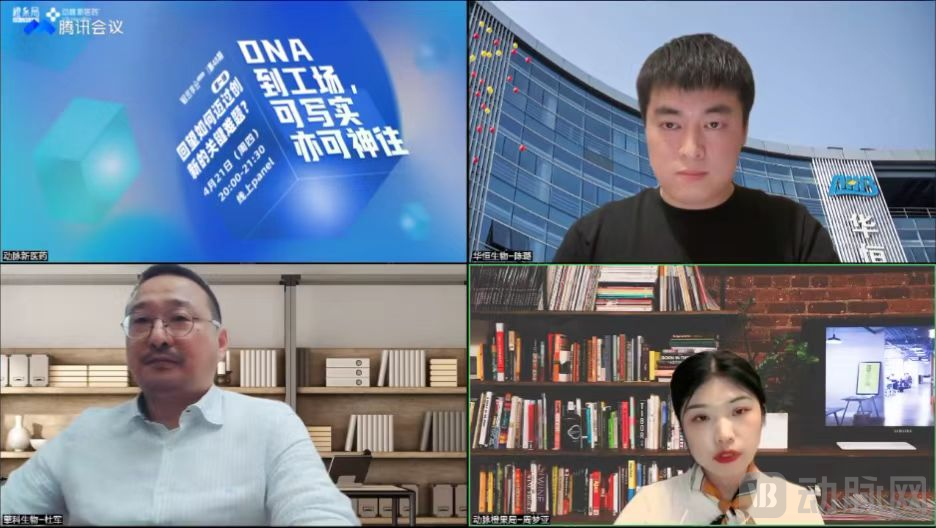
Note: Bottom left: Du Jun, Vice President of Beijing Tsingke Biotechnology; Top right: Chen Lu, Deputy Director of Huaheng Biology Research Institute; Bottom right: Zhou Mengya, Reporter/Senior Researcher at VCBeat Chengguo Bureau
How to Appreciate the Canvas of “Synthetic Biology”
Dr. Chen Lu:
Despite the high expectations for synthetic biology manufacturing and its applications, the path to industrialization faces several critical junctures and challenges.All key milestones from R&D to commercialization are critical.However, if a primary-secondary distinction must be made, I believe it can be presented in reverse order.。
First, achieve stable mass production.. For the industry, if industrialization is to be achieved, mass production will ultimately determine whether a product can be launched into the market. This involves adapting mature process systems to production bases, and in practice, there are many detailed and fragmented technical challenges that need to be addressed; these will not be elaborated upon here.Next is the optimization of fermentation process. Here, we need to break away from certain ingrained mindsets in development. While there is an ample supply of fermentation engineers as traditionally defined, their foundational skill sets remain relatively weak. They have not adopted a cross-disciplinary approach by thinking “upstream” or “downstream,” which often makes it difficult to overcome critical bottlenecks.Finally, upstream molecular development and designWe must firmly believe that good products are designed, not tested. Testing is merely for optimization; design is fundamental. Of course, this also poses greater challenges to R&D personnel at the forefront, as only by understanding the entire industry chain can they achieve their goals. In the Design-Build-Test-Learn (DBTL) closed loop, the Learn step is the core of the entire process, but the ultimate outcome of learning is actually to provide support for the design phase. Therefore, molecular-level design and development, as I mentioned earlier,If downstream pilot-scale fermentation and base production are taken into account, and if there is a fundamental enhancement in understanding of the market, customers, policies, and capital, enabling a comprehensive view of the entire corporate ecosystem chain, then returning to molecular design and development will allow R&D personnel to work with greater ease and proficiency. This is precisely what Huaheng Research Institute is currently undertaking, and it represents the inevitable direction for upstream synthetic biology R&D in all future biomanufacturing enterprises.。
Dr. Du Jun:
Synthetic biology, as an interdisciplinary field, is not synonymous with synthetic biological manufacturing. In the three major application domains—biomedicine, synthetic biological manufacturing, and food and environmental applications—the chosen strategic directions differ due to their distinct objectives.
The entire research, development, and application of synthetic biology products can be broadly divided into three stages: science, technology, and engineering.The importance of each step varies across different stages.。For instance, in many cases, we often rely on reverse engineering to drive technological and scientific advancements; however, in certain scenarios, forward deduction can also lead to breakthroughs.Therefore, it is important to emphasize that variations in product types, technical focal points, and stages of product development all lead to shifts in key milestones. Meanwhile, the influence of policy and the industry’s developmental environment is substantial, yet these factors are often overlooked.
Detailed Outline of Product Selection and Process Scale-Up Challenges
Dr. Lu Chen:
The core competency and foundation of an excellent enterprise lie in selecting sufficiently superior products that can achieve tight integration with the market. Therefore, for enterprises, identifying needs, addressing needs, conducting market research, and understanding the business environment are clearly the primary considerations during product selection.In terms of product selection strategy, companies generally pursue one of two paths: one involves high unit prices but a limited overall market size, while the other features low unit prices that better accommodate large-scale demand.. The choice between these two paths should, in general, be determined by aligning with the company’s strategic positioning and its specific stage of development. However, an increasingly notable trend is the emergence of products with relatively high unit prices yet substantial market sizes, which are gradually appearing in the marketplace and on corporate product selection lists. This phenomenon is driven by tangible breakthroughs in certain technologies, representing a promising direction for the industry.The earlier an enterprise can accurately anticipate core technologies and even key policy trends, the sooner it can seize opportunities and achieve first-mover advantage.。
Dr. Du Jun:
Product selection is, in fact, a matter of personal perspective.
From a national perspective, listing biomanufacturing as a strategic emerging industry reflects greater consideration of social benefits, public welfare benefits, and driving effects, which is also part of product selection.
From a corporate perspective, product selection is a multidimensional consideration.。First, the company's strategic direction for development, under strategic planning, consider market dimensions to assess market size and distinguish between existing markets and future markets.Secondly, it is necessary to comprehensively consider economic and technical issues, with the latter further divided into technical feasibility and technical cost-effectiveness.. Product selection often fails because the critical intersection of feasibility and economic viability is not identified, leading to prolonged R&D cycles and insurmountable challenges in industrialization, replication, and scale-up. While technical feasibility may be apparent, the lack of economic feasibility creates an unbridgeable gap.Finally, the corporate environment, the market environment in which enterprises operate and their own development status.
Dr. Lu Chen:
We have consistently maintained that process scale-up is not a challenge exclusive to startups, but rather a challenge facing the entire industry. We focus primarily on two aspects:One is from a technical perspective, and the other is from a human perspective.
From a technical perspective, scale-up simply involves translating small-scale systems, which have been successfully developed, to large-scale production. However, this process often reveals gaps in fundamental knowledge. Theoretically, if the microbial strain were thoroughly understood, scale-up challenges could be addressed during the design phase. Yet, given current practical operations and R&D tools, this ideal remains unattainable at present. Some companies are attempting to address scale-up issues through model construction; however, because models must be strictly tailored to specific application scenarios, this approach introduces its own set of unique challenges for enterprises.In future development, addressing process scale-up will still heavily rely on model building, but the entire process is extremely challenging.From a human-centric perspective, the traditional concepts of upstream and downstream processes are reflected in the specific skill sets required for fermentation engineers. We aim to set higher expectations for fermentation engineers or process scale-up engineers, which is a practice Huaheng has consistently upheld. We expect them to adopt a product manager’s mindset, taking ownership of the product itself rather than merely being responsible for process technology.It is precisely this paradigm-shifting mindset—where individuals at each stage proactively assume responsibility for downstream processes—that makes the entire manufacturing system run more smoothly.。
The Freehand Expression of Innovation Pathways
In the current development of the synthetic biology industry, continuous innovation has always been the development goal of many practitioners, and there are obviously differences in the focus of different enterprises on the choice of innovation paths and project initiation.
Dr. Lu Chen:
Project initiation is one of the most frequently considered and contemplated topics for Huaheng Research Institute. During the project initiation process, it is essential to make corresponding adjustments to each stage based on the specific characteristics of the project itself, as project initiation is not a rigid or static procedure. Secondly, top-level design must be well-executed to ensure that the overall operational system of the project is highly efficient. Finally, the ability to let the product speak for itself is crucial, which relates to the issue of project closure. In fact, Huaheng Research Institute simultaneously undertakes the optimization of collaborative research projects and the most front-end work involving development from 0 to 1. Although it is often said that the beginning is always the hardest, the closing phase of a project also presents significant challenges. For instance, how to maintain the original value of the project during the closure process, how to extend the subsequent value chain, and how to achieve cost reduction through technological improvements are all issues that require continuous reflection. In summary,We aim to develop optimized chassis bacteria along two parallel tracks: one on the industrial production line, delivering immediate value to enterprises; and the other on the laboratory evolution track, enabling continuous evolution and enhanced potential of the chassis bacteria in the lab, thereby ensuring they are always ready to leverage the latest R&D technologies and provide future value to enterprises.
Dr. Jun Du:
For Tsingke Biotechnology, its mission is to further reduce the cost of gene synthesis, empowering more enterprises to boldly pursue innovation. Therefore, in the process of building its synthetic biology technology platform, Tsingke Biotechnology hasThis is primarily driven by cost-reduction considerations, aimed at fostering the sustained future development of various fields involved in synthetic biology.Synthetic biology is essentially a favorable tool that supports enterprises in scaling up and strengthening their competitiveness, but it is by no means the only pathway.
The Foundational Impact and Future Vision Brought by New Technologies
In recent years, innovative technologies such as artificial intelligence (AI), gene editing, and high-throughput sequencing have provided tools that increasingly empower the development of the synthetic biology industry. Specifically, how do the applications of these innovative technologies and tools impact synthetic biology?
Dr. Chen Lu:
The development of the computer industry has indeed made indispensable contributions to the advancement of synthetic biology. However, overall, synthetic biology is still in its nascent stages, with true breakthroughs yet to come in future developments. Therefore, companies in this sector need to be patient and take a long-term view.
Dr. Du Jun:
Advancements in information technology (IT) and the convergence of biotechnology (BT) and IT have significantly promoted the development of the synthetic biology industry. The emergence and application of high-throughput sequencing technologies have also played a positive role in advancing synthetic biology.Therefore, the current development of synthetic biology is actually driven by a leap in overall integrated technologies, rather than the advancement of any single technology.。
Thus, it is evident that technology plays a significant role in driving the development of the synthetic biology industry. However, with regard to the issue of “how domestic enterprises can explore future development possibilities,” technological advancement is clearly not the sole answer.
Dr. Du Jun:
For domestic enterprises, it is possible to obtain guidance on the development of China’s industrial sector at the technological, platform, and integration levels by leveraging the competitive advantages, advanced technologies, and scientific theories of foreign companies. However, it is important to note thatThere are significant differences in investment philosophies between overseas and domestic markets, making it even more essential to align strategies with one’s own circumstances and the local environment.。
Dr. Lu Chen:
In exploring viable future development paths, enterprises can focus on the following aspects:
First, platformization. Whether for traditional product-focused companies or today’s startups and laboratories, platformization is an inevitable direction for future development.
Second, attention should be paid to some fundamental issues brought about by synthetic biology, such as improvements in productivity and increases in efficiency.
Third, specialization.Leverage the DBTL framework to achieve a degree of labor division and specialization, enabling professionals to focus on their respective expertise, thereby reducing costs., but it should be noted that this refinement is actually distinct from the pipeline refinement understood in the past.
China’s synthetic biology industry actually enjoys unique advantages, underpinned by substantial early-stage accumulation in industrial development. As such, the Chinese market presents significant opportunities and potential, poised to become a key breakthrough point for the future growth of the synthetic biology sector.