

From Zero to Global Leader: How MIT Pioneered the University-Industry Collaboration Model in Medical Innovation
Medical innovation appears to be the defining theme of our era.Over the three years of the rampant COVID-19 pandemic, innovation and transformation in the medical field have undoubtedly been among the most closely watched topics, both in China and abroad.
On February 23, 2022, MIT Technology Review released its list of “10 Breakthrough Technologies.”Oral COVID-19 Drugs, AI Protein Folding, Malaria Vaccines, Tracking SARS-CoV-2 VariantsRanking among the top ten medical technologies, these breakthroughs not only provide ample opportunities for translating scientific discoveries and research findings into real-world therapies and diagnostic agents but also underscore MIT’s superiority in medical innovation and translation.
As a world-class research university, the Massachusetts Institute of Technology (MIT), founded in 1861, has nurtured 97 Nobel laureates, eight Fields Medalists, 26 Turing Award winners, and 52 National Medal of Science recipients. Meanwhile, companies founded by its alumniThe company's total profit reached$1.8 trillion, equivalent to the world's 11th largest economy (2014).
In fact, MIT has recognized the importance of medical innovation and translation from the very beginning. It is understood that MIT has not only pioneered“University + Enterprise”collaborative research model, becomingGlobal "Industry-Academia-Research"Combined with the most successful organization, and it is home to the world’s largest biomedical engineering laboratory, which yields a substantial volume of cutting-edge scientific and technological achievements in the medical field each year.
Yet this is no easy feat. Even for world-class universities, achieving global leadership in medical innovation and translation requires not only a solid foundation in scientific research but also mastery of the methods to unlock innovative potential. So, what exactly has MIT done right in the realm of medical innovation R&D and technology transfer?VBInsight Orange BureauA thorough analysis was conducted.
The Aorta Connecting the Heart: MIT and Kendall’s “Shared Destiny”
MIT has stood at the center of global medical innovation from the very beginning.
When it comes to the Massachusetts Institute of Technology, one cannot help but mention Kendall Square. Kendall Square is hailed as“The Most Innovative Square Mile on Earth”, here gathers13 Biopharmaceutical Companies Selected for the Global Top 20, attracted66,000 Sci-Tech Innovation TalentsLive and work here.
The First Female President of MITSusan Hockfield“He once described this land, rich in innovative DNA, as follows: ‘Kendall Square is the birthplace of a creative intensity found in few other places on Earth, characterized by an entrepreneurial culture and an incredible focus on socially significant issues.’”
These “geographic advantages” provide MIT with boundless possibilities for innovation and translation. Located at the heart of Kendall Square, MIT offers access to top-tier bioengineering laboratories and researchers, whileLeveraging Kendall Square’s robust pharmaceutical ecosystem and its unique biopharma environment,Facilitate the translation of research achievements into practical applications within one's own medical field.The Boston Globe once vividly described the relationship between the two,“Kendall Square is like a beating heart, and MIT is the aorta.”
Indeed, this is the case. Whether it was the initial Cancer Research Center and Cambridge Innovation Center, or today’s MIT Innovation Headquarters, within Kendall Square’s unique pharmaceutical ecosystem,The Massachusetts Institute of Technology has established novel, cross-sector complementary relationships with enterprises.By pursuing a three-pronged approach integrating industry, academia, and research, we have laid a solid foundation for the translation of our own scientific and technological achievements.
Theoretical Support, Practical Implementation: MIT-TLO Leverages Its “Incubator” Function
1970, pioneered by Stanford“Technology Licensing Office”(Office of Technology Licensing, or OTL) This new functional department’s core mission is to facilitate the commercialization of on-campus scientific research achievements. In its wake, major universities across the United States followed suit, including the Massachusetts Institute of Technology.
However, MIT did not adopt the title “Technology Licensing Office”; instead, it was named“Technology Licensing Office”(Technology Licensing Office, abbreviated as MIT-TLO), mainly responsible for on-campus scientific research achievementsEnd-to-end services spanning invention disclosure, technology assessment, patent protection, and ultimate commercialization of value.
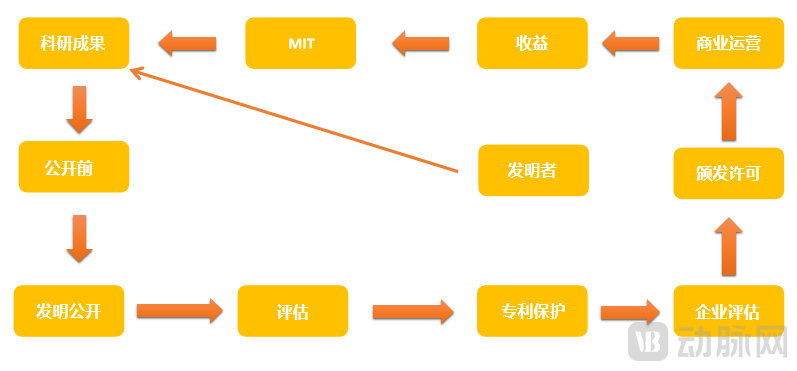
MIT Technology Licensing Office (MIT-TLO) Technology Transfer Process
Specifically, when MIT researchers or teams achieve results such as advanced technologies, equipment, or new materials during the R&D process, and deem the invention valuable or necessary for public technology transfer, they will engage with “Office of Technology LicensingEngage in early contact and enter the phase of exchange and discussion, during which both parties jointly identify potential issues related to subsequent disclosure, evaluation, and intellectual property protection of the invention, before proceeding to the formal technology transfer process.
It is worth noting that MIT’s technology transfer process is highly systematized,It is not a policy, but a comprehensive ecosystem.This process is divided into seven stages,Clear Disclosure, Technical Assessment, Patent Protection, Buyer Assessment, Technology Licensing, Technology Transfer, Revenue Distribution.The stages are closely interlinked, forming a relatively mature “incubator system.”
How Should We Understand the “Incubator System”? The “Incubator” Operated by the Massachusetts Institute of TechnologyEmphasizing the linkage between universities, enterprises, and society, and highlighting the translation and application of high-tech achievements,and to promote technology transfer and product commercialization between universities and industry.
“Led by the Massachusetts Institute of Technology (MIT),"M2D2 Incubator"as an example. This incubator is jointly operated by the University of Massachusetts Lowell and its medical school, primarily providing startups with professional services in engineering, business management, medical procedures, prototyping, and clinical trials.
Specifically,M2D2 IncubatorEstablished a diversified and comprehensive innovation service chain for startups.
On one hand, it provides hardware support, primarily referring to laboratories.It is reported that M2D2’s laboratory is equipped with key instruments supporting early-stage product development. More importantly, M2D2 conducts annual surveys among its resident companies to guide equipment upgrades and replacements based on startups’ needs for shared device types and resources. Statistics show that over the past year, M2D2 has invested more than $1 million in equipment and upgrades.
On the other hand, it provides market-oriented resources.It is reported that M2D2 annually organizes events to provide startups with exposure and access to funding channels, helping them secure rapid financing or connect with market resources. In addition, M2D2 analyzes these market resources based on the specific needs of startups and ultimately delivers precise matches. Notably, throughout this process, M2D2 does not hold any equity stakes in the startups, nor does it claim any intellectual property rights.
According to statistics, since its establishment in 2008, the M2D2 incubator has reviewed approximately 260 medical device and biotechnology startups in Massachusetts for inclusion in its incubation program, and has helped more than 80 startups advance the development of their medical device and biotechnology innovations. To date, among the companies participating in the M2D2 incubation program,Eighteen companies have successfully graduated after being acquired or expanding beyond the incubator’s scope.
Lessons from Abroad: How Can Chinese Universities “Ride the Wind” to Accelerate Technology Transfer?
Currently, universities across China are accelerating innovation and translation in the medical field.
Established in 2017 by the Beijing Tsinghua Industrial R&D Institute,Global Healthcare Innovation Center (GHIC)Officially established, it is primarilyComprehensive Incubation Services for Early- to Mid-Stage Medical Device Projects;In 2019, Peking University Health Science Center initiated and officially launched the Peking University Medical Technology Transfer and Innovation & Entrepreneurship Center (hereinafter referred to as the PKU Medical Innovation Center)., aiming to explore new areas, models, and mechanisms for the collaborative development of medical universities and various sectors of society, and to provide an incubation platform for the transformation of scientific and technological achievements in medical colleges and universities across China.
In addition, there areWestlake UniversityWestlake University, which was officially renamed in 2018, is a private, novel institution dedicated to cutting-edge research. Positioned with a “high starting point, small scale and refined focus, and research-oriented” approach, it deeply concentrates on 13 first-level disciplines, including biomedical engineering, aiming to accelerate the innovation and translation of frontier scientific and technological achievements through a more efficient and systematic model.
But this is only the “tip of the iceberg”; many more Chinese universities are currently still in the exploratory stage when it comes to medical innovation and translation.
According to the data from the "2020 China Patent Survey Report" issued by the China National Intellectual Property Administration, IThe patent conversion rate at Chinese universities stands at approximately 10.7%, a slight increase from 8.1% in the previous year; however, it remains at a relatively low level on a global scale.The proportions of the three major technology transfer methods were 4.4% for patent licensing, 3.6% for assignment, and 2.7% for equity contribution via technology. The commercialization rate at universities was only 3.0%, significantly lower than the 46.0% observed in enterprises.
This inevitably points to certain issues. So, what lessons can we learn from the “pioneer,” Massachusetts Institute of Technology, in translating medical research achievements into practical applications?
First, build regional innovation geographic clusters.The path of research commercialization at the Massachusetts Institute of Technology (MIT) demonstrates that high-tech enterprises spawned from university scientific research outcomes tend to cluster in proximity to their parent institutions. This agglomeration gradually fosters a geographic cluster that attracts venture capitalists, entrepreneurs, managers, and other supporting organizations, thereby serving as a foundational “magnet” for the regional innovation system.
Second, cultivate an experienced technology transfer team.Many universities in the United States have established Technology Transfer Offices, which are directly managed by the institutions to handle intellectual property matters. These offices serve as bridges and links between researchers and industry, responsible for the commercialization of scientific and technological achievements. The Technology Licensing Office has been the most significant driving force behind MIT’s success in transforming patented technologies from laboratories into large-scale scientific and technological outcomes.
Third, promote a three-pronged approach integrating industry, academia, and research.The Massachusetts Institute of Technology pioneered the university-led “university–government–industry” model. On one hand, MIT has established close interactive relationships by accepting funding from government and industry partners and entering into cooperative agreements with them. On the other hand, leveraging its own strengths, MIT cultivates talent for government and society, transfers scientific and technological achievements, supports local industrial upgrading, continuously spawns new companies and enterprises, and serves the local economy.
Under this model, MIT provides a diverse range of support mechanisms to assist students and faculty in their efforts to commercialize technologies, thereby achieving an optimal balance among scientific research, practical applications, teaching, and institutional revenue.
Fourth, establish a reasonable mechanism for the transfer and allocation.In the core area of benefit distribution for the commercialization of scientific research achievements, MIT’s distribution mechanism serves as a key driver promoting the translation of technological innovations. During the distribution process, the Technology Licensing Office retains a 15% commission, inventors receive one-third of the profits, and the remainder is shared among the respective departments and foundations. Notably, both inventors and MIT reinvest their respective shares back into medical innovation, thereby sustaining the vitality of translating scientific research outcomes.
For Chinese universities today, innovation and translation in the medical field are becoming new focal points. Therefore, during this initial or so-called reshaping phase, it is entirely normal to encounter challenges and experience slow progress; MIT faced similar circumstances in its early stages.
The translation of medical research achievements into clinical applications is inevitably a protracted process that requires time to mature. Therefore, for universities currently navigating this path, it is crucial to fully recognize the challenges inherent in the innovation and commercialization pipeline and address them gradually through internal capabilities or external support.