

Deepwise Medical Advances National Key R&D Initiatives with Dual Focus on Scientific Research and Industrialization

DeepWise
Developer of Artificial Intelligence Medical Imaging Diagnosis System
Recently, DeepWise disclosed information regarding the launch of three major special projects from the Ministry of Science and Technology that it participated in and had approved in 2021. This marks the largest number of Ministry of Science and Technology projects approved for DeepWise in recent years. Statistics show that the company has undertaken nearly 40 scientific research projects from the Ministry of Science and Technology, the National Natural Science Foundation of China, and various provincial and municipal levels across the country.
As a pioneer in the industrialization of medical AI, DeepWise currently holds five Class III medical device certificates issued by the National Medical Products Administration (NMPA), with its pneumonia AI product being among the first in China to receive such approval. In 2021, the company achieved remarkable explosive business growth, positioning itself at the forefront of the industry. That same year, it launched four new products, completed two rounds of financing, and integrated Yitu Healthcare into its operations, marking the largest merger and acquisition in the history of China’s medical imaging AI sector.
How Can Scientific Research Strength and Industrialization Capability Work in Tandem to Complement Each Other? DeepWise Has Delivered Its Answer to the Industry Through Its Own Practical Development.
Participated in key R&D projects of the Ministry of Science and Technology, keeping pace with the forefront of technological development
As the technological revolution and industrial transformation exhibit a trend of significantly shortened evolution cycles from “science to technology, and then to market,” with increasingly blurred boundaries between stages, participation in the National Key R&D Program is not only a litmus test for assessing a company’s innovation capabilities but also a valuable opportunity to accumulate cutting-edge knowledge and build up technological reserves.
DeepWise’s participation in the major special projects of the Ministry of Science and Technology includes two projects under the “Science and Technology Innovation 2030” Major Special Project and one project under the Major Special Project for Prevention and Control Research of Common and Frequently Occurring Diseases. The former comprises a batch of major initiatives deployed with a view to 2030, reflecting national strategic intentions; the latter aims to strengthen comprehensive prevention and control of common and frequently occurring diseases, promote early diagnosis and treatment as well as scientifically based prevention and control, and facilitate the transition from disease treatment to health management.
To date, DeepWise has led or participated in seven major special projects of the Ministry of Science and Technology. The deep integration of artificial intelligence technologies into these key national science and technology initiatives has revealed that AI’s development in healthcare scenarios is becoming increasingly profound, with its reach extending into more cutting-edge research domains.
It is no small feat for a company like DeepWise to have been selected multiple consecutive times to participate in the Ministry of Science and Technology’s major special projects.Professor Yu Yizhou, Chief Scientist at DeepWise, stated:“DeepWise has repeatedly participated in key technological breakthroughs under the Ministry of Science and Technology’s Major National Science and Technology Projects. This reflects, on one hand, the recognition by the Ministry of Science and Technology and other relevant departments of DeepWise’s technical strength and innovation capabilities. Such affirmation motivates DeepWise to collaborate with industry peers in tackling critical challenges associated with these major projects that embody national strategic priorities. On the other hand, participation in and undertaking of scientific research projects have strengthened DeepWise’s accumulation of knowledge and technological reserves. Upon completion of these research initiatives, certain accumulated technologies can be rapidly translated into practical applications, thereby contributing to national scientific and technological innovation and empowering the health industry through commercialized products.”
Corporate involvement in key projects creates a bidirectional flow of value. First, by leveraging the company’s industry-leading technical expertise, the project can ensure its smooth implementation to the greatest extent. Second, through deep engagement in the project, the company can better align its own R&D efforts with frontier research directions.
From the perspective of DeepWise’s own development, participating in key project initiatives serves to further build upon its existing technical capabilities, thereby playing a positive role in its product research and development. This is evident from DeepWise’s current industrial layout.
Deep Integration of Industry, Academia, and Research to Comprehensively Enhance Corporate Industrialization Capabilities
As a technology-driven company in the AI sector, DeepWise’s original R&D capabilities are widely recognized within the industry.Taking its participation in research projects at various levels as an example, DeepWise has, to date, been involved in 7 major special projects of the Ministry of Science and Technology, 9 projects funded by the National Natural Science Foundation of China (NSFC), and more than 30 provincial and municipal-level research initiatives. In 2021 alone, DeepWise collaborated with multiple renowned medical institutions in China to successfully secure approval for four NSFC projects through joint applications.
The seven major special projects of the Ministry of Science and Technology in which DeepWise has participated cover medical image processing, the construction and application of knowledge systems for healthcare big data, and related discussions on digital therapeutics. These research directions align perfectly with the current product development strategy of DeepWise. For example:
Research on Novel Artificial Intelligence Algorithms and Their Application in Precision Interventional Treatment Planning for Liver Cancer
In 2020, DeepWise collaborated with Harbin Medical University on the project “Research on Novel Artificial Intelligence Algorithms and Their Application in Precision Interventional Treatment Planning for Liver Cancer,” under the Ministry of Science and Technology’s National Key R&D Program for “Development of Digital Diagnostic and Therapeutic Equipment.” Interventional therapy is a critical component of liver cancer management across all stages. By leveraging artificial intelligence algorithms, this collaboration provides more comprehensive data support and preoperative planning for interventional procedures, thereby enabling more precise treatment strategies for patients. Participation in this initiative fully demonstrates DeepWise’s strength in the field of medical imaging.
Key Technologies and Applications of Human-Machine Integrated Medical Consultation
The 2021 newly approved major project under the “Science and Technology Innovation 2030—Next-Generation Artificial Intelligence” initiative, titled “Key Technologies and Applications of Human-Machine Integrated Medical Consultation,” is a key special project of the Ministry of Science and Technology conducted in collaboration between DeepWise and Professor Liu Ting from Harbin Institute of Technology. This project primarily conducts exploratory research on the generation of diagnostic and treatment decisions based on human-machine debate and negotiation in multi-party consultations.
By researching key technologies such as the extraction, generation, and classification of medical evidence, this work facilitates precise, interpretable diagnostic and therapeutic decision-making based on human-AI debate.Leveraging artificial intelligence to govern and apply medical big data, thereby providing physicians with more intelligent decision support, is also the core element of DeepWise’s current medical big data products.
“Major Special Projects on Brain Science and Brain-Inspired Research” and “Major Special Projects on Prevention and Treatment of Common and Frequently Occurring Diseases”
Digital therapeutics leverage digital means to transform existing medical principles, clinical guidelines, or standard treatment protocols into software-driven interventions. This innovative approach effectively enhances patient adherence and accessibility in chronic disease management, overcoming the limitations of traditional pharmacotherapy. DeepWise’s robust R&D capabilities provide solid technical support for research into such novel digital therapeutics.
In 2021, DeepWise was newly approved for two major projects under the “Science and Technology Innovation 2030” initiative: the “Brain Science and Brain-like Research” Major Project and the Major Project on Prevention and Treatment of Common and Frequently Occurring Diseases. These initiatives primarily focus on the pathogenesis of anxiety disorders, intervention technologies, and precision treatment of acute respiratory distress syndrome (ARDS). By leveraging artificial intelligence technologies and integrating various types of clinical multimodal data, DeepWise conducts scientific research on digital therapeutics, including differential diagnosis, intervention strategies, and refined treatment approaches for these conditions.
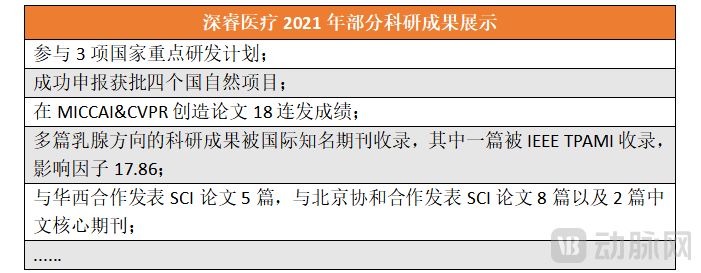
Overall, DeepWise has assembled a team of professionals specializing in artificial intelligence, internet cloud computing, medical imaging, and other fields. Its core R&D team comprises nearly 100 master’s and doctoral graduates as well as senior researchers from top domestic and international institutions, including Stanford University, Peking University, Tsinghua University, and the Chinese Academy of Sciences. The company has established the DeepWise Research Institute, which serves as its “intelligent brain” to drive scientific research and technological innovation.Meanwhile, DeepWiseCollaborates closely with research institutes and frontline medical institutions across China, yielding numerous achievements.
Source: DeepWise Official WeChat Account Information Collection
In late 2021, DeepWise held an online “AI-Led Smart Research Achievements Presentation,” centrally showcasing research outcome cases jointly completed with its partner institutions and users across more than 30 provinces and municipalities in China. The research areas covered the respiratory system, cardiovascular and cerebrovascular systems, and other malignant diseases.
However, innovative technologies are not elitist pursuits detached from reality; rather, as a strategic pillar for enhancing social productivity and comprehensive national strength, technological innovation serves as a vital instrument of national power. The Chinese government has successively introduced policies and guidelines to encourage innovation. According to the updated listing standards for the Science and Technology Innovation Board (STAR Market) released in April 2021 (Version 3 by the Shanghai Stock Exchange), independently leading or spearheading projects under the “National Major Science and Technology Special Projects” that are related to a company’s core business and key technologies constitutes a critical criterion under “Evaluation Standard II for Scientific and Technological Innovation Attributes.” This demonstrates that leading or undertaking major special projects designated by the Ministry of Science and Technology serves as a significant definition and endorsement of a company’s scientific and technological innovation credentials.
Every innovative technology must ultimately be implemented in industrial development and social life. This is also true in the field of medical AI, where only innovations that inject new momentum into industry development through the integration of medicine and engineering, as well as collaboration among industry, academia, and research, and ultimately empower clinical practice, are truly valuable and meaningful.
How to promote the integration of industry, academia, and research has become another important aspect of technological innovation.DeepWise and the Children's Hospital, Zhejiang University School of Medicine, Jointly Established a Clinical Data Research Paradigm:Addressing real-world clinical challenges, with multimodal data as the core driver, this approach integrates medical big data with clinical research to enhance scientific output while promoting clinical translation and enabling real-world validation of research findings.
The pediatric asthma intelligent auxiliary diagnosis project, launched through this collaboration, leverages AI technology to replicate physicians’ diagnostic capabilities, effectively alleviating the shortage of pediatricians and enhancing the hospital’s standardized diagnosis and treatment capacity. Through this hospital-enterprise partnership, both parties can fully leverage their comparative advantages to develop efficient, clinically oriented artificial intelligence solutions.
Most of the research achievements from DeepWise’s collaborations utilize clinical data as the primary subject of study, enabling rapid translation into clinical practice and the development of intelligent product solutions that enhance daily diagnostic and treatment efficiency as well as the management of complex and critical cases.
Guided by Clinical Prior Knowledge to Build a Closed-Loop Product Optimization System
A rich product portfolio has always been a hallmark advantage of DeepWise’s AI-assisted diagnostic system for smart medical imaging. DeepWise’s solutions are widely deployed across multiple disease areas, including respiratory, cardiovascular, neurological, and digestive systems, as well as in specialized fields such as women’s health and pediatrics.Such an extensive product portfolio is rare in China’s medical imaging AI sector.。
In 2021, DeepWise completed the acquisition of Yitu Healthcare. This transaction, the largest in the history of China’s AI medical imaging sector at the time, significantly elevated DeepWise’s overall product portfolio and brought about a major transformation in its business layout. By integrating Yitu Healthcare’s products and achievements in medical big data governance with DeepWise’s various business segments, and through the combined clinical application of medical imaging and medical big data, the construction of smart healthcare has been comprehensively accelerated.
Within the industry, DeepWise is renowned for the speed and breadth of its product development. What principles has it adhered to in building such a comprehensive AI-powered medical big data product portfolio covering medical imaging? How does it define and manage the lifecycle of this product portfolio?
“We have consistently adhered to guiding product development with clinical prior knowledge. This forms a closed loop and, more importantly, a steadily ascending pathway for product optimization.”Professor Yu Yizhou outlined DeepWise’s R&D roadmap.
Specifically, amid the growing trend of industry-academia-research collaboration, enterprises, medical institutions, and research organizations engage in multidisciplinary exchanges based on clinical pain points to jointly produce high-quality research outcomes. Meanwhile, cutting-edge scientific knowledge and technologies are rapidly applied to clinical practice and translated into products. In turn, clinical settings provide more extensive and valuable feedback to guide further scientific exploration and product optimization.
Since its establishment, DeepWise has obtained more than 700 patents and software copyrights, with the cumulative impact factor of all its published scientific research outputs approaching 1,000.It is evident that extensive technological innovation and exploration in the research domain have enabled DeepWise to build a diverse product portfolio, while also driving its explosive business growth.In 2021 alone, DeepWise launched multiple new products, including a one-stop solution for the nervous system, an intelligent medical teaching and research platform, and an intelligent education module, thereby enhancing its smart healthcare ecosystem.
In the same year, DeepWise’s AI-assisted diagnostic product for intracranial aneurysms was included in the public notice of the National Medical Products Administration’s Special Review Procedure for Innovative Medical Devices, becomingIts second product to enter the NMPA’s innovative approval pathwayPreviously, DeepWise's AI product for pulmonary nodules was the first medical imaging AI product in China to obtain an NMPA Class III certification through the innovative approval pathway.
The intracranial aneurysm product admitted through the innovation channel originates from the Key Program of the National Natural Science Foundation of China undertaken by DeepWise, titled “Construction of an Automated Detection Model for Intracranial Aneurysms Based on CTA and MRA.” The product’s related technologies and clinical application outcomes were published in Nature Communications in 2020, with an impact factor of 14.919, representing one of the few multi-center validated artificial intelligence studies on intracranial aneurysm detection worldwide.
For DeepWise, on the one hand, extensive knowledge and technologies from various disciplines, along with the outcomes of interdisciplinary exchanges through communication and collaboration with experts across fields, have played a highly positive role in optimizing and enriching its product portfolio. On the other hand, the widespread application of DeepWise’s products can provide more clinical evidence for scientific research.
Overall, DeepWise has established a comprehensive portfolio of medical AI products, encompassing intelligent imaging, intelligent services, intelligent research, intelligent cloud, intelligent education, and intelligent equipment. It provides end-to-end AI solutions spanning assisted diagnosis, intelligent screening, clinical decision support, patient services, medical big data governance, scientific research, physician training, and capacity building.
Final Thoughts:
“Practical Application for the Betterment of Society” is the ultimate ideal of most Chinese scholars, and it also represents the value that scientific research and technological innovation bring to industry and society.
Professor Yu Yizhou also shared his insights on the development of the medical AI industry: “The integration of artificial intelligence and healthcare has been underway for some time. During this process, we have found that the healthcare sector has its own unique characteristics and underlying principles. Merely applying AI technology is insufficient; what the industry needs is original R&D targeted at addressing the specific challenges and pain points within medical scenarios.”
DeepWise has centered its development on innovative artificial intelligence technologies, integrating clinical prior knowledge and maintaining synchronized advancements in scientific research and industrialization. By translating research into products and leveraging products to facilitate further research, the company has secured its leading position in technological innovation, scientific research capabilities, and business growth.