

China Renaissance Identifies Two Structural Shifts in Life Sciences, Unveiling Emerging Opportunities

China Renaissance
Financial Services Investment Institutions
Amid the turbulent and surging wave of venture capital and private equity in China over the past two decades, China Renaissance has undoubtedly stood out as a distinctive and pivotal player.
This is evident from China Renaissance’s achievements in the innovation economy and intelligence sectors: its clients include a host of leading innovative enterprises such as SenseTime, AInnovation, JAKA Robotics, NIO, POP MART, and Huitongda.
It is worth noting that in the private equity financing business, China Renaissance has ranked first in market share for 17 consecutive years, and through continuous development, it has become a financial services institution driven by the three wheels of “investment + investment banking + wealth management,” covering the entire value chain and spanning both the primary and secondary markets.
Founder Bao Fan once stated,China Renaissance focuses on long-term trends spanning ten, twenty, or even more years. “In investment, it is not necessary to pay excessive attention to the short-term fluctuations in asset prices; the key lies in whether there is potential for five- to tenfold growth over the next decade.”"Guided by this philosophy, China Renaissance has intensified its efforts in recent years to penetrate the vast blue ocean of healthcare, starting from the innovation economy."
A look at China Renaissance’s medical investment portfolio reveals a roster of leading enterprises, including WuXi AppTec, MGI Tech, MicroPort NeuroTech, Fapon Biotech, ClearMind Bio, and Jianhai Technology.On the other hand, China Renaissance has provided financing, M&A, and IPO services to nearly 140 healthcare companies, with cumulative transaction value exceeding $20 billion.
How did China Renaissance penetrate the healthcare industry? How does it view the current innovative changes in the medical and health sector? What new opportunities are emerging in the industry? Next, VCBeat provides an analysis through interviews and reviews.
Healthcare and wellness have become a sector of paramount importance to China Renaissance.
“Continuous innovations in the healthcare and life sciences sector have made it one of the most dynamic industries,” Dr. Luo Xi, Executive Director of the Healthcare Technology Group at Huaxing New Economy Fund, told VCBeat.Two major structural changes are currently emerging in the healthcare and wellness industry.
First, the digitalization and intelligent transformation of the entire healthcare industry are accelerating.Among the areas undergoing significant changes are clinical decision-making and the research and development of pharmaceuticals and medical devices. “We have all observed that data and algorithms are increasingly being used to assist physicians in clinical decision-making, thereby making patients’ diagnostic and treatment processes more precise and personalized, while substantially reducing the workload of physicians.”
Moreover, in the process of pharmaceutical product R&D, driven by new-generation AI solutions represented by AlphaFold, integrated with high-throughput automated experimental platforms, and supported by more structured pharmaceutical R&D data, the R&D decision-making process is becoming increasingly objective and efficient.
Second, the entire medical value chain is extending in both directions from treatment.The front end encompasses health management, disease prevention, and screening for the general public, while the back end covers patient rehabilitation and follow-up care. However, within the current healthcare value chain, the industry has devoted the vast majority of its efforts and resources to the treatment segment, focusing primarily on products for disease diagnosis and treatment, as well as corresponding medical resources.
“By examining the entire end-to-end healthcare process, we can observe thatCurrently, the industry fails to effectively manage both ends of the entire process. For instance, at the front end, there is still a lack of comprehensive and cost-effective solutions for health management of the general population, disease prevention, and early disease screening.; and after patients are discharged following treatment, they face similar challenges with a series of issues such as functional recovery and follow-up care,” said Luo Xi.
It is precisely based on the judgment of these two structural opportunities that China Renaissance invested in ColonTech Bio last year. The underlying logic is that ColonTech Bio is positioned within a major structural shift in the healthcare value chain: as society places increasing emphasis on cancer prevention and control, greater attention will be directed toward early screening and detection in future cancer diagnosis and treatment processes. This is because, in the comprehensive management of cancer, early-stage investment is more efficient than late-stage intervention. Health economics studies have shown that every $1 invested in prevention and screening can save up to $9 in subsequent treatment costs.
In terms of selecting specific investment targets, China Renaissance primarily focuses on three key indicators.
· First, whether the target company operates in a high-growth sector;
· Second, whether it aligns with national policies, is compatible with China’s healthcare system, and can genuinely conserve medical resources and enhance overall efficiency;
· Third, whether the company’s business model and the structure of its product commercialization team are mature.
Taking Conlming Biotech as an example, Luo Xi believes that high-quality early cancer screening products hold significant clinical value and social importance, representing a sector that has attracted widespread global attention and investment. Furthermore, policy support is bolstering the development of the early cancer screening industry. For instance, the State Council’s “Opinions on Implementing the Healthy China Action” stipulate that the overall five-year cancer survival rate should reach no less than 43.3% by 2022 and 46.6% by 2030.
In terms of business model construction, Kangliming Biotech has deeply cultivated hospital testing channels, establishing substantial barriers to entry within hospitals. With its existing early-stage colorectal cancer detection products and a robust pipeline of products under development, the company provides physicians and patients with comprehensive solutions for early tumor diagnosis, while also enabling more efficient utilization of China’s relatively scarce oncology diagnosis and treatment resources.
It is precisely for the aforementioned reasons that we began monitoring and engaging with Kangliming Bio in early 2019, and participated in its RMB 560 million Series D financing round in 2021.
“We have been closely monitoring Kangliming Biotech and the development of the early cancer screening industry. Once the business model proves viable, we will not miss the opportunity,” said Luo Xi.In terms of investment stage selection, China Renaissance prefers companies whose overall technical products have reached a relatively mature stage.“Our investment methodology is as follows: Through forward-looking, in-depth industry research, we identify emerging sectors with high growth potential and their leading enterprises at a relatively early stage. We engage with these companies to establish connections and maintain long-term tracking, although our actual investment transactions may occur at a later stage. This approach allows us ample time to thoroughly understand and evaluate both the target companies and the development of their respective sectors, enabling us to provide better industrial resource empowerment during critical phases of the companies’ growth.”
Notably, unlike other investment institutions, China Renaissance leverages its diversified business ecosystem to excel in providing full-lifecycle services spanning financing, investment, and IPO underwriting.
For instance, in 2020, MGI Tech secured over $1 billion in a major financing round, with China Renaissance New Economy Fund as one of the lead investors, and China Renaissance served as the exclusive financial advisor for this round.
Through the two-way synergy of its “investment + investment banking” businesses, China Renaissance is able to establish strong relationships with emerging medical innovators during their VC/PE stages, thereby capturing potential IPO underwriting opportunities. Furthermore, by integrating the entire value chain from financing to public listing, China Renaissance can provide long-term support and companionship to these enterprises as they grow.
Entrepreneurship in the field of medical innovation is often a perilous endeavor with a high risk of failure.
Among the many challenges plaguing innovative enterprises, financing has always been a formidable hurdle. In response, a large number of financial advisory (FA) firms have emerged, with their core role being to provide third-party professional services for corporate financing and mergers and acquisitions.After nearly two decades of evolution in healthcare venture capital investment, the healthcare sector now boasts a cohort of high-quality financial advisors (FAs), including China Renaissance.
“As the company’s financial advisor, China Renaissance is consistently involved in the entire operational lifecycle of a project, encompassing preliminary communications, mid-term services, and post-deal value creation,” Jiang Jiajia, Managing Director of the Healthcare and Life Sciences Division at China Renaissance, told VCBeat. “We deeply recognize that founders’ time represents their most significant cost. Therefore, before engaging with the capital markets, we conduct thorough discussions and brainstorming sessions with the founding team. We systematically analyze and explore multiple dimensions—including corporate philosophy, products, market dynamics, and business models—to identify the company’s technological barriers and key strengths, craft a compelling narrative, and communicate a differentiated positioning to the market, thereby selecting the most suitable investors and strategic partners for the company.”
As of now, China Renaissance has assisted nearly 140 pharmaceutical companies in completing M&A, financing, and IPO services, covering sub-sectors such as biopharmaceuticals, medical devices, genetic testing, smart healthcare, and medical services. Among these, successfully served companies include I-Mab Biopharma, XtalPi, Weigao Interventional, Aikobio, InnoCare Pharma, Jingyu Medical, Huayi Lejian, BeiGene, Dian Diagnostics, Medbanks Health, and JD Health.
For startups, in addition to needing empowerment from industrial development, there is also strong demand for various resources such as talent and distribution channels.“We aim to do more than just execute transactions; we seek to identify great companies within each niche sector and provide long-term companionship, advice, and services throughout their development journey. Beyond capital market operations such as financing, IPOs, and M&A, we actively engage in strategic planning and business development collaborations, helping companies establish their industry standing and build ecosystems,” said Jiang Jiajia, Managing Director of the Healthcare and Life Sciences Division at China Renaissance.
From a data perspective, as of now, the Healthcare and Life Sciences Division of China Renaissance has facilitated primary and secondary capital market services for more than ten companies and organized hundreds of in-depth exchange sessions, thereby building a bridge of communication between investment decision-makers and China’s leading medical innovation forces.
“Venture capital is gradually moving beyond the simple stage of value discovery and increasingly engaging directly in the process of value creation, thereby making a more direct contribution to innovation and upgrading,” said Wang Lixing, Co-Head of the Investment Banking Division at China Renaissance.
To ensure that long-accumulated information and experience are effectively integrated into daily operations, each industry group at China Renaissance has established its own data collection and classification mining system.
As of 2022, medical innovation enterprises are facing increasingly complex problems and more arduous challenges. In response, China Renaissance’s Healthcare and Life Sciences Division has offered six recommendations:
1: Return to rationality, prioritize the market, and consider long-term growth within the limits of market capacity, rather than focusing solely on sector hype;
2: Differentiated positioning to avoid involution and homogenization; ensure that differentiation is implemented in product design and clinical validation.
3: Product portfolio strategy should be end-goal oriented, aligning with clinical needs and commercial accessibility, while focusing on products with relative scarcity. For products in hot therapeutic areas, consider breakthroughs in business models or deploy low-cost products designed to compete effectively in centralized volume-based procurement.
4. Regarding financing, it is advisable to build up cash reserves to withstand economic downturns and volatility, while improving capital efficiency. Financing should be initiated proactively when the company still has ample liquidity, thereby allowing the enterprise to actively control its development pace. Additionally, optimization of the equity structure should be considered from the outset of the financing process, with predefined timing and contingency plans in place.
5. Team: At different stages, the team must maintain integrity and strong execution capabilities, break down and implement internal milestones, and complete the validation of concepts in the shortest possible time. Whether the outcome is correct or involves trial and error, the team should be able to move forward rapidly, fully leveraging the agility advantage of startups;
6: Finally, it is recommended that companies, regardless of their position in the competitive landscape, actively monitor competitors, keep abreast of industry developments from both business and capital perspectives, and respond in a timely manner.
The life sciences sector is entering a period of significant growth.
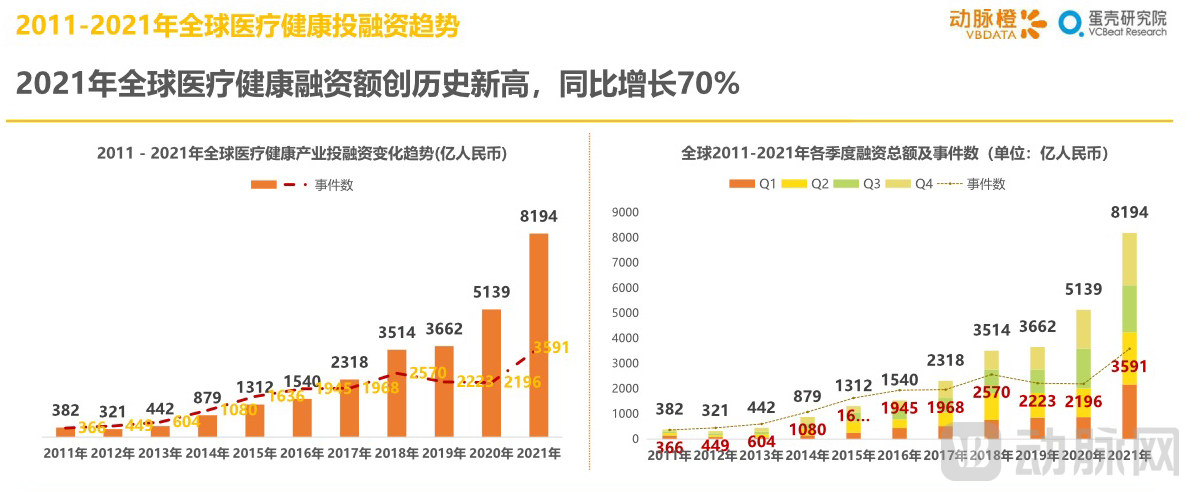
According to data from the VBInsight database, global healthcare financing reached a record high of $127.1 billion (approximately RMB 819.4 billion) in 2021, representing a year-on-year increase of 70%. The number of financing deals also rose by 3,052, a year-on-year increase of approximately 63%. Among these, there were 360 financing transactions exceeding $100 million, accounting for a significant 10% of the total.
Beyond the venture capital sector, biopharmaceuticals and general health have also become top priorities at the national level in China’s 14th Five-Year Plan. In the “14th Five-Year Plan for the Development of the Biopharmaceutical Industry” released last year, the state reaffirmed the strategic emerging industry status of the biopharmaceutical sector, explicitly calling for accelerated development of biopharmaceuticals and other related industries to strengthen and expand the bioeconomy.
Against this backdrop, China Renaissance remains bullish on the numerous development opportunities in the life sciences sector, andIn the remaining three quarters of 2022, we will make refined investments in each sub-sector, primarily focusing on four major sub-trends.
First, in the field of medicine and biotechnology, China Renaissance will place greater emphasis on disease treatment and clinical perspectives in the field of small and large molecule therapies, focusing on companies that can truly address unmet clinical needs; in cell and gene therapy, it will focus on next-generation technologies with practical implementation capabilities, particularly tools and platforms that reduce product costs and trial-and-error expenses; in the areas of next-generation therapies and delivery systems, it will prioritize source patent technologies, as well as the translatability and compatibility of delivery tools across different diseases; meanwhile, it will take a rational approach to AI-driven drug discovery and synthetic biology, leveraging them as efficiency-enhancing tools, selecting high-potential enterprises, and fostering industry collaborations for mutual development.
Second, in the field of medical devices, we will delve deeply into major therapeutic areas, particularly seeking new opportunities in the cardiovascular and orthopedic markets, to identify investment-worthy targets in niche segments such as heart failure, electrophysiology, and orthopedic materials; meanwhile, we are optimistic about companies positioned in high-potential sectors like ophthalmology and minimally invasive surgical devices.
Third, in terms of medical diagnosis, as many niche sectors began to experience “involution” in 2021, with intense homogeneous competition, Huaxing Capital will focus in the remaining three quarters of 2022 on sectors characterized by strong innovation capabilities, high technological barriers, and long-term, substantial growth potential, against the backdrop of post-pandemic and post-genomic industry development trends.
"We believe, the momentum for innovation in upstream life sciences equipment will continue, including single-cell and single-molecule technologies, as well as automation and high-end equipment driven by the demand for domestic substitution.“Given the significance of multi-omics technologies—including proteomics, metabolomics, single-cell analysis, and phenomics—to personalized precision diagnosis and treatment, coupled with supportive policies gradually opening up Laboratory Developed Tests (LDTs), China’s abundant large-scale clinical cohorts, and advanced capabilities in mining and analyzing multi-omics data, China is poised to produce global leaders in the multi-omics sector,” said Jiang Jiajia. “In managing diseases across their entire lifecycle, we will focus on industry disruptors that leverage integrated diagnostics to deliver high-quality testing, ensure product accessibility, and achieve successful commercialization. We believe there will be more cross-sector integration in the diagnostics industry this year, and we look forward to innovative transformations driven by digitalization and intelligence.”
Fourth, in the field of smart healthcareChina Renaissance will focus on areas related to digitalization and technology empowerment, particularly original Chinese innovations and foundational breakthroughs. It will also pay greater attention to projects in inclusive healthcare, aligned with the overall development trends of the medical system. In terms of key strategic directions, it will align with national policies to prioritize fields such as brain science, robotics, and AI-driven technologies, while seeking enterprises that have achieved breakthrough progress in critical upstream “bottleneck” segments.
Amidst the major wave of healthcare venture capital, Dr. Luo Xi, Executive Director of the Healthcare Technology Group at Huaxing New Economy Fund, stated that China Renaissance will continue to focus on companies driving source innovation in medical technology. Beyond providing capital, the firm will leverage its integrated “investment + investment banking” ecosystem to offer fresh perspectives to enterprises at various stages of development and deliver richer industry resources.