

Fangcun Doctor Files IPO Prospectus Amid the Pivotal Year for Digital Therapeutics
Over the past two years, the Digital Therapeutics (DTx) industry has witnessed a surge of dynamic growth.
According to Insight Partners, the global digital therapeutics market is projected to grow from $4.22 billion in 2021 to $18.06 billion by 2028, at a compound annual growth rate (CAGR) of 23.1%, indicating substantial market potential.
As a typical “cross-sector” industry, digital therapeutics has attracted a large number of companies from China’s gaming, software, and healthcare sectors to enter the market. Policy support is also gaining momentum: Hainan Province took the lead in including digital therapeutics in its provincial plan, marking the first time that digital therapeutics have received attention and promotion at the provincial level and accelerating their development. Digital therapeutics are transitioning from product innovation—where origins matter less—to the stages of business model construction and market validation.
However, ample historical evidence demonstrates that those who truly capitalize on emerging opportunities are typically early movers who profoundly grasp the essence of transformative changes. Fangcun Doctor, a dedicated provider in pediatric brain science services, entered the post-diagnosis management sector early on, establishing a specialized closed-loop service ecosystem encompassing follow-up consultations and rehabilitation training.
From the perspective of Fangcun Doctor, digital therapeutics are not merely a epoch-making innovation in software functionality, but rather represent an expansion and transformation of doctor-patient interactions and the role of healthcare service providers. These transformative elements will exert a more profound impact on the evolution of healthcare delivery models. The era of digital therapeutics has arrived, and Fangcun Doctor, guided by its own reflections, is moving toward its promised land.
ADHD, commonly known as "hyperactivity disorder," is one of the most common neurodevelopmental disorders in children.The overall prevalence of ADHD among children and adolescents in China is as high as 6%., patients may exhibit symptoms such as inattention, hyperactivity, and impulsivity. ADHD is typically diagnosed during childhood, and only 22% of patients achieve full remission by adulthood. The functional impairment caused by the disease can severely affect patients' lives, including their academic performance, family relationships, and peer relationships.
Regarding treatment, patients with ADHD can select and integrate pharmacotherapy, psychotherapy, and behavioral interventions based on their clinical condition and individual needs. However, pharmacological treatments are associated with varying degrees of adverse effects, often leading to trade-offs that limit parental acceptance.Parents have a stronger demand for non-pharmacological therapies (such as behavioral interventions and parent training), but they struggle to find high-quality solutions.Because non-pharmacological therapies are heavily reliant on manual labor, they face numerous challenges, including a scarcity of rehabilitation resources, disorganized intervention institutions, and the proliferation of so-called “miracle cures.”
The emergence of digital therapeutics has revealed opportunities to disrupt the ADHD market landscape and address unmet market needs.“With the exception of pharmaceuticals, ADHD interventions across various settings have the potential to be partially or even fully digitized, delivering care to patients in the form of digital therapeutics, improving the efficiency of rehabilitation, and cleansing the market,” said Chen Xiang, Founder and CEO of Fangcun Doctor.。
So, how large is this digitizable space exactly?
SEC filings submitted by Akili, a leading digital therapeutics company, reveal that 70 million ADHD medication prescriptions are issued annually in the United States, representing a $10 billion pharmaceutical treatment market. According to data from the U.S. Centers for Disease Control and Prevention (CDC), among children aged 4–17 with ADHD, approximately 40% receive medication-only treatment, 30% receive combined medication and behavioral therapy, 10% receive behavioral therapy alone, and the remainder receive nutritional supplementation or no treatment. Based on these figures, it is estimated that in the futureMarket Size of Non-Pharmacological Treatment Coverage in the United Statesup to $14 billion.
Compared to the more than 10 million ADHD patients in the United States, China has over 23 million children and adolescents with ADHD. The market holds substantial untapped potential, and digital therapeutics represent a timely entry point.Its robust capacity enables the integration of cutting-edge medical and digital technologies into high-demand clinical scenarios such as ADHD intervention, thereby unlocking and releasing greater medical value and driving expanded market growth.
The development of any emerging industry must overcome the hurdles of product R&D and commercialization, and digital therapeutics are no exception.
Although distinct from the preclinical development of innovative drugs, most current digital therapeutics are developed based on relatively mature technologies and medical principles. Their lower difficulty, risk, and investment requirements have resulted in a low barrier to entry into the digital therapeutics sector, leading to a market rife with assertions that “obtaining regulatory approval is merely a matter of time.”
Yet no company is unwilling to possess a moat. Currently, the moats for digital therapeutics are more likely deeply rooted in doctor-patient interactions within specialized disease areas and market advantages in healthcare services.In highly specialized fields such as medical specialties, vertical integration is more likely to concentrate resources and lead the sector.
Taking Fangcun Doctor as an example, the company incorporated ADHD into its post-diagnosis management business segment from its inception in 2015. In 2019, following a strategic upgrade, Fangcun Doctor chose to focus on the field of pediatric neurological and neurodevelopmental disorders, establishing a comprehensive, closed-loop service network comprising a “Physician Diagnosis and Treatment Center + Digital Disease Management Platform + Offline Xingsi Rehabilitation Training Center.”
In terms of channels, Fangcun Doctor leverages extensive high-quality resources of specialized physicians and maintains a stable patient flow through multiple offline patient training centers, adding over 4,000 new patients monthly. Currently, the company’s ADHD diagnosis and treatment service platform has connected with and served more than 500 tertiary hospitals across China and approximately 1,200 pediatric neuropsychiatrists, covering 70% of the ADHD patient population undergoing treatment.
These figures indicate that Fangcun Doctor has secured the majority of already scarce ADHD medical resources, amassed a large and precisely targeted patient population, and established a notable brand reputation. This serves as a significant impetus for its digital therapeutics clinical trials and real-world studies.
Furthermore, Fangcun Doctor’s R&D team boasts a strong interdisciplinary background, comprising product and gamified education planning experts from leading internet and gamification companies, as well as top-tier medical and medical-engineering specialists from Beijing Normal University and Peking University Sixth Hospital. Dr. Yue Xin, Head of Digital Therapeutics at Fangcun Doctor, is an expert in neurobiology and cognitive science. He formerly served as a management consultant at IQVIA and possesses extensive experience in digital marketing management.
Of course, product development and regulatory approval are merely the foundation of digital therapeutics. To realize their clinical value and align with their market potential, the key determinant lies in commercialization capabilities post-approval.
In recent years, innovation in China’s digital health sector has primarily remained on the periphery of healthcare, focusing on “connectivity” functions, with companies competing based on internet traffic-driven mindsets. Furthermore, although digital therapeutics in the United States have developed rapidly, with multiple companies going public in succession, the significant differences in healthcare environments and payment models have led to substantial disparities in the commercial logic of healthcare between China and the U.S.
Past thinking cannot be continued, and the American model cannot be copied; China’s digital therapeutics must forge its own path.
First, the payment issue that most troubles digital therapeutics companies is seen by Fangcun Doctor as a natural outcome. Compared with other diseases,Domestic parents in China demonstrate a relatively high willingness and ability to pay for their children's ADHD treatment, with levels comparable to those in the United States.
“At this stage, the focus is on validating whether the product’s medical value truly aligns with patients’ needs. Once this prerequisite is met, reimbursement will follow naturally. Furthermore, digital therapeutics hold significant potential for broad accessibility. If they can be integrated into commercial health insurance and national basic medical insurance in the future, the sector is highly likely to experience explosive growth, propelling us onto a new growth curve,” said Chen Xiang.
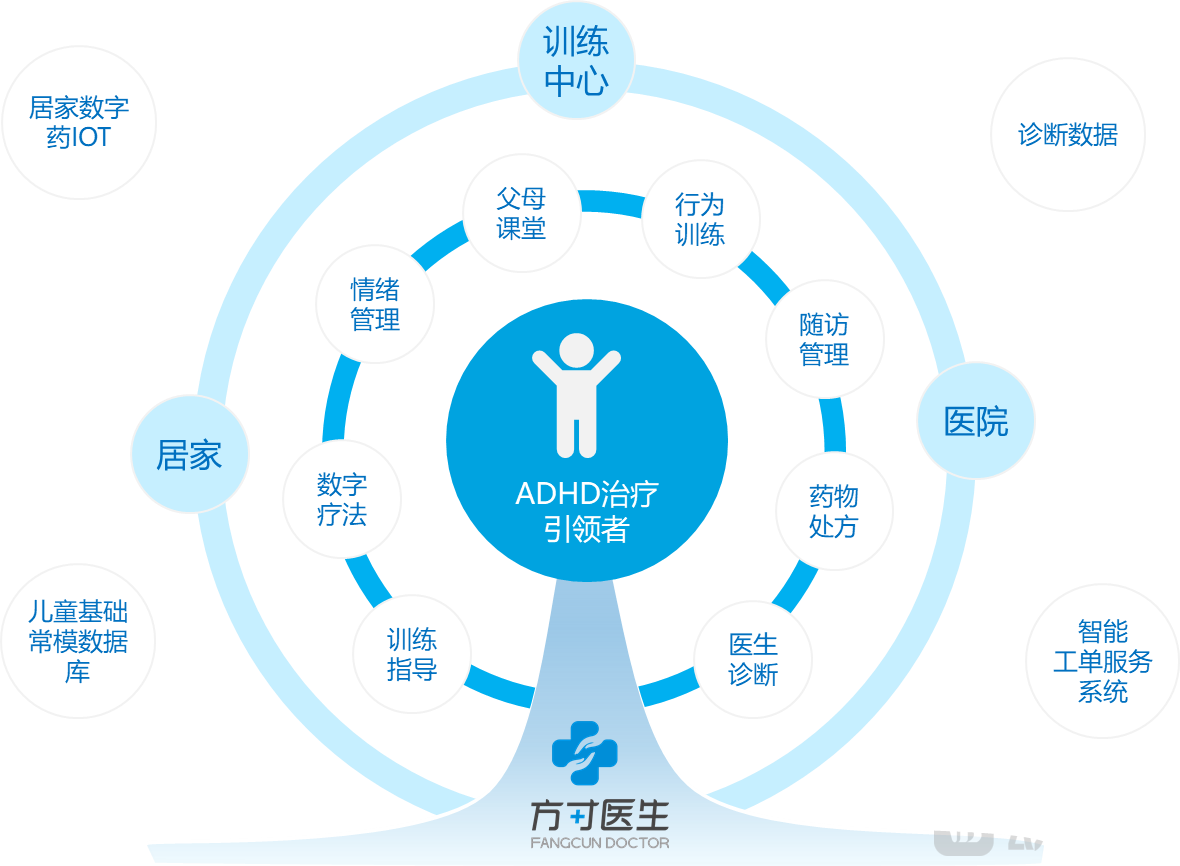
Meanwhile, Fangcun Doctor offers not just individual digital therapeutics products, but comprehensive combinations of various digital therapeutics solutions, with digital therapeutics serving as a key link in its commercial closed-loop ecosystem.
Over the years, Fangcun Doctor has established a complete closed-loop system for brain diagnosis, treatment, and rehabilitation, offering end-to-end, full-cycle services. The deep integration of its consultation, prescription, behavioral training, and post-diagnosis patient management channels enables additional patient needs arising during the use of digital therapeutics products to be seamlessly directed back to Fangcun Doctor’s existing business lines, thereby maximizing patient benefits.
Returning to the digital therapeutics product itself, its core lies in supporting the brain’s self-repair and accelerating the formation of neural feedback through efficient, personalized training. This technology integrates big data, micro-sensors, and artificial intelligence to provide pediatric patients with personalized treatment that is easy to adhere to.
In June 2020, EndeavorRx (AKL-T01), a digital therapeutic product from Akili Interactive Labs, received FDA approval. It is the first FDA-approved video game-based digital treatment for ADHD. Its efficacy has been robustly validated by evidence-based medicine, and its safety and adherence profiles far surpass those of comparable pharmaceuticals.
Fangcun Doctor was also inspired by this, endowing ADHD digital therapeutics with gamified and personalized intervention formats.

Interface of Fangcun Doctor’s Digital Therapeutics Product (Image provided by the company)
Regarding Efficacy Assurance, Chen Xiang Shared Fangcun Doctor’s Insights with VCBeat: “In addition to rigorous clinical validation, it is essential to ensure adherence from both parents and children. Children’s adherence can be enhanced through continuous product design iterations informed by observations of their training performance, thereby helping them persist with the regimen. Parents’ adherence, on the other hand, hinges primarily on their trust in the brand; this requires alleviating parental concerns through expert endorsements and tangible demonstrations of efficacy, ultimately leading them to choose Fangcun.”
Fangcun Doctor has established in-depth collaborations with leading medical institutions in China, including Beijing Anding Hospital, Peking Union Medical College Hospital, Peking University Sixth Hospital, and West China Hospital of Sichuan University.Currently, Fangcun Doctor’s digital therapeutics products have entered the phase of multi-center clinical trials across China and are expected to obtain Class II medical device certification from the NMPA within the year.Meanwhile, Fangcun Doctor is launching a new round of financing to support the research and development and clinical advancement of its multi-scenario digital therapeutic product pipeline for ADHD.
Fangcun Doctor has integrated multi-disciplinary professional services, including pediatric neuropsychiatrists with strong subspecialty expertise, brain training occupational therapists, psychological counselors, parent trainers, and physicians. By consolidating fragmented specialist resources required for diagnosis and treatment, it enhances the efficiency of medical services and ensures treatment quality. Its multiple offline brain rehabilitation training centers have established an online-offline data and treatment closed loop in cities across China, including Wenzhou, Qingdao, and Chengdu.
Over the next three years, Fangcun Doctor will continue to focus on the field of ADHD, combining digital therapeutics with online and offline services to deeply specialize in this vertical condition, aiming to become a leading force in non-pharmacological therapies for ADHD.
“By elevating medical innovation to a strategic priority, the state is driving structural changes in the healthcare landscape. In fields such as attention-deficit/hyperactivity disorder (ADHD)—a neurodevelopmental and psychiatric condition that remains highly labor-intensive—each advance in digitalization requires the integration of cutting-edge achievements in technology and algorithms, steering diagnosis and treatment toward standardized, intelligent, and efficient innovation,” said Chen Xiang.
Fangcun Doctor believes that the digital therapeutics industry is currently in the stage of engineering construction, integrating existing neuroscience, information science, and computational science technologies into the digital therapeutics platform, and then fully releasing them to the medical market to realize their value. The future development trend will be based on the full utilization of real-world data generated by digital therapeutics to influence basic science and promote changes in underlying technical theories, which is a slow but highly revolutionary process.
In summary, from a medical perspective, digital therapeutics hold promise for advancing disease diagnosis and treatment as well as foundational scientific research; in the marketplace, the allure of this trend lies in its potential to fundamentally reshape the landscape of commercial competition. The rise of digital therapeutics has already attracted diverse enterprises to enter and strategically position themselves in this space, perhaps reflecting the human tendency to follow the tide and rush toward emerging opportunities.
But we believe that true gold emerges only after the sands have been washed away by the great waves.
References:
1. Wang T, et al. BMC Psychiatry. 2017 Jan 19;17(1):32.
2. Zheng Yi, Liu Jing, eds. Guidelines for the Prevention and Treatment of Attention-Deficit/Hyperactivity Disorder in China (2nd ed.). Chinese Medical Multimedia Press; 2015.
3. Jin Xingming. Journal of Educational Biology. 2015; 3(1):1-3.
4. Lu Lin, ed. Shen Yucun Psychiatry (6th ed.). Beijing: People's Medical Publishing House; 2018.
5. https://www.cdc.gov/media/releases/2015/p0401-ADHD.html
6. https://www.sec.gov/ix?doc=/Archives/edgar/data/0001850266/000119312522040917/d285722ds4.htm#rom285722_30
7. “White Paper on China’s Digital Therapeutics Industry”