

2022 Assisted Reproductive Technology Industry Report: Domestic Brands Like MGI Gain Momentum as Import Monopoly Ends

MGI
Gene Sequencing Instruments and Related Reagent & Consumables R&D Manufacturer
2021 was a year when assisted reproductive technology was “favored” by policy.
The “Guiding Principles for the Planning of Human Assisted Reproductive Technology Applications (2021 Edition),” issued in January 2021, moderately relaxed the access requirements for third-generation in vitro fertilization (IVF) technology and actively encouraged more assisted reproductive technology (ART) institutions to enhance their service capabilities to support eugenics and healthy childbirth. In response to the birth rate falling below 1% for the first time in 2020 (8.52‰), the Chinese government introduced the “Three-Child Policy” along with supporting measures in July 2021 to promote population growth and optimize demographic structure. The policy explicitly emphasized the establishment of a reasonably structured ART service system to improve outcomes in eugenics and healthy childbirth. In August 2021, the National Healthcare Security Administration included a range of ART-related medications in the medical insurance reimbursement catalog, thereby opening the door to insurance coverage for assisted reproductive services.
The successive promulgation of the aforementioned policies has repeatedly thrust assisted reproductive technology into the spotlight, driving sustained growth in industry interest.
VCBeat, through its in-depth understanding of policies and multi-dimensional analysis of industry data, conducted research on one scientific research institute, eight innovative enterprises, and two investment institutions, and interviewed eight experts, company founders, and investors to produce the “2022 Assisted Reproductive Technology Industry Research Report” (hereinafter referred to as the “Report”).
Report estimates indicate that policy dividends will build an assisted reproductive technology (ART) market nearing RMB 800 billion. Driven by both demand and policy, ART has entered a period of rapid growth, with approvals for upstream medical devices reaching a milestone peak in 2021, accelerating the process of domestic substitution.
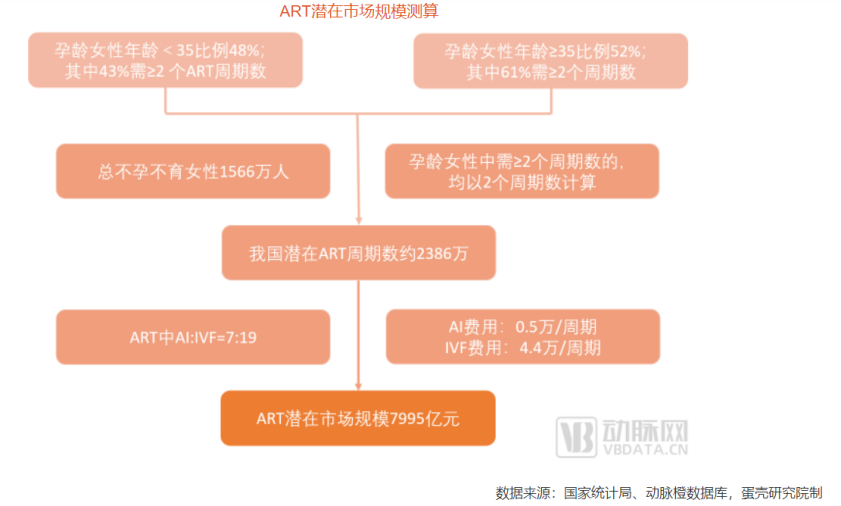
Although the potential market size for assisted reproduction in China is comparable to the combined markets of Europe and the United States, the late start of assisted reproductive technology (ART) has resulted in a significant reliance on imported upstream medical devices.The breakthrough point for domestic brands lies in quality and technological innovation. However, product approval is merely the first step toward implementation. To gain market recognition and achieve genuine localization-based substitution, Chinese manufacturers of assisted reproductive technology devices must follow a three-step strategy.
Three Steps from Certification to Implementation: Technology Follow-up, Product Innovation, and Domestic Substitution.In the past, medical device registration for assisted reproductive technology (ART) in China almost universally required clinical trials, resulting in high time and financial costs as well as significant difficulties. Consequently, certain technologies and products in the ART sector in China remained at the previous generation level, either because they were still in use or because medical professionals were accustomed to them. Most of these devices were imported ART medical devices, leading to a clear monopoly. By the end of 2019, the National Medical Products Administration (NMPA) of China exempted most ART devices from mandatory clinical trials for registration. This measure accelerated the approval process for domestically produced ART medical devices. For instance, in the upstream equipment for third-generation IVF, specifically preimplantation genetic testing (PGT), MGI has successively launched the MGISEQ-200, MGISEQ-2000, and DNBSEQ-T7 gene sequencers, which possess fully independent intellectual property rights and reach internationally advanced standards. Domestic brands are gradually gaining favor in the domestic market, ending the monopoly held by imported brands. Currently, multiple MGI gene sequencers have been approved by the NMPA for market release and have been purchased by several domestic PGT service providers, who are integrating them into the development of related service products. In the current market, there are also some rebranded domestic gene sequencers produced under OEM licensing, production guidance, and registration support provided by MGI, which are further supporting the development and improvement of China’s assisted reproduction industry.
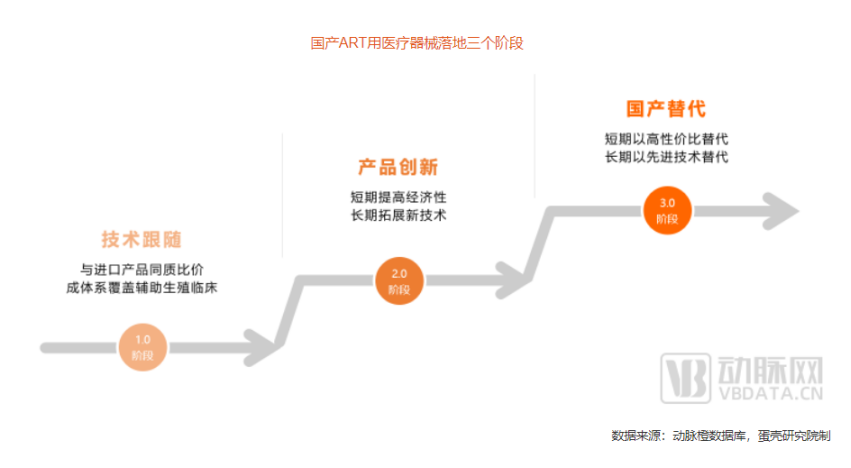
(1) Technology Following Stage:Currently, the commercialization of domestically produced ART devices is still in its early stages. The primary characteristic of this technology-following phase is aligning with the pace of major international manufacturers and benchmarking against overseas quality standards.
(2) Product Innovation Stage:Domestic New Technologies Have Already Emerged. In the upstream sector of assisted reproduction, domestic gene sequencer manufacturers, represented by MGI, are actively developing innovative technologies. For instance, MGI’s innovatively developed DNBSEQ rolling circle linear amplification technology ensures that the RCA polymerase, with its strand displacement function, consistently performs hundreds of copies based on the original template during rolling circle replication. Compared to traditional PCR amplification, DNBSEQ avoids the exponential amplification of errors, thereby ensuring sequencing accuracy. Furthermore, the duplicate sequence rate in sequencing data from the DNBSEQ platform remains consistently lower than that of other platforms, indicating higher data utilization efficiency.
(3) Domestic Substitution Phase:During the policy-driven window exempting clinical trials, domestically produced medical devices for assisted reproductive technology (ART) will rapidly complete their product pipelines and achieve full coverage of all ART clinical applications. Driven by favorable promotion strategies and the trend toward domestic substitution, Chinese-made ART medical devices with equivalent technical capabilities will capture an increasing market share due to their absolute cost-performance advantage. In recent years, constrained by the continuously rising costs of foreign sequencing reagents, domestic PGT testing service providers have begun seeking localized alternatives. However, there are currently few upstream manufacturers in China capable of providing stable sequencing technology platforms. Leading enterprises, such as MGI, have independently developed high-, medium-, and low-throughput gene sequencers and配套 reagents, enabling reasonable cost control and a multi-platform strategic layout.
Notice on the Broad Exemption of Clinical Trials for ART-Related Medical Devices Provides a Milestone Boost to Certification of Domestically Produced Medical Devices. Although China’s assisted reproductive technology (ART) device sector remains in an early stage of technological follow-up, Chinese enterprises, supported by policies such as clinical trial exemptions and preferential measures for domestically produced products, will gradually narrow the technological gap with overseas benchmarks and reclaim the domestic market for ART medical device companies.
MGI, dedicated to becoming a creator of core tools for life sciences, is the only company in China and one of only three globally capable of mass-producing clinical-grade high-throughput sequencers. Leveraging years of industry expertise and technological accumulation, MGI has fully demonstrated the robust technological prowess of “Intelligent Manufacturing in China” in the upstream instrumentation sector for assisted reproduction. Beyond the aforementioned achievements, MGI’s comprehensive suite of independently developed core life science equipment meets the diverse application needs in the field of assisted reproduction, driving the domestic substitution and closing the loop of the assisted reproduction industry chain.
Upstream Gene Sequencer Supplier for Assisted Reproduction, Covering Life Digitalization Equipment and Systems.MGI, established in 2016, is a Chinese supplier of next-generation sequencing instruments for preimplantation genetic testing (PGT) used in third-generation in vitro fertilization (IVF). Upholding the philosophy of “Innovative Intelligent Manufacturing Leading Life Sciences,” the company is committed to the independent R&D, manufacturing, and sales of instruments, equipment, reagents, and consumables in the fields of life sciences and biotechnology. By achieving breakthroughs in several cutting-edge core technologies, including gene sequencing, MGI contributes to the self-sufficiency and controllability of domestic gene sequencing industrial chains encompassing equipment, instruments, and reagents.
Multiple independently developed and controllable gene sequencers to meet the diverse testing needs of preimplantation genetic testing (PGT) in assisted reproduction.Currently, MGI has launched multiple independently controlled, domestically produced gene sequencers, such as the MGISEQ-200, MGISEQ-2000, and DNBSEQ-T7. These instruments have obtained various certifications, including China NMPA, EU CE, and North American c-TUV-us, facilitating assisted reproductive technology companies in compliantly implementing hospital-based localized solutions and deploying overseas operations.
Among them, the MGISEQ-200 is a compact and flexible desktop gene sequencer. Based on the innovative DNBSEQ rolling circle linear amplification technology, it avoids the exponential amplification of PCR errors, ensures high accuracy, reduces the duplicate rate of sequencing data, effectively controls sequencing costs, and enhances service accessibility and compliance. The MGISEQ-200 supports four read lengths: SE50, SE100, PE100, and PE150, and is compatible with both high- and low-throughput flow cells. This versatility meets the diverse testing requirements for preimplantation genetic testing (PGT) in assisted reproduction, as well as the time and throughput demands of various application scenarios.
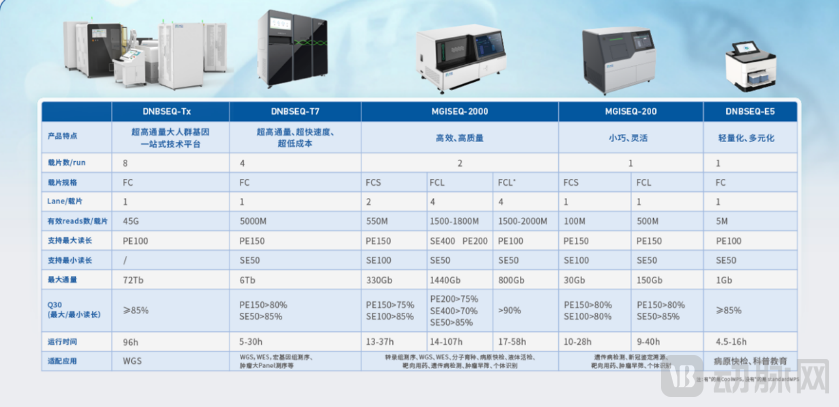
Figure: Inventory of MGI Gene Sequencers
Powered by Automated Sample Preparation Systems to Achieve Stable and Efficient Third-Generation IVF Testing.MGI’s independently developed MGISP-100 is an automated sample preparation system dedicated to high-throughput sequencing. It can replace manual operations in library construction, offering speed, stability, and efficiency. With its integrated design, the MGISP-100 enables automated processing of 16 samples at once, providing a one-stop solution for complex library preparation steps.
Furthermore, MGI offers high-throughput sample processing systems such as the MGISP-960 and MGISP-Smart 8. These systems are compatible not only with the DNBSEQ sequencing platform but also with Illumina and Thermo Fisher Scientific gene sequencers, and they support high-throughput sequencing sample preparation kits from multiple third-party brands, thereby providing automated solutions for the stable and efficient operation of PGT.
In March 2021, MGI and Beikang Medical entered into a strategic R&D collaboration on sequencers to develop next-generation automated laboratory platforms tailored for the field of assisted reproduction, thereby further enhancing automated testing capabilities in this domain.
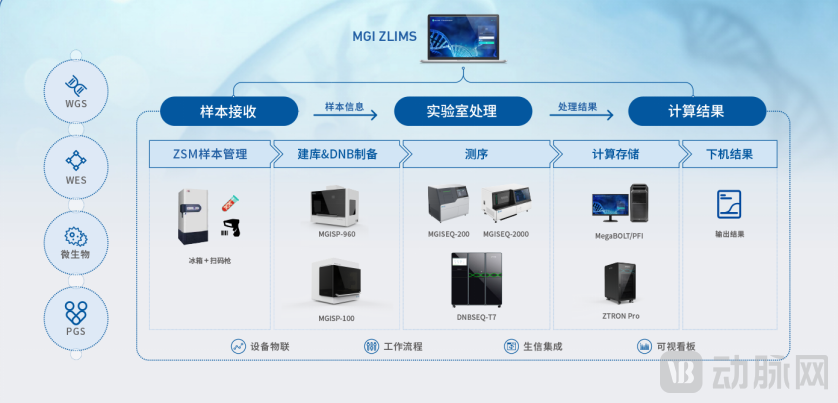
Figure: MGI’s One-Stop Portfolio of High-Throughput Sequencing Products
From Detection to Storage: A One-Stop Product Portfolio Creates a Closed-Loop Industry Chain.To address the storage demands of massive sample volumes and challenges in ensuring sample quality, MGI has developed the MGICLab-LT series of ultra-low temperature automated sample repositories. Featuring a dual-temperature zone design (a -80°C storage zone and a variable-temperature buffer zone at -20°C/-40°C), the system ensures safe sample storage while enabling precise, automated access to save time and labor. Integrated with a sample repository management system, it facilitates full lifecycle management of samples and offers customized capacity options ranging from 500,000 to several million samples.
MGI has meticulously developed a one-stop “testing + storage” automated product portfolio for PGT. Centered on the compact and flexible desktop genomic sequencing platform MGISEQ-200, this portfolio integrates the MGICLab-LT ultra-low temperature automated biobank series, the MGISP-100 automated sample preparation system, the Single Cell CNV data analysis and report interpretation system, the ZSM biobank management system, and the ZLIMS information management platform specifically designed for sequencing workflows. Together, these components form an automated solution covering the entire process from embryo cell testing to storage, empowering partners to establish localized PGT testing platforms.