

Why Are Blood Products Giants Committed to Innovation Despite Supply Shortages and Unusual Price Increases in Volume-Based Procurement?
Anxiety over potential inclusion in centralized procurement has caused the blood products industry, long sheltered from competition, to experience market capitalization fluctuations that now appear unnecessary.
At the beginning of the year, the Guangdong Provincial Drug Exchange Center released the “Guangdong Alliance Centralized Volume-Based Procurement Document for Drugs Including Diclofenac,” marking the first inclusion of blood products in the scope of volume-based procurement. The procurement covered five varieties: intravenous human immunoglobulin (pH 4), human immunoglobulin, human coagulation factor VIII, human fibrinogen, and human serum albumin. Following the announcement, the share prices of major domestic blood product manufacturers, including Hualan Biological Engineering Inc., Beijing Tiantan Biological Products Corporation Limited, and Boya Bio-pharmaceutical Group Co., Ltd., fell sharply.
Yet it is precisely volume-based procurement that makes this industry, which has long suffered from supply shortages, appear quite distinctive.
Due to the scarcity of raw materials and the difficulty in replicating the “volume-for-price” logic of generic drugs, blood products have been categorized separately in centralized procurement. Enterprises can secure their entire forecasted and allocated volumes simply by quoting either the current lowest market price or the maximum ceiling price. In other words, the centralized procurement of blood products does not involve intense competitive bidding. As a result, the price reductions driven by centralized procurement are not significant; indeed, based on the published quotes, the ceiling prices for certain products are even higher than previous tender prices. For instance, the maximum effective declaration price for the commonly used 2.5g specification of intravenous immunoglobulin (IVIG) is RMB 917.5, representing a 53% “price increase” compared to the previous average price of RMB 600. This makes blood products a highly unique category in the practice of centralized procurement.
So, what opportunities lie within this “distorted” industry where product pricing has increased rather than decreased during centralized procurement?
First, let’s gain an understanding of blood products.
In addition to the five categories mentioned in the Guangdong Alliance centralized procurement, blood products include dozens of other types, such as human tetanus immunoglobulin, human rabies immunoglobulin, human hepatitis B immunoglobulin, lyophilized intravenous human hepatitis B immunoglobulin (pH 4), human histamine immunoglobulin, and human prothrombin complex. In short, blood products are biologically active preparations derived from healthy human plasma and manufactured using biological processes or separation and purification technologies. They play a crucial role in emergency medical care and in the prevention and treatment of certain specific diseases.
Among these, the most common blood product is human serum albumin, which is isolated and purified from the plasma of healthy donors using the cold ethanol fractionation method. After heat treatment for viral inactivation, it is approved for clinical use and is widely employed in the management of hemorrhage, edema, severe liver disease, and hemodialysis. For instance, according to the Rapid Recommendation Guidelines on the Use of Human Serum Albumin in the Treatment of Liver Cirrhosis, the use of human serum albumin is recommended when a patient’s plasma albumin concentration reaches a certain threshold or when specific functional impairments or pathophysiological abnormalities are present. Furthermore, the Expert Consensus on the Prevention and Management of Hypotension During Hemodialysis, developed in March 2022 by the expert group of the Nephrology and Blood Purification Professional Committee of the China Medical Education Association, recommends intravenous infusion of human serum albumin for hemodialysis patients who experience hypotension.
Intravenous human immunoglobulin (pH4), used in the treatment of patients with severe COVID-19 infection, is also isolated and purified through low-temperature ethanol protein fractionation. It is an indispensable biological product in the treatment of severe infections, neonatal sepsis, Kawasaki disease, and other conditions. Notably, the Trial Ninth Edition of the Diagnosis and Treatment Protocol for Novel Coronavirus Pneumonia, released by the National Health Commission, mentions that intravenous COVID-19 human immunoglobulin may be used in patients who are in the early stage of the disease course, have high-risk factors, exhibit high viral loads, or experience rapid disease progression.
Originating from the blood products industry during World War II, the sector has evolved over nearly a century into an oligopolistic market highly dominated by global giants. According to data from the International Plasma Protein Therapeutics Association (IPTA), the seven largest manufacturers worldwide—including Spain’s Grifols, the US-based Baxalta, and Australia’s CSL—account for 78.84% of global blood product revenues. Although China maintains strict regulatory oversight on the importation of blood products, these overseas giants still capture the majority of the market in permitted segments. For instance, more than half of the albumin products used in China rely on imports.
The production of blood products requires the collection of human plasma. In China, institutions authorized to collect human blood fall into two categories: the blood station system and plasmapheresis plasma stations. Blood collected by the blood station system undergoes basic processing and is directly supplied to medical institutions. In contrast, plasmapheresis plasma stations collect only plasma from blood while returning the blood cells to the donor. The collected plasma is supplied exclusively to specific blood product manufacturers, where various types of blood products are produced and subsequently distributed to medical institutions, pharmacies, and other end users.
For a long time, China’s blood products market has been characterized by supply falling short of demand. Data show that the domestic supply of intravenous human immunoglobulin meets only about 30% of clinical demand, while coagulation factor products remain in short supply. According to Beijing Tiantan Biological Products Corporation Limited’s 2021 annual report, the company produced 11.9539 million bottles and sold 12.4749 million bottles of blood products in 2021, representing year-on-year increases of 8.5% and 14.16%, respectively. This directly led to a 23.62% reduction in inventory; in other words, virtually all blood products produced were sold.
Currently, upstream source plasma collection stations within China’s blood products industry chain operate as subsidiaries or branches of midstream blood products manufacturers. The comprehensive competitive strength of these manufacturers is largely determined by the number and operational efficiency of their affiliated plasma collection stations. For instance, Beijing Tiantan Biological Products Corporation Limited operates 55 active plasma collection stations, collecting nearly 2,000 tons of plasma annually, thereby securing its leading position in the domestic blood products market. Similarly, for leading blood products companies such as Hualan Biological Engineering and Boya Bio-pharmaceutical Group, the number of plasma collection stations and plasma collection volumes are highly positively correlated with revenue levels. Establishing new plasma collection stations is a key annual priority for blood products manufacturers. For example, Boya Bio-pharmaceutical Group brought one new plasma collection station into operation in 2021, which drove its annual blood products revenue from over RMB 900 million to more than RMB 1.2 billion, representing a 24.1% increase.
Next, we analyze the underlying logic behind the long-term supply shortage of blood products.
The primary challenge is the persistent shortage of raw materials. As previously mentioned, blood products require human plasma as the raw material. In China, source plasma can only be collected through plasmapheresis, a process that uses physical methods to separate plasma from cellular components in whole blood and returns all components except plasma to the donor. The strategic importance of plasmapheresis centers for the business expansion of blood product companies is self-evident. Indeed, the growth trajectories of international giants such as Grifols and Baxalta are replete with instances of acquiring competitors to secure operating rights to plasma collection centers. For example, CSL seized the opportunity during a downturn in the global blood products cycle to acquire rivals, purchasing ZLB and 47 plasma centers in the United States in 2000, and merging with Aventis Behring in 2004 to bring its plasma centers under its umbrella, thereby extending its business footprint beyond Australia.
In China, regulatory rules governing the construction and operation of plasmapheresis stations are stricter than those abroad. A series of policies issued since 1993 have ultimately standardized the blood products supply into a closed-loop business with extremely high entry barriers, making it nearly impossible for new entrants to join the market. Meanwhile, industry giants find it difficult to break through business boundaries except through mergers and acquisitions with peers.
In 1993, the Ministry of Health issued the Administrative Measures for Blood Collection and Supply Institutions and Blood, which for the first time clearly distinguished between plasmapheresis stations, blood stations, and blood banks. It defined plasmapheresis stations as blood collection and supply institutions responsible for collecting source plasma used in the production of blood products and supplying such plasma to blood product manufacturers, thereby differentiating ordinary blood centers and blood stations from commercial plasmapheresis stations operated for the purpose of producing blood products. According to the Regulations on the Administration of Blood Products promulgated by the State Council three years later, plasmapheresis stations were to be established either by blood product manufacturers or by the health administrative departments of county-level people’s governments. During this period, there were no clear regulatory rules governing the construction and operation of plasmapheresis stations, leading to significant disorder in plasma collection, trading, and the management of plasma donors.
Consequently, in 1998, the state implemented a Good Manufacturing Practice (GMP) certification management system for the blood products industry, mandating that only GMP-certified enterprises could produce and distribute blood products. In May 2001, the General Office of the State Council issued the "Notice on Printing and Distributing the China Action Plan for Containing and Preventing HIV/AIDS (2001–2005)," which stipulated the implementation of aggregate control over the number of blood product manufacturers, strengthened regulatory oversight, and ceased approval of new blood product manufacturing enterprises. By 2006, with the release of the "Work Plan for the Restructuring of Plasmapheresis Stations," plasmapheresis stations were formally integrated as raw material collection units for blood product manufacturers. To date, there are 28 blood product enterprises in normal production in China. Although blood product companies may establish new plasmapheresis stations based on operational needs, the network extending to the source plasma supply remains underdeveloped due to the substantial investments required in human resources, capital, and materials.
Secondly, the state imposes stringent supervision on the operation of plasmapheresis stations. In addition to restricting factors such as the age range and donation frequency of plasma donors, countries around the world have established strict regulations for the collection and preparation of such blood products to minimize the risk of disease transmission during medical use; China is no exception. Prior to plasma collection, donors must undergo rigorous physical examinations to ensure they do not carry any detectable pathogens, thereby maximizing the safety of the blood itself. These examinations include physical check-ups and blood tests (covering infectious diseases such as hepatitis B, hepatitis C, HIV antibodies, and syphilis), as well as assessments for conditions that prohibit donation (e.g., high-risk groups susceptible to HIV infection, drug users) or warrant temporary deferral. Furthermore, in accordance with the "Quality Management Norms for Plasmapheresis Stations," blood collection materials must be single-use only, and guidelines are provided for the selection of anticoagulants and physiological saline.
After plasma collection, further testing and sterilization are required. On one hand, plasmapheresis centers must exhaust all available reliable testing methods to determine whether the plasma carries or may carry pathogens. On the other hand, regardless of whether pathogens are detected, it is necessary to inactivate microorganisms in the plasma as much as possible while preserving the biological molecular activity.
Overall, although blood product manufacturers have integrated the upstream and midstream segments of the industry chain, costs remain beyond their autonomous control. On one hand, stringent regulations on the establishment of plasmapheresis stations have intensified channel competition among blood product companies, driving up the unit cost of plasma year by year. According to Beijing Tiantan Biological Products Corporation Limited’s 2021 annual report, the average cost per ton of plasma surged from approximately RMB 679,000 in 2020 to around RMB 778,000 in 2021, representing a 14.5% increase. Boya Bio-pharmaceutical Group Co., Ltd. also reported similar increases in plasma costs, with the unit cost rising from approximately RMB 694,000 in 2020 to about RMB 759,000 in 2021. On the other hand, strict oversight of plasmapheresis station operations has continuously elevated operational costs for blood product enterprises. As disclosed in Beijing Tiantan Biological Products Corporation Limited’s financial report, labor and manufacturing costs associated with plasma collection increased by 20.2% and 23.4%, respectively, from 2020 to 2021, significantly outpacing the growth in the average unit price of blood products.
In fact, despite the high cost of plasma collection, blood product companies in China do not utilize plasma to a high degree.
First, the variety of blood products that can be extracted is relatively limited. Compared with overseas blood product giants such as CSL, Baxter, and Grifols, most domestic manufacturers have weaker R&D capabilities and can stably supply only a narrow range of blood products. Among more than 50 blood products already marketed globally, Chinese blood product companies are capable of producing no more than 20 types, and most listed blood product enterprises offer no more than 10 types. Notably, Beijing Tiantan Biological Products Corporation Limited, through its multiple subsidiaries, is able to provide 14 types of blood products, making it a leader among Chinese blood product companies.
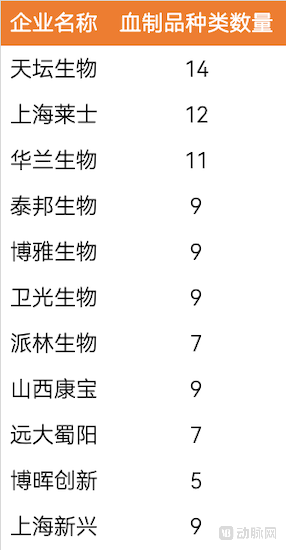
Types of Blood Products Offered by Major Domestic Blood Product Companies (Data Source: Compiled by VCBeat from Public Information)
Secondly, most of the blood products currently available are simple products with relatively low unit prices. At present, human serum albumin, various immunoglobulins, and a few coagulation factor products are the mainstream offerings of domestic blood product manufacturers. For instance, in Boya Bio-pharmaceutical Group’s 2021 revenue from blood products, three categories—human fibrinogen (33.8%), intravenous immunoglobulin (29.5%), and human serum albumin (29%)—accounted for the majority of sales. The unit prices of these simple blood products are all below RMB 1,000, which is significantly lower than those of coagulation factors and inhibitors, which can cost thousands or even tens of thousands of yuan. For example, the unit price of alpha-1 protease inhibitor is approximately RMB 11,000, while that of human coagulation factor X reaches as high as RMB 22,000.
It is not that plasma-derived medicinal products (PDMP) manufacturers are unwilling to invest in research and development; rather, in an industry subject to such stringent regulatory oversight, product innovation inevitably requires considerable time. In fact, major PDMP companies are increasingly becoming key drivers of innovation, propelling advancements in both product categories and manufacturing processes to new heights.
For instance, Hualan Biological Engineering Inc. has accelerated the development of drugs such as human von Willebrand factor (vWF), human coagulation factor IX (FIX), and intravenous human immunoglobulin for COVID-19, while continuing clinical research on recombinant Exendin-4-FC fusion protein injection and high-concentration next-generation intravenous human immunoglobulin. Meanwhile, Chengdu Rongsheng, a subsidiary of Beijing Tiantan Biological Products Corporation Limited, obtained the Drug Registration Approval for its human coagulation factor VIII. In the meantime, the subcutaneous human immunoglobulin developed by Chengdu Rongsheng was the first to be approved for clinical trials in China and has entered Phase III clinical trials. Boya Bio-pharmaceutical Group Co., Ltd. is also vigorously promoting the development of high-value-added blood products, including human coagulation factor vWF, alpha-1 protease inhibitor, and C1 esterase inhibitor.
Notably, as higher-value-added recombinant blood products continue to enter the market and become blockbuster drugs, an increasing number of plasma-derived product giants and biotechnology companies are strategically investing in this field. Taking recombinant coagulation factor VIII as an example, Anjiayin, the first domestically produced recombinant coagulation factor VIII under Sinocelltech, has provided strong momentum for the company’s revenue growth since its approval and market launch in July 2021. According to Sinocelltech’s 2021 annual report, Anjiayin achieved quarterly sales exceeding RMB 100 million, driving a more than 400-fold year-on-year increase in the company’s annual revenue. During this period, Beijing Tiantan Biological Products Corporation Limited, Taibang Biological Group, Chia Tai Tianqing Pharmaceutical, and Jiangsu Shengsi Biopharmaceutical have successively organized R&D efforts and conducted clinical trials. Among them, Beijing Tiantan Biological Products’ recombinant human coagulation factor VIII for injection has completed Phase III clinical trials in adult and adolescent populations and obtained the summary report, with market launch imminent.
Furthermore, the development of other types of recombinant blood products is proceeding vigorously. For instance, Chengdu Rongsheng, a subsidiary of Beijing Tiantan Biological Products Corporation Limited, has received approval to initiate Phase I clinical trials for its recombinant human coagulation factor VIIa. Recombinant human coagulation factor VIIa is primarily indicated for the treatment of bleeding during surgical procedures or invasive interventions, as well as for acquired hemophilia. Currently, the only recombinant human coagulation factor VIIa available on the market is NovoSeven, marketed by Novo Nordisk, with a price exceeding RMB 7,000 per mg. In late April 2022, Zelt Therapeutics announced that it had submitted a Biologics License Application (BLA) to the National Medical Products Administration (NMPA) for its independently developed recombinant human thrombin. This recombinant blood product, primarily used for intraoperative hemostasis, faces competition only from Bayer’s Recothrom, which has not yet been introduced to the Chinese domestic market. It is understood that Zelt Therapeutics’ candidate is currently the only product in China utilizing recombinant gene technology to produce recombinant human thrombin that has successfully completed Phase III clinical trials. Additionally, on April 21, Genobank, a new drug R&D enterprise focused on the development of natural fully human antibody drugs, announced that its independently developed TNM002 injection, a natural fully human monoclonal antibody against tetanus toxin, had officially commenced Phase II clinical trials in the Chinese population, with the successful enrollment and dosing of the first subject.
It is evident that in the face of ever-growing unmet clinical needs, no product or market can remain static. Even in the heavily regulated blood products industry, there is an irrepressible demand for innovation and breakthrough attempts. We look forward to the extraction of more beneficial substances from plasma for clinical applications to address the shortfall in source supply. Furthermore, we anticipate that emerging technologies will better meet the demand for blood products, thereby reducing reliance on plasma itself.