

Beyond Licensing: How Internet Medical Parks Are Building Sustainable Ecosystems for Digital Health
Since 2022, the internet healthcare sector has remained calm, while internet healthcare parks have heated up!
In April, two companies signed agreements with local governments in Guangdong and Hunan provinces, respectively, to establish internet healthcare industrial parks. Together with the previously established Guizhou Haiou Digital Medical Device Industrial Park, Qingdao Haicheng Digital Healthcare Industrial Park, and the park projects signed by Natery in Chengdu, Sichuan Province, and Zibo, Shandong Province, at least six internet healthcare-themed industrial parks have been launched since 2022.
Apart from Yinchuan and Hainan, most industrial parks in other regions currently prioritize the acquisition of internet hospital licenses as a key incentive to attract enterprises, and obtaining such qualifications has indeed become a practical necessity for many companies in the industry. However, once the license is secured, enterprises aim for long-term development. The more critical issue deserving close attention is whether these parks can provide ongoing support to foster mutual growth with the enterprises they host.
Since 2014, internet healthcare companies such as Yilian have been incubated and developed in Chengdu Tianfu Software Park. In 2017, a batch of enterprises that were early pioneers of internet hospitals gathered in Yinchuan. At the end of 2017, the Yinchuan Zhongguancun Innovation Center was unveiled and began operations, attracting internet companies, including those in the internet healthcare sector, to settle there. Thus, a clustered development model for the internet healthcare industry took shape, and today, the industrial park has become one of the key business formats in this field.
Currently, many regions across China have already established or are in the process of planning internet healthcare industrial parks:
·In 2017, the Yinchuan Zhongguancun Innovation Center was unveiled and began operations.
·In 2019, the Hainan Ecological Software Park began attracting internet hospitals to establish operations there, while a small number of internet hospitals also set up presence in Boao Lecheng.
·In 2021, the Chengdu Shuangliu Dolphin Digital Medical Industrial Park was put into operation; the Chengdu Wenjiang Health Service Industry Cluster incorporated internet hospitals as a component of its business ecosystem; and the Tianjin Economic-Technological Development Area intensified its investment promotion efforts for internet hospitals.
· In 2022, the Guizhou Haiou Digital Medical Device Industrial Park was prepared for construction, with its internet hospital positioned as a key infrastructure facility of the park; the Qingdao Haicheng Digital Medical Industrial Park launched investment promotion; and agreements were signed to prepare for the establishment of the Chengdu Naiterui Tianfu “Internet + Healthcare” Incubation Base, the Zibo Economic Development Zone Naiterui Internet Hospital Incubation Base, the Guangdong Naiterui Internet Healthcare Industry Cluster, and the Hunan Yunque Internet Healthcare Industrial Park.
Since then, internet healthcare industrial parks have sprung up across China. In April 2022 alone, two such park projects signed agreements with local government authorities to initiate preparatory construction.
On April 12, Netray signed strategic cooperation agreements with the Commerce Bureau of Guangzhou Nansha Economic and Technological Development Zone and Guangdong Medical Valley Industrial Park, respectively, for the “Netray Internet Healthcare Industry Cluster” project. Following the signing, Netray will establish an “Internet + Healthcare” industrial base within the Guangdong Medical Valley Industrial Park. On April 24, Yunque Internet Healthcare Industrial Park signed an agreement with Yuhu District in Xiangtan, Hunan Province, to set up operations in the Yuhu High-Tech Industrial Development Zone.
According to incomplete statistics, the majority of enterprise-led internet hospitals across China are concentrated in the aforementioned regions. Meanwhile, the enterprises settled in these industrial parks extend far beyond traditional internet healthcare companies; they also include pharmaceutical and medical device manufacturers, distributors, insurance companies, and health technology firms. In other words, companies of various types are leveraging the space-transcending nature of the internet to treat internet hospitals as infrastructure, thereby extending their reach to patient-facing services.
The rapid emergence of industrial parks signifies that a growing number of enterprises are keen to engage in park construction and operations, becoming the “water carriers” that support various companies in the broader health sector as they deploy internet hospitals. Some companies have even established parks in multiple locations; for example, the Dolphin Digital Medical Industrial Park and the Seagull Digital Medical Device Industrial Park are operated by subsidiaries of Taozi Health, while Netray has signed agreements to build parks in Chengdu, Zibo, Guangzhou, and other cities.
The emergence of internet healthcare industrial parks is influenced by factors such as local policy environments, human resource conditions, and industrial foundations, with these parks serving different functions at various stages of enterprise settlement.
Pre-move-in, one-stop software and hardware services
Prior to the official establishment of enterprises within the park, its primary function is to assist companies in obtaining internet hospital licenses by providing comprehensive end-to-end support across both online and offline dimensions. Online services encompass system development, integration with regulatory platforms, and acceptance testing, while offline services include the reliance on or establishment of physical medical institutions and the provision of office facilities.
“The biggest challenge we faced initially was the variation in application policies across different regions; even within the same locality, policies could be adjusted based on actual circumstances,” Ding Jinhuan, Head of Operations at Chengdu Shuangliu Arula Internet Hospital, told VCBeat, noting that relying solely on in-house research would entail substantial costs.
Although the National Health Commission has issued the “Administrative Measures for Internet Hospitals (Trial),” requirements vary across provinces in practice. Some provinces mandate that internet hospitals be affiliated with hospitals, while others permit affiliation with comprehensive outpatient departments; some require a one-to-one correspondence between a medical institution and an internet hospital, whereas others allow a single medical institution to operate multiple internet hospitals.
At a more granular level, requirements for data integration and interface standards between internet hospitals and regulatory platforms vary by region and are subject to change. For companies applying for licensure for the first time—and potentially only once—understanding these requirements also entails significant time costs.
“Currently, the process by which we assist enterprises in obtaining licenses has become streamlined, standardized, and regulated,” said Chen Jingbo, Vice President of Dolphin Digital Medical Industrial Park.
Therefore, for resident enterprises, the primary benefit of gaining park support is a more efficient qualification application process.
After onboarding, operational support is provided to “get you started.”
After enterprises settle in and commence operations of their internet hospitals, the industrial park primarily provides them with a range of support services—including talent acquisition, management, and risk control—to help them get on track as quickly as possible.
The Dolphin Digital Healthcare Industrial Park was fully operational in September 2021, and the tenant companies are currently in the early stages of their operations. Chen Jingbo, Vice President of the industrial park, noted that the park holds more than 40 internet hospital licenses, with approximately 80% of these licensed enterprises having moved in to commence on-site operations. While companies with mature internet healthcare business systems, such as JD Health and Jointown Pharmaceutical Group, have rapidly adapted to the environment, enterprises operating an internet hospital for the first time may encounter numerous challenges. “Therefore, our current focus has shifted from license acquisition to operational support.”
It is understood that to support enterprise operations, the Dolphin Digital Medical Industrial Park has established a Consultation Capability Output Center and a Medical Affairs Center. The Consultation Capability Output Center primarily assists enterprises in optimizing team structures and formulating standards for physician training and management. The Medical Affairs Center mainly helps enterprises build medical affairs systems, implement standardized medical quality control, collaborate on legal risk management, and assist in handling complaints and disputes, thereby aiding enterprises in risk prevention and control. In addition, the industrial park provides enterprises with policy interpretation, as well as sharing and training on practical case studies.
Internet healthcare has given rise to a variety of new roles, such as physician operations, patient engagement, medical new media management, clinical administration, and technical development and operations, while also maintaining a substantial demand for physicians.
“Talent shortages are a common challenge reported by many enterprises,” said Chen Jingbo, Vice President of Dolphin Digital Medical Industrial Park. To address this, the park has partnered with five medical universities in Sichuan Province to conduct joint campus recruitment drives, helping tenant companies attract a diverse range of talent.
Wang Han, CEO of Haicheng Digital Medical Industrial Park, stated that the park has established a resource pool of physicians and academicians by leveraging Haier’s technological capabilities and medical resources, which will provide support to internet hospitals settling in the park in the future.
Growth Phase: Standardized Regulation and Industrial Support Go Hand in Hand
Among the industrial parks across China, those in Yinchuan and Hainan commenced operations earlier, with a greater number of enterprises having entered the operational phase. At this stage, the parks are also assuming different roles.
After the number of internet hospitals reached a certain scale, Yinchuan and Hainan have introduced a series of policies over the past two years to strengthen regulatory oversight across all aspects of internet hospital operations, including standardization of diagnosis and treatment services, transparency of hospital affairs, and annual verification.
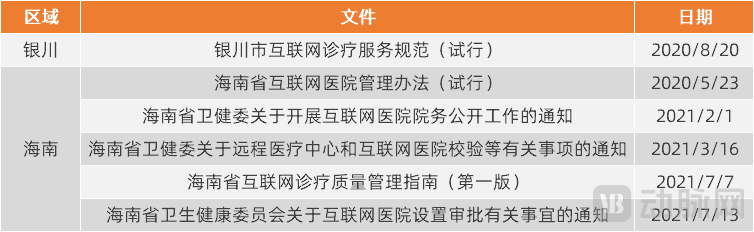
Internet Hospital Regulatory Policies in Yinchuan and Hainan over the Past Two Years, Source: Official Websites of the Health Commission of Hainan Province and the Health Commission of Yinchuan City
In 2021, the Hainan Provincial Health Commission began to publicly disclose service volume data for privately operated internet hospitals. In January 2021, among 58 internet hospitals, only a few generated valid operational data; 20 internet hospitals had zero physicians, 47 had zero clinical consultations, and 51 had zero prescriptions.
Driven by the mandate for data disclosure, more internet hospitals commenced actual operations. By the third quarter of 2021, the vast majority had entered operational status, with only a few still remaining in a “zero”-operation state.
Amid strengthened regulatory oversight, the industrial park is tasked with promptly disseminating and interpreting policies to guide corporate self-discipline, while also sustaining enterprise growth through resource matchmaking and industry exchanges.
For example, when the Yinchuan Internet Diagnosis and Treatment Service Standards (Trial) were released in 2020, the Yinchuan Municipal Health Commission and the Yinchuan Internet + Medical Health Association immediately partnered with VCBeat as the exclusive platform to livestream an interpretation of the new regulations, with enterprises from the Zhongguancun Innovation Center also participating in the discussion. In April 2021, the Yinchuan Zhongguancun Innovation Center hosted a policy briefing on “Internet Hospital Operations and Data Compliance,” inviting lawyers to provide in-depth analysis of the relevant policies.
Meanwhile, the Yinchuan Zhongguancun Innovation Center is also facilitating resource matchmaking for enterprises in areas such as pharmaceutical and medical device supply, intellectual property protection, and health insurance collaboration.
Overall, the park operator at this stage primarily assumes dual functions: guiding standardized development and providing industrial support.
Although all industrial parks require robust policy support, with guidance from government departments and operational participation by enterprises, two major types have emerged overall: policy-driven and enterprise-driven. The scope of services provided within these parks also varies by type.
Policy-driven initiatives centered on Yinchuan and Hainan
As a pioneer city for internet hospitals in China, Yinchuan has seen policy breakthroughs play a direct guiding role. In addition to early entrants such as Haodf Online, WeDoctor, DXY, and Chunyu Doctor, which established their presence in Yinchuan as early as 2017, numerous other medical and health enterprises have subsequently settled there, particularly clustering in the Yinchuan Zhongguancun Innovation Center.
“Yinchuan Guyitang Internet Hospital was approved in 2019. Guyitang’s offline operations are primarily based in Hunan Province, while its online services cover the entire country. As a pilot demonstration zone for internet hospitals, Yinchuan Health Industrial Park has provided timely and forward-looking information and opportunities in areas such as interpretation of the latest policies, training on internet healthcare knowledge, industry exchange conferences, and applications for government support policies. It has also offered corresponding support, including investment and financing matchmaking and project roadshows. During the pandemic, the park further supported tenants by providing one month of rent exemption for office spaces,” said a representative from Guyitang Internet Hospital.
“Most companies establish operations in Yinchuan primarily due to policy guidance,” said Zhang Chao, Founder and CEO of Zuoshou Doctor. To better support the development of its AI-driven diagnostic and treatment products, the company obtained an internet hospital license in Yinchuan in 2021, with the Zhongguancun Innovation Center facilitating government-enterprise communication channels.
The same holds true for Hainan. From 2019 to 2020, a large number of enterprises, attracted by Hainan’s approval policies, flocked to the Hainan Eco-Software Park to apply for licenses to operate internet hospitals. With Hainan’s growing industrial accumulation in the field of digital health, digital therapeutics has now become a key area of local exploration. In 2022, Hainan Province included “exploring pilot trials of digital therapeutics” as one of the major tasks in its 14th Five-Year Plan for digital health development, marking the first time that digital therapeutics was incorporated into a provincial-level plan. The Hainan Eco-Software Park is well-positioned to serve as a research and development hub for digital therapeutics.
This policy direction also happens to meet the needs of some enterprises. Miaoyijia Internet Hospital, which has settled in Hainan Ecological Software Park, stated that the company is currently applying for digital therapeutics approvals for conditions such as hypertension, diabetes, and sleep-related psychological disorders, with plans to implement these solutions within the park. Therefore, it hopes that both Hainan Province and the park will provide targeted support in terms of digital therapeutics policies.
Overall, policy-driven industrial parks primarily rely on local policies—particularly those with nationwide breakthrough significance—to attract enterprises. As a vehicle for industrial development, these parks focus on delivering robust follow-up services.
Enterprise-Oriented Services Centered on Qualification Application
For enterprise-oriented industrial parks, although strong support from local government authorities is still required to secure policies such as approvals, tax incentives, and investment attraction rewards, the park development and operating enterprises play a more critical role in “orchestrating” the overall ecosystem.
Compared with policy-driven industrial parks, the key distinction of enterprise-driven parks is that obtaining an Internet hospital license serves as one of the primary incentives to attract tenant companies. This has evolved into a standardized service offering, typically involving initial application fees exceeding RMB 2 million in the first year, followed by annual recurring costs amounting to hundreds of thousands of yuan.
“We have transformed from a technology-driven company specializing in the development of healthcare information systems into a digital healthcare ecosystem service provider,” said Wang Han, CEO of Haicheng Digital Healthcare Industrial Park. “Over the past two years, demand among various healthcare enterprises for internet hospital licenses has gradually intensified. We launched end-to-end infrastructure services to support qualification applications, and by the end of 2021, we were preparing to establish an industrial park in Qingdao. Prior to the official launch of Haicheng Digital Healthcare Industrial Park in Qingdao this year, we had already successfully built digital healthcare platforms and secured internet hospital licenses for more than ten companies.”
Qu Yi, Founder and CEO of Natrui, stated that there is an urgent need for digital transformation across the traditional healthcare industry chain. Under the models prevalent in previous years, these digital transformation initiatives lacked a high degree of centralization. As centralization gradually increased, multiple internet healthcare industrial parks emerged, with former system construction service providers evolving into park developers and operators.
Following the establishment of enterprises in the industrial park, the park provides operational support on one hand, and seeks additional preferential policies or policy breakthroughs based on the collective demands of these enterprises on the other. For example, as companies continue to settle in, the Dolphin Digital Medical Industrial Park is actively negotiating with local healthcare security authorities to secure medical insurance reimbursement policies.
In addition, there are industrial parks that exhibit characteristics of both types. In 2022, the State Council issued Document No. 2, titled “Opinions of the State Council on Supporting Guizhou in Blazing New Trails in the Large-Scale Development of the Western Region in the New Era,” which positioned Guizhou as a pilot zone for innovative development of the digital economy. The document supports Guizhou in deeply implementing its digital economy strategy, strengthening scientific and technological innovation support, unlocking the potential of data as a factor of production, promoting the integrated development of the digital and real economies, and exploring experience for industrial transformation and upgrading as well as the construction of Digital China.
Against this backdrop, the Guizhou Provincial Government has vigorously promoted the integrated development of internet healthcare and digital therapeutics. The Seagull Digital Medical Device Industrial Park, led by the local government and built and operated with enterprise participation, has been established in Baiyun District, Guiyang.
It is understood that the Seagull Digital Medical Device Industrial Park will attract internet healthcare and digital health-related enterprises and institutions to settle in. The park will provide end-to-end services for eligible enterprises, including assistance with obtaining qualifications such as Internet Hospital construction permits and Digital Therapeutics (DTx) product certifications, along with follow-up operational support.
Amidst the fervor surrounding internet healthcare industrial parks, dissenting voices have emerged within the industry, particularly concerning enterprise-oriented parks. Some insiders argue that this model is intermediary in nature; given that medical practices demand stringent attention to safety and quality, they remain skeptical of internet hospitals operating under an “agency” or “facilitation” model.
“We do not deny providing intermediary or agency services to enterprises, as the vast majority of companies are unfamiliar with the construction process and require support from professional teams,” stated Wang Han, CEO of Haicheng Digital Medical Industrial Park. “Under the premise of strictly adhering to medical safety regulations and constructing facilities in full compliance with approval and acceptance rules and standards, improving the efficiency of qualification applications for enterprises is itself meaningful and value-creating. Qualification application is merely the foundation for entry; the true value of the industrial park lies in comprehensively empowering enterprises beyond this baseline, fostering a smarter healthcare ecosystem, and providing end-to-end services including infrastructure for internet hospitals, rapidly deployable personalized systems, operational management, resource linkage, and investment and financing support, thereby nurturing more ‘unicorn’ companies in the digital health sector.”
Qu Yi, founder and CEO of Naiterui, believes that this model is an inevitable outcome in the development of the internet healthcare sector, reflecting a clearer division of labor within the industry. “Specialization matters; it is unrealistic to expect every company to become an internet firm and engage in redundant work, which only wastes time and capital. The healthy development of the healthcare industry chain should foster the growth of numerous B2B-oriented companies. Meanwhile, with more enterprises building such infrastructure, robust competition and survival of the fittest will drive the industry toward better outcomes.”
VCBeat believes that not only during the application process but throughout the entire subsequent workflow of online medical services, both park operators and enterprises themselves should adhere to high standards of self-regulation to ensure the sustainable development of this park model.
Internet healthcare differs from traditional brick-and-mortar industries, as a significant portion of its operations can be conducted online. Once an industrial cluster is formed, how can it evolve into a true industrial park?
“Industrial synergy” was a frequently mentioned term during exchanges among numerous industrial parks, enterprises, and VCBeat. However, the industry has not yet established mature pathways for industrial synergy, with various companies offering their experiences, suggestions, and visions on the matter.
A representative from Hainan Manniu Health Internet Hospital stated that since the company established its presence in Boao Lecheng, it has made several attempts at business synergy. For instance, by expanding the pool of physicians practicing at multiple sites and leveraging doctor resources from physical hospitals in Hainan, the number of registered physicians and online consultations has seen rapid year-on-year growth over the past year. Additionally, the company has integrated its existing chronic disease management services with high-end projects in Boao Lecheng, connecting with Lecheng’s unique consumer healthcare resources in offline medical aesthetics, wellness, and regenerative medicine. By capitalizing on the geographical advantages of its offline telemedicine centers and establishing dedicated offline service teams, the company aims to deliver premium services to high-net-worth clients, thereby facilitating the implementation of an integrated ecosystem encompassing pharmaceuticals, healthcare, and insurance services.
The official further recommended that the park leverage the core competencies of each medical institution to formulate preferential policies for business cooperation among them, thereby enabling mutual empowerment and enhancing overall competitiveness. It was also suggested that preferential policies for importing drugs and medical devices be further opened up and optimized to help institutions identify suitable advanced foreign pharmaceuticals and medical devices, and facilitate connections with local medical institutions and project opportunities. Additionally, more policies should be developed to attract specialized talent, assisting internet hospitals in expanding their local capabilities in medical services, patient escorting, and online care within Lecheng.
Ding Jinhuan, Head of Operations at Chengdu Shuangliu Arula Internet Hospital, noted that there are also insurance-backed enterprises located within the same industrial park, expressing hope to identify opportunities for collaboration between the healthcare and insurance sectors in the future.
Wang Han, CEO of Haicheng Digital Medical Industrial Park, believes that clustering enables enterprises to “band together for mutual support” and foster collaboration across multiple dimensions. “For instance, each internet hospital has its own service focus; if referral networks are established among internet hospitals within the park, overall customer acquisition costs could be reduced. Meanwhile, companies can share infrastructure such as telemedicine platforms, thereby lowering hardware investment.”
Furthermore, Naiterui’s internet healthcare industry clusters in locations such as Chengdu Park Royal and Guangdong Medical Valley will foster synergy between online and offline medical resources. According to Qu Yi, Founder and CEO of Naiterui, the industrial parks are positioned as integrated medical complexes. “While launching online operations to serve patients across China, we are also strengthening offline services for local patients at medical institutions. By introducing enterprises specializing in various clinical specialties and medical technologies into the parks, we aim to function as a ‘comprehensive hospital’ that meets the diverse needs of patients.”
Therefore, in the future, industrial parks across various regions need to explore practical models for industrial synergy to help enterprises achieve long-term cost reduction and efficiency improvement, rather than engaging in “one-off deals” solely focused on obtaining licenses.
Acknowledgements to the following organizations for their support of this article:
Chengdu Dolphin Digital Medical Industrial Park
Guizhou Seagull Digital Medical Device Industrial Park
Qingdao Haicheng Digital Medical Industrial Park
Beijing Naiterui Technology Co., Ltd.
Hainan Miaoyijia Internet Hospital
Yinchuan Guyitang Internet Hospital
Yinchuan Zuoyi Internet Hospital
Chengdu Shuangliu Arula Internet Hospital
Chengdu Shuangliu Xinhe Internet Hospital
Hainan Manniu Health Internet Hospital