

China's First Successful BTR Case with Extracorporeal Artificial Heart for Cardiogenic Shock Patient Marks Milestone for MoyoAssist®
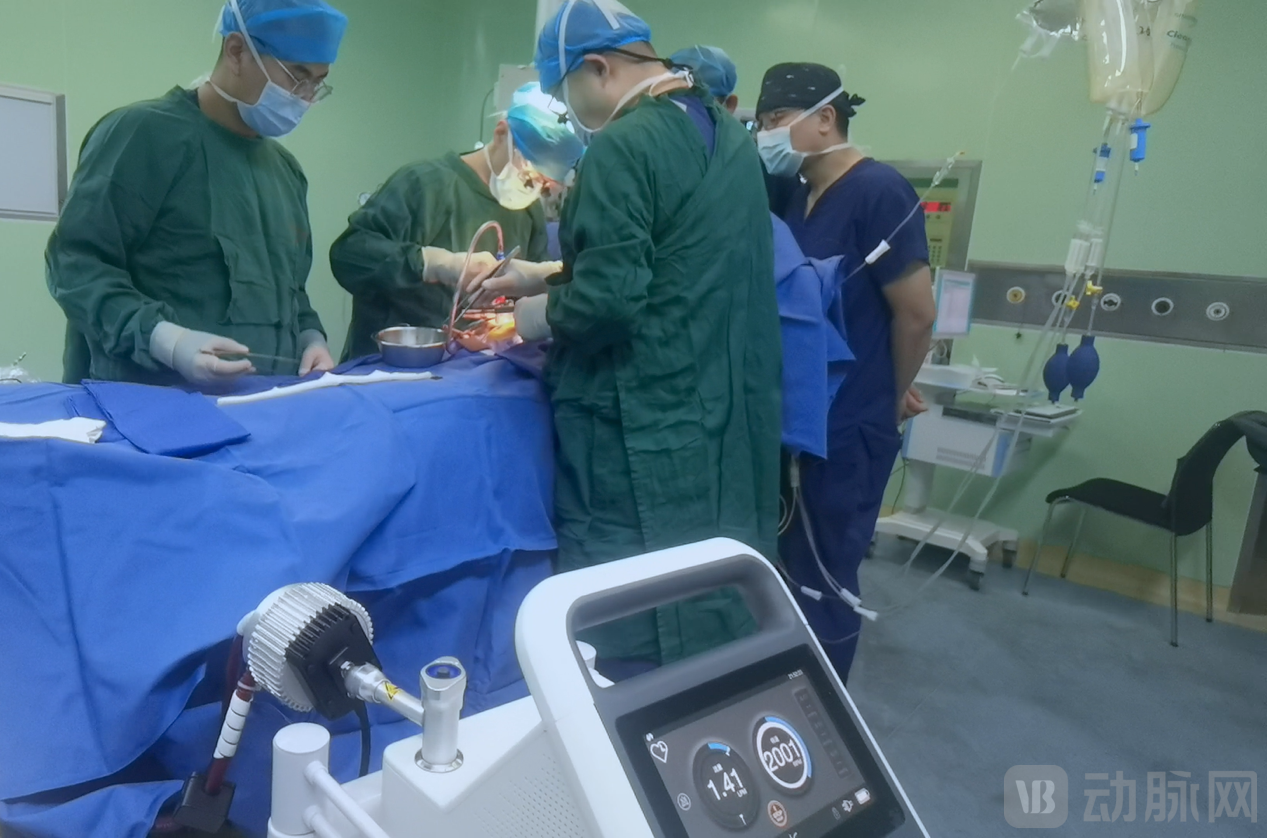
Recently, Shanxi Cardiovascular Hospital used the extracorporeal magnetically levitated artificial heart (MoyoAssist) developed and manufactured by Suzhou XinQing Medical Technology Co., Ltd. (hereinafter referred to as: XinQing Medical).®Extra-VAD), successfully completed the first clinical trial in China for this class of products to achieve BTR (bridge to recovery), helping a patient with cardiogenic shock safely navigate the critical period.
MoyoAssist Extracorporeal Magnetically Levitated Artificial Heart by Xinqing Medical®Extra-VAD) is China’s first independently developed, domestically produced extracorporeal fully magnetically levitated ventricular assist system. This product was successfully applied in clinical practice for the first time worldwide in 2021 and underwent China’s first multicenter clinical trial for an extracorporeal artificial heart. MedHeart Medical employs the world’s most advanced computational fluid dynamics technology and full magnetic levitation technology. Its extracorporeal artificial heart achieves international top-tier blood compatibility, providing life support for up to 30 days. It offers stable support throughout the potential cycles of bridge-to-recovery (BTR), bridge-to-transplant (BTT), and bridge-to-decision/other therapies (BTD), while ensuring reduced surgical trauma and fewer side effects.
This clinical case conducted at Shanxi Cardiovascular Hospital marks the first implementation of MoyoAssist.®Clinical Application of BTR: Providing Patients with the Most Suitable Solutions for Their Condition, Minimizing Unnecessary Harm While Offering a Stable Transitional Period for Cardiac Recovery.

In late November 2021, Vice President Xi Jicheng and Director Zhang Zhibiao of Shanxi Provincial Cardiovascular Hospital led a surgical team in performing coronary artery bypass grafting (CABG) on a patient. Intraoperatively, severe vascular calcification was observed, posing significant challenges for anastomosis. Although the medical team successfully completed the procedure with exceptional skill, the patient’s complex postoperative clinical course necessitated re-intervention for bleeding. During this second surgery, maintaining extracorporeal circulation proved difficult. After a series of interventions, the team found it challenging to sustain hemodynamic stability during weaning from cardiopulmonary bypass (CPB). Consequently, an intra-aortic balloon pump (IABP) was instituted for circulatory support. Upon a subsequent attempt to discontinue CPB, elevated left atrial pressure was noted, further complicating the weaning process.
After discussion with the patient’s family, it was communicated that innovative therapy could be administered through a clinical trial. The patient was successfully weaned off cardiopulmonary bypass and established on an extracorporeal ventricular assist device (VAD) circuit for circulatory support. Postoperatively, the patient was transferred to the ICU. After several days of continuous VAD support, the myocardium received adequate rest and recovery time under appropriate flow assistance, enabling successful weaning from the device. The patient was subsequently transferred to a general ward for further treatment and remained stable. In early January 2022, the patient was discharged in good health.
Vice President Xi Jicheng stated, “At that time, there were two options available: conventional ECMO (extracorporeal membrane oxygenation) and an extracorporeal ventricular assist system (i.e., an external artificial heart). We chose the latter. Since the patient primarily suffered from left ventricular dysfunction with no significant pulmonary issues, the Qingcheng extracorporeal ventricular assist system was more suitable for providing supportive care to help the patient successfully navigate the acute phase.”
Director Zhang Zhibiao stated, “In cardiac surgery, if an emergency arises where the patient cannot be weaned off cardiopulmonary bypass and prolonged support is not feasible, and if simple intra-aortic balloon pump (IABP) counterpulsation fails to maintain adequate circulation, the use of an external artificial heart (extracorporeal ventricular assist system) as a bridge therapy benefits patients awaiting heart transplantation or those with end-stage heart failure. It provides a buffer period, granting them the time and opportunity to wait for a suitable donor heart. Although extracorporeal membrane oxygenation (ECMO) offers sufficient circulatory support, it involves greater operational complexity and higher demands on postoperative care. In contrast, the external artificial heart can address cardiac issues more directly. The interface between cardiopulmonary bypass and the Qingxin artificial heart is straightforward, allowing for smooth exchange and transition with minimal difficulty, thereby facilitating ease of operation for surgeons.”
Dr. Yan Fang, an ICU physician, also stated that this ventricular assist system has low anticoagulation requirements and minimal impact on the patient’s internal environment. The device is highly intelligent, requiring no special calibration, which reduces nursing demands and eases the burden of equipment management for the ICU team.
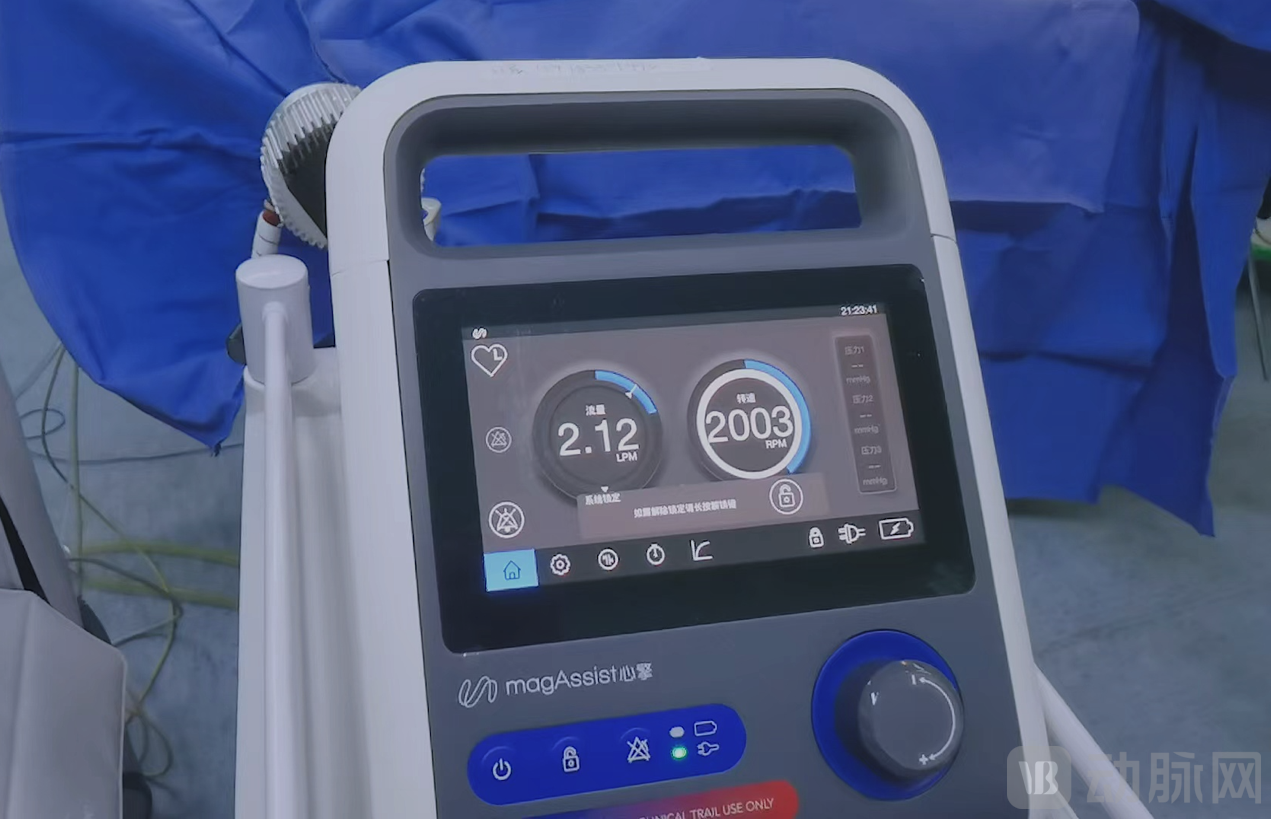
The XinQing Extracorporeal Magnetically Levitated Artificial Heart is a fully magnetically levitated system designed for short- to medium-term extracorporeal ventricular assistance. As the only extracorporeal magnetically levitated artificial heart product in China, it possesses independent intellectual property rights and supports multiple modes of ventricular assistance. Its key performance metrics are comparable to those of Abbott’s CentriMag, the only such product currently approved by both the FDA and CE, while demonstrating superior performance in shock resistance, anti-torsional stability, and portability.
This product’s magnetically levitated motor features IPX4 water resistance, making it suitable for a variety of complex environments. It also incorporates a patented, detachable, multi-angle mounting structure that facilitates flexible establishment of tubing circuits by healthcare professionals in demanding ICU and ER settings. The fully magnetically levitated impeller rotor delivers high resistance to vibration and torsional oscillation, meeting the needs for patient transfers within hospitals, between facilities, and over long-distance inter-provincial transports. Its advanced front-end UI design ensures an excellent human-machine interaction experience, enabling rapid deployment and portability during transport.
Due to the shortage of donor hearts, artificial hearts (ventricular assist devices, abbreviated as VADs) have become a focal point of research. Since 2006, nearly 30,000 patients worldwide have received VAD therapy. Clinical data from the United States indicate that VADs of all generations (first, second, and third) significantly improve survival rates in patients with end-stage heart failure compared to pharmacological treatment alone. Consequently, VADs have become an important surgical intervention for heart failure. For patients without pulmonary oxygenation issues, extracorporeal ventricular assist devices (Extra VAD) are a superior alternative to extracorporeal membrane oxygenation (ECMO).
Compared with ECMO, the extracorporeal ventricular assist device ExtraVAD offers significant advantages by avoiding North-South syndrome associated with ECMO:
● It does not have an oxygenator, which can eliminate complications associated with the oxygenator.
● Avoids the issue of increased left ventricular afterload associated with ECMO, achieves complete ventricular unloading without the need for drainage, and provides stronger support for cardiac recovery
● Survival rates for bridging to heart transplantation are higher than with ECMO
● Significantly reduced hemolysis and extended support duration, allowing patients to “wait safely”
● Reduces the complexity of equipment management, requiring only 1–2 nursing staff members
Therefore, for patients with low cardiac output following cardiac surgery, extracorporeal ventricular assist devices may be a preferable option. The advancement of this clinical trial will further validate MoyoAssist.®effectiveness, it is expected to bring newer technologies and better treatment options to critically ill patients in need of urgent care.