

Hengnuokang Pharma Breaks mRNA Upstream Bottleneck with Proprietary Capping Reagent LZCap®
The outbreak of the COVID-19 pandemic has propelled the mRNA vaccine sector into the spotlight, with revenues from COVID-19 mRNA vaccines exceeding $50 billion between 2021 and 2022, while the upstream market approached $10 billion. In the long term, beyond COVID-19 vaccines, mRNA technology has gradually matured in areas such as cancer vaccines, gene editing, CAR-T cell therapy, protein replacement therapy, and preventive vaccines for other infectious diseases, with a steady pipeline of products reaching the market. Benefiting from advantages such as short development cycles and scalable manufacturing processes for mRNA vaccines and therapeutics, mRNA has become a prominent focus of research and development in the biopharmaceutical industry in recent years.
Downstream market booms often drive upstream demand; however, the surge in the mRNA sector has highlighted the immaturity of China’s upstream technological reserves, as the core capping components for domestically produced mRNA products still rely on imports. For both mRNA vaccines and mRNA therapeutics, nucleotides are the key raw materials. Among these, high-barrier core components—namely “capped nucleotide raw materials” and “modified nucleotides”—account for over 40%–50% of raw material costs.
Currently, Trilink Biotechnologies in the United States is the sole company worldwide holding intellectual property rights for Clean Cap, a high-end capping reagent. Consequently, Chinese mRNA enterprises seeking to develop products based on next-generation capping technologies must rely entirely on imported upstream raw materials. The manufacturing process for high-end capping reagents is complex, with prices reaching as high as RMB 1 million per gram. This prohibitive cost creates substantial R&D barriers for domestic mRNA vaccine and pharmaceutical companies, making it a critical “chokepoint” technology that constrains the development of China’s mRNA vaccine and drug sectors.
To achieve top-down, full-industry-chain substitution in the mRNA sector and ensure the autonomous and controllable development of China’s mRNA industry, Guangzhou Henovcom Bioscience Co., Ltd. has independently developed domestically produced co-transcriptional capping reagents. Leveraging the team’s over 30 years of expertise in nucleotides and several months of dedicated R&D, the company optimized its triphosphate synthesis process. In 2022, it successfully developed a series of nucleoside triphosphate (NTP) raw materials for mRNA vaccines and therapeutics, including NTPs, PseudoUTP (pseudouridine), N1-Me-pseudoUTP, modified NTPs, ARCA, and the patented third-generation co-transcriptional capping reagent, LZCap.
Henovcom Bioscience, officially known as Guangzhou Henovcom Bioscience Co., Ltd., was established in 2013. It is a clinical-stage innovative drug research and development company. The company’s pipeline of innovative drugs includes novel antiviral, anti-fibrotic, anti-tumor, and central nervous system (CNS) therapeutics. Its most advanced asset, a Class 1 innovative anti-influenza drug, has completed Phase I clinical trials in the United States. Another Class 1 new drug for the treatment of non-idiopathic pulmonary fibrosis has completed Phase Ia clinical trials in the U.S., while a Class 2.1 long-acting formulation for the treatment of Parkinson’s disease has already submitted an Investigational New Drug (IND) application. To date, the company has been granted 15 invention patents related to its new drug candidates.
Notably, following the outbreak of the pandemic, Guangzhou Henovcom Bioscience Co., Ltd. established new pipelines related to anti-epidemic efforts. To support the development of downstream mRNA-related products, the company independently built a nucleoside triphosphate synthesis and service platform. It provides high-quality premium nucleotide products and services to global biopharmaceutical, vaccine, diagnostic, and cell and gene therapy companies with the most competitive quality and pricing. These offerings include raw materials for mRNA vaccines and therapeutics (LZCap, PseudoUTP, NTPs, ARCA), raw materials for molecular diagnostic reagents (fluorescently labeled nucleoside triphosphates, biotinylated nucleoside triphosphates, dNTPs), and raw materials for nucleic acid sequencing (fluorescently labeled nucleoside triphosphates, dNTPs).
Leveraging its platform technology, Guangzhou Henovcom Bioscience Co., Ltd. has optimized the synthesis process for N1-methylpseudouridine triphosphate (N1-Me-PseudoUTP). N1-Me-PseudoUTP can replace conventional UTP to reduce the immunogenicity of mRNA and enhance its expression. By incorporating N1-Me-PseudoUTP during in vitro transcription of mRNA, recognition by innate immune sensors is avoided upon in vivo administration, thereby preventing the activation of TLR3, TLR7, TLR8, RIG-I, and other innate immune sensors. This reduces the production of IFN-I, IL-6, and TNF-α, diminishes immune stimulation, and improves the safety profile of mRNA vaccines and therapeutics. Notably, the COVID-19 vaccines marketed by BioNTech and Moderna both utilize the modified nucleoside pseudouridine. Additionally, Henovcom has independently developed LZCap, a novel capping reagent with a unique structure, which achieves mRNA capping efficiency exceeding 95%, enhances mRNA stability, and significantly boosts protein expression levels.
Transcription is the process by which RNA is synthesized from DNA. In this process, immature precursor RNA (pre-mRNA) is first generated using DNA as a template, and then undergoes a series of post-transcriptional modifications within the nucleus to form mature mRNA. mRNA serves as the template for the subsequent translation of amino acids into proteins.
Mature mRNA comprises five structural elements: the 5' cap, the 5' untranslated region (5' UTR), the open reading frame encoding the antigen, the 3' untranslated region (3' UTR), and a poly(A) tail. Among these, the cap structure is critical for mRNA. The cap not only regulates mRNA splicing and maturation and facilitates the transport of RNA transcripts through the selective pores of the nuclear envelope, but also protects mRNA from degradation by exonucleases. Furthermore, it works synergistically with translation initiation factors to recruit ribosomes and assist in their binding to mRNA, thereby initiating translation.
Therefore, the in vitro modification process becomes critical during the development of mRNA products. mRNA vaccines or therapeutics must form a cap structure to ensure stable expression in vivo. However, traditional in vitro mRNA capping methods are primarily based on enzymatic capping, where double-stranded DNA (dsDNA) serves as the template to transcribe uncapped mRNA, which is then converted into mature capped mRNA through enzymatic reactions.
However, the drawback of this method lies in the high cost of using vaccinia virus capping enzymes, resulting in elevated enzymatic reaction costs. Additionally, enzymatic capping introduces exogenous proteins, complicating the manufacturing process by requiring multiple purification steps and increasing QA/QC testing requirements. In contrast, next-generation “co-transcriptional capping” utilizes cap analogs to directly generate capped mRNA through in vitro transcription, enabling a “one-pot” mRNA production process. This streamlined workflow simplifies the manufacturing process and can rapidly scale up the production capacity of mRNA vaccines and therapeutics.
It is reported that BioNTech’s marketed COVID-19 vaccine, BNT162b2, employs the co-transcriptional capping process. However, due to the high patent licensing fees associated with this technique, Chinese manufacturers are in urgent need of a domestically developed alternative capable of achieving “co-transcriptional capping” while circumventing patent barriers. Guangzhou Henovcom Bioscience Co., Ltd. has taken on this challenge, leveraging its expertise in nucleoside modification and industrial-scale production processes for nucleoside triphosphates to research and develop a new generation of capping reagents.
Zhang Jiancun, founder of Guangzhou Henovcom Bioscience Co., Ltd., introduced that the company’s nucleotide capping reagent “LZCap” is benchmarked against the overseas product CleanCap. It supports “one-pot” mRNA synthesis and achieves higher mRNA yield and protein expression levels than CleanCap. LZCap is a cap analog trimer that generates a Cap1 structure via chemical synthesis. Incorporating LZCap during in vitro co-transcription produces mRNA with a native Cap1 structure, boosting capping efficiency to over 95%. This provides a new solution to the limitations of traditional capping methods, such as the low efficiency of ARCA or the high cost of enzymatic approaches.
The company is currently expanding its 2,200 m² professional GMP facilities, production system, and analytical quality system to ensure multi-kilogram batch production capacity.
In addition to its “co-transcriptional capping” products, Guangzhou Henovcom Bioscience Co., Ltd. has established four major technology platforms over nearly a decade of development, encompassing small-molecule drug design and synthesis, comprehensive analytical quality control and formulation research, pharmacokinetics and non-GLP safety assessment, as well as active pharmaceutical ingredient (API) process development and GMP-like manufacturing. Multiple projects have advanced into clinical and preclinical research stages.
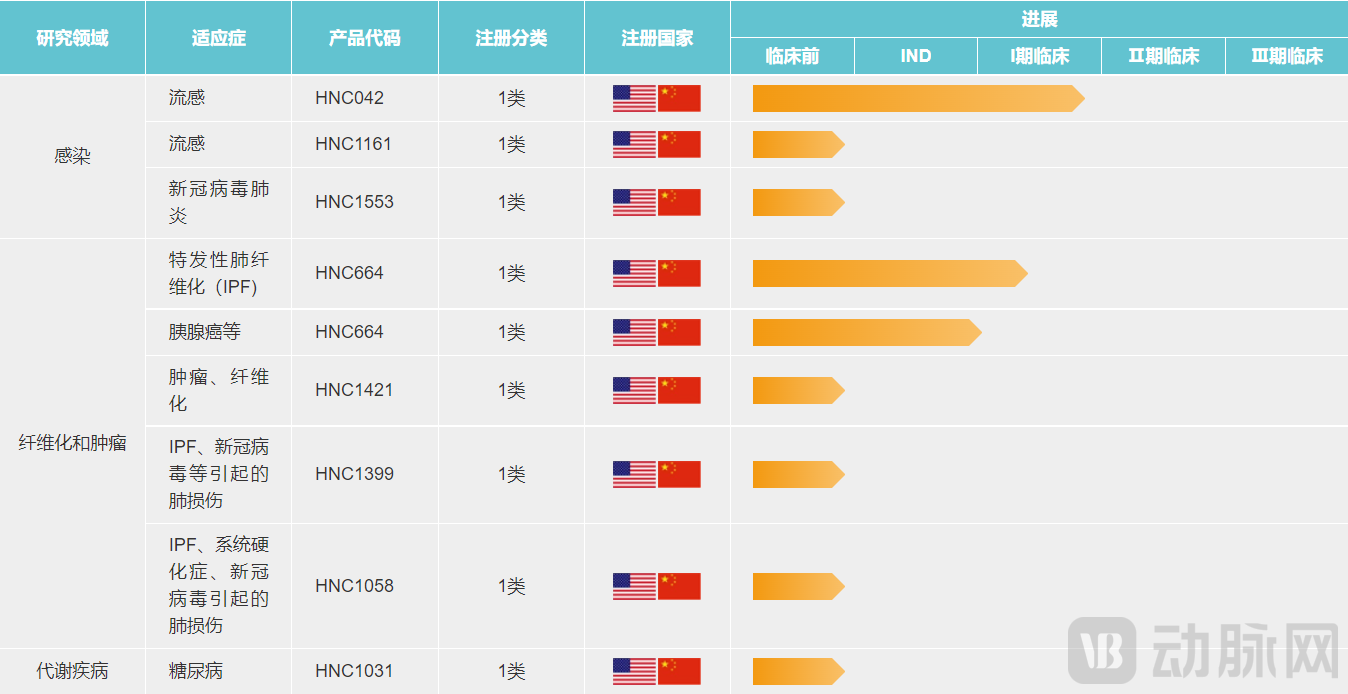
Henovcom Bioscience Clinical Pipeline Progress (Screenshot from Official Website)
From the independent R&D of innovative drugs to overcoming technical barriers for the domestic production of “co-transcriptional capping” products, Guangzhou Henovcom Bioscience Co., Ltd. closely follows market demand changes. By adopting a dual-pronged strategy and driving corporate development through two complementary engines, the company not only supplies upstream mRNA technical materials but also builds a robust pipeline of innovative drug candidates, delivering better healthcare solutions for humanity.
It is reported that Guangzhou Henovcom Bioscience Co., Ltd. is on the verge of closing its pre-Series B financing round. The funds raised will accelerate the advancement of the company’s innovative drug pipeline and the construction of its nucleic acid raw material production base, among other initiatives.