

From Expulsion to Harvard Polymath: George Church’s Journey as Founder of 22 Biotech Ventures

George Church, Professor of Genetics at Harvard University
Professor George Church is arguably one of the most commercially successful scientists at Harvard University. A leading authority in human genetics and biotechnology, he has gained global renown for his research contributions to genome sequencing, gene editing, synthetic biology, and neuroscience. He is also a pioneer in personal genomics and synthetic biology. His industrial contributions span human genomics, green chemistry, and clean energy. In 1984, he helped launch the Human Genome Project, regarded as one of the greatest scientific endeavors of the 20th century. He joined Harvard Medical School in 1986 and currently serves as Professor of Genetics at Harvard Medical School, as well as a founding member of the Wyss Institute for Biologically Inspired Engineering at Harvard University.
Over a research career spanning more than 40 years, Church has emerged as a preeminent scientist at the pinnacle of fields such as genome engineering, regenerative medicine, and synthetic biology. He pioneered concepts such as multiplexed molecules and has achieved remarkable success in translating and commercializing new technologies. In the life sciences, he has published more than 400 academic papers and holds 95 patents. Many of his breakthrough innovations have laid the foundation for prominent biotechnology innovators such as Editas Medicine (gene therapy) and Gen9bio (synthetic DNA). These companies are applying these innovative technologies to medical diagnostics, novel therapeutics, and synthetic biology.
In August 1954, this pioneering geneticist was born at MacDill Air Force Base in Florida. He attended both public and Catholic schools, but he considered the educational resources of both systems to be rather limited. Dissatisfied with the school curriculum, Church read extensively, with a particular interest in science. Around the age of 10, Church built his own analog computer.
His stepfather was a physician, and under his influence, Church developed a strong interest in biochemistry. The medical kit in his stepfather’s possession contained various medications, which sparked young Church’s curiosity. He collected some tadpoles and divided them into two groups, crushing tablets and adding them to the water of one group to observe and compare the growth of the two groups. Ultimately, he discovered that hormones could accelerate tadpole growth to a certain extent and presented his findings in biology class.
During high school, Church left Florida for the first time to attend Phillips Academy in Andover, Massachusetts. He kept a collection of carnivorous plants in his dormitory, attempting to transform them into giants by watering them with gibberellins; he taught himself computer science using shared computers at Dartmouth College; and after completing his chemistry coursework, he was granted independent access to the chemistry laboratory to continue exploring compounds. This experience had a lasting impact on his undergraduate career: after enrolling at Duke University in 1972, Church took numerous graduate-level and independent study courses, completing them within two years, while also attending a summer program in quantum physics at the Massachusetts Institute of Technology (MIT).
In 1973, Church joined Sung-Hou Kim’s crystallography laboratory, where he “finally found the intersection of computer science and biology.” Driven by intense curiosity about physics, mathematics, biology, chemistry, and computer science, he spent his sophomore and senior years at Duke University immersed in work there.
Church once recalled this period: “Kim treated me almost as an equal; he was able to recognize my strengths, which others had failed to notice.”
Church’s dedication to scientific research led him to pursue graduate studies. Feeling young and immature, he believed he should remain at the same institution and applied for a Ph.D. in Microbiology at Duke University. During this period, he continued working in Kim’s laboratory and quickly published five papers. A year later, Church switched to a Ph.D. program in Biochemistry. However, he soon encountered his first major setback in life—Church was expelled from the university. The expulsion resulted from his failure to attend classes, which led to failing grades in both Biochemistry and Microbiology courses. Church maintained that he had already mastered the course material and saw no need to repeat it. Although his advisor, Kim, attempted to persuade the university to allow Church to remain, these efforts ultimately proved unsuccessful.
Years later, Peter Miller, a senior editor at National Geographic, remarked in the series The Innovators: “As a graduate student at Duke University… he used X-ray crystallography to study the three-dimensional structure of ‘transfer’ RNA, which decodes DNA and transmits instructions to other parts of the cell. This was groundbreaking research, but Church spent up to 100 hours per week in the laboratory, to the extent that he neglected his other courses (in the fall of 1975).”
“I enjoy doing research, but I don’t like attending classes, as I already covered that material during my undergraduate studies,” Church has often recalled when reflecting on this experience.
Fortunately, Kim did not give up on him and allowed Church to remain in the laboratory as a technician. At a time when Church was dispirited and resigned to spending his life in that role, it was Kim who encouraged him, saying, “I don’t believe you’ll stop at being a technician. You have many ideas and should apply for graduate school.” Church, however, remained skeptical, wondering how someone who had been expelled from Duke University could possibly be admitted to a graduate program. As a result, he half-heartedly completed an application for the Ph.D. program in Molecular Biology at Harvard University, waiting with little expectation. Even years later, Church remained astonished that he had been accepted into Harvard’s doctoral program.
During the summer before starting his Ph.D. at Harvard University, Church stayed in Boston reading molecular biology papers and planning experiments. At that time, he was already conceptualizing improvements to DNA sequencing technology and decided to join the laboratory of Nobel laureate Walter Gilbert. During his doctoral studies, Church investigated polymerase-based sequencing methods and developed some of the earliest sequencers, sparking the next-generation sequencing revolution.
For the subsequent decades, Church has been engaged in teaching and research at Harvard University. His research achievements laid the foundation for the development of genome sequencing and gene editing. Building on this fundamental research, he established a prominent reputation in high-profile fields such as gene sequencing, synthetic biology, and brain science. Here, he ushered in his own era in the life sciences.
In 1985, an ambitious initiative was launched in the field of life sciences—the Human Genome Project. This multinational, interdisciplinary scientific endeavor aimed to determine the nucleotide sequence composed of the three billion base pairs that make up human chromosomes (referring to the haploid set), thereby mapping the human genome and identifying its constituent genes and their sequences, with the ultimate goal of deciphering human genetic information. Church was one of the initiators of this project.
Furthermore, Church co-invented direct genomic sequencing with Walter Gilbert, laying the foundation for the development of next-generation sequencing (NGS) technologies. These technologies began to impact large-scale sequencing in 2005. Moreover, Church is one of the inventors of nanopore sequencing technology and currently serves as a consultant for nearly all major sequencing companies, including Illumina, Danaher Corporation, Roche Diagnostics, and Pacific Biosciences. It is no exaggeration to state that he is a key pioneer of next-generation sequencing.
The advent of second-generation sequencers has driven down sequencing costs at a pace reminiscent of an “ultra-Moore’s Law,” prompting George Church to champion the popularization of personal genomics. In 2005, he launched the Personal Genome Project (PGP), aiming to recruit 100,000 participants worldwide. By sharing genomic data, the project seeks to answer a fundamental question: why do humans develop certain diseases or remain resistant to others? The key to achieving this goal lies in data integration and sharing. Countries currently participating in the initiative include the United States, Canada, the United Kingdom, Austria, and China. Reportedly, the PGP is the only global initiative that openly provides access to human genome and phenotype datasets.
He co-founded Veritas Genetics in 2014 and Nebula Genomics in 2018, with the aim of enabling more people to benefit from genomic data through technologies such as sequencing and blockchain.
Since 2004, Church and his team have been dedicated to research on DNA synthesis and assembly, developing synthesizers for the assembly of DNA arrays (also known as DNA chips) used in combinatorial libraries and large genomic fragments. In recognition of his outstanding contributions to the Human Genome Project, sequencing technologies, and the field of DNA synthesis and assembly, he was elected a member of the U.S. National Academy of Engineering in 2012.
Church is also one of the pioneers of “genetic engineering.” He began researching general homologous recombination or sequence-specific nuclease technologies in 1997, and optimized the CRISPR/Cas9 technology discovered by Jennifer Doudna and Emmanuelle Charpentier to develop Multiplex Automated Genome Engineering (MAGE). Unlike techniques that modify only one gene at a time, MAGE can edit multiple genes or loci on cellular chromosomes through diverse mechanisms, including insertion, mismatch, or deletion. Based on this technology, Church and his team conducted numerous applied studies, laying the foundation for subsequent advancements in synthetic biology, cell therapy, xenotransplantation, and other fields.
In 2013, his team achieved the first recoding of the Escherichia coli genome. They further engineered E. coli strains to enable the production of an amino acid that is neither naturally occurring nor synthesizable by the organism itself. Over several decades, scientists have made various attempts to incorporate non-canonical amino acids into proteins. Genetic code expansion technology represents one such approach. By site-specifically inserting non-canonical amino acids, this technique expands the landscape of drug design and breaks through the existing paradigms of traditional macromolecular drug development, marking it as a highly promising revolutionary technology.
In 2017, leveraging research in synthetic biology and gene editing, the Church Laboratory incubated a startup named GRObio. The company has recoded the genome of Escherichia coli, enabling these bacteria to produce proteins using non-canonical amino acids, and has secured $31.2 million in funding to date.
iPS reprogramming holds significant application value in constructing disease models and developing new drugs, making it a research hotspot in recent years. Church is one of the leading researchers in the field of human induced pluripotent stem cells (hiPSCs). In 2014, he led a team to conduct CRISPR gene-editing studies in human iPS cells. By combining whole-genome sequencing with targeted deep sequencing, they evaluated the off-target effects of Cas9 editing in iPS cells and identified a single nucleotide variant (SNV) that affects Cas9 specificity.
In addition to human-based studies, Church has also conducted more cutting-edge and ambitious experiments in animal research using gene-editing technologies. In 2015, Church successfully inserted mammoth gene fragments into the genome of an Asian elephant using CRISPR gene editing. Scientists obtained these genetic fragments—including information related to ear structure, subcutaneous fat, and hair characteristics—from frozen mammoth specimens and integrated them into the DNA of Asian elephant skin cells. This experiment marked the first time since their extinction that mammoth genes became functionally active.
However, Church stated, “Merely altering DNA is meaningless. We aim to read out the phenotype.” To achieve this, the team plans to conduct further research, attempting to transform hybrid elephant/mammoth skin cells into hybrid embryos capable of developing in artificial wombs. On September 13, 2021, Church founded Colossal, a company dedicated to leveraging genetic code to revive the woolly mammoth.
However, mammoth remains have endured for tens of thousands of years, and their cell nuclei are long damaged. Therefore, strictly speaking, the so-called “de-extinction” can only mean “producing a new individual whose genome contains certain mammoth traits.” Colossal has currently announced that it has secured $15 million in seed funding.
He also contributed to the discovery of multiple applications for DNA, including Weakly Interacting Massive Particle (WIMP) dark matter detectors, anti-cancer “nanorobots,” and digital data storage strategies with a density one million times greater than that of conventional disk drives. Through the action of polymerases, DNA can be used to sense and store changes in photons, nucleotides, or ions.
Church was also one of the proponents of the Brain Initiative. At a sponsored event in the United Kingdom in September 2011, Church and Rafael Yuste, a Columbia University scientist affiliated with the Kavli Foundation, advocated for a broad, coordinated effort to develop new technologies for tracking functional connectivity in the human brain, ultimately aiming to measure the activity of every single neuron. Although some attendees were skeptical, the initiative eventually resulted in a white paper, with Miyoung Chun, Vice President of the Kavli Foundation’s Scientists Program, leading the promotional efforts. In December of the same year, they held a series of meetings at the NIH, DARPA, and the White House Office of Science and Technology Policy (OSTP).
In 2012, the six-member team published an article in *Neuron* detailing the project’s objectives and methodology, explaining that the initiative would progressively evolve from mapping brain activity in simple model organisms such as fruit flies to constructing brain maps of creatures like the small shrew, which possesses approximately one million neurons. They emphasized that while mapping human brain activity is the ultimate goal of the project, it is not a near-term objective.
In July of that year, in response to the Office of Science and Technology Policy’s (OSTP) call for initiatives posing grand challenges in science and technology akin to the Human Genome Project, George Church and his co-authors engaged in multiple discussions with federal agency officials, particularly Tom Kali, Deputy Director of the OSTP Division of Policy. These consultations led to revisions of the earlier proposal, shifting the project’s focus more toward its applicability to humans. The involvement of the OSTP and the National Institutes of Health (NIH) steered the initiative toward a direction with greater social significance.
In 2013, President Obama announced the launch of the “Brain Research through Advancing Innovative Neurotechnologies” (BRAIN) Initiative, which originated from the “Brain Activity Map” proposal put forward by a six-member team the previous year. The initiative’s objectives underwent continuous adjustments: evolving from an initial focus on developing technologies to study brain function, to shifting toward breakthroughs in mapping brain activity in animal models, then to emphasizing the human brain, and finally culminating in President Obama’s official announcement. The ultimate research goals were established to encompass not only the study of brain function but also the development of neurotechnologies and tools.
As a scientist, Church has undoubtedly achieved remarkable success and excellence. He is a pioneer of next-generation sequencing and CRISPR technologies, and, leveraging these research tools, he has ushered in new eras in personal genomics, synthetic biology, and brain science.
Similarly, Church is also a successful entrepreneur. His experience at Biogen sparked his interest in translational research; while immersed in scientific research, he filed numerous patents and worked extensively with his students on technology transfer. According to incomplete statistics, Church has participated in the founding of 22 companies spanning multiple fields, including genomics, cancer therapy, microbiology and pathogens, genetic engineering, green chemistry, blockchain, and synthetic biology. He also provides consulting services to nearly all major next-generation sequencing companies on the market.
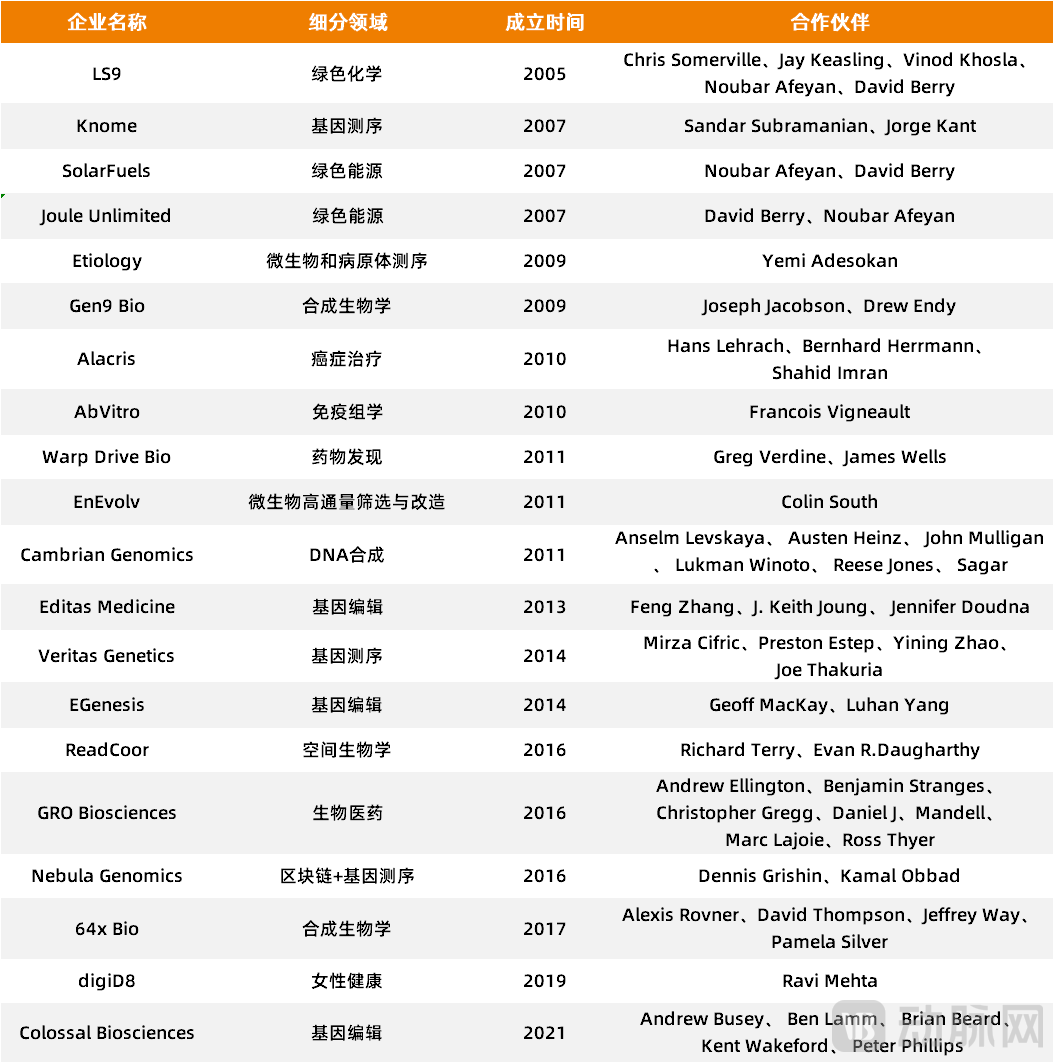
Companies Co-founded by Church
To outside observers, technology transfer might appear to consume the majority of his time. However, in an interview, Church himself emphasized that this is not the case, expressing a preference for entrusting the future to the younger generation. Most of Church’s companies were co-founded with his students, with him typically serving only as a co-founder or scientific advisor. Whether in the laboratory or in business ventures, Church generally provides high-level strategic guidance without engaging in day-to-day operations. He finds it deeply rewarding to witness young people driving change in the world through concrete actions.
His scientific spirit also influences his students. In the Church Lab, there is no so-called hierarchy; all are equal scientists. They come from diverse regions, bringing different cultures and backgrounds, yet share the same reverence for science and curiosity. These young scientists spontaneously form research groups based on shared interests, driving innovation and vitality in fields such as biomedicine, medical devices, energy, and environmental protection.
In Church’s view, the next generation of frontier sciences with transformative power—such as gene sequencing, gene editing, and synthetic biology—will exert a profound impact, and these research endeavors typically carry a certain degree of social influence. Leveraging these technologies to conduct research that benefits society and changes the world is the starting point for many of his projects. This philosophy is being passed down through him, his laboratory, and his students. From basic research to industrial applications, spanning gene sequencing, gene editing, and brain science, the new generation is setting sail.