ITBT Meets Synthetic Biology: Driving Innovation from Healthcare to Chemical Manufacturing
Atantares
Developer of DNA Synthesis Technology
The ITBT sector has remained hot for over a year, with synthetic biology consistently being the most prominent area. This wave of interest has spawned a number of startups and attracted attention from incubators and early-stage capital.
In this innovative arena, how will various stakeholders collaborate to drive the overall upgrading of the industry?
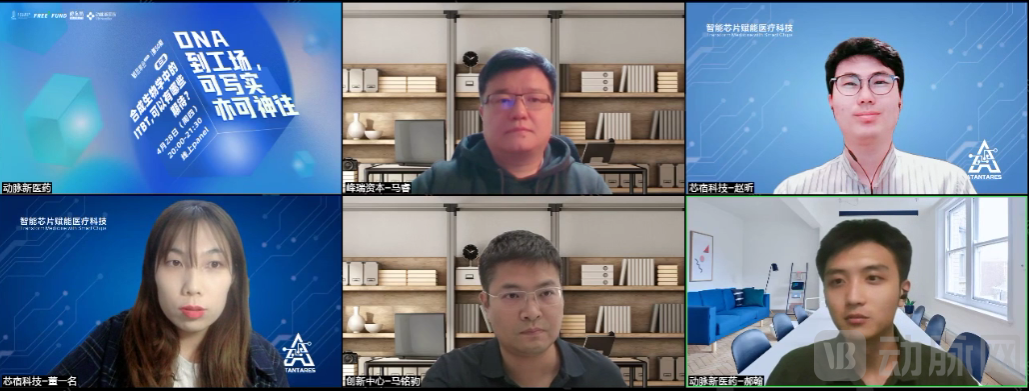
▲ [VBInsight Salon] – [Synthetic Biology Series] Episode 3 Online Salon
Top row (left to right): Dr. Ma Rui, Partner at FreeS Fund; Dr. Zhao Xin, Co-founder and CEO of Xinsu Medical Technology
Second row (bottom), from left to right: Dr. Dong Yiming, Chief Scientist at Xinsu Medical Technology; Dr. Ma Mingju, Head of the Shenzhen Engineering Biology Industry Innovation Center;Hao Han, Editor-in-Chief of VCBeat New Medicine
The third session of the VB Thought Leadership Series on “Synthetic Biology,” titled “From DNA to Factory: Both Realistic and Aspirational,” entitled “What Can We Expect from ITBT in Synthetic Biology?” concluded on the evening of April 28. This session featured four guests: Ma Mingju, Head of the Shenzhen Engineering Biology Industry Innovation Center; Zhao Xin, Co-founder and CEO of Shanghai Xinsu Medical Technology Co., Ltd.; Dong Yiming, Partner at Shanghai Xinsu Medical Technology Co., Ltd.; and Ma Rui, Partner at FreeS Fund. They engaged in discussions around hot topics related to ITBT (Integration of Information Technology, Biotechnology, and Engineering) in synthetic biology. VCBeat (WeChat ID: vcbeat) has compiled the key highlights from the discussion for our readers’ benefit.
The Synthetic Biology Industry Requires Interdisciplinary Talent; Companies Must Cultivate an Industry Mindset from the Outset
VCBeat: What are the needs of a synthetic biology company in its early startup stage?
Xinsu Technology:From an entrepreneurial perspective, success hinges on three core elements: capital, talent, and execution. First and foremost, capital support is a critical factor; only with adequate funding can a company proceed with subsequent initiatives such as recruitment, attract top-tier talent, sustain R&D efforts, and maintain technological leadership. Additionally, startups seek robust hardware infrastructure and sound industry guidance to help them better advance their strategic business layouts.
Secondly, interdisciplinary biotechnology companies cover a wide range of disciplines and thus face certain challenges in recruitment. Startups often find it difficult to attract talent. Although our strategic direction holds significant potential and we have established a certain reputation within the venture capital community, many candidates are unfamiliar with the VC landscape, and only a small number are inclined to join startups for cutting-edge research. Therefore, we strongly hope to leverage influential platforms to attract more innovative and outstanding talents to join our company.
Ultimately, the most critical factor is execution. Founders must engage in deep strategic thinking, proactively anticipating both internal challenges and external threats. This involves assessing the external business environment and internal organizational structure to make timely adjustments or even advance preparations, followed by rapid execution.
VCBeat: In response to the needs of synthetic biology companies, what is the Innovation Center currently doing?
Innovation Center:The Innovation Center was established to address the high technical barriers faced by synthetic biology startups, including laboratory space and supporting facilities, environmental impact assessments and waste management, access to certain high-cost equipment and instruments, and specialized policy support.
First, in terms of laboratory space and supporting facilities, the Innovation Center has achieved a “move-in ready” status, providing resident enterprises with equipped office environments, shared public areas, and a platform for shared experimental equipment. This effectively addresses the lack of advanced laboratory equipment among startups, alleviates their initial financial burden, and supports their high-quality development.
Secondly, regarding the management of waste gas, wastewater, and solid waste in environmental impact assessments, the company effectively treats the waste gas and wastewater generated during R&D to ensure compliant discharge; the resulting solid waste is entrusted to qualified third-party professional treatment agencies for lawful and compliant disposal.
Finally, the Guangming District Government, where we are located, launched 22 special policies targeted specifically at synthetic biology enterprises last year. These policies assist companies in translating R&D achievements into practical applications with lower startup costs by providing support in areas such as rent, equipment procurement, renovation, R&D, and investment subsidies, thereby fostering the development of a synthetic biology industrial cluster in Guangming District.
Regarding the talent acquisition challenges emphasized by Shanghai Xinsu Medical Technology Co., Ltd., our Innovation Center conducts annual campus recruitment drives at universities across China. We compile corporate information into promotional brochures distributed at spring job fairs, enabling students to establish direct contact with enterprises. Furthermore, in the realm of interdisciplinary talent, the School of Synthetic Biology at Shenzhen University of Advanced Technology cultivates composite professionals proficient in both biological experimentation and computational programming. Leveraging the service ecosystem of our Innovation Center, we help address the recruitment difficulties faced by startups.
VCBeat: How can investment institutions collaborate with other support systems to build an ecosystem for industry incubation at the earliest stages of industrial development?
FreeS Fund:Frees Fund has actually invested in many scientists, helping them achieve the commercialization of their research and accompanying young scientists as they grow from recent PhD graduates into successful entrepreneurs. In fact, there are three key elements to early-stage project incubation: finance, market, and technology. For synthetic biology, an additional element—“industry”—must be included.
In fact, post-investment management is a highly specific discipline. Often, we encounter teams with profound technical expertise in synthetic biology but no prior experience in running a company and limited understanding of financial markets. Prior to our investment, they may have had only a vague concept of their strategic direction and product selection. In such cases, it becomes necessary for us to provide assistance. We primarily support these companies through “soft” aspects.
Financially, for instance, by providing financial assistance to enterprises, acting as their guide in the capital markets, familiarizing them with these markets, and helping them secure their next round of financing.
Technically, we will delve into a deep understanding of the technology, including key milestones in its development, and then collaborate with enterprises to make judgments on which direction to pursue.
In the market, discussions with the company take place at an early stage. What kind of product should be developed? Who are our customers? Who are the competitors? How will we enter the market in the future?
From an industry perspective, we are also considering how to help our portfolio companies develop an industrial mindset. After all, synthetic biology is a major industry that extends beyond R&D; it requires considering all production-related factors from the outset—such as site selection for implementation, policy support, and raw material sourcing—thereby guiding companies to address these issues early on.
Datafication is the development direction of the healthcare industry, and synthetic biology is a typical scenario of ITBT.
VCBeat: As an investment firm spanning TMT, high-tech, and biopharmaceuticals, how does Frees Fund view the application of digital technologies in the field of synthetic biology?
FreeS Fund:This is a key focus for FreeS Fund: investing in frontier biotechnology, particularly synthetic biology, from a digitalization perspective. We place great emphasis on whether these ventures can achieve industrialization, deliver tangible products, and leverage digital platforms to address these challenges.
Synthetic biology companies face two major challenges: first, how to achieve scalable manufacturing; second, how to select the right products. Delving deeper, why is scalable biological manufacturing so difficult? One reason is that while organisms can be programmed, doing so is extremely challenging. Another reason is the extensive length of the entire biological value chain, which requires not only strain construction but also resolution of process engineering issues, progressing through laboratory-scale, pilot-scale, and demonstration-scale trials, before finally addressing full-scale production challenges.Why is biological programming so difficult? Why can’t we assemble biological systems from the bottom up, much like connecting diodes and transistors? The primary reasons are insufficient data digitization, inadequate characterization data, limited understanding of biological systems and evolution, and sparse exploration of the chemo-biological space. Therefore, synthetic biology represents a direction that best demonstrates how the integration of IT (Information Technology) and BT (Biotechnology) can accelerate the digitization of biological systems.
Under the broad frontier biology concept, Fengrui Capital has invested in more than 40 IT+BT companies, ranging from the first category of companies that help digitize biological systems, to the second category of computational biology firms that perform AI-based computation and prediction after data acquisition, and further to DNA synthesis companies that apply biological components for intervention based on data understanding.
Addressing production and process challenges may increasingly rely on the integration of IT and BT (Information Technology and Biotechnology). Bluepha has excelled in this area by utilizing smart fermenters and monitoring fermentation status throughout the entire process. Additionally, companies like Cathay Biotech have already implemented fully digitalized factories. I believe this represents the future trend: achieving synthetic biology production through data-driven approaches.
VCBeat: Within the scope of ITBT, what advanced projects has the Innovation Center incubated, and in which niche sectors are they distributed?
Innovation Center:Foundational technologies in synthetic biology include software, DNA/RNA synthesis, organism construction, and automation platforms. Among these, DNA data storage is a critical area of focus. Zhongke Tanyuan, one of the enterprises incubated by our Innovation Center, is dedicated to addressing global big data storage challenges by concentrating on the research, development, and business expansion of DNA data storage technologies. Meanwhile, it is actively expanding its end-to-end technical services for DNA synthesis and sequencing tailored to functional applications within the DNA data storage framework, aiming to become China’s first and internationally leading carbon-based data storage enterprise.
The Institute of Synthetic Biology has also established major infrastructure for synthetic biology. The facility is currently in the renovation phase. Built upon a high-throughput, automated engineering biology experimental platform, it can support diverse experimental workflows, automating processes that previously relied on manual execution to ensure reproducibility. While automated platforms were formerly monopolized by foreign entities, this major synthetic biology infrastructure aims to create an industrialized synthetic biology research platform that integrates a user-oriented “cloud laboratory” with an operator-oriented “smart laboratory.” Grounded in fundamental research in synthetic biology, it introduces the concept of intelligent manufacturing from industrial automation into synthetic biology research.
The large-scale synthetic biology infrastructure is expected to commence phased operations by the end of 2022. Intensive preparations are underway for large-scale equipment installation, commissioning, and software development, with system acceptance testing and trial runs being carried out in stages. Currently, there are more than 40 hardware and software engineers, and the team is projected to expand to over 100 members by the end of 2023. Subsequently, the automation platforms will be gradually opened to enterprises. The initial plan involves integrating more than 30 automated platforms to provide companies with a range of high-throughput automation services, thereby accelerating the development of synthetic biology.
VCBeat: At the application layer, how is Xinsu Technology currently implementing digital technologies in real-world scenarios?
Xinsu Technology:Digitization is a critical strategic direction for us. We are particularly focused on implementing digital technologies across the entire application scenario to achieve high-throughput, low-cost DNA writing, including sequence synthesis, assembly, and error correction.
In addition to classic chemical synthesis techniques, we have also established a presence in enzymatic DNA synthesis, including the development of a DNA polymerase database and leveraging this resource for the optimization, screening, and rational design of DNA polymerases.
Beyond DNA synthesis, we can also perform molecular sequencing to achieve information recognition and reading at the molecular level. These are areas where digital empowerment can be applied, including in engineering, where digital technologies enable precise programmatic control.
Finally, for service-oriented businesses, digital optimization of production processes and order management are implemented to better serve users.
High-Throughput DNA Synthesis Is the Trend; Cost Reduction Will Drive Development Across Multiple Fields
VCBeat: What is the current development status of DNA synthesis, a technological field that has become a critical bottleneck?
Xinsu Technology:This field is vast and, technically speaking, can be broadly divided into two complementary pillars: one is the biochemical methods for DNA synthesis, and the other is the development of automated, high-throughput tools.
Regarding DNA chemical synthesis methods, China’s industrial chain is relatively mature. It primarily relies on classical chemical synthesis techniques, with all key raw materials being domestically produced. This includes the classic column-based synthesis method, which is applicable to scenarios such as PCR primer preparation and is currently widely used in the life sciences industry.
To further increase throughput and reduce costs to meet diverse needs, engineering based on the principles of chemical synthesis is required. Mechanical methods can be adopted, such as inkjet-based short-chain synthesis and gene splicing using processes similar to wafer packaging; alternatively, chip-based approaches can be utilized. For instance, we are currently leveraging integrated circuits for high-throughput synthesis, which necessitates interdisciplinary collaboration and certain technological breakthroughs.
Chemical synthesis has certain limitations, as the purity of the product significantly declines after two to three hundred cycles. Consequently, researchers have turned to template-free enzymatic synthesis. Theoretically, enzymatic synthesis offers high efficiency, low energy consumption, and the potential for de novo synthesis. However, in current practical applications, the various technical approaches employed to ensure accuracy still face challenges related to cost and turnaround time, falling short of ideal performance. This is an area where our company is significantly increasing its strategic investment.
Overall, different synthetic routes each have their own advantages and disadvantages, with varying suitability for specific application scenarios.
VCBeat: How does Fengrui view the future development of the DNA synthesis sector?
FreeS Fund:The most critical capability for DNA synthesis is engineering prowess, an area where Shanghai Xinsu Medical Technology Co., Ltd. excels. The application of chip technology in the biotech sector is still in its early stages, representing a highly promising avenue. I believe DNA synthesis serves as the foundational bedrock of this field. Although the current DNA synthesis market in China is estimated at only RMB 1–1.5 billion, I anticipate that improvements in synthesis efficiency and reductions in cost will unlock numerous applications, thereby driving significant incremental market growth.
VCBeat: From your personal perspective and that of the Innovation Center, what insights have you gained from incubating projects with such high technological barriers?
Innovation Center:Synthetic biology companies face high entry barriers, as they need to secure patents for scientific and technological innovations and overcome critical technologies controlled by overseas entities. When incubating such enterprises, we exercise greater patience and adopt longer timeframes to facilitate the translation of related scientific research achievements into commercial applications.
DNA/RNA synthesis is the foundational enabling technology of synthetic biology. To achieve large-fragment assembly and gene synthesis, the primary challenge lies in synthesizing small DNA fragments. The current key issue is how to reduce the cost of DNA synthesis. Rapid DNA synthesis is also a focal area for our Innovation Center.
The Battlefield of Non-Medical Synthetic Biology Lies in the Chemical Industry, with Future Application Scenarios Becoming Further Integrated
VCBeat: Approximately how many projects at the Innovation Center are in non-healthcare sectors? How do you view the differentiation between healthcare and non-healthcare sectors?
Innovation Center:In fact, half of the enterprises stationed in our Innovation Center are from non-medical fields, including food, consumer goods, agriculture, and more. However, synthetic biology is an interdisciplinary field, and I believe that many synthetic biology companies can develop products related to the medical sector as well as participate in the development of non-medical products.
For instance, the same underlying technology can be used by a company to produce both organoids and cultured meat. How do we classify such applications as either medical or non-medical? I believe this boundary will become increasingly blurred within synthetic biology. Even pharmaceutical companies, when formulating their short- and long-term strategic plans based on their core technologies, may diversify into areas such as pesticides or skincare products, which entail different production cycles. Synthetic biology is not solely biopharmaceuticals; it is an interdisciplinary field. Consequently, it will foster industrial clusters across various sectors, all underpinned by the same foundational technologies.
VCBeat: Beyond the medical field, what other applications of synthetic biology on a broader scale are worth anticipating?
Frees Fund:In China, the chemical industry takes the lead. China accounts for 40% of global chemical production, and its pool of chemical engineering talent is ten times that of the United States. A significant portion of synthetic biology applications lies in manufacturing; therefore, I believe such applications, particularly in the chemical sector, will emerge earlier in China.
We have also observed a trend wherein, in addition to leading enterprises, overseas returnees and university professors are launching startups in synthetic biology, while some large chemical companies are beginning to pivot toward this field. In the future, multiple forces will converge, giving rise to both competition and collaboration.
On the other hand, it should be recognized that molecules themselves may “jump” across different fields. After a startup develops one or two molecules, the inherent properties of these molecules may lead the company to pivot into different sectors. For instance, it is quite normal for a company to initially focus on healthcare, shift to chemical engineering midway, and eventually return to healthcare.
VCBeat: How does Xinsu determine its initial market entry point? Is there potential for future expansion?
Xinsu Technology:Xinsu operates primarily in the upstream segment, providing raw materials and extending its services to enterprises beyond the healthcare sector. That said, the medical segment remains a crucial and high-value-added component of our business. It is fair to say that the healthcare industry discovered and chose us, rather than us deliberately targeting this specific track. We leverage molecular chip-based synthesis to deliver technical products and solutions to synthetic biology companies, sequencing firms, and pharmaceutical enterprises, creating substantial value. For diverse clients, we are continuously seeking expanded opportunities for collaboration and innovation. Xinsu’s mission is to harness high-throughput technologies to reduce the cost of both short- and long-chain DNA synthesis, thereby empowering downstream companies. This represents a classic application scenario integrating IT (Information Technology) and BT (Biotechnology).
This article presents only selected excerpts from the guest’s discussion on this topic. For more insightful discussions on hot topics in the synthetic biology industry, please watch the event replay: scan the QR code below to access the video replay.

For more information on the synthetic biology industry, please scan the QR code below to add our assistant and join the [Synthetic Biology] Industry Exchange Group.