Home Janssen's Teclistamab Receives CDE Acceptance for Two New Indications in Relapsed/Refractory Multiple Myeloma

Janssen's Teclistamab Receives CDE Acceptance for Two New Indications in Relapsed/Refractory Multiple Myeloma

Apr 17, 2026 14:37 CST Updated 14:37

Johnson & Johnson

Medical Device R&D and Manufacturer

图片On April 17, the official website of the Center for Drug Evaluation (CDE) of the National Medical Products Administration (NMPA) announced that Johnson & Johnson's key oncology drugTelituximab Injection (Trade Name: Talique ®)Two Class 2.2 Biological ProductsThe listing application has been officially accepted (Acceptance Nos.: JXSS2600038, JXSS2600039).
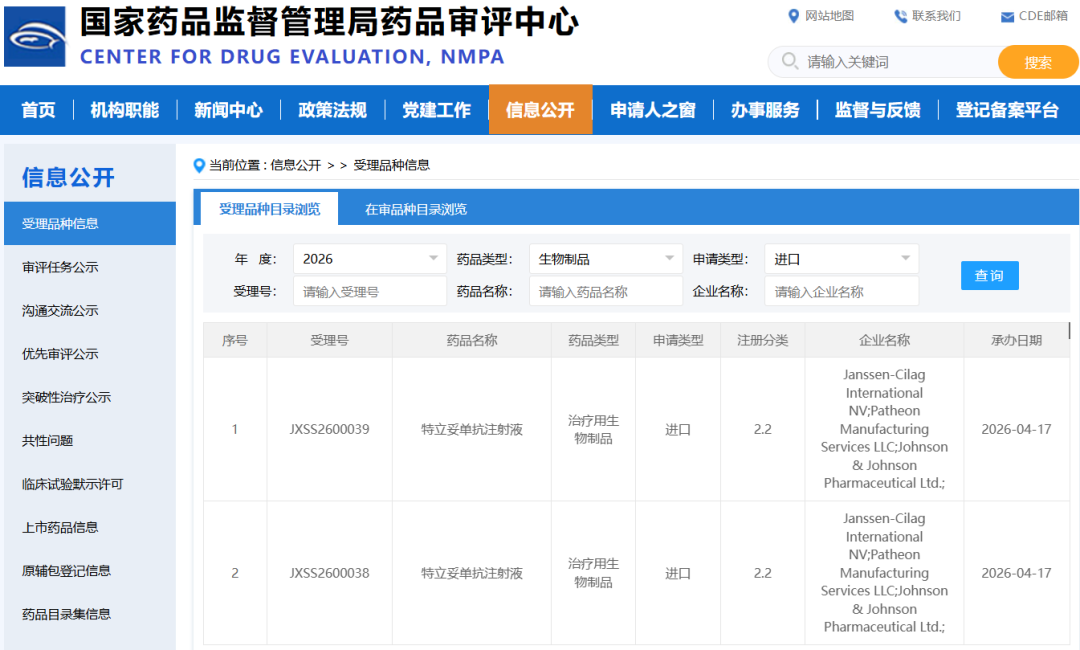
Image
Important Clarification: Although the generic name of Telitumomab contains the word "monoclonal antibody," it isBispecific Antibody Targeting Both BCMA and CD3(Commonly abbreviated as BCMA/CD3 bispecific antibody in the industry), it is not a traditional single-target monoclonal antibody. This is a historical issue with the naming rules for generic drug names in China. All bispecific antibodies approved before 2023 used "monoclonal antibody" as a suffix.
This is only 24 days after it received the third Breakthrough Therapy Designation from the CDE on March 24, marking the official entry of this world's first BCMA/CD3 bispecific antibody into the forefront of China's multiple myeloma treatment market.

Two New Indications Filed Simultaneously, Targeting Second-Line and Beyond Treatment

The two new indications applied for this time precisely correspond to the latest clinical breakthroughs of Trastuzumab globally:
  • Telituximab in combination with subcutaneous Daratumumab: For the treatment of adult patients with relapsed or refractory multiple myeloma (R/R MM) who have received at least one prior line of therapy (including proteasome inhibitors and immunomodulatory agents).
  • Tislelizumab Monotherapy: For the treatment of adult patients with R/R MM who have received at least one prior line of therapy

Among them, the combination therapy was officially approved by the US FDA on March 5 this year, becomingThe World's First Approved BCMA/CD3 Bispecific Antibody Combination Regimen for Second-Line Treatment of R/R MM. Its approval was based on the landmark Phase III MajesTEC-3 study data:After a median follow-up of three years, the combination therapy reduced the risk of disease progression or death by 83% compared to standard treatment. The three-year progression-free survival rate was as high as 83%, compared to only 30% in the control group., The median progression-free survival in the combination therapy group has not been reached to date.
This data has been hailed as a "revolutionary breakthrough in the history of multiple myeloma treatment" within the industry. Previously, the standard regimen for second-line treatment of R/R MM mainly consisted of proteasome inhibitors combined with immunomodulatory agents, with a median progression-free survival typically less than 2 years.


Scan the QR code below, register your information, and 10 lucky viewers will be selected to receive the book on the right!
图片
图片
图片

From Last-line to Front-line, Johnson & Johnson Builds "Full-cycle Dominance" in Myeloma

Talimogene laherparepvec isThe World's First Approved BCMA/CD3 Bispecific Antibody, it was launched in Europe and the US in 2022, and approved in China in June 2024 for adult patients with R/R MM who have received at least three prior lines of therapy. As a "ready-to-use" subcutaneous injection bispecific antibody, it eliminates the need for weeks of preparation like CAR-T, significantly improving the convenience of administration. Data from China's registration clinical trials showed an overall response rate (ORR) of 76.9%, all of which were very good partial responses or better.
This advancement in indications is a key step in Johnson & Johnson's "full mechanism, full cycle" strategy in the multiple myeloma field. Currently, Johnson & Johnson has established a complete product matrix covering from frontline to later-line treatments:
  • Daratumumab (CD38 Monoclonal Antibody): The cornerstone of global multiple myeloma treatment, with global sales reaching $14.351 billion by 2025, accounting for 56% of Johnson & Johnson's oncology business revenue.
  • Telituximab (BCMA/CD3 Bispecific Antibody): Global sales of $670 million in 2025, increasing by 22.1% year-on-year, rapidly advancing towards blockbuster status
  • Cilta-cel (BCMA CAR-T): Developed in collaboration with Legend Biotech, with sales of $597 million in the first quarter of 2026, representing a year-over-year increase of 62.1%.
Through "Single-target monoclonal antibody + bispecific antibody + CAR-T"With a combination of strategies, Johnson & Johnson has firmly captured over 70% of the global multiple myeloma market. The submission of the second-line indication for Talquetamab will further solidify its market position and create a strong synergistic effect with Daratumumab, squeezing the survival space of competitors."

Competition for BCMA/CD3 Bispecific Antibodies Heats Up in China, with Domestic Alternatives Poised for Action


As of April 2026, the domestic BCMA/CD3 bispecific antibody market in China is still dominated by imported products, with only two approved drugs available: Teclistamab from Johnson & Johnson and Elranatamab from Pfizer, both used for third-line or higher treatment of R/R MM.
In terms of domestic production, ZhiXiang JinTai'sVelitomab (GR1803)Leading the track, its conditional marketing application for third-line and above R/R MM was accepted by the CDE in January 2026 and included in the priority review, with approval expected in the second half of 2026, poised to becomeThe First China-Produced BCMA/CD3 Bispecific AntibodyMoreover, similar products from Kelun Botai, Innovent Biologics, and Hengrui Medicine have also entered the late clinical stage.
Industry analysts believe that the early layout of Telituximab in second-line treatment will bring significant pressure to domestically produced products. However, domestic products have obvious advantages in terms of price and accessibility, and the future market will present a competitive landscape of "imported products leading the frontline, domestic products capturing the backend." Meanwhile, bispecific antibodies and CAR-T are not in a simple substitution relationship but rather complementary — bispecific antibodies, with their ready-to-use and convenient advantages, are more suitable for second-line and above treatments; CAR-T, with its deeper relief depth, is more appropriate for end-stage refractory patients.
For millions of multiple myeloma patients in China, the submission of the new indication for teclistamab is undoubtedly a significant positive development. As more innovative drugs gain approval and indications expand, multiple myeloma is gradually transforming from an "incurable disease" into a manageable chronic condition, with notable improvements in patient survival times and quality of life.

Scan the WeChat QR code, add the editor of the Antibody Circle, and those who meet the requirements can join.
Antibody WeChat Group!
Please indicate: Name + Research Direction!

图片
图片


Edition
Authority
Sound
Ming
All articles reproduced in this official account are intended to convey more information, with the source and author clearly indicated. Media or individuals who do not wish to be reprinted can contact us (cbplib@163.com), and we will immediately delete the content. All articles represent the views of the author, not this site.
图片