

Billion-Dollar Digital Therapeutics Boom: How Big Is the Opportunity for Enablers?

SLANHEALTH
Digital Therapeutics CDMO and Full-process Service Developer
Citation: In the mid-19th century, a “Gold Rush” swept through California, USA. Workers, farmers, sailors, and missionaries flocked to pan for gold in relentless waves. Yet some individuals carved out unique paths by engaging in businesses such as horse trading, boat ferrying, and selling alcohol and water. These people later became collectively known as “water sellers.” The essence of the Water Seller Theory lies in meeting emerging demands within industries that have already achieved scale or are poised to do so, by providing services to others. With a keen eye for opportunity, “water seller” roles can be found in every industry.
As digital therapeutics mark the first shift of digital health toward serious medical care, startups are racing to enter the field. Companies from sectors such as pharmaceuticals and medical devices, wearables, gaming, internet healthcare, artificial intelligence, and mental health are collectively exerting their efforts, making digitalThe therapy is in high demand.
However, looking at the domestic landscape, it remains unclear which of the current digital therapeutics companies will truly emerge as the market leader. What is certain, though, is that the core value of digital therapeutics lies in serious medical care, and evidence-based digital therapeutics products are the cornerstone of all commercialization possibilities.
Digital therapeutics involves an interconnected process spanning medical protocol design, product development, regulatory submission, clinical trials, market launch and operations, and real-world studies. Any issue in any of these stages can significantly impact a company’s efforts to gain a foothold in the digital therapeutics market.
However, there remains a significant gap in professional oversight across the entire process from research and development to market access. As the saying goes, where some are “panning for gold,” others must be “selling water.” This has inadvertently created an opportunity for value reevaluation for SLANHEALTH, the pioneer in obtaining certification for digital therapeutics.
Prescription digital therapeutics are fundamentally similar to traditional pharmaceuticals and medical devices, emphasizing an evidence-based medicine foundation. They require rigorous approval and regulatory oversight to ensure clinical safety and efficacy. However, as an innovative ecosystem, digital therapeutics lack unified industry standards for clinical trials, meaning that most current clinical trial efforts remain in an exploratory phase.
Gao Yunlong, General Manager of SLANHEALTH, stated: “Unlike traditional drug targets (causes), digital therapeutic targets are more often data-driven phenotypic characteristics (effects). The underlying logic of digital therapeutic product development is digital technology based on medical principles and knowledge graphs.”
For internet healthcare companies that have historically focused on connecting medical resources, the development of relevant clinical capabilities has often been lacking. Furthermore, digital therapeutics are data-driven and heavily reliant on digital technologies, while traditional healthcare enterprises lack corresponding experience in integrating with digital solutions.
As the saying goes, specialized tasks should be entrusted to specialists. In this context, people often first think of pharmaceutical CDMOs and medical device CROs. However, in Gao Yunlong’s view, digital therapeutics, as an emerging disease treatment modality distinct from drugs and medical devices, requires its own dedicated CDMO services.
First, pharmaceutical CDMOs leverage their technical expertise and manufacturing capabilities to undertake process development and production functions for pharmaceutical companies, thereby enabling these companies to focus more on drug R&D.Currently, the state of digital therapeutics is such that many companies possess only product concepts or prototypes; they lack clarity on how to design medical protocols, conduct clinical trials, or even navigate regulatory submissions, and they are unfamiliar with the evidence-based medicine logic that must be integrated throughout each stage.。
Medical device CRO firms often only step in when the product enters the regulatory submission phase, on the premise that the digital therapeutics company has already established a tangible product form and that the product basically meets regulatory requirements. According to Gao Yunlong, in factMany pharmaceutical and medical device companies, wearable technology firms, internet healthcare providers, and gaming enterprises transitioning to digital therapeutics are often relatively weak in the pre-submission medical protocol, product design, and R&D phases, leaving medical device CROs unable to offer effective assistance.
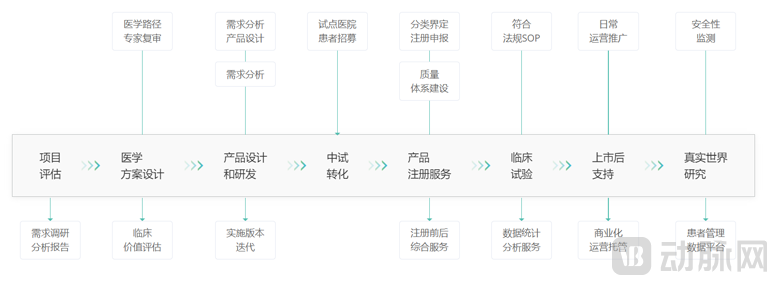
SLANHEALTH Digital Therapeutics CDMO and Full-Process Services | Source: Corporate Official Website
“Digital therapeutics CDMOs differ fundamentally from traditional biopharmaceutical CDMOs or medical device CROs in their roles and positioning. A digital therapeutics CDMO is not merely a service outsourcing provider, but a deep strategic partner for enterprises. Through this partnership, both parties can leverage broader resources and explore more possibilities for ecosystem collaboration,” explained Gao Yunlong.
Furthermore, the scope of application for digital therapeutics (DTx) products depends on the methods of disease intervention and the accessibility of therapeutic targets, with no inherent limitations on the types of indications. Generally speaking, diseases characterized by the need for long-term management, multiple intervention measures, clear clinical guidelines, and low patient adherence and self-management capabilities are more suitable for the development of DTx products. In fact, many diseases do not remain isolated in their advanced stages but are often accompanied by multiple complications; however, the research and development of many DTx solutions has not fully accounted for these comprehensive treatment scenarios.
Therefore, SLANHEALTH, one of the first companies to receive certification for digital therapeutics, has chosen to replicate its experience and capabilities to build a larger CDMO and full-process service platform for digital therapeutics. By providing comprehensive assessments and holistic medical design solutions for specific indications, it aims to serve as a ladder to help more digital therapeutic products achieve success.
According to Insight Partners’ statistics, the global digital therapeutics market is projected to grow from USD 4.22 billion in 2021 to USD 18.06 billion in 2028, representing a compound annual growth rate (CAGR) of 23.1%. This vast market has attracted numerous companies from sectors such as gaming, medical devices, biopharmaceuticals, and smart devices to enter the field.
However, objectively speaking, the development of digital therapeutics is still in its early stages, with numerous constraints hindering large-scale commercial adoption. For instance, digital therapeutics offer a favorable entry point for smart device companies seeking to penetrate the healthcare sector. While these companies possess advanced devices and a large user base, they remain outside the realm of serious medical care, with limited medical expertise and healthcare resources.
Pharmaceutical companies cannot rely solely on acquiring digital therapeutics firms to expand their business, as they face integration risks and limited resource accessibility. In contrast, digital therapeutics CDMOs operate with a “customization + platform” model, enabling them to develop tailored products based on clients’ specific needs while leveraging more diverse distribution channels and medical resources.
Founded in 2015, SLANHEALTH provides digital therapeutics CDMO and end-to-end services that deeply integrate the entire industry chain, from digital therapeutics R&D to real-world studies. As a long-standing pioneer in the field of digital therapeutics, SLANHEALTH has accumulated substantial advantages and proven success in medical protocol design, product development, functional refinement, and efficacy validation.
In terms of medical capability building, SLANHEALTH possesses top-tier clinical research resources in China.. Over 65% of the team members possess medical backgrounds and experience in the healthcare industry. From product initiation to real-world studies, SLANHEALTH employs dedicated interdisciplinary teams of medical and engineering experts to lead evidence-based medical protocol design, clinical study design, post-market operations and maintenance, and real-world data validation, thereby ensuring the scientific rigor, safety, and efficacy of its digital therapeutics products at every stage.
Furthermore, SLANHEALTH has assembled a team of more than 10 key collaborating experts and academicians across various digital therapeutic product pipelines, along with over 2,300 medical experts specializing in digital therapeutics. Having managed care for more than 600,000 patients, the company possesses extensive experience in providing full-lifecycle health services. Its independently developed auxiliary management software for mother-to-child transmission blockade of hepatitis B has completed Phase II of its real-world study, involving data governance for nearly 40,000 datasets, making it the largest-scale real-world study case in the field of digital therapeutics to date.
SLANHEALTH has also partnered with more than 300 Grade A tertiary hospitals across China to jointly develop and establish digital therapeutics and application centers. It has carried out collaborations with entities such as the Chinese Center for Disease Control and Prevention, the Guangzhou Institute of Respiratory Health, the Primary Healthcare Foundation, and the China Hepatitis Prevention and Control Foundation, and has participated in multiple national-level medical research projects.

SLANHEALTH’s CDMO Services Can Reduce Core Workflow Timelines by Over 50%
In terms of market access for digital therapeutics, the most critical step at present is obtaining approval from the NMPA.SLANHEALTH’s digital therapeutic product for the prevention of mother-to-child transmission of hepatitis B is among the first batch of certified digital therapeutics in China, demonstrating its proven track record in regulatory support for market approval, as well as in registration and filing services for digital therapeutic products.
SLANHEALTH has also established a comprehensive set of standardized processes and built communication channels with accreditation agencies across China, including those in Zhejiang Province, Guangdong Province, Hunan Province, Hainan Province, Shanghai, Tianjin, and Chengdu.
Furthermore, there is currently a lack of unified standards for the review and approval of digital therapeutics, with regulatory authorities at all levels still in the process of exploration. Throughout the development of these industry standards, SLANHEALTH has actively participated and continuously provided relevant insights and professional expertise to regulatory bodies and clinical experts.
Beyond drugs and medical devices, digital therapeutics offer a novel treatment modality. Backed by evidence from evidence-based medicine and real-world studies demonstrating their clinical efficacy and safety, they represent a significant innovation in the healthcare sector.
Compared with innovative treatment modalities such as gene therapy and cell therapy, which often cost hundreds of thousands to millions of dollars, digital therapeutics offer lower medical costs and greater accessibility, making them suitable for large-scale adoption and helping to reduce treatment expenses. Meanwhile, most digital therapeutics possess robust capabilities in disease prevention and control, thereby facilitating effective healthcare cost savings for both patients and society at large.
Gao Yunlong stated in an interview, “The role we play is to empower our partners.” He believes that the position of the CDMO industry within the overall digital therapeutics ecosystem is fundamentally determined by its inherent industry characteristics. By fulfilling this role and empowering global partners in pharmaceuticals, medical devices, wearables, gaming, and digital therapeutics, the CDMO sector can accelerate the market launch of digital therapeutic products. In doing so, it will undoubtedly serve as a key catalyst for the entire R&D ecosystem of digital therapeutics.
It is reported that SLANHEALTH launched its digital therapeutics CDMO and end-to-end service solutions at the end of 2021. Within just six months, the company has engaged with more than 40 enterprises seeking to incubate digital therapeutics products and has provided in-depth services to multiple clients.

“From the perspective of the overall development trajectory, digital therapeutics (DTx) evolved from the introduction of the concept in 2017 to a global upsurge and entry into commercial validation by 2021, spanning less than five years—a pace far quicker than that of other medical subsectors.” It is foreseeable that the promising DTx market, valued at over ten billion yuan, will become increasingly crowded, with countless “gold rushers” vying for position. However, from a business standpoint, those who can consistently secure a share of the profits will always be the “water sellers.”