

Digital Therapeutics Online Salon 2022: Innovating Diagnosis and Treatment of Brain-Related Disorders
Digital therapeutics, as a novel concept of medical approach or digital health solution, has developed rapidly in recent years. This growth is driven not only by its alignment with the "Healthy China" strategy’s shift from “treatment” to “prevention,” but also by the increasing recognition of its clinical value within the industry. At its core, digital therapeutics consists of human-computer interaction programs based on digital devices that stimulate patients’ inherent neuroplasticity to achieve therapeutic effects for mental disorders.
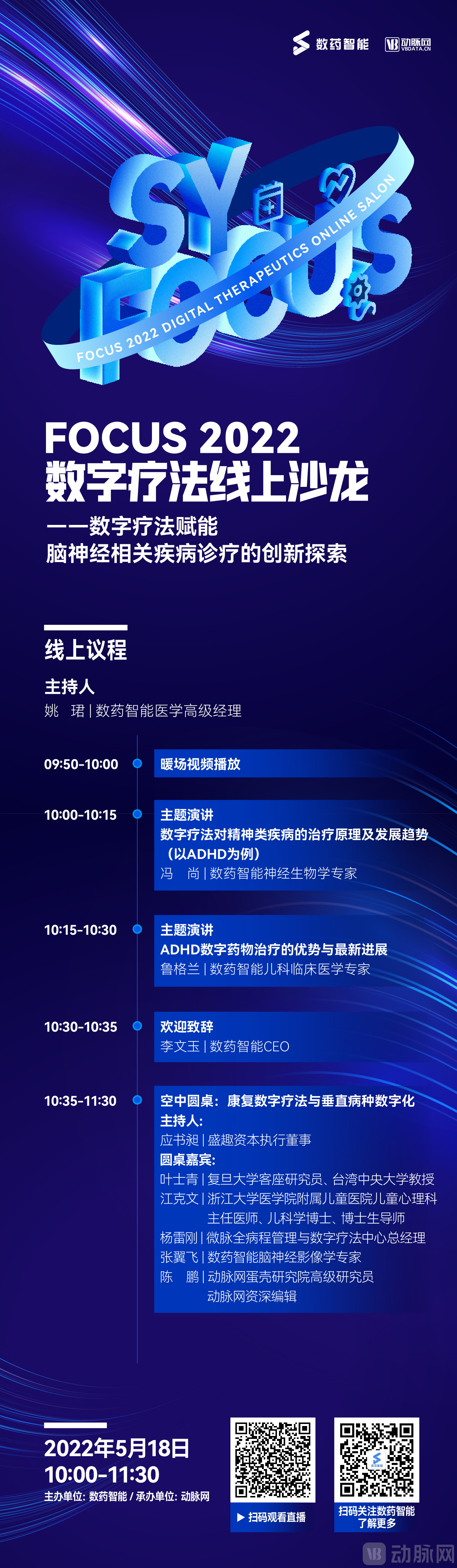
FOCUS 2022 Digital Therapeutics Online Salon—Innovative Explorations in Empowering the Diagnosis and Treatment of Neurological Disorders with Digital Therapeutics, Invited by Shuyao Intelligence and VCBeatNeurobiology Expert Feng ShangandLu Gelan, Clinical Pediatrics ExpertSharing a keynote speech on the exploration of digital therapeutics applied to ADHD treatment; the online roundtable session has invitedJiang Kewen, Chief Physician and Doctoral Supervisor, Department of Child Psychology, The Children's Hospital, Zhejiang University School of Medicine,Ye Shiqing, Visiting Research Fellow at Fudan University and Professor at National Central University,Yang Leigang, General Manager of the Full-Course Disease Management and Digital Therapeutics Center at Weimai,Zhang Yifei, Expert in Neuroimaging at Shuyao Intelligence,Chen Peng, Senior Researcher at VCBeat Eggshell Institute and Senior Editor at VCBeat,Shengqu Capital Executive Director Ying ShuchangJoin forces to focus on the field of digital therapeutics, discussing rehabilitation digital therapeutics and digitized content for specific disease verticals.
Scan the QR Code to Watch the Live Stream
In recent years, significant breakthroughs have been made in the treatment of many diseases. With the aid of various therapeutic approaches, cancer—once considered an “incurable disease”—has shown marked improvements in both incidence rates and survival outcomes. In contrast, progress in treating cognitive impairments, characterized by symptoms such as poor concentration, memory loss, and difficulties in learning and decision-making, remains uncertain. This area is now regarded as one of the largest unmet medical needs worldwide.
Attention-Deficit/Hyperactivity Disorder (ADHD) is a major category of cognitive impairments and one of the most common neurodevelopmental disorders in childhood. In China, the overall prevalence of ADHD among children and adolescents is as high as 6%. The emergence of digital therapeutics has brought more possibilities to the treatment of ADHD.
Attention-Deficit/Hyperactivity Disorder (ADHD) in ChildrenAs one of the most common pediatric psychiatric and behavioral disorders, ADHD is primarily driven by genetic factors that lead to incomplete functional development across multiple brain regions and subsystems. It is clinically characterized by age-inappropriate difficulties in focusing, sustaining, and shifting attention, as well as hyperactivity and abnormalities in emotion and behavior. Due to the inability to localize specific lesions or trace the etiology to a definitive source, ADHD cannot be cured; instead, treatment is symptomatic, targeting specific cognitive impairments.
Digital Therapeutics Offer Significant Advantages Over Traditional Treatment Methods
First, digital therapeutics have no age restrictions. In traditional treatment protocols, children aged 6 and older with ADHD are often treated with central nervous system stimulants or inhibitors. However, for children under the age of 6, pharmacological intervention is generally not recommended in clinical practice due to incomplete brain development; instead, behavioral adjunctive therapies are typically employed, though their efficacy is often unsatisfactory. Digital therapeutics are also applicable to children under the age of 6, thereby expanding treatment options for more families of children with ADHD.
Secondly, digital therapeutics have no side effects. Although pharmacological treatments demonstrate evident efficacy, they are associated with numerous adverse effects, such as fever, irritability, weight loss, slowed linear growth, insomnia, blood pressure fluctuations, abdominal pain, and allergic reactions. In contrast, digital therapeutics do not present significant side effects, except in cases where treatment cannot be completed due to cognitive impairments or sensory deficits in vision and hearing.
Finally, digital therapeutics demonstrate better adherence. Statistics show that only 30% of parents maintain long-term adherence with pharmacological treatments. In contrast, digital therapeutics leverage digital tools to enhance children’s attention, memory, and reasoning abilities through uniquely designed interactive mechanisms. Action-oriented games can exercise the brain and improve players’ cognitive capabilities across multiple dimensions. Furthermore, by transcending time and spatial constraints and employing diverse formats such as gaming and interaction, digital therapeutics boost patient engagement and adherence. Their inherent convenience and privacy also help reduce patient stress, thereby improving therapeutic outcomes.
Digital therapeutics can assist clinicians in diagnosing a range of pediatric neurodevelopmental disorders, including attention-deficit/hyperactivity disorder (ADHD). Traditional diagnostic procedures rely heavily on extensive questionnaires completed by parents or guardians and clinical observations by physicians. This process is cumbersome and inefficient, and it depends significantly on the subjective judgments of caregivers and the experience level of clinicians. In contrast, digital therapeutics can capture high-efficiency, accurate data directly from patients’ behavioral patterns, thereby enabling physicians to make more informed diagnostic decisions.
There remain numerous avenues for the application of digital therapeutics (DTx) in the treatment of neurological disorders, with further room for improvement in therapeutic modalities. Beyond interventions for attention-deficit/hyperactivity disorder (ADHD), DTx can also be utilized for insomnia, autism spectrum disorder in children, depression, and Alzheimer’s disease. Given that neurological conditions are often accompanied by comorbidities, future strategies may consider combined treatments targeting these co-occurring conditions.
Digital therapeutics for psychiatry and brain health will see increasingly widespread application in the future. In this process, achieving true universality and driving market-wide adoption is a challenge facing the entire industry. It requires R&D professionals to possess not only specialized development skills but also a solid foundation in medical theory. Only after thoroughly understanding the full spectrum of pathological mechanisms, diagnosis, rehabilitation, and treatment protocols can they develop innovative digital therapeutics that are highly efficient, user-friendly, and universally applicable.
About Shuyao Intelligence (Shanghai Shuyao Information Technology Co., Ltd.)
Shuyao Intelligence is a member of the Century Huatong ecosystem and a technology company focused on digital therapeutics. Leveraging cutting-edge research in neural networks, Shuyao Intelligence develops digital therapeutic interventions for neurological disorders within the fields of psychology and psychiatry. The company is committed to providing digital therapeutic solutions for the diagnosis and treatment of neurological diseases, developing technologies, products, and platforms tailored for digital therapeutics, and pioneering efficient, convenient, and universally accessible digital therapeutic approaches.

Scan the QR Code to Watch the Live Stream